This is a guide to Berlin’s Wild East, hence the part of Germany’s capital Berlin that used to be behind the proverbial Iron Curtain, obviously.

Formerly the capital of the GDR, Berlin’s Eastern neighborhoods actually changed really fast for the better and cooler. Today, they are more exciting than the settled and full West.
In my post BERLIN guide: get the most for less on bus 100, I took you on a smooth bus ride across Berlin, Germany’s exciting capital. We started at the Alexanderplatz in the east. Then, we went westwards all the way to the former main train station, Bahnhof Zoologischer Garten.
In today’s post, let’s discover what you get to see and experience when you turn east at the Alexanderplatz. Here, we walk right into the heart of the ex-capital of the former German Democratic Republic, GDR in short.
Alexanderplatz – Breathing History
Since I’d been to Berlin for the first time, I’ve felt like literally breathing history there. From the stiff German Empire to the liberal, progressive, and exciting Weimar Republic, leading into the hellish years of WWII. It was followed by the division into sectors that led to the disunion, marked by the Berlin Wall from 1961 until the unification in 1989.
Sometimes it’s beyond interesting or fascinating. At times, I find it simply overwhelming. Is there a spot in this city that is not of historic relevance?!

So again, like on the tour by bus #100, we start at the Alexanderplatz. It is one of the largest and most important squares in Berlin, also due to Alfred Döblin’s legendary, impressionistic novel Berlin Alexanderplatz from 1929. He describes in a very deep and touching manner the fate of the proletarian class in a metropolis between the two World Wars.
The Alexanderplatz was celebrated in a novel by Alfred Döblin:

Alfred Döblin
(*10 August 1878 | † 26 June 1957)
A modernistic novelist, essayist, and doctor. Due to his expressionist work and his cultural and political ideas, he had to flee the Nazis first to Switzerland and France, and eventually to the USA. Nevertheless, after the war, he and his wife came back to Europe, settled first in Germany and then in France. Only in 1956, Döblin was able to live up to his most famous work Berlin Alexanderplatz by his last novel Tales of a Long Night. That book was published in 1956, one year before his death.
(Photo: unknown photographer, probably from allied military forces, Doeblin alfred 1946, cropped to 5:7, B/W-filter, CC0 1.0)

Today, Alexanderplatz is a central place when it comes to shopping and dining. Also, the so-called Weltzeituhr, a large turret-style clock, and the television tower can be visited here.
Coming from the tower, let’s cross the Karl-Liebknecht-Straße in front of the Marienkirche. Then keep walking into a small alley at the corner of the bakery Treibmann. This way, you’ll get to Rosenstraße.
The Karl-Liebknecht-Straße is named after Karl Liebknecht:

Karl Liebknecht
(*13 August 1871 | † 15 January 1919)
Karl Liebknecht co-founded the German Communist Party with Rosa Luxemburg. He also initiated the Spartacist uprising of 1919. However, the uprising was crushed by the Social Democratic government with the help of paramilitary units. Liebknecht and Luxemburg were executed and are regarded as martyrs of the turmoil between the two World Wars.
(Photo: Unknown, KarlLiebknecht1900, cropped to 5:7, B/W-filter, CC BY-SA 4.0)

Rosenstraße
Rosenstraße, hence the street of roses, bears a beautiful name. Albeit, it was at Rosenstraße where, in the middle of all the Nazi terror, a sort of miracle happened in 1943.
In February of that year, about 8,000 Jewish men were arrested right at their workplaces. Obviously, they were destined for deportation to the concentration camps. However, some of these men were married to so-called ‘Aryan’, hence, German, non-Jewish women. Therefore, for two months, these wives protested in front of this building against the arrest of their husbands. Day by day, they proved that they had no intention to accept the abduction of their loved ones.
In order to avoid bloodshed in the very center of the capital of the ‘Reich’, the regime backed down. The men were released.

Since 1995, there has been a sculpture by Ingeborg Hunzinger called Block der Frauen, hence, Block of Women. It honors these incredibly brave women who stood up against the Nazi terror here at Rosenstraße.
There is the book Resistance of the Heart by Nathan Stoltzfus, as well as the movie Rosenstraße by Margarethe von Trotta on this story.
*Note
In this article, I’m writing out some of the German names and places, obviously. You will also notice that there are letters that might not exist in other languages.
Firstly, there is the letter ß that exists only in the German alphabet, and it’s by no means a B – it’s a ‘sharp’, double S as in kiss. When writing, you can actually replace it with a double S.
Then there are three more vowels, ä being the easiest one since it’s pronounced like an open e as in head.
Ö and ü are tougher, ö being pronounced more or less like the e in her and ü as the u in huge.
As you turn left at the next cross street, you’ll get to the Litfaßplatz. It honors Ernst Litfaß, the inventor of the Litfaßsäule.

You might know the Litfaßsäule rather by the name advertising column, because that’s what it is. However, they were invented by clever Mr. Litfaß in 1854, and the first 100 columns were actually installed in Berlin.
Hackescher Markt
After this little fun fact, keep walking towards the Hackescher Markt. You cannot miss it since it’s right behind the S-Bahn station, and there is a café or restaurant next to the other, and in the center are stalls selling produce and snacks and knick-knacks, and it’s a very vivid, nice square.

A good place to enjoy some good fast food is the restaurant BBQ Kitchen. They serve excellent burgers, ribs, and German Currywurst every day from 11 a.m. until midnight.

Hackesche Höfe
Just a stone’s throw from the Hackescher Markt is the Hackesche Höfe, a gorgeous courtyard complex that consists of eight interconnected courtyards.

While these courtyards, built and decorated in an Art Nouveau style, house costly boutiques and chains and big labels, the adjacent Schwarzenberg house withstands posh tenants and stands like a fortress, dedicated to besieging the globalized, capitalist conqueror.

Hence, the Schwarzenberg house is richly decorated with graffiti and quirky sculptures, and the bars here are rather rustic. There are independent galleries, an arthouse cinema, and also two memorial sites.

Firstly, the Anne Frank Zentrum – I refrain from explaining who Anne Frank was. Although Anne Frank was born in Frankfurt and lived most of her far too short life in Amsterdam, there is an exhibition here in Berlin on her life, the significance of her diary, and the epoch she lived in.
This center is mainly designed to encourage young people to take political responsibility and stand up for freedom, tolerance, and democracy.
The center can be visited at Rosenthaler Straße 39, Tuesday to Sunday from 10 a.m. to 6 p.m.
Otto Weidt’s Workshop
Another important memorial is the Museum Blindenwerkstatt Otto Weidt, Museum Otto Weidt’s Workshop for the Blind, housed actually in the former workshop. By employing Jews, Otto Weidt managed to save them from deportation to the concentration camps – or at least, he deferred it.

Yes, he was a smaller version of Oskar Schindler, and he also saved fewer lives. But most importantly, Steven Spielberg did not make a film about his heroic deeds.
Still, his story is fascinating and encouraging just the same, and everybody should know about him.
The Museum Otto Weidt’s Workshop for the Blind is open every day from 10 a.m. to 8 p.m.
The Workshop for the Blind, where many people found shelter, was run by:

Otto Weidt
(* 2 May 1883 | † 22 December 1947)
Suffering from decreasing eyesight, he opened a workshop for brushes and brooms, employing mainly blind people. During WWII, he fought to protect his Jewish workers against deportation. Consequently, in 1971, he was recognized as one of the Righteous Men of the World’s Nations by Yad Vashem.
(Photo: Hanay, אוטו ויידט תמונה במוזיאון (cropped), cropped to 5:7, B/W-filter, CC BY-SA 3.0)

Although Spielberg didn’t make a movie about Otto Weidt, there is a TV movie. It deals with Otto Weidt’s heroic concept and also his love for Alice Licht, one of his Jewish employees who, with his help, even managed to escape a concentration camp.
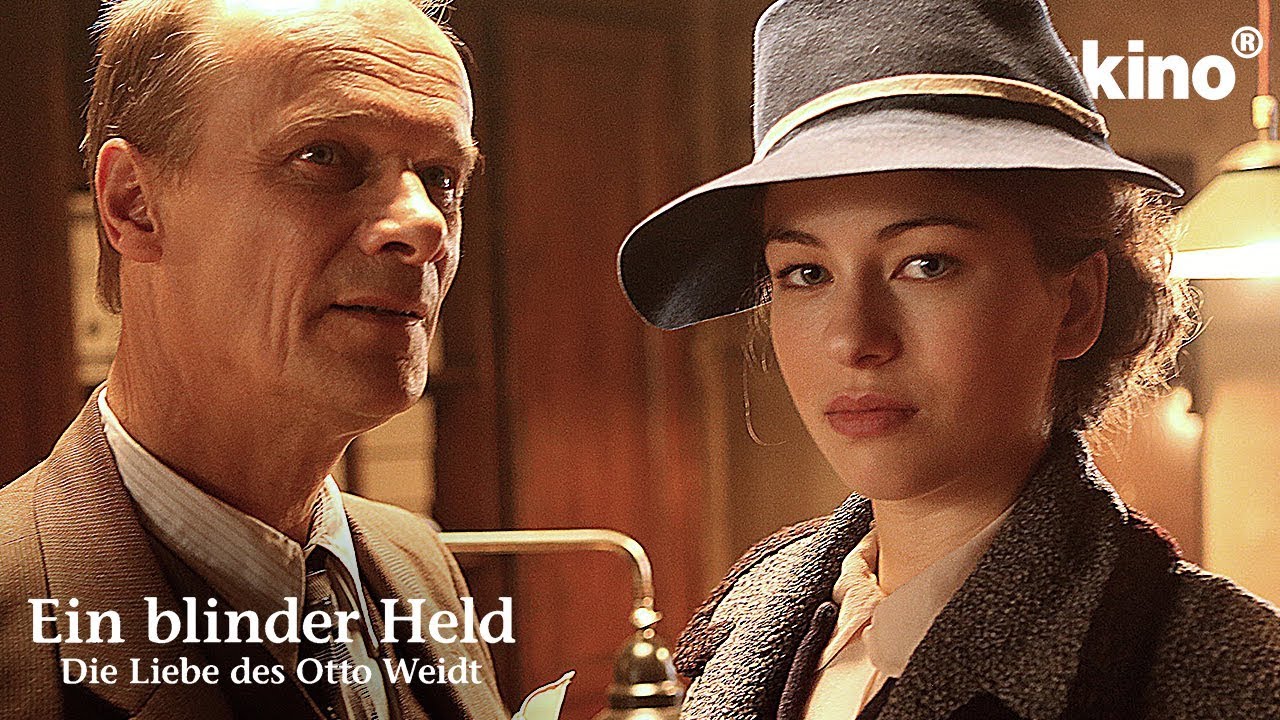
By the way, it’s mainly because of people like Otto Weidt that I don’t feel comfortable when people speak about ‘the Germans’ having done all the atrocities.
Righteous Men And Women
This being said, I by no means intend to whitewash anyone. But not every German citizen was a staunch Nazi. As a matter of fact, there were even a number of Germans who were victims themselves: German Communists, Clerics, Homosexuals, and others were prosecuted, too.
On the other hand, sadly, the Nazis found support in searching for and rounding up Jewish people in every European country. As a matter of fact, as far as I know, only Denmark managed to save almost the entire Jewish population by sending them in boats to Sweden.
Refugees coming by boats – doesn’t that sound familiar?!
Also, it’s sad to say that in every other country, the Nazis had allies or collaborators.
So, however, life would be so easy if one could blame exclusively one entire nation for being the devil. We could declare the Germans the planet’s only villains so that the rest of the world’s population would frolic and pick daisies on a lush lawn. Unfortunately – or probably thank God – it’s obviously not that simple.
Walking along the Hackesche Höfe on Rosenthaler Straße, you then turn left into Sophienstraße at the next corner. It’s a very cute street with many small shops and lovely cafés and bakeries where you can just sit in front of the window, enjoying a cup of coffee and a piece of homemade cake.
Jewish Heritage
The next cross street is the Große Hamburger Straße. This used to be Berlin’s Jewish neighborhood, hence, on the street’s southern end is the Jewish Cemetery. Across the street, Berlin’s first Jewish retirement home was opened, with the Jewish School for Boys next to it. As a matter of fact, these buildings were used by the Nazis to round up Jews for their deportation.

In 1943, the Jewish cemetery was destroyed and turned into an air-raid shelter. The gravestones were used to reinforce the walls. Later, the grounds became a mass grave for soldiers and civilians killed during Allied air raids. Today, one symbolic tombstone and a sarcophagus filled with remains of gravestones are all that’s left. About 3,000 war victims, as well as approximately 3,000 Jewish dead, are now buried together.
Treats
At the end of the Große Hamburger Straße, you turn right into the Oranienburger Straße, you will also find many nice places where you can have a snack or a coffee.
At Oranienburger Straße 1, there is a branch of the excellent ice cream parlor chain Amorino. They are open from noon till 9 p.m.

Also, some of the best Currywurst – the typical sausage with tomato sauce and curry powder – is sold at Curry 61 at Oranienburger Straße 6. They are open from 11 a.m. till midnight.
With your stomach full, let’s keep walking down the Oranienburger Straße to Number 28.
New Synagogue
Here in 1866, the Neue Synagoge, hence, the New Synagogue, was inaugurated. 3,200 seats made it Germany’s largest Jewish house of worship.

Unlike other Synagogues, it was not destroyed during the ‘Kristallnacht’, the Pogrom Night in 1938. Nevertheless, eventually, it was severely damaged during air raids. Finally, in 1958, the main hall was dynamited so that only the facade remained. After restoration, the Synagogue was reopened in 1995. Now the building houses the Centrum Judaicum as well as its museum. There is also a small prayer room for about 100 people on the 3rd floor.
At the next corner, turn left into the Tucholskystraße and eventually right into Ziegelstraße to get to the Friedrichstraße.
The Tucholskystraße is named after Kurt Tucholsky:

Kurt Tucholsky
(* 9 January 9 1890 | † 21 December 21 1935)
Undoubtedly one of the most important German journalists and novelists of the Weimar Republic, famous for his wit and outstanding ability to use the German language. Being Jewish, after the Nazis came to power, obviously, his books were burnt and his citizenship revoked. Tucholsky migrated to Sweden, where he overdosed on sleeping pills. However, it is not evident if this happened on purpose or accidentally.
(Photo: Unknown, Ktktkt, cropped to 5:7, B/W-filter, CC0 1.0)

Center of the GDR Era
On Friedrichstraße, to your right is the Friedrichstadt-Palast, a revue theatre from the GDR era.

(Photo: User:Dabbelju, Berlin Friedrichstadtpalast 2006, cropped to 7:5, CC BY-SA 3.0)

As you cross into Reinhardtstraße, you’ll get the chance to visit one of the remaining air raid shelters that today houses a private art gallery, the Boros Foundation.

Businessman and collector Christian Boros and his wife Karen not only own the bunker but are living in a spacious penthouse on the upper floor. They also call an impressive collection of contemporary art their own. The gallery can be visited, but only on a pre-booked guided tour, which is available in German and English.
Now walk back to the Friedrichstraße and turn right to cross the Weidendammer Brücke.
Past Full Of Tears
On the right-hand side towards the river Spree is a glass building called Tränenpalast, the palace of tears. This used to be basically the only place where the Berlin Wall was a tiny bit permeable – visitors from the West were allowed to enter the GDR after having been grilled; and some people from East Berlin – namely retirees – were allowed to go west…for a short visit.

Today, there is an exhibition on this whole pretty rigid and sometimes cruel border traffic.
Opening hours are Tuesday to Friday 9 a.m. to 7 p.m. and weekends from 10 a.m. to 6 p.m.

To get to the next stop of our tour, you can either walk up the Friedrichstraße, which further north leads into Chausseestraße.
Here, at number 128, you can check out what’s on at the Neuer Berliner Kunstverein, New Berlin Art Association. They usually have rather unusual, quirky artists – exhibitions and performances alike.
Bertolt Brecht
A few steps further, at number 126, the entrance to the Dorotheenstädtischer Friedhof can be found.

Here, some great Germans are laid to rest: The philosopher Friedrich Hegel 1770 – 1831), the artists and architects Karl Friedrich Schinkel (1781 – 1841) and Johann Gottfried Schadow (1764 – 1850), novelists such as Heinrich Mann (1871 – 1950), Anna Seghers (1900 – 1983), and Christa Wolf (1929 – 2011). And the theater power couple, Bertolt Brecht and Helene Weigel.
The cemetery can be visited from March to October from 8 a.m. to 8 p.m. and from November to February till 5 p.m.
Funny enough, Bertolt Brecht and Helene Weigel didn’t have to move far after they passed away: Their last home was right next to the cemetery, and today there is a museum honoring their work. The memorial center can be visited on guided tours in German and English. No advance booking required. Please check their website since there are too many hours to list here.
If you’re not sure whether you’ve heard about Bertolt Brecht before: His most famous musical theater piece is the Threepenny Opera, adapted from John Gay’s The Beggar’s Opera. While Brecht wrote the lyrics, the music is by Kurt Weill – and you certainly know the song Mack The Knife?! Well, here you go then. Another internationally known song would be the Moon of Alabama, written for his play Rise and Fall of the City of Mahagonny. So, show me the way to the next whiskey bar – and don’t ask why, no, don’t ask why….
Remembering one of Germany’s most important writers:

Bertolt Brecht
(* 10 February 1898 | † 14 August 1956)
Clearly one of the most important and famous German dramatists and poets. He was a dedicated communist and pacifist, and consequently, most of his plays deal with the hardship of and the injustice and inequality between men. His poems, however, tend to be surprisingly tender and romantic. Being a communist and pacifist, obviously, Brecht had to migrate from Nazi Germany – first to Sweden and eventually to the USA, where, by the way, he was again prosecuted during the McCarthy era. In 1949, however, he moved back to Germany and settled in the Russian sector, the GDR’s predecessor.
(Photo: Bundesarchiv, Bild 183-W0409-300 / Kolbe, Jörg / CC-BY-SA 3.0, Bertolt-Brecht, Formatted to 5:7, CC BY-SA 3.0 DE)

…and his wife:

Helene Weigel
(* 12 May 1900 | † 6 May 1971)
German character actress and artistic director. Being Bert Brecht’s second wife, she played many roles of his famous plays, Mutter Courage und ihre Kinder / Mother Courage and Her Children being the most celebrated one. Being of Jewish descent and a member of the communist party since 1930, she migrated from Nazi Germany to Los Angeles, where, for obvious reasons, she could not pursue her career. After moving back to East Germany in 1949, she founded, together with her husband Bertolt Brecht, the theater Berliner Ensemble.
(Photo: Deutsche Fotothek, Fotothek df Pk 89, Formatted to 5:7, CC BY-SA 3.0 DE)

While Brecht and Weigel, along with other artists, writers, journalists, etc., saw a Socialist State as a valid alternative, especially to the Fascism they had just suffered through, for many people, the way this political system was installed by the leaders meant hardship and pain.
Phoenix From the Ashes
During the first years after the war, the frontier between East and West Berlin was pretty much open, and the Berliners were able to travel back and forth as they pleased.
Only when more and more people decided to leave the eastern part and make a living rather in the west, the grip got slowly tighter and finally, in 1961, the GDR government built the infamous wall.

There are memorials and remnants of the wall all over the place, but at the Bernauer Straße, the situation was particularly bizarre. The wall went right through the houses – and even through a church wall.

(Photo: Willy Pragher, Berlin Bernauer Straße 48 Mahnmal Ida Siekmann 078927, Formatted to 7:5, CC BY 3.0)

So before the GDR soldiers were able to brick up the windows, people just entered the houses on the east side and jumped off the windows to the west, from any storey available. Needless to say that there were casualties since people literally jumped even from the fourth floor.

(Photo: Olga Bandelowa, Versöhnungskirche Bernauer Straße, cropped to 7:5, CC BY-SA 2.0 DE)

Today, there is a Memorial Park at Bernauer Straße 111 and a very informative visitor center at Bernauer Straße 119. You get there from the Brecht-Weigel-House by walking up Chausseestraße and turning right into Zinnowitzer Straße, which leads first into Julie-Wolfthorn-Straße and then Bernauer Straße.
And Now
So what do you think so far? A city bursting with history from different epochs – terrible and full of hope, very dark, but with a tiny spark of light.
And today? Today, this part of Berlin is one of the hippest neighborhoods.
As you walk on Ackerstraße back south from the Memorial Park, you’ll get to Torstraße, Linienstraße, and Auguststraße. Each of these cross streets is lined with art galleries, snack bars, and coffee shops, so that you just have to take your pick where to hang out with the in-crowd.

Linienstraße and Auguststraße end at Oranienburger Straße in the west, and this is the Land of Cockaigne when it comes to food from all over the world: Asian, Arabic, European – everybody finds their favorite here.


Walking down Linienstraße eastwards, you’ll get to our final stop, the Rosa-Luxemburg-Platz, the Rosa Luxemburg Square.

No wonder that this place, named after one of the world’s greatest communist icons, is also home to Germany’s extreme left-wing party Die Linke, with a huge portrait of Che Guevara decorating their building.
Giving Theater to the People
But the most impressive structure here is the Volksbühne, the People’s Theater, built in 1913 / 1914. The idea was to have a theater literally for the people instead of the bourgeois elite. They tried to promote naturalist plays that people could relate to and also offered them at prices that the common workers could afford. Obviously, the theater could not keep these ideals up after the Nazis came into power.
After the war, the heavily damaged building was rebuilt from 1950 to 1954.

Since their repertoire – apart from interesting, new plays – includes also modern dance performances and different concerts, it’s worth checking it out for a pleasant evening out, like a real Berliner.
Walking down the Rosa-Luxemburg-Straße, you’ll get back to the Alexanderplatz, where our tour started.
The Rosa-Luxemburg-Straße is named after:

Rosa Luxemburg
(* 5 March 1871 | † 15 January 1919)
Polish-born philosopher, economist, and anti-war activist. However, she got German citizenship in 1899. Also, she was the co-founder of the communist newspaper Die Rote Fahne/The Red Flag. Together with Karl Liebknecht, she founded the German Communist Party and initiated the Spartacist uprising of 1919. After it was crushed by the Social Democratic Government with the help of paramilitary units, Rosa Luxemburg’s dead body was thrown into the creek Landwehrkanal.
So, guys, I hope I managed to show you some interesting and inspiring things – and I hope you’ve enjoyed your walk through the Wild Wild East.
I’d be more than pleased to learn what you think, so just let me have it in the comment section below.
Dankeschön!
Where to Stay
If you are planning on exploring mainly Berlin’s Wild Wild East, staying close to the Alexanderplatz is highly recommended. From there, you can follow my above itinerary walking.

The Premier Inn* is just a few steps from the Alexanderplatz and offers modern, comfortable rooms at a reasonable price.
However, if you want to check out a different location, you can easily do so on this map*:
Final Note
In this post, I refrain from posting general travel info on how to get there and around, the money, the WelcomeCard, etc. You’ll find all this general information in my post BERLIN guide: get the most for less on bus 100.
To explore Berlin’s amazing Street Art, rush over to my post Best Street Art in BERLIN
Before coming to Germany, you might want to check out my post All you need to know before going to GERMANY.
This information will make your trip smoother and more enjoyable.
Map
Here you can trace the tour on a responsive street map. Clicking on the slider symbol at the top left or the full-screen icon at the top right will display the whole map, including the legend.
Pinnable Pictures
If you choose to pin this post for later, please use one of these pictures:


Note: I am completing, editing, and updating this post regularly – last in October 2026.
Did You Enjoy This Post? Then You Might Also Like These:

24 hours in HAMBURG

Guide to the Island of FOEHR – every village a home
Best Street Art in BERLIN

A Visit to the Berlin Biennale 2022
BOOMTOWN BREMERHAVEN – Complete Guide

An Audience With the Queen
Guide to the Island of FEHMARN – Where Plan B is the Best Plan

Baroque Splendor And River Romance: The Must-Sees of DRESDEN
Disclaimer: The Premier Inn invited me to stay with them. Yet, all opinions on their service are mine. They weren’t by any means influenced by my cooperation partner.
* There are affiliate links in this article. By booking through my affiliate links at no extra cost to you, I will receive a small commission. This helps me to run this site. Thank you so much for supporting me!
Your article helped me a lot, is there any more related content? Thanks!
There actually is an even more comprehensive post on Berlin: BERLIN guide: get the most for less on bus 100 and then there is an extract for 24 hours in Berlin. Hope this helps 🙂
Great post about Berlin. I have always wanted to visit and there seems like there is so much to do!!
It simply doesn’t stop! 😀
I was in Berlin twice, but I still have a lot to see there. Next time I’m going to visit it with your great tips. I don’t want to miss those architectural and historically significant places. It’s so a detailed guide!
Berlin definitely is one of those cities that never get old 🙂
Great post with a fascinating history of Berlin and some of the personalities from World War II Era. The sculptures and art work on Berlin wall is amazing!
I’m so glad you appreciate my less lighter approach to the city 🙂
On our Baltic cruise, we had the chance to go to Berlin for a day trip and passed on that because we want to spend a much longer time in the city one day. Your post sure shows that we made the right decision to plan more time for Berlin. How interesting to see a different view of Berlin when you head east of the Alexanderplatz. Certainly moving to visit the Anne Frank house. And to see the Jewish memorials. I never knew there was a small opening in the Berlin Wall that let people through for a short visit. So much history!
This is a great post. I always knew that Berlin is a historic place but it is fascinating to actually read about it. Looks like a place worth visiting.
Very informative article. I love how you included the actual German words.
It’s going to be the end of my day, except before ending I am reading this wonderful piece of writing to increase my experience.
Hahaha – cheers! 🙂
Super detailed and informative post about my home town Berlin. I will recommend it to English speaking friends! If you come back sometimes, I think you would enjoy the James Turrell light installation on the Dorotheenstädischer Friedhof. And a few weeks ago I went on a VR tour with Timr Ride through East Berlin – it was a bit tacky- but fun too.
Berlin is definitely on my bucket list!!! I wish I could go there someday!
So much history and culture! What a wonderful tour through the city!
I have never been to Berlin. But I can see there are lot of nice places to visit there. Will definitely love to visit there sometimes
berlin is so much fun! Lovely guide, it totally makes me want to take my chances and visit it again
Renate, I know you are a solo traveler, but I want to go hang out with you in these places. I absolutely love it!
Thanks for the guide as it brought back many wonderful memories of when I was there. My favorite, the East side gallery. – Knycx Journeying
My boyfriend was an expat in Berlin and has told me a lot about the city. He also said that he goes to Hackesche frequently and that we should absolutely go once it’s safe to fly again. Thank you for your handy tips and guide!
I’m glad he’s backing my tips 😉 I hope you get to explore Berlin with him very soon 🙂
Fascinating story. Love these place. I love the photos.
I have never been to Berlin. It sounds like there is so much to see there.
This is cool, it looks like it has some awesome places to visit and learn more about the history.
Block der Frauen looks simply magical! Beautiful post