Tenerife is by far not just about beaches’n’volcanos: In this post, I’m introducing the best in street art the island has to offer.

Tenerife
Tenerife is the largest of the Canary Islands, and due to its climatic and geographical diversity, as well as differentiated flora and fauna, it is defined as a microcontinent since it boasts an amazing number of microclimates. You’ll find those infamous Tourist ghettos only in the island’s southeast. The rest is picturesque villages, lush fields, bewitched forests, black lava beaches – and on top of it all, the mighty Mount Teide.
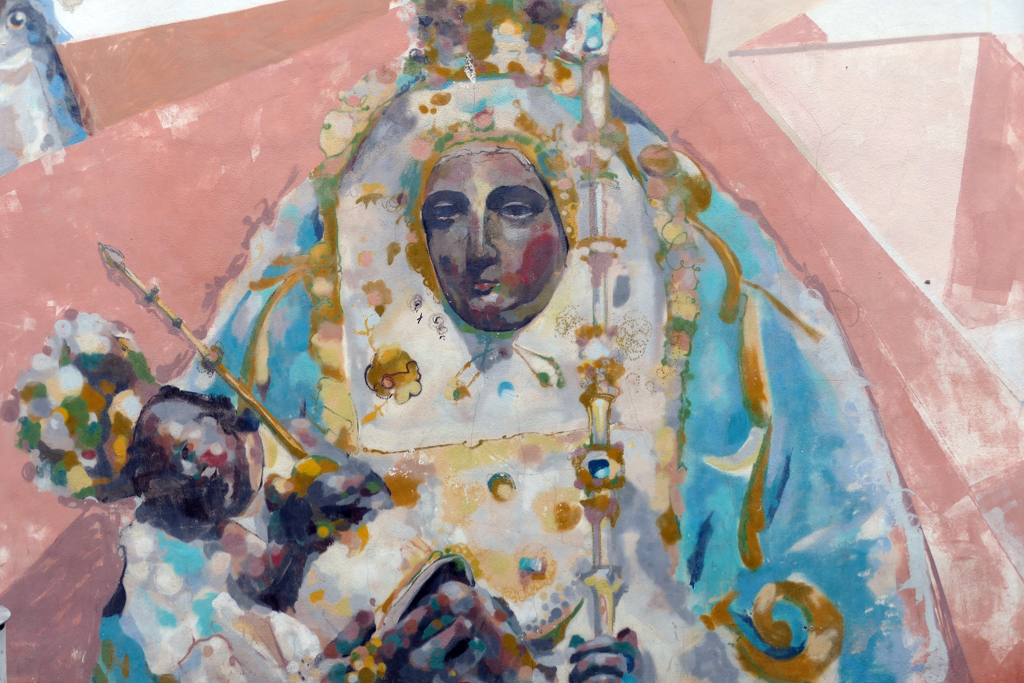
I’ve introduced many alluring spots on the island in various posts, hence, you might also want to check those out.
This one, however, is exclusively dedicated to the powerful messages and bold colors of Tenerife’s street art.
Before we jump right into it, a quick note: In this post, I’ve organized the artworks according to the three most important locations for street art: the capital, Santa Cruz de Tenerife, and the cities of San Cristobal de la Laguna and Puerto de la Cruz. Furthermore, many of the local artists have left works in multiple places, but you’ll only find their biographies when I mention them for the first time, obviously.
Santa Cruz de Tenerife
Santa Cruz de Tenerife is the vibrant capital of Tenerife and one of the main ports of the Canary Islands. Known for its modern urban layout, lively cultural scene, and bustling commercial areas, the city blends contemporary architecture with historical landmarks.
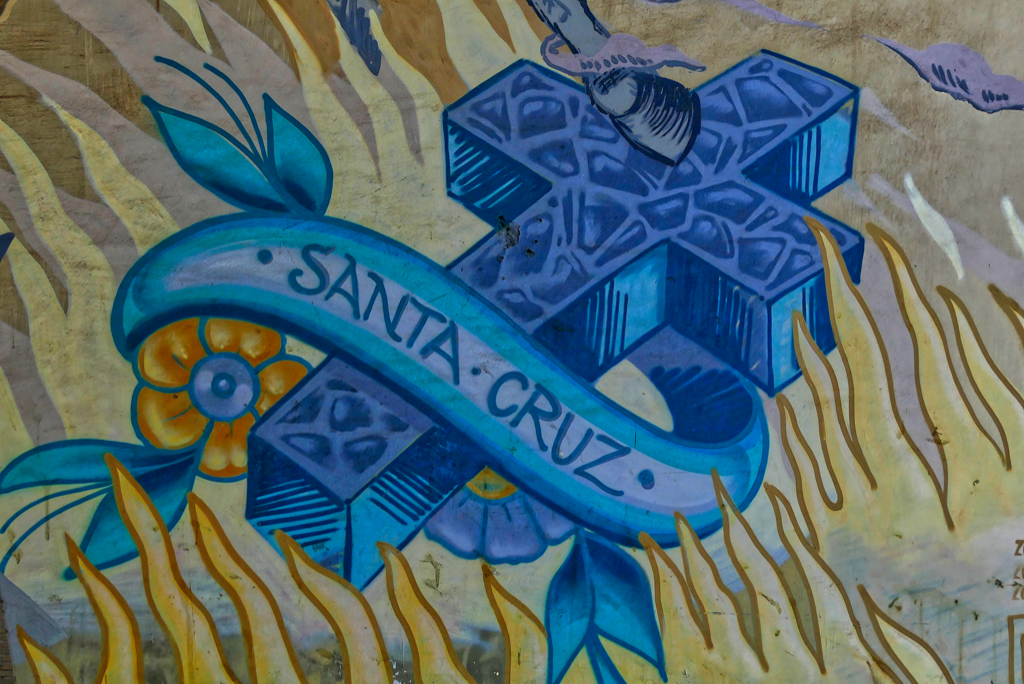
The city also hosts major events like the world-famous Carnival of Santa Cruz de Tenerife. In addition, you’ll find numerous museums, theaters, and public spaces that showcase Canarian culture. Its coastal location and port make Santa Cruz both a hub for trade and a gateway to the island’s natural attractions. All this adds up to an amazing mix of commerce, culture, and maritime life.
Urban Art Projects in Santa Cruz
Sumérgete en Santa Cruz
Sumérgete en Santa Cruz is an urban art initiative promoted by the Fundación Cepsa together with the City Council of Santa Cruz de Tenerife. Cepsa is a Spanish multinational oil and gas company.
The project, whose name translates to Immerse Yourself in Santa Cruz, began as a means of improving public spaces into open-air galleries. Over the years, it has become one of the most dynamic cultural programs in the city. The idea is neither unique nor new, yet still very powerful: use large-format murals to bring art out of museums and into everyday life, making it accessible to everyone while at the same time revitalizing neglected corners of a city. I’ve introduced similar initiatives in my posts on street art projects in Amsterdam, Copenhagen, Lisbon, Paris, and Seville, to name just a few.
The initiative invites artists to create works that connect with the city’s landscape and its people. Therefore, the murals often highlight themes closely tied to Santa Cruz and Tenerife: the environment, biodiversity, seafaring traditions, and community identity.
An Additional Dimension
However, one of the distinctive aspects of Sumérgete en Santa Cruz is the emphasis on participation. Several works have been carried out in schools, where students collaborate with artists. This way, they not only learn painting techniques but also about teamwork, creativity, and the value of art in shaping their surroundings. This educational dimension ensures the project isn’t just decorative but also formative for the younger generation.
In addition, beyond aesthetics, the initiative plays a role in urban regeneration. Many of the chosen walls were previously plain or deteriorated. Hence, the new artworks change not only the physical look but also the perception of those spaces. In this sense, Sumérgete en Santa Cruz has helped weave art into the daily fabric of the city. It turned walks through its streets into cultural experiences and reinforcing Santa Cruz’s reputation as a vibrant, creative capital in the Canary Islands.
Campeonato de Canarias de Graffitis
The Campeonato de Canarias de Graffitis was a graffiti competition held mainly in Santa Cruz’s neighborhood of El Toscal in June 2012. Organized by cultural associations like Cultura con Estilo together with the local council, it brought together some of the best-known urban artists from the Canary Islands.
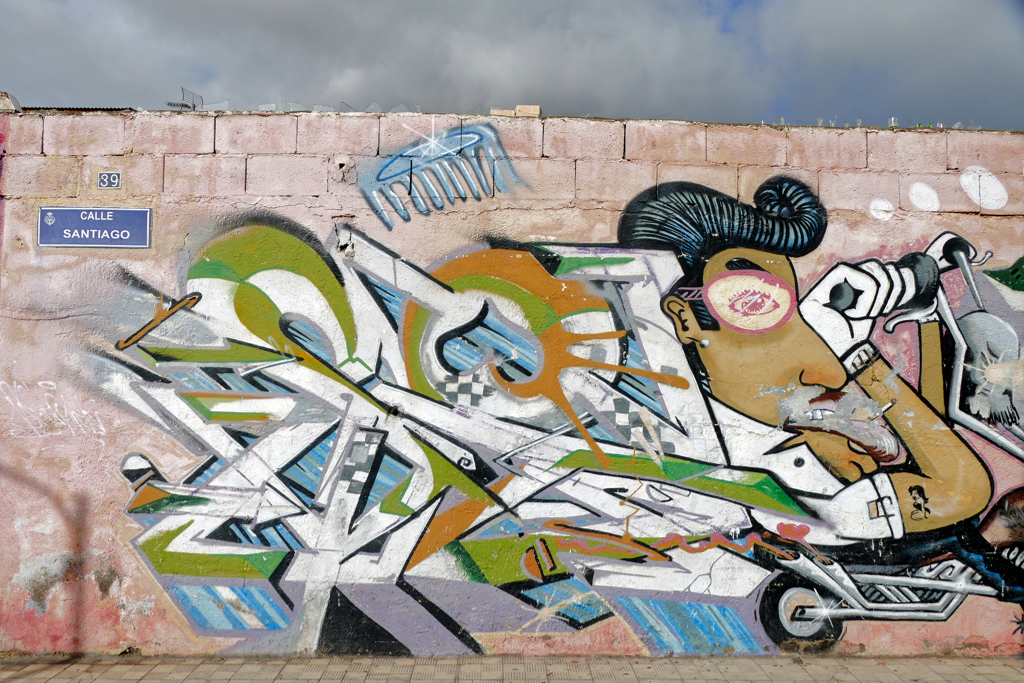
The artists worked on officially commissioned walls, obviously. However, the event not only produced striking murals that remained as part of the urban landscape to this date. It also helped shift public perception of street art from vandalism to cultural expression. This way, it strengthened its place in the artistic identity of Santa Cruz de Tenerife.
The Artists
Carmen Cólogan
Carmen Cólogan was born in San Cristobal de la Laguna in 1959. She is a distinguished artist whose work spans painting, installations, and interdisciplinary projects. A graduate in Fine Arts from the Complutense University of Madrid, she has developed a multifaceted career. Cólogan often explores themes of insularity, identity, and the natural environment, reflecting her deep connection to the Canary Islands. She has held over twenty solo exhibitions in Spain and internationally.
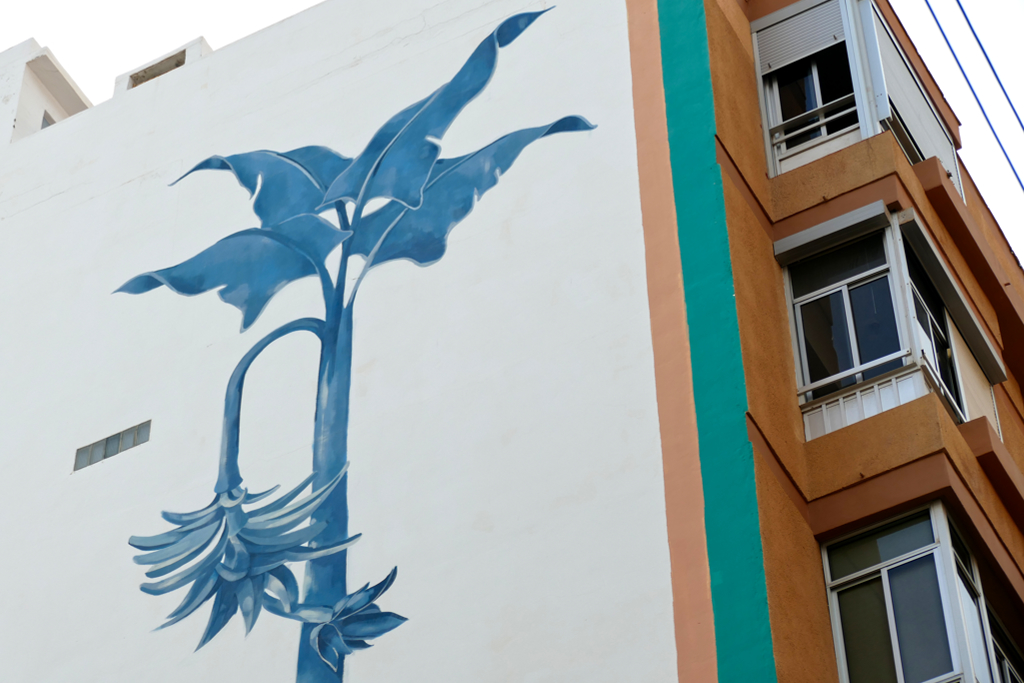
Her work is characterized by an approach of meticulousness and contemplation. She’s drawing inspiration from Eastern philosophy and employs various materials such as glass, wood, textiles, paper, metal sheets, and oil on canvas.
Ione Dominguez
Ione Domínguez is a Tenerife-born urban artist whose work bridges the worlds of street art and contemporary muralism. Beginning his artistic journey in 2005, he was initially drawn to the clandestine nature of graffiti, influenced by street culture and hip-hop.
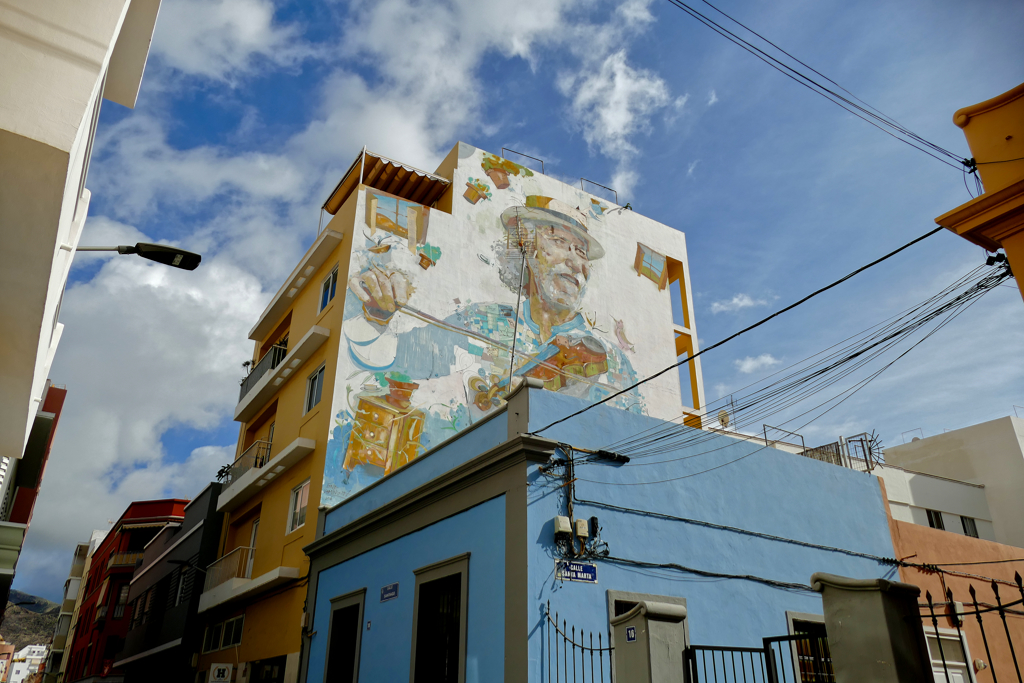
By 2013, Domínguez transitioned to professional muralism. In his commissioned projects, he focuses on a blend of academic techniques and expressive, dreamlike imagery. His art offers a blend of personal expression and universal themes that invite viewers to explore the stories and emotions embedded in his murals.
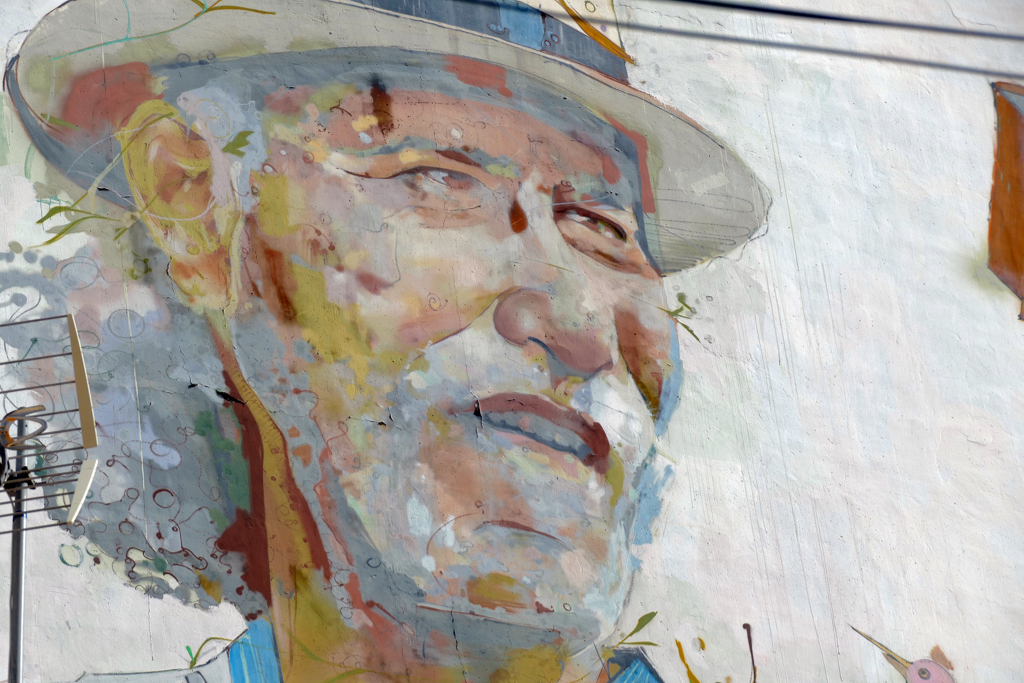
Domínguez’s work has been exhibited internationally, with murals in countries such as Argentina, Uruguay, Brazil, and the United Kingdom, as well as various cities across Spain.
The Heart of Tenerife
The Heart of Tenerife solidarity event in the Valleseco neighborhood of Santa Cruz de Tenerife was a community-driven initiative aimed at honoring the area’s rich fishing heritage. Organized by the Fundación Cepsa, the Santa Cruz de Tenerife Port Authority, the city council, and the local association FACOCIP, the event culminated in the creation of a mural that reflects the neighborhood’s maritime history.
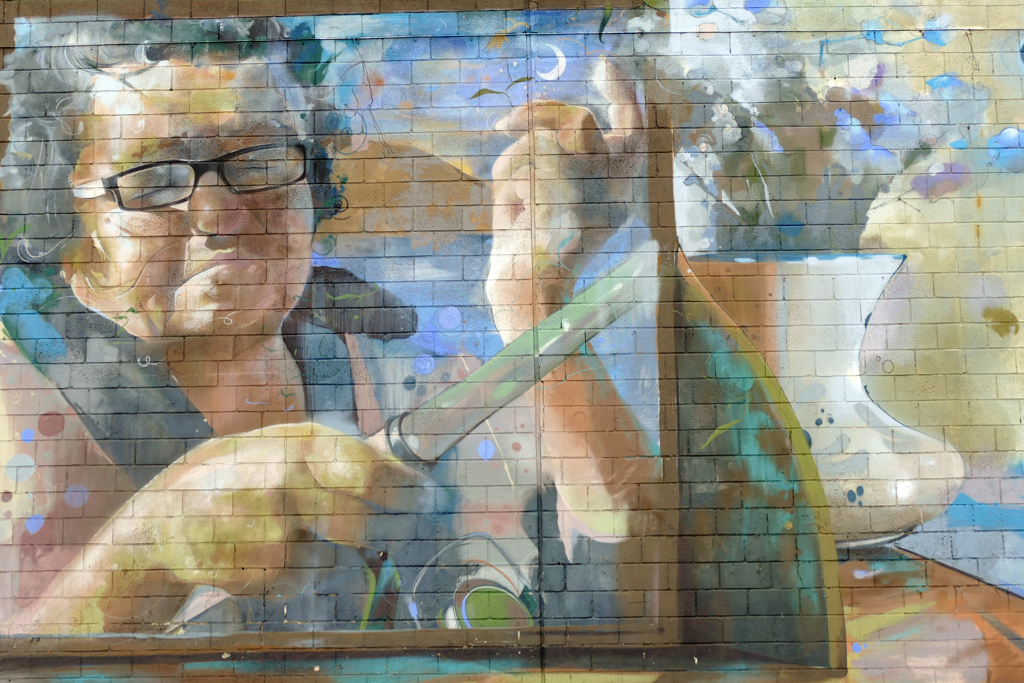
The mural that Domínguez painted in 2019 was selected through a participatory process involving over 180 local residents. This way, it was ensured that the artwork resonated with the community’s collective identity.
This mural not only beautifies the entrance to Valleseco. It also serves as a testament to the collaborative spirit of the neighborhood and its commitment to preserving and celebrating its cultural heritage. The Heart of Tenerife event exemplifies once more how art can foster community engagement and solidarity, leaving a lasting impact on the local landscape and its people.
I’ve introduced another one of Ione Domínguez beautiful murals in my post PUERTO del ROSARIO – Fuerteventura’s Underrated Capital.
Luis Eduardo Fierro
Luis Eduardo Fierro is renowned for his work as a painter, illustrator, muralist, and cultural activist. Holding a degree in Fine Arts from the University of La Laguna, he has been actively engaged in the arts since the 1990s. His artistic approach is characterized by a blend of realism, abstraction, and surrealism.
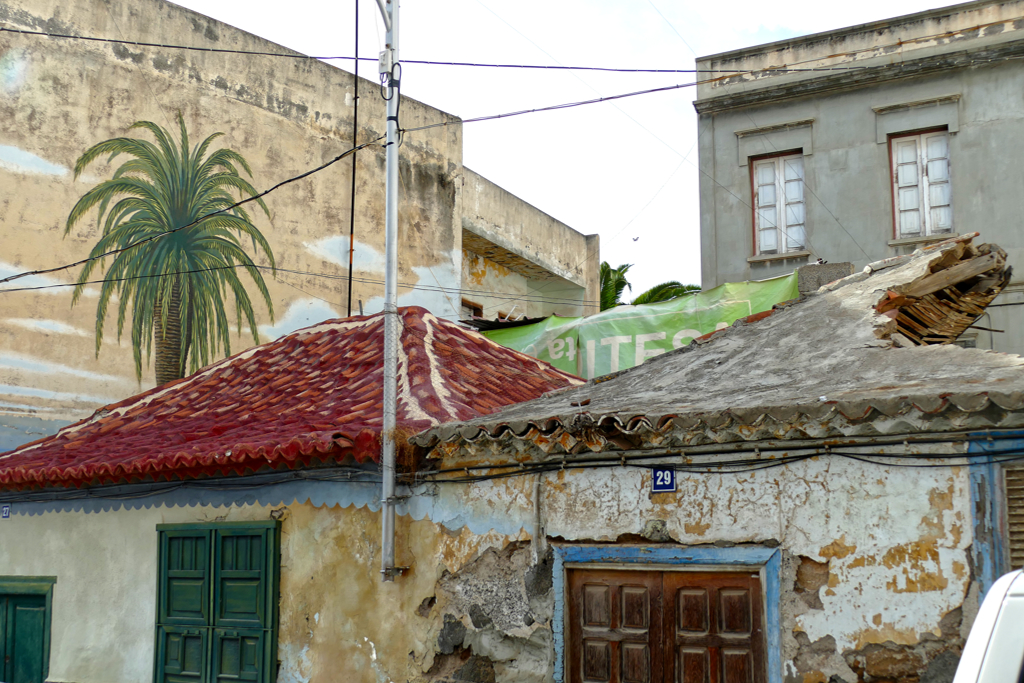
Beyond his visual art, Fierro is a vocal advocate for the preservation of traditional Canarian architecture. He is doing his best to save the traditional one-story tile-roofed houses called casas terrerast from the 18th century from destruction. Sadly, it’s common for the owners to let them fall apart until the city allows them to be replaced. Fierro has organized events aimed at raising awareness about the decline of traditional Canarian houses.
Currently residing near the Norwegian city of Trondheim, Fierro continues to contribute to the arts both locally and internationally. He has expanded his practice to include decorative painting, mural creation, and illustration for comics and books. He’s also collaborating with various cultural projects. His work is still deeply committed to cultural heritage and artistic expression.
Stoyko Gagamov
Stoyko Gagamov is a Bulgarian-born artist. He is renowned for his unique open-air installations that blend portraiture with natural landscapes.
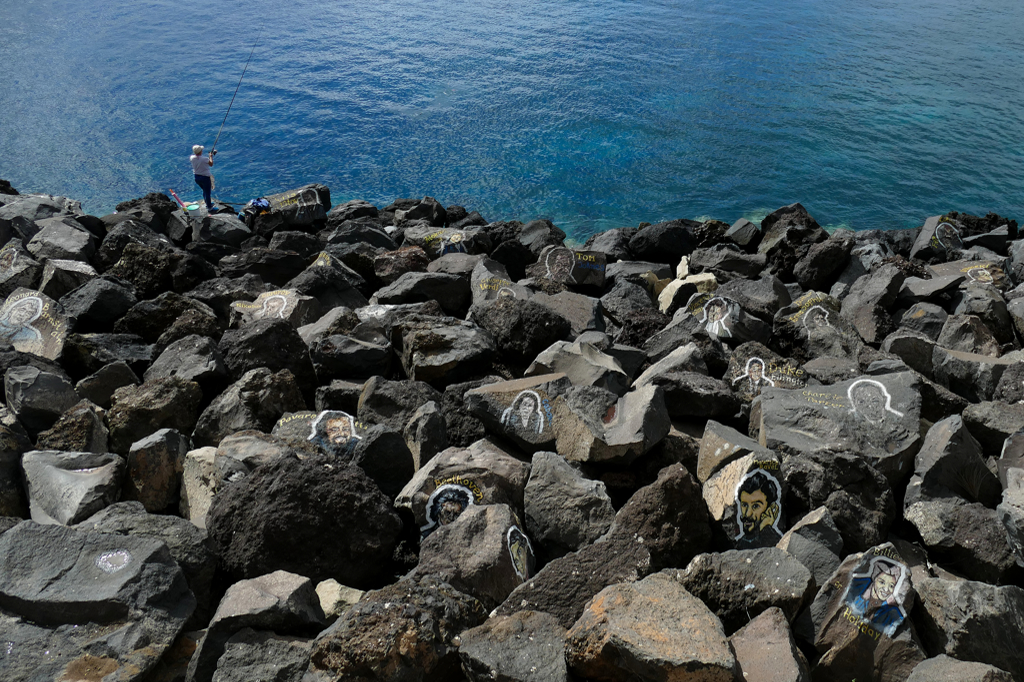
His artistic journey began under the guidance of his grandfather, a self-taught artist, who painted on unconventional surfaces, too. However, Gagamov actually graduated in fine mechanics. This impacted his choice to paint on durable materials like syenite and granite. In his works, he honors historical figures in conceptual compositions.
Cien Caras
Gagamov’s most notable work is the Cien Caras, hence, Hundred Faces project in Santa Cruz de Tenerife. Next to the Auditorio de Tenerife, he painted portraits of 100 renowned musicians and composers on the dark volcanic rocks and concrete blocks between 2010 and 2011 .
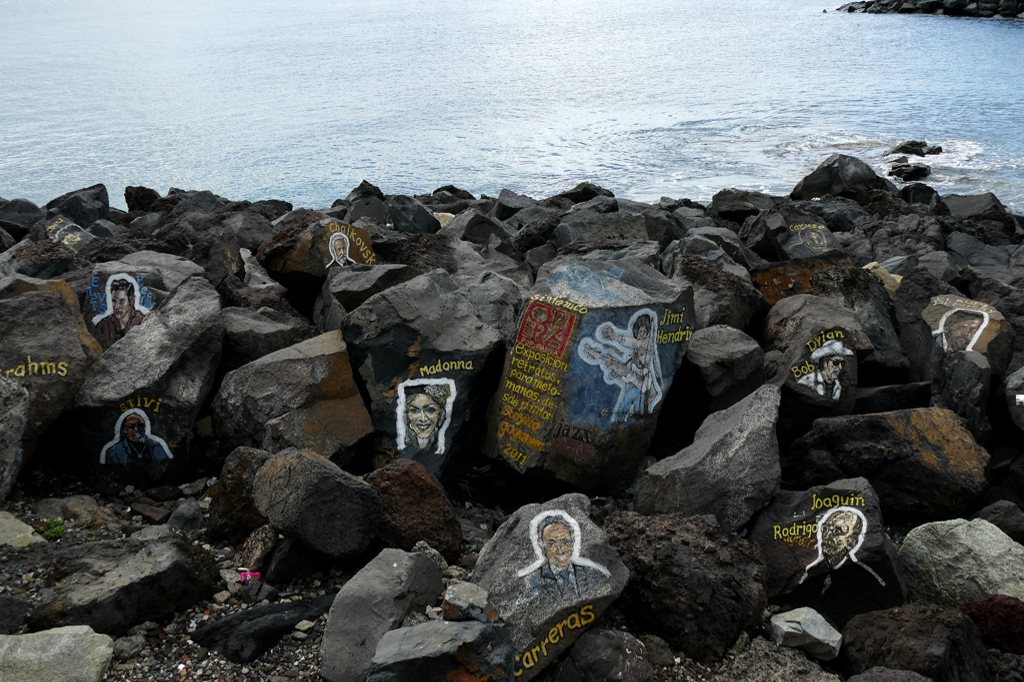
The project began with portraits of architect Santiago Calatrava, who designed the Auditorio, and opera singer Luciano Pavarotti. In over eight months, Gagamov added icons such as Michael Jackson, Madonna, Elvis Presley, Jimi Hendrix, John Lennon, Beethoven, Freddie Mercury, Maria Callas, and Paco de Lucía. White silhouettes were used as a backdrop to make the portraits stand out against the dark stones, creating a striking visual effect that can be appreciated from the promenade.
The installation exemplifies, amazingly, how art can transform everyday urban spaces into immersive cultural experiences.
Beyond Tenerife, Gagamov has created similar installations in other locations, including his Bulgarian hometown of Primorsko.
Airán de León
Airán de León is a Tenerife-born graffiti artist who describes himself as an old-fashioned graffiti writer. His style is rooted in the raw energy of graffiti culture, deliberately distant from academic or institutional frameworks. It is defined by an insistence on authenticity rather than polish. Entirely self-taught, he approaches graffiti with a focus on speed, spontaneity, and the deconstruction of letters.
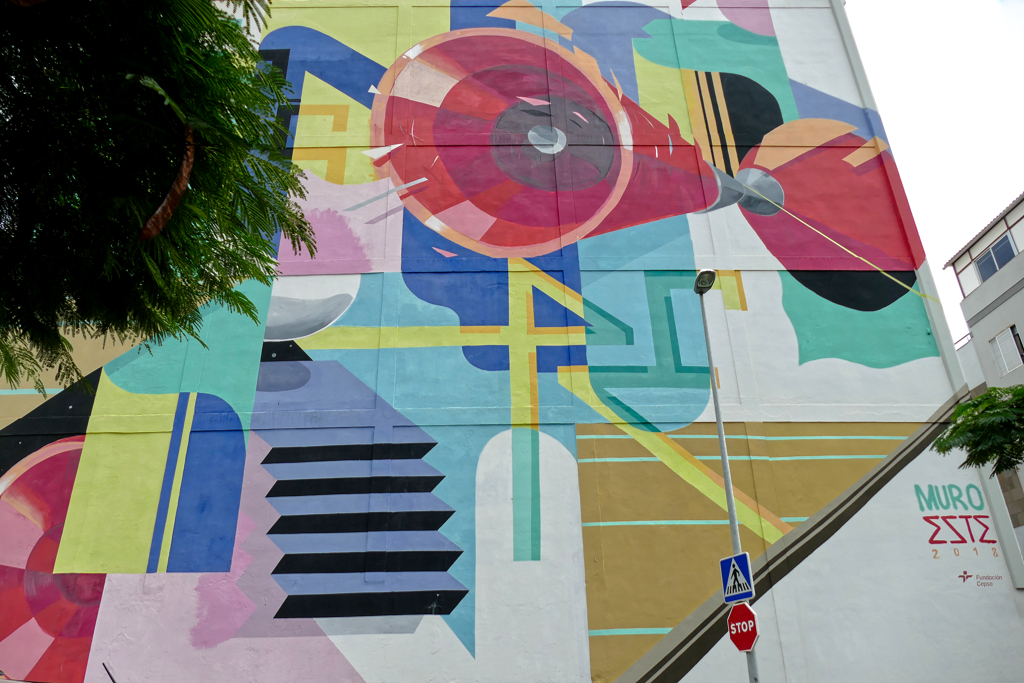
Over the years, Airán has left his mark across the Canary Islands and mainland Spain. Between 2006 and 2012, he often worked alongside Iker Muro. They created memorable pieces that combined experimental lettering with playful characters. Together they created a striking mural of more than 300 square meters. This work is inspired by childhood toys, with symbolic elements such as the diabolo evoking nostalgia.
By combining the immediacy of graffiti with large-scale public art projects, Airán de León bridges the worlds of underground street culture and institutional muralism.
I’m introducing Iker Muro, Airán’s partner in crime paint in the section on street art in San Cristobal de la Laguna below.
César Manrique
César Manrique Cabrera was a painter, architect, sculptor, and environmentalist born in Lanzarote in 1919. In the 1930s, he fought as a volunteer alongside Franco’s fascist putschists in the Spanish Civil War. Since I’ve learned this little fun fact about El señor Manrique, I’m far less impressed.
Howsoever, he graduated from the Art Academy in Madrid with a master’s degree in drawing and painting in 1950. Manrique became one of Spain’s avant-garde pioneers. In 1954, he opened the country’s first gallery for non-figurative art in Madrid. His work was strongly influenced by abstract expressionism, pop art, and kinetic art, obviously.
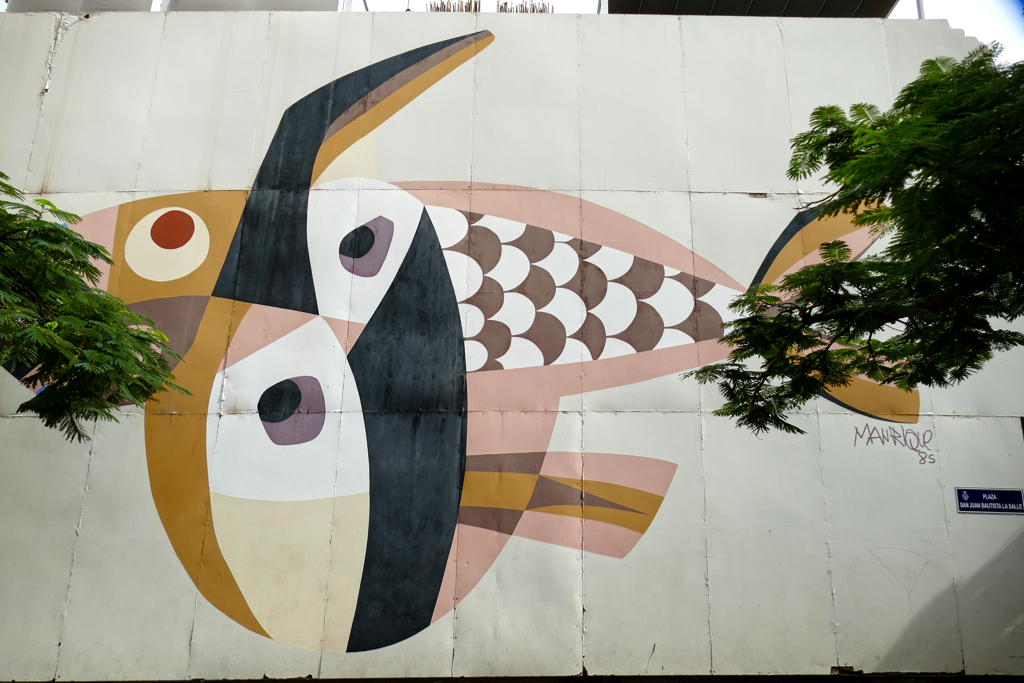
This mural is actually a 1997 reproduction of a 1985 work by Cesar Manrique.
Manrique returned to Lanzarote for good in 1968. There, he forged the modest plan to transform his home island into none less than one of the most beautiful places in the world. This included allowing only traditional edifices, and buildings were allowed to have three storeys max. Houses had to be whitewashed and shutters, doors, and fences painted blue in fishing villages and green in agricultural areas. Eventually, the color brown was added. Also, billboards alongside the roads were forbidden. Since Manrique had ties with powerful people in the island’s government, he found all his wishes fulfilled.
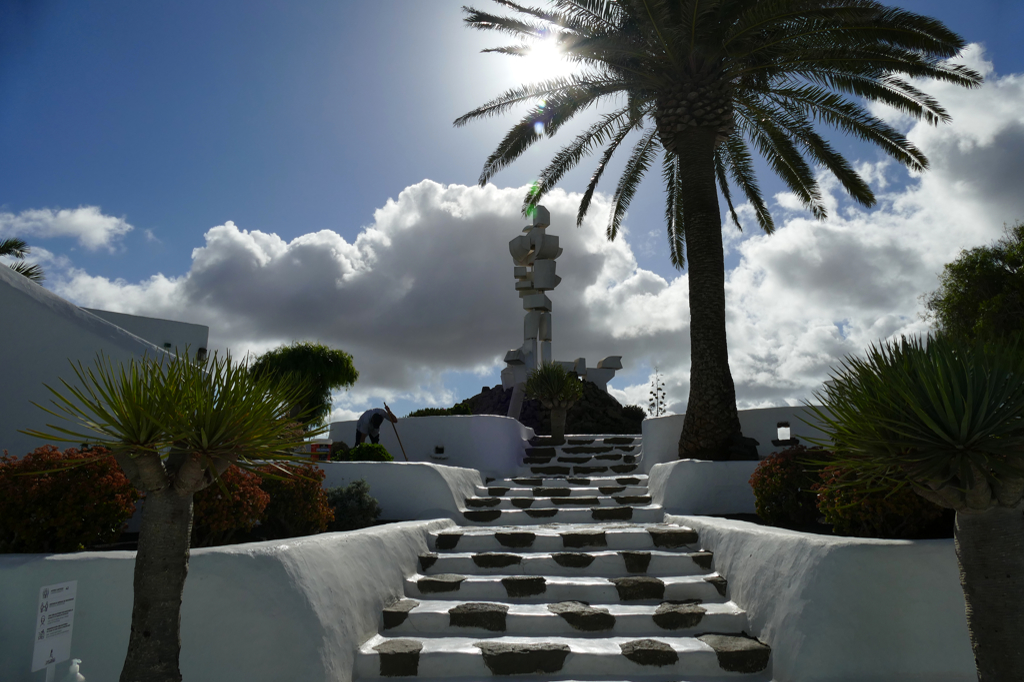
To this date, you’ll find outstanding architectural projects by César Manrique, who died in a car crash in 1992, on most of the Canary Islands.
Matías Mata aka Sabotaje al Montaje
Matías Mata, better known by his artistic pseudonym Sabotaje al Montaje, is a renowned street artist from the Canary Islands. Born in Lanzarote in 1973, he later moved to Las Palmas de Gran Canaria. There, he began his graffiti career in 1990, influenced by skate and hip-hop cultures. Within just two years, he gained recognition by winning the first Urban Art Competition of Las Palmas!
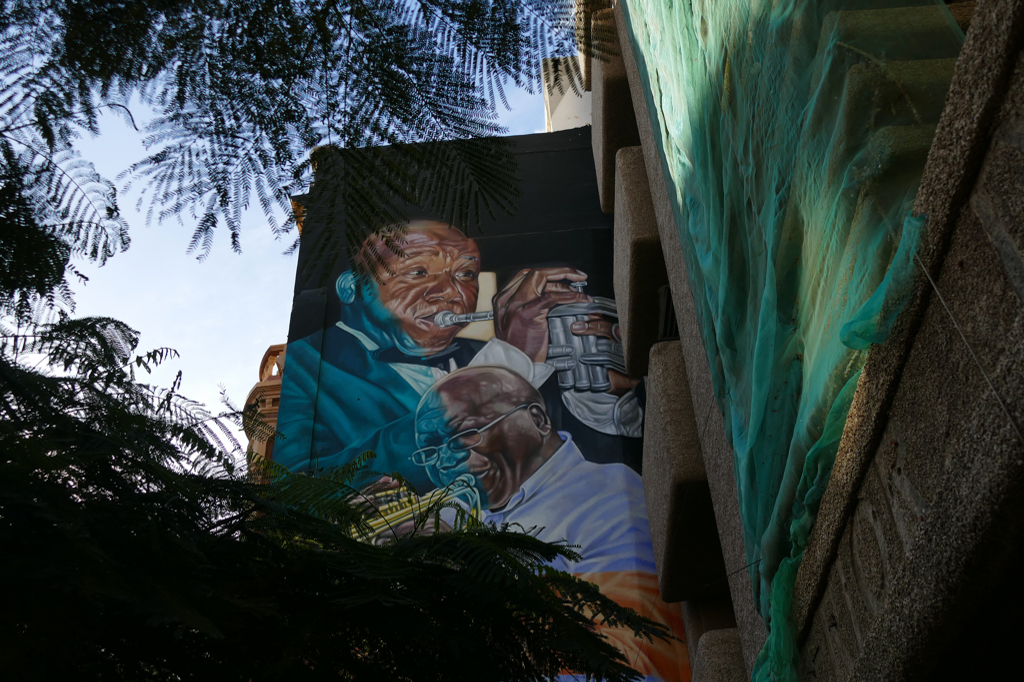
This is Mat’s omage to street musician Nilo Caparrosa, a Dominican who for many years played on the streets of Calle Castillo until he sadly passed away in 2020.
Mata pursued formal studies in Fine Arts at the University of La Laguna, graduating in 2003. His work is characterized by vibrant colors, figurative representations, and large-scale murals that often address social and environmental themes. He frequently depicts local figures and everyday people, reflecting his strong connection to community and place.
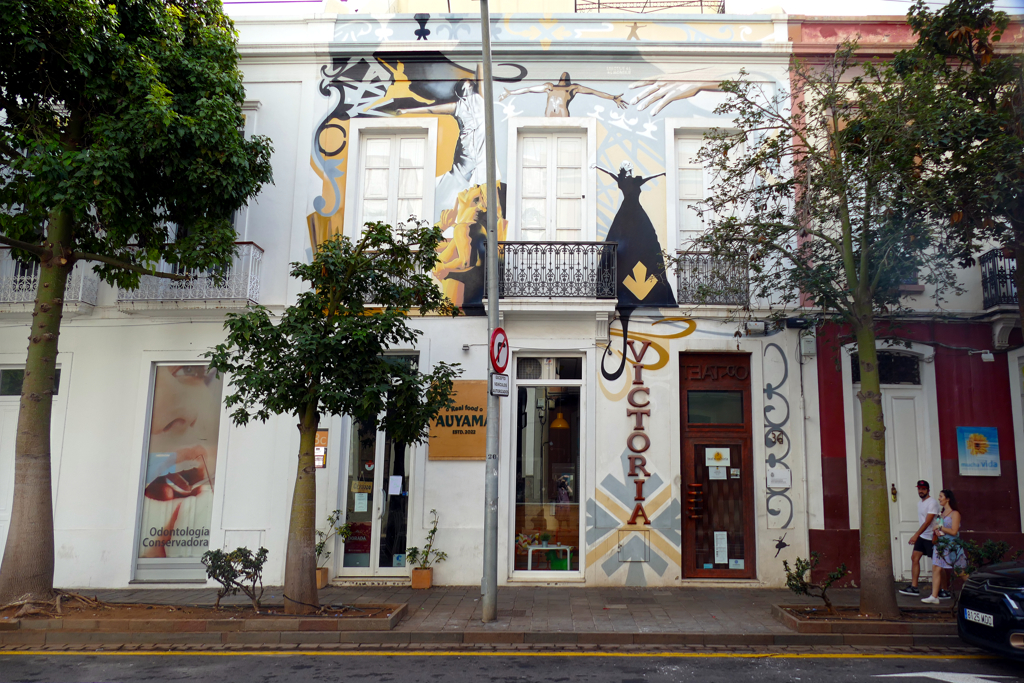
Throughout his career, Sabotaje al Montaje has participated in numerous international festivals and exhibitions. He left his mark in cities such as Buenos Aires, Paris, and Amman. His murals can be found in public spaces and contemporary art institutions, including the Atlantic Modern Art Centre in Las Palmas de Gran Canaria.
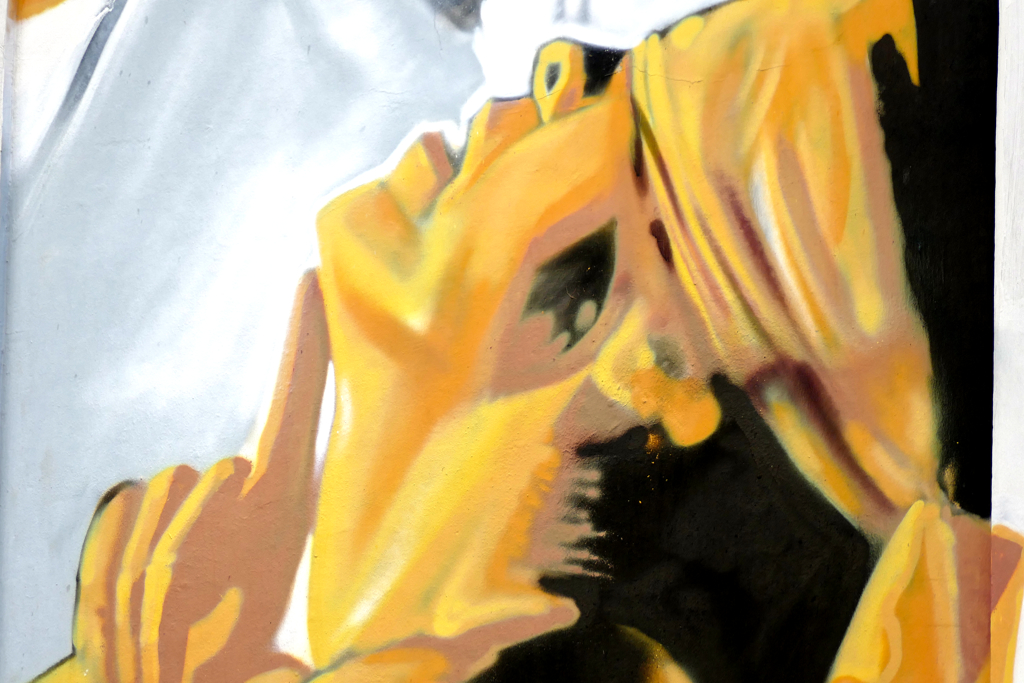
Through his work, Mata blends street art with social commentary in a way that has become emblematic of contemporary Canarian urban art. He continues to engage audiences in meaningful dialogues about identity, culture, and the urban environment.
I’m introducing his works also in the two other sections below, as well as in my posts on Morro Jable in the South of Fuerteventura and Santa Brigida on the island of Gran Canaria.
Diego Mena aka ZEZ608
Diego Mena aka ZEZ608, is a street artist active in Santa Cruz de Tenerife and one of the contributors to the city’s growing urban art movement. Among his best-known pieces is the mural Chicharro Worldwide. In this painting beneath the Serrador Bridge, he blends human figures with fish and birds to evoke the identity of Santa Cruz and its people, whose nickname is chicharreros.
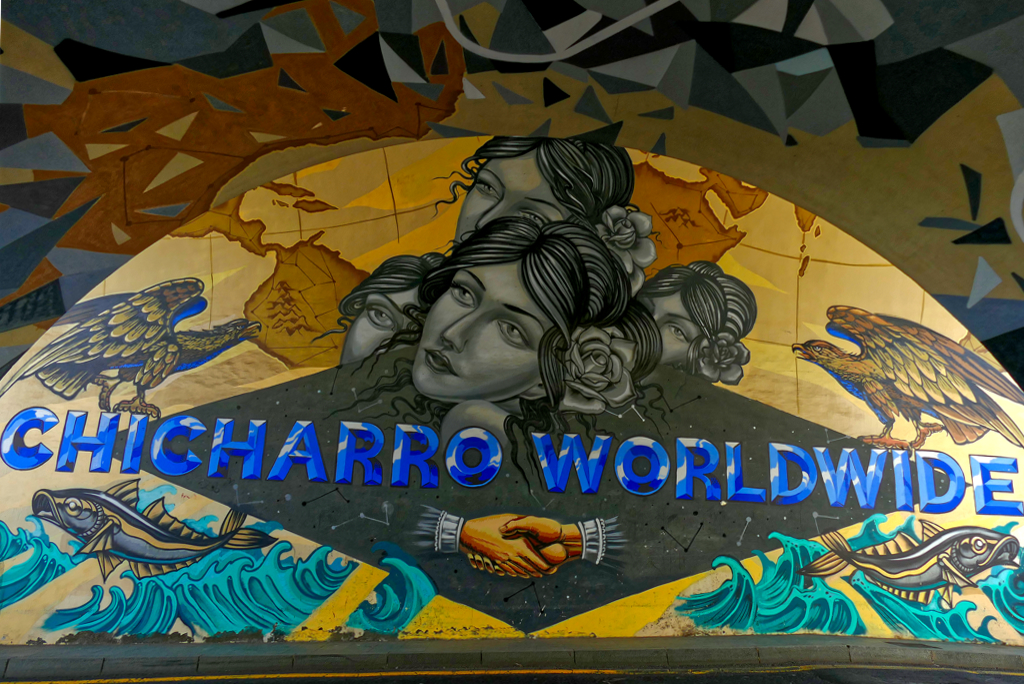
Mena’s style is colorful and figurative, mixing local symbols with playful, imaginative imagery. His murals are designed not only to beautify neglected urban corners, but also to reinforce cultural pride and community identity. While detailed biographical information about him is scarce, his presence in local art projects has made him a recognizable figure in Tenerife’s street art scene.
Puente General Serrador
As a matter of fact, the Serrador Bridge, which spans the Barranco de Santos, has become a unique showcase for urban art. As part of the Sumérgete en Santa Cruz project, several murals have been created beneath its arches. They are turning what was once a neglected space into a vibrant open-air gallery.
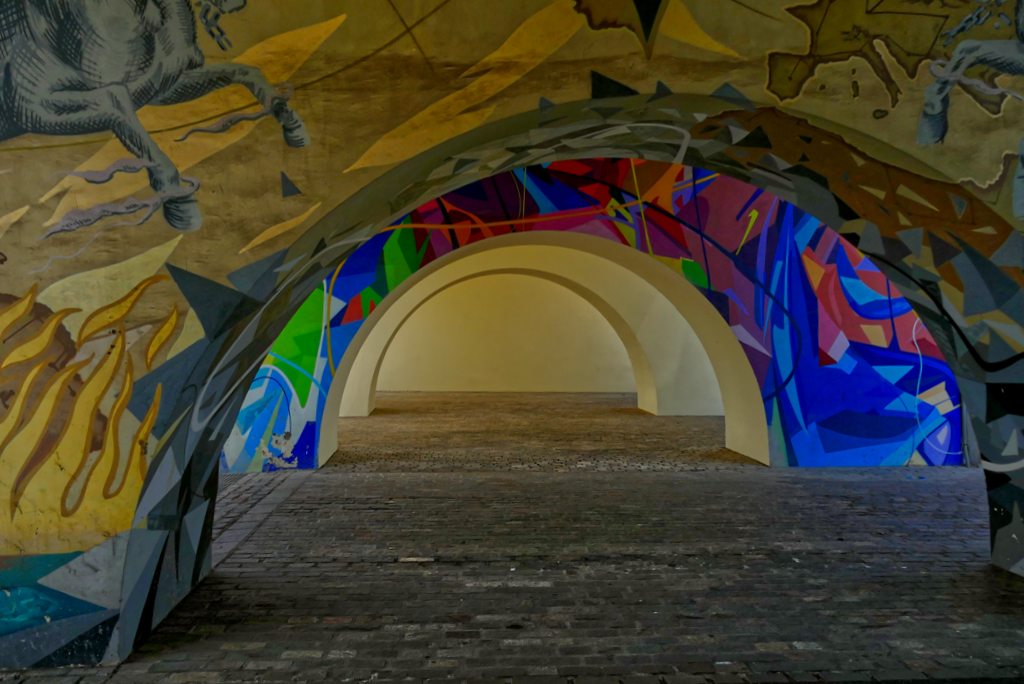
In addition to Diego Mena, Tanausú Alemán, Iker Muro, and Matías Mata aka Sabotaje al Montaje contributed to this art project. I’m introducing Mata above, Iker Muro in the next paragraph, and Alemán in the section on San Cristóbal de la Laguna below.
Iker Muro aka MurOne
In his work, street artist and graphic designer Iker Muro aka Mur0ne blends seamlessly graffiti, illustration, pop culture, and graphic design. Born in Bilbao in 1979, he began his artistic journey in 2002 and has since gained international recognition for his vibrant, large-scale murals.
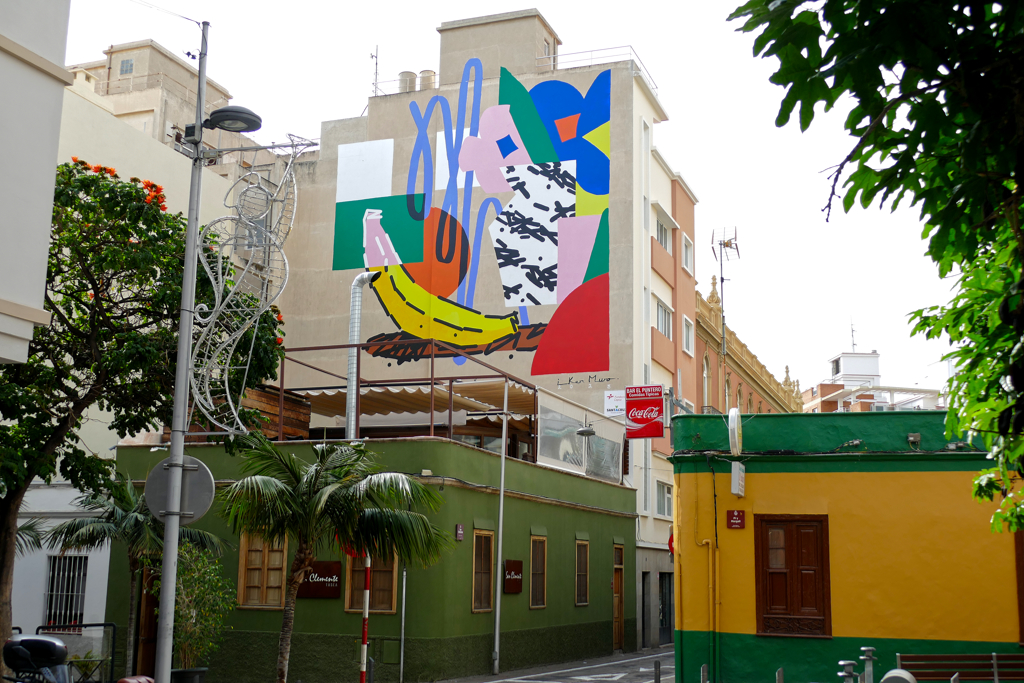
His style is characterized by bold colors, geometric abstraction, and a dynamic interplay of shapes and forms, often drawing inspiration from 1980s graphic design and psychedelic surrealism. His work aims to transform urban spaces, infusing them with energy, optimism, and visual storytelling.
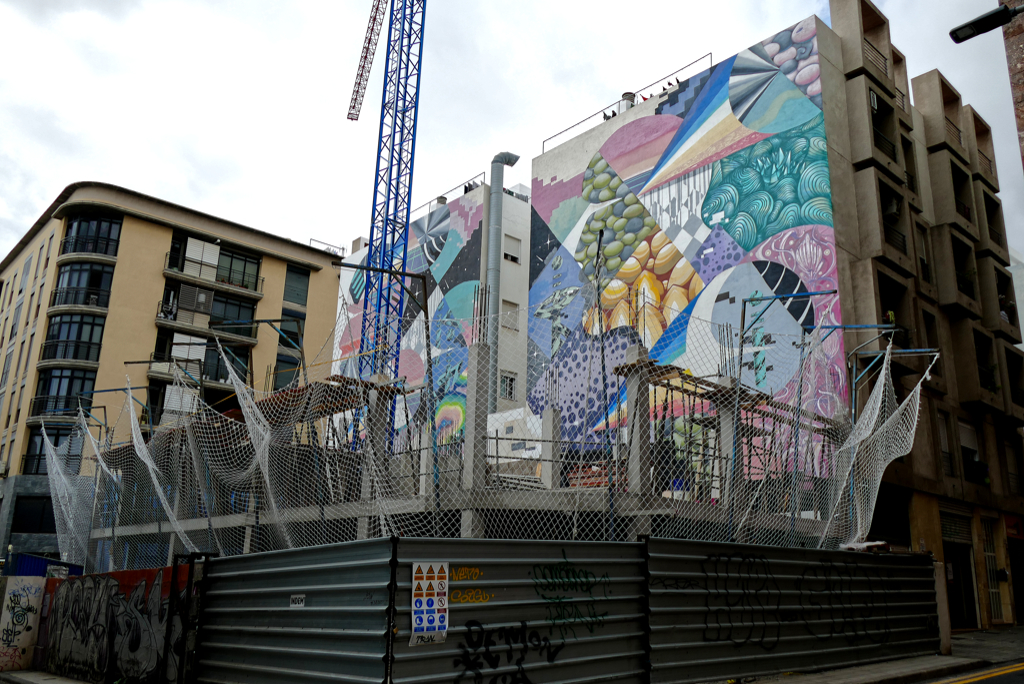
In Tenerife, Mur0ne has made notable contributions to the Sumérgete en Santa Cruz initiative.
However, he has painted murals in cities around the world, including Málaga, Washington, Boston, and Riyadh.
Beyond traditional murals, Mur0ne has also integrated his artistic vision into sports spaces by painting tennis courts and other athletic facilities to merge art with urban life, physical activity and well-being. His work consistently reflects a commitment to engaging with communities and enhancing public spaces through creativity.
Víctor Pacheco aka KOB
Víctor Pacheco aka KOB is a celebrated street artist from Puerto de la Cruz. He began his graffiti career in 1999,. Over the years, his work has developed into a distinctive style of organic abstraction. Influenced by his background in sculpture and installation art, KOB creates surreal compositions featuring invented animals, plants, and fantastical creatures. His murals are known for their vibrant colors and intricate designs.
Through his work, KOB has played a key role in redefining public art in the Canary Islands, making it more accessible and engaging for the community. Today, they are found across Tenerife and cities in mainland Spain.
Txemy
Txemy Basualto is a Chilean-born artist who has made a significant mark on the Canary Islands’ street art scene.
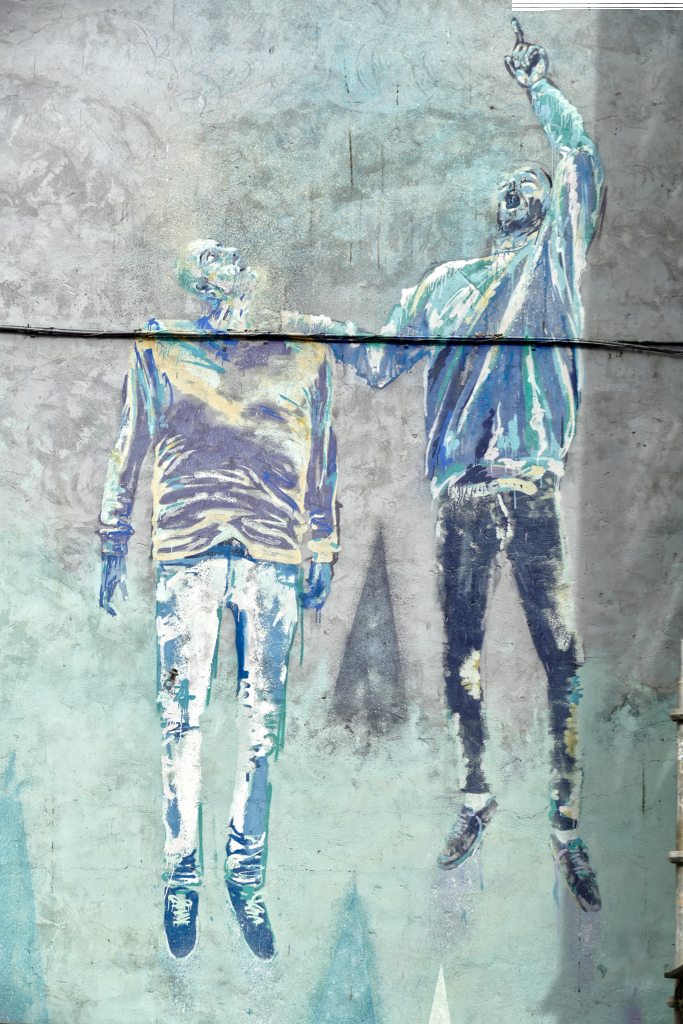
Born in 1981, he moved to Barcelona in 2001. His artistic roots, however, were established early in Tenerife, influenced by his mother, a pattern maker, and his father, who ran a large silkscreen workshop. He began painting in 1994 and entered the Art School in Tenerife at the age of 13. Eventually, he completed his studies at the University of Barcelona.
Txemy’s work initially emerged from graffiti and muralism, characterized by vibrant colors, bold forms, and a dynamic energy that reflects urban life. Over time, his style evolved toward more conceptual, studio-based work. Yet he has maintained the vibrancy and expressiveness that define his murals. He has contributed to Tenerife’s street art landscape with notable works in areas such as Bajamar, La Laguna, and Santa Cruz, obviously.
Txemy’s trajectory bridges street culture and contemporary art, making him a prominent figure both locally in the Canaries and globally. Hence, he has also presented his art in cities like Paris, London, Miami, and New York. In addition, he has collaborated with major brands including Adidas, Nike, Converse, and Ray-Ban.
Shirley Wintsch
Shirley Wintsch, also known as Whirley, is a Spanish-American contemporary artist whose work spans murals, paintings, sculptures, and installations. Initially trained as a civil engineer, she transitioned into the arts, bringing a strong sense of structure and geometry to her practice. Her style often features vibrant colors, geometric abstraction, and luminescent effects. In Santa Cruz de Tenerife, she has contributed to the Sumérgete en Santa Cruz project, obviously.
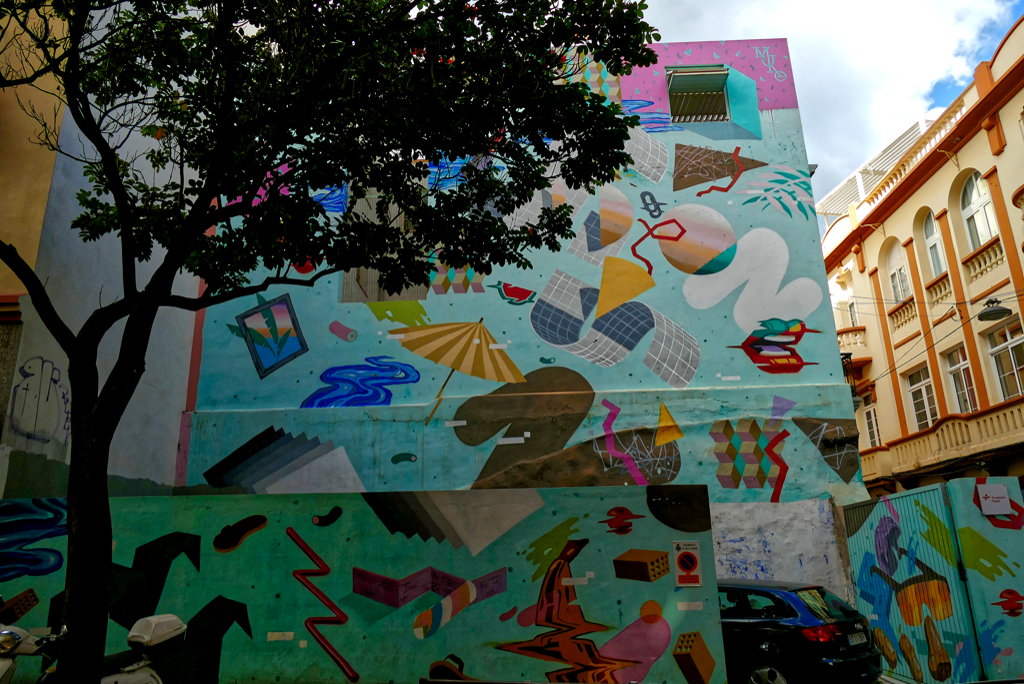
Beyond murals, Wintsch collaborates on mixed-media projects, including resin and plexiglass works. She also has worked with other artists such as PIA Transborda.
San Cristobal de la Laguna
San Cristobal de la Laguna, often simply called La Laguna, is a historic city in the northern part of Tenerife. Actually, it is so close to the capital Santa Cruz that a short tram ride connects both cities.
Founded in the late 15th century, La Laguna was the island’s capital until the 18th century. Today, it is renowned for its well-preserved colonial architecture. Its grid-like street layout actually inspired urban planning in Latin America.
Declared a UNESCO World Heritage Site in 1999, La Laguna is home to the University of La Laguna, which gives it a vibrant cultural and student atmosphere. Its combination of historical charm, bustling streets, and cultural life makes it one of Tenerife’s most important and picturesque cities.
Like everyone else, I came to La Laguna for the historic old core in the first place. However, during my visit, the unexpected amount of powerful street art amazed me right away. Only later did I learn about the awesome urban art projects behind it.
Urban Art Projects in San Cristóbal de la Laguna
Calle Malpei
While La Laguna has a rich artistic heritage, muralism arrived relatively late to the city, and the Calle Malpei project played a key role in introducing it to the urban landscape. It is an urban art initiative which local artist fEO fliP launched in 2017. Its aim was to showcase large-scale murals by both local and international artists and thus, transform the city’s streets into vibrant open-air galleries.
The first edition featured murals by fEO fliP himself and by Ione Domínguez, whom I’m introducing above. In the following years, artists such as Victor Seus, 4CON, Sabotaje al Montaje, DRNUBAH, and Iker Muro contributed works in their personal iconic style.
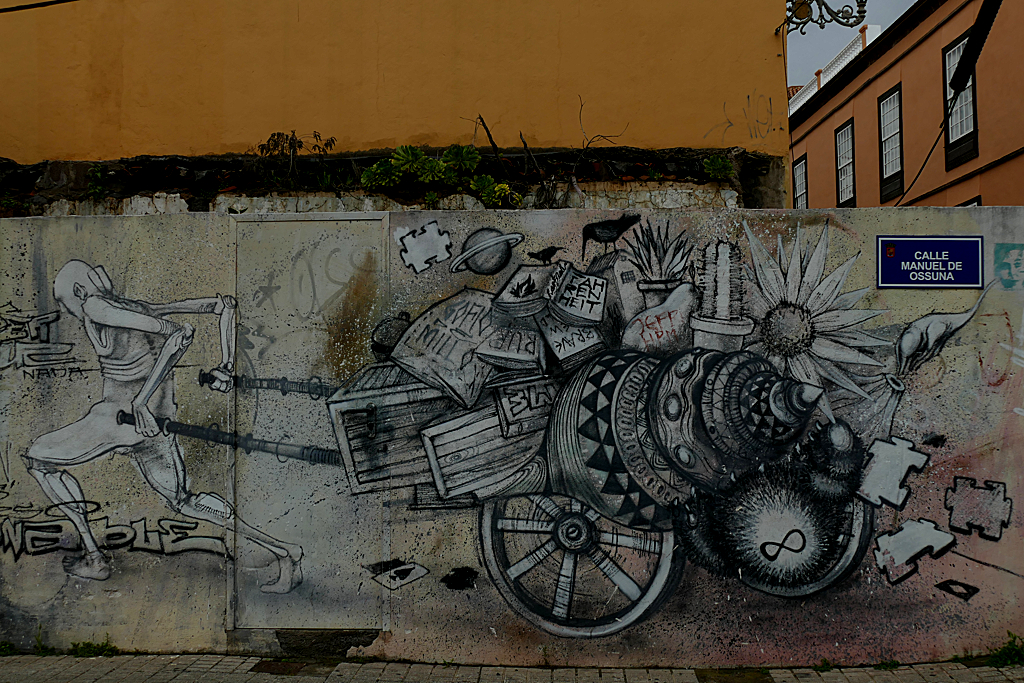
Nevertheless, beyond aesthetics, Calle Malpei has also fostered community engagement. Residents and artists have collaborated through jam sessions, exhibitions, and video projects that document the evolution of the murals. This participatory approach has strengthened the city’s cultural fabric and created a sense of shared ownership over public spaces.
Although meanwhile some of the older murals were later removed, the project has left a lasting mark on La Laguna. It reinforced the city’s reputation as a hub for urban art in the Canary Islands. Calle Malpei continues to serve as a platform for artistic experimentation and community dialogue.
Muros Libres
Another pioneering initiative aimed at integrating urban art into public spaces in a legal and participatory way is Muros Libres. Launched in 2017 by local artists Erik Air and Ayoze Álvarez, the project transforms walls and surfaces around the city into open canvases for graffiti artists and muralists, promoting creativity while reducing unauthorized tagging.
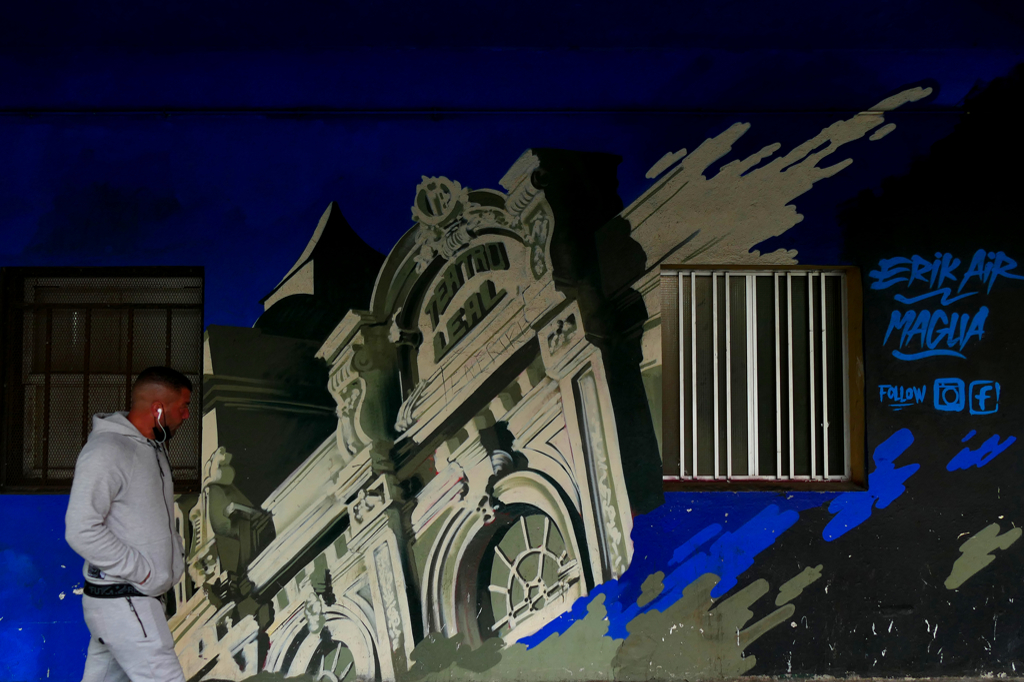
Muros Libres emerged from an agreement between local graffiti collectives and the La Laguna City Council to provide legal spaces for urban art, helping to prevent fines and conflicts. Since its inception, the initiative has contributed to a reported 30% reduction in graffiti-related incidents in the city.
Over the years, the project has designated multiple walls in strategic areas of La Laguna, including Concepción, Trinidad, and around the University of La Laguna. The murals created span a wide range of styles, from abstract graffiti to figurative art, reflecting the diversity and richness of contemporary urban expression.
Beyond aesthetics, Muros Libres serves as a cultural and social platform, allowing artists to communicate messages and ideas to the community. The project also collaborates with educational institutions, enabling the creation of murals in schools and promoting art education among young people.
The Artists
4CON aka ACON
4CON aka ACON, is a street artist whose work has become an integral part of Tenerife’s urban art scene. While detailed biographical information is limited, his murals and collaborations demonstrate a strong commitment to transforming public spaces and engaging local communities through art.
He has contributed to several prominent art projects across the island. In 2021, 4CON worked alongside artists KOB and Tanausú Alemán on a mural for a parking structure in Los Realejos, turning an ordinary urban surface into a vibrant visual landmark. He has also been involved in the Calle Malpei project.
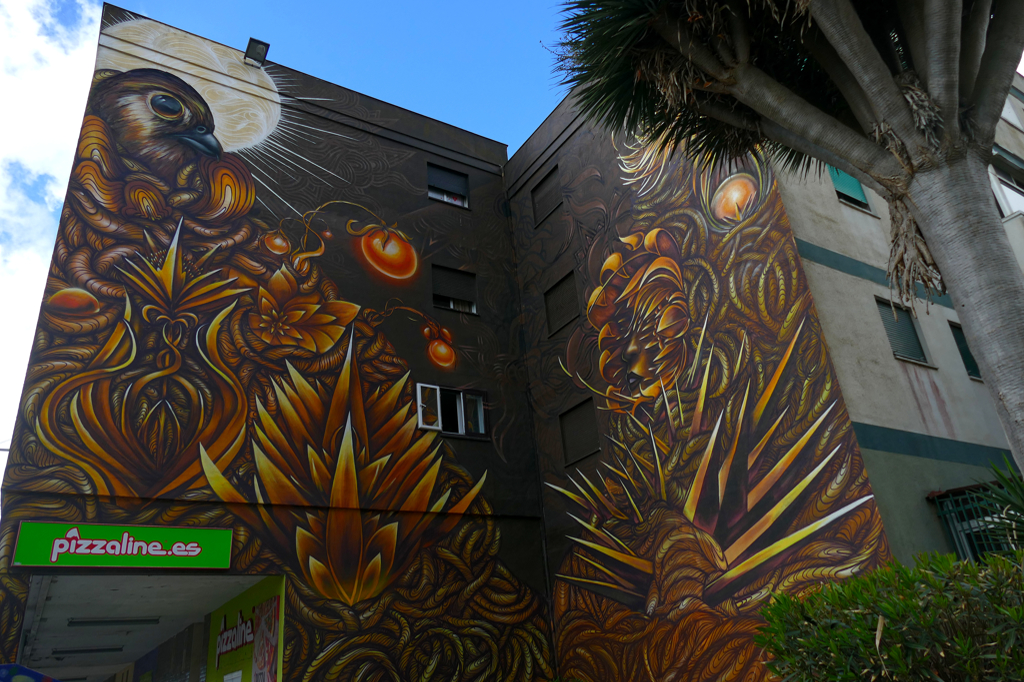
Although his artistic style is not extensively documented, his contributions are characterized by a collaborative, community-focused approach, adding depth and color to Tenerife’s public spaces. Through these works, 4CON plays a role in making urban art accessible, dynamic, and reflective of the island’s cultural identity.
Erik Air
Erik Verstraete aka Erik Air is an artist whose graffiti career began in 2004. Later, he founded the urban art project Muros Libres together with Ayoze Álvarez in La Laguna in 2017. Since then, he has also organized conferences and round table talks, promoting graffiti and urban art around the Canary Islands.
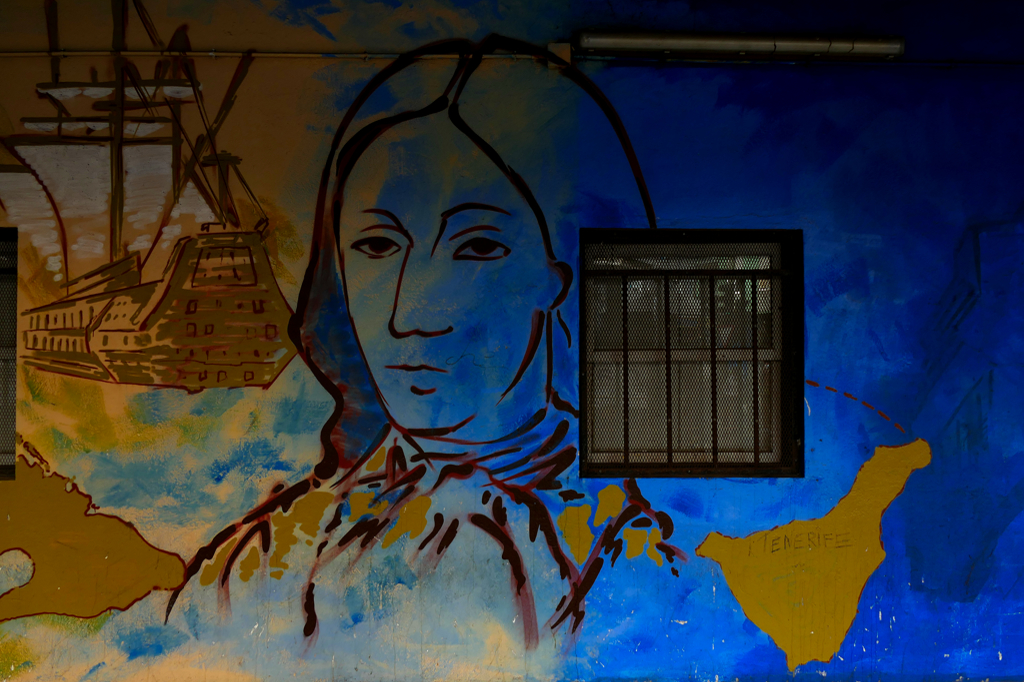
Since 2020, Erik Air has worked as a professional artist in a company specializing in murals. His aim is to create quality murals, obviously. However, he’s also keen on creating jobs within this often belittled field.
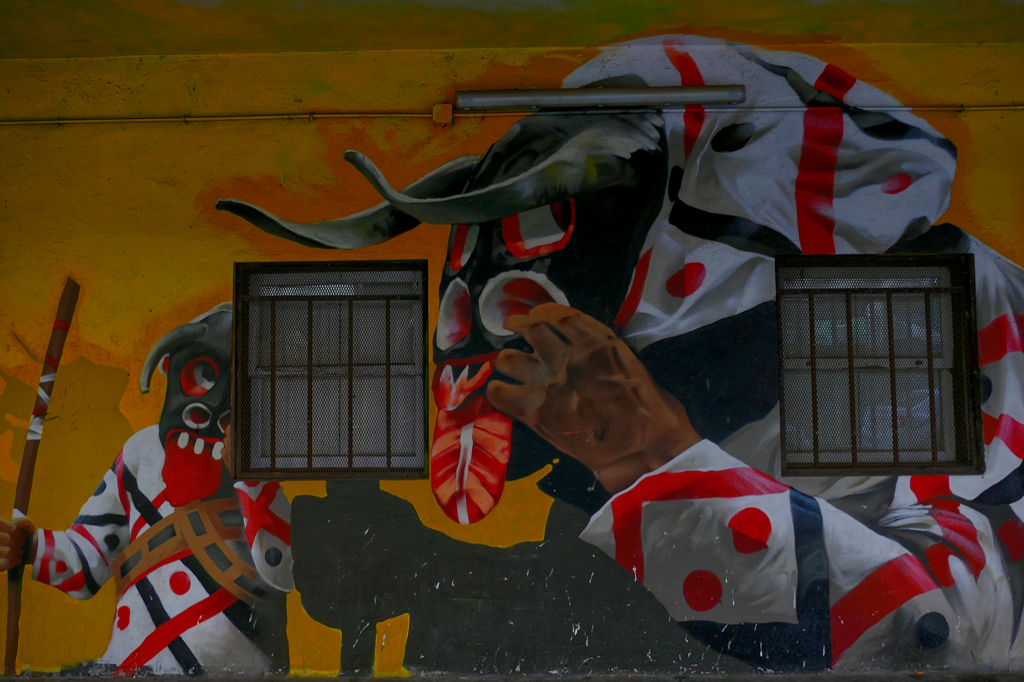
Not all of Erik Air’s works are part of the Muros Libres project. His mural at the arcade in Calle Barcelona celebrates the 18th anniversary of the designation of La Laguna’s old town as a World Heritage Site. It depicts historic moments, iconic buildings, and unique traditions.
Tanausú Alemán
If you are coming to La Laguna by car, you’ll definitely notice the series of paintings next to the Plaza del Adelantado. Very different motives are embellishing an ugly wall right next to the spacious parking lot northeast of the square. Here, three artists contributed different scenes of La Laguna to the compilation Domingo en La Laguna, hence, Sunday in La Laguna. Apart from MurOne, whom I’m introducing in the section on street art in Santa Cruz de Tenerife above, Óscar Lorenzo, a graphic designer and illustrator by trade and an independent artist by heart, and muralist, illustrator, and secondary school teacher Tanausú Alemán, contributed as well.
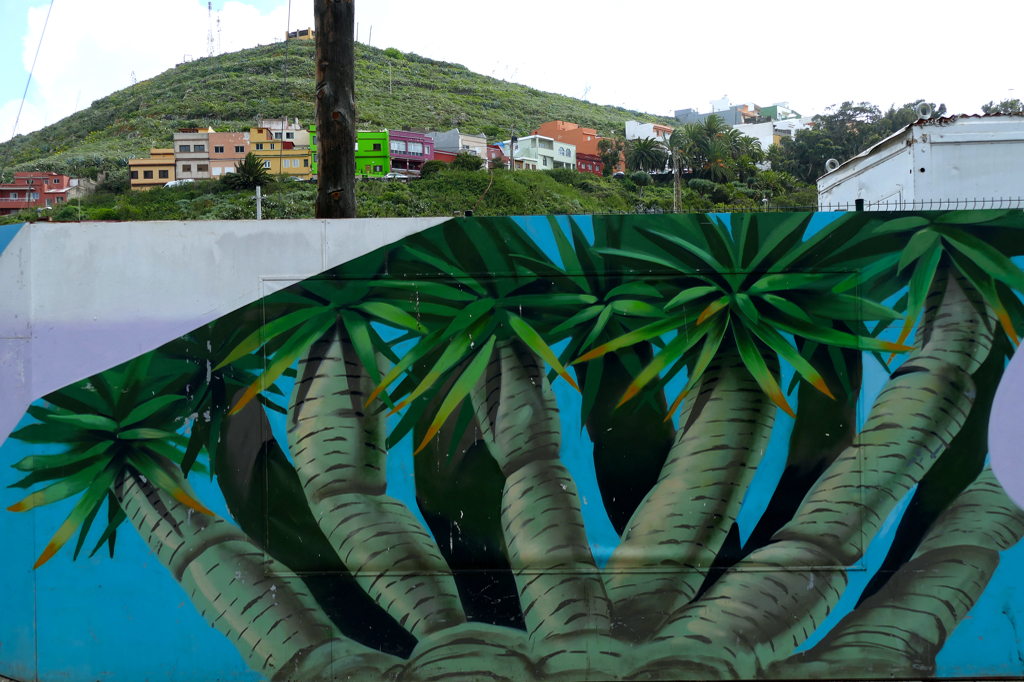
Tanausú Alemán is a street artist whose work has been gaining visibility through public art projects and mural festivals on Tenerife. Trained in Fine Arts at the University of La Laguna, he bridges academic technique with the spontaneity and impact of urban art. His style often gravitates towards portraiture and human figures, marked by vibrant colours, strong volumes, and an expressive use of form.
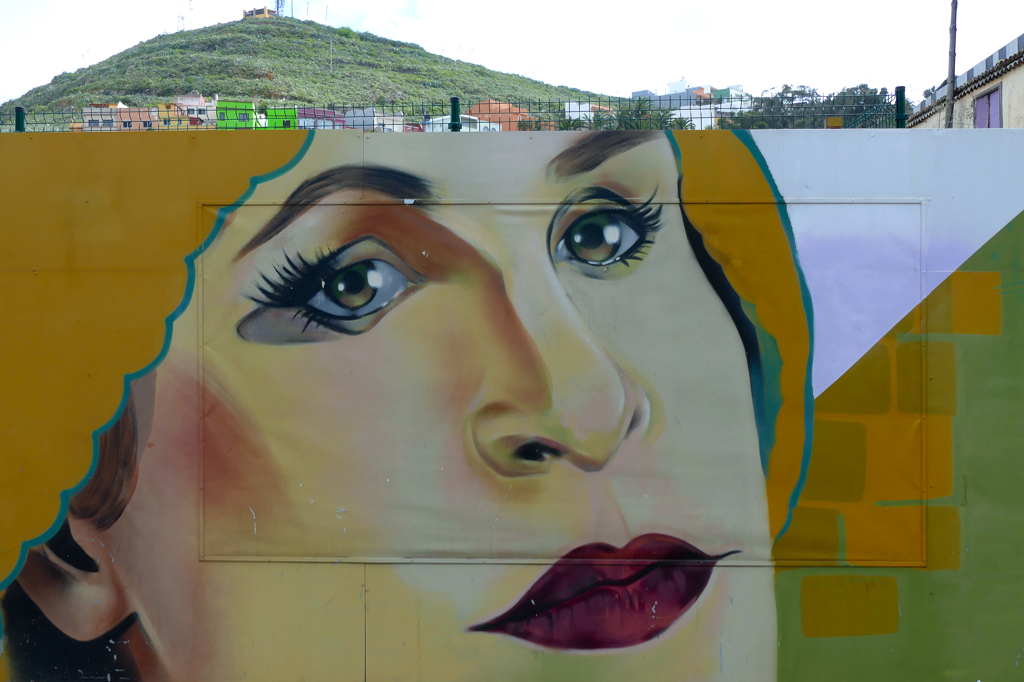
One of his early public projects took place in 2015 as part of Sumérgete en Santa Cruz. More recently, he has participated in the open-air festival 6 of 12 in Los Realejos, further consolidating his presence in Tenerife’s growing street art movement.
Although his body of work is still developing, Alemán is part of a new generation of Canarian artists who use the street as their canvas, transforming public spaces into areas of reflection and creativity. His murals stand out not only for their technical quality but also for their ability to engage passersby in a dialogue between art and the urban environment.
Artist Collective
Just around the corner from 4CON’s mural is a small dead-end alley. Here you’ll see many great murals and graffiti dealing with feminist topics. They are especially related to female migrants. Iris García, Elisa Estévez, Sarah Perdomo, Irene Morales Almeda, Erika Ravelo Mendoza, Alexander Carballo Rodríguez, Martina A. Valero, Itziar Martín Francisco, María García, Manez, Ana Tejera created this hidden gem.
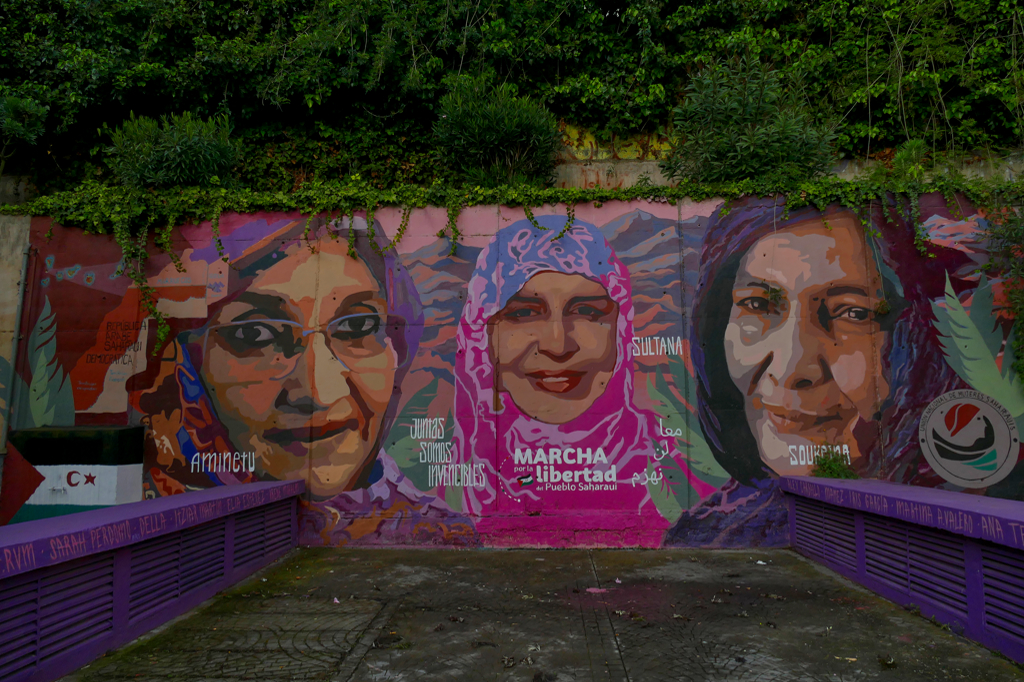
One of the most powerful pieces deals with the Marcha por la Libertad del Pueblo Saharaui, the freedom march for Sahrawi aka West Sahara, referring to the conflict between Morocco and the neighboring West Sahara, obviously.
Faces, a prominent feature of pictorial tradition, are a central element of this mural. Three women are portrayed here: Sukeina, Aminatou, and Sultana. They represent three particular life stories that reflect the lives of many Sahrawi women. A few kilometers from the Canary Islands archipelago, they are exposed to occupation and war. A brief look at their biographies reveals much about this struggle and its impact on Canarian society and the Spanish state as a whole.
DRNUBAH
DRNUBAH is a street artist whose work stands out for its dynamic, expressive style that blends graffiti, surrealism, and elements of social commentary. Obviously, he has also contributed to major projects such as the Calle Malpei festival.
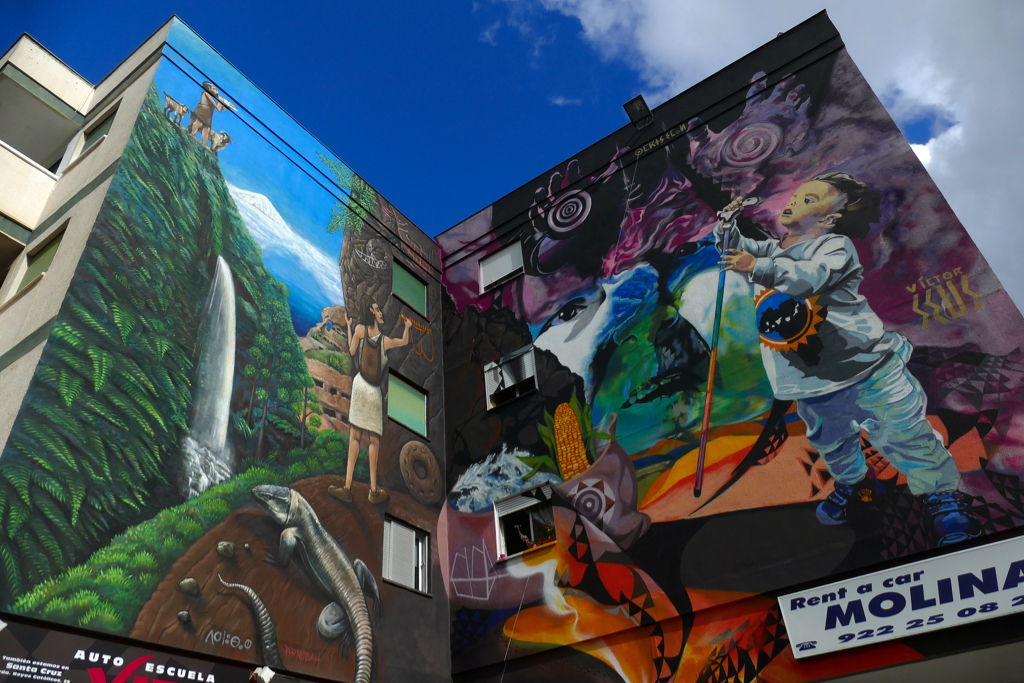
Through his work, DRNUBAH engages both the local community and wider audiences, emphasizing the potential of urban art to activate neglected spaces and spark dialogue.
His murals often combine bold lines, intricate details, and a fusion of organic and geometric forms. DRNUBAH also contributed to the murals under the Puente General Serrador in 2019.
fEO fliP
Fran Feo aka fEO fliP is a multidisciplinary street artist primarily active in Tenerife and Lanzarote. Emerging in the late 1990s, he began his journey in street art at a time when urban art was not widely recognized. Therefore, he was first working clandestinely with chalk, markers, and spray paint in abandoned spaces.
In the early 2000s, however, fEO fliP co-founded the collective Chinijos del Millo. This crew was engaging in social artivism through street theatre, performance, and graffiti. Between 2005 and 2011, he lived in Barcelona, Galicia, and the Greek city of Thessaloniki. There, he continued his artistic practice within the squatting movement. Nevertheless, he also studied Fine Arts at the University of Barcelona and completed an Erasmus program at Aristotle University of Thessaloniki.
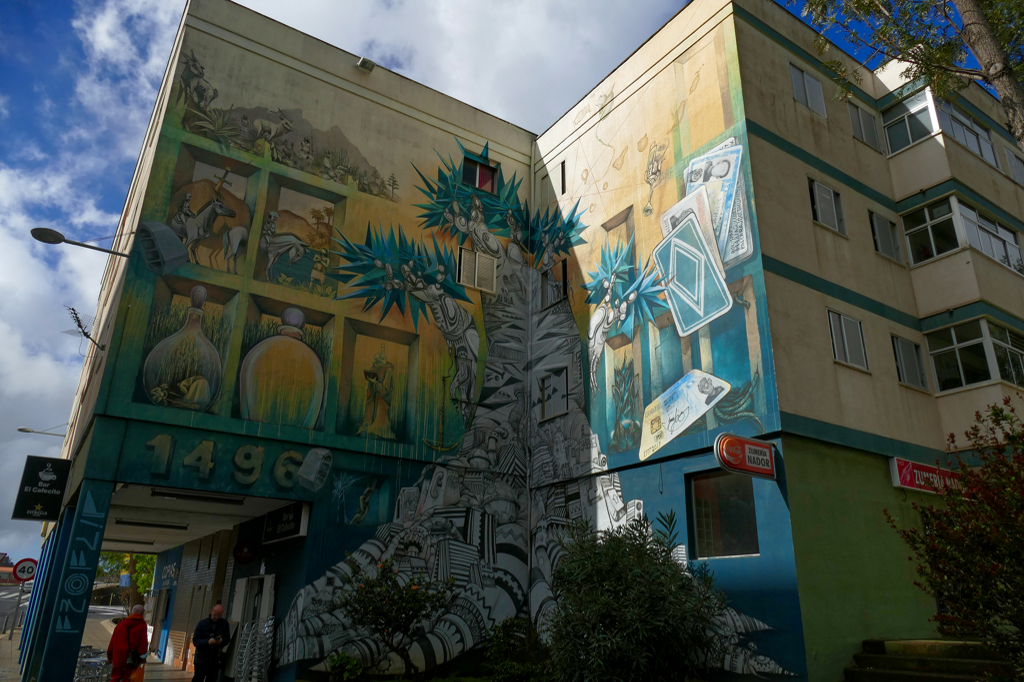
fEO fliP’s work combines elements of nature, robotics, history, symbolism, and recycling. His imagery is often infused with a bittersweet, almost acidic tone.
In 2017, fEO fliP initiated the Calle Malpei urban art project, which has become a key platform for street art in Tenerife ever since. In addition, his work has been exhibited across Europe and Latin America in cities such as Barcelona, Thessaloniki, Fortaleza, Salvador de Bahia, and Rio de Janeiro.
Matías Mata aka Sabotaje al Montaje
Of course, the omnipresent Matías Mata, aka Sabotaje al Montaje, couldn’t be missing from this street art project. As a matter of fact, his contribution is one of my favorite works in Tenerife.
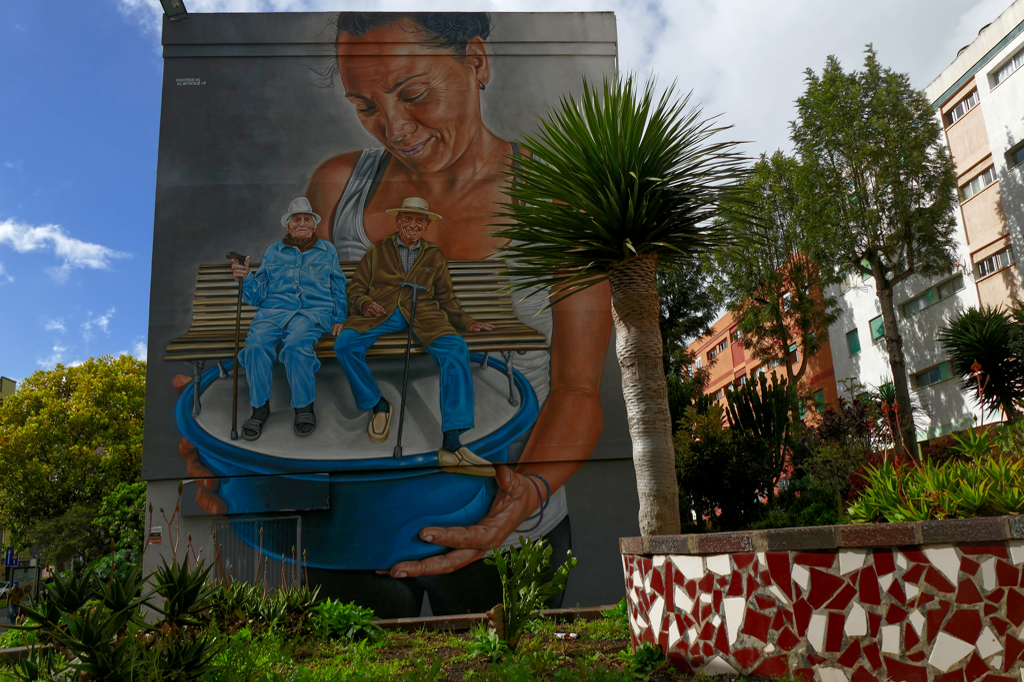
I introduced Matías Mata aka Sabotaje al Montaje in the section on street art in Santa Cruz above, and you’ll find another one of his amazing portraits in the section on street art in Puerto de la Cruz below.
Víctor Seus
In his work, multidisciplinary artist Víctor Seus bridges urban art, pedagogy, and social activism. Emerging from the island’s hip-hop culture in 1999, he began his artistic journey through graffiti and rap. However, he later earned a Fine Arts degree from the University of La Laguna in 2009, with further studies in Granada and Lisbon.
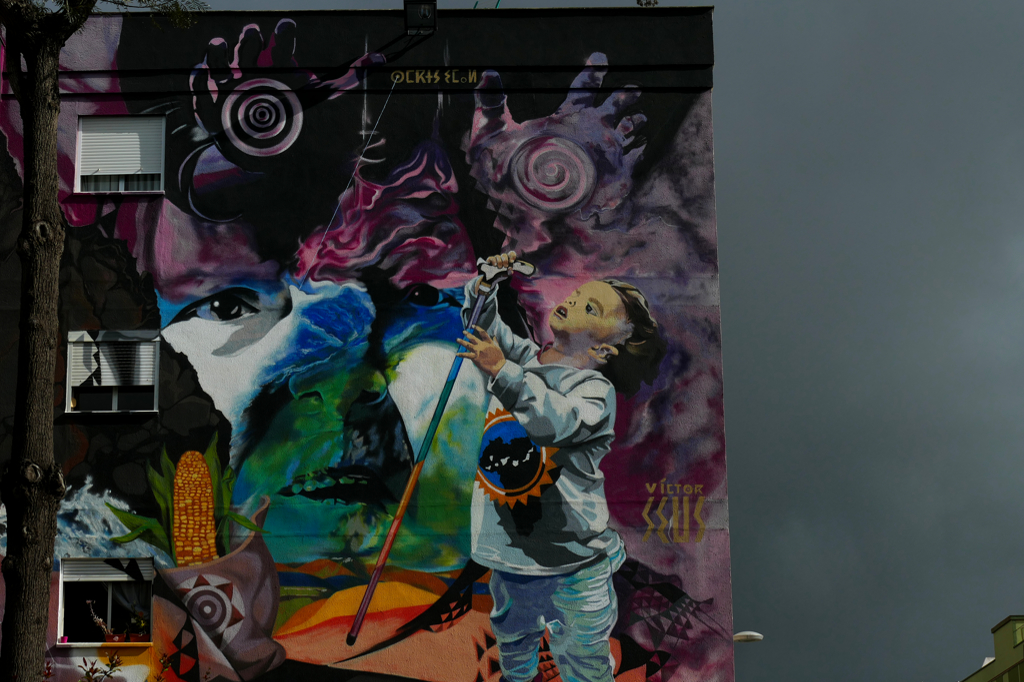
Seus’s work is characterized by its participatory approach. He often involves local residents in the creation of urban art. This engagement fosters a sense of ownership and strengthens community ties.
Beyond Tenerife, Seus has extended his practice internationally.
Throughout his career, Víctor Seus has remained committed to using art as a tool for social engagement and cultural connection, demonstrating how public art can inspire, empower, and unify communities.
Víctor Sues still lives in Tenerife. You can see another one of his amazing works in the section on street art in Puerto de la Cruz below.
Puerto de la Cruz
Way back in Tenerife’s early years of tourism, the former fishing village Puerto de la Cruz was apparently destined to become this major mass tourism resort. Sadly, in some spots, merciless planners succeeded so that the town has to endure some of those horrific, soulless high-rising prefab buildings. But as mass tourism finally moved mostly to the south coast, Puerto de la Cruz got somehow stuck between its old charm and the ugly remains from the second half of the 20th century. It remained in a peculiar limbo between idyllic beaches and striking urban art. There is the old and the new, the borrowed and the blue – all in all, Puerto de la Cruz is a place of many contrasts
Sadly, the most prominent buildings in Puerto de la Cruz are those horrific skyscrapers built in the soulless style of the 1970s. You notice them first since they are so high. But as you walk around town, turn corners into narrow streets and stay as close to the water as possible, you’ll discover Puerto de la Cruz the way it must have been before the tourists flocked in.
You’ll walk through alleys lined with low, humble, at times a bit crooked houses. But you’ll be pleased with how colorful they are. Behind some of them, on higher façades, you’ll spot bold murals.
Urban Art Project in Puerto de la Cruz
To my delight and that of many other visitors, the urban art project Puerto Street Art was launched in 2014.
It is an urban art initiative that has transformed the city into a living open-air museum that focuses on revitalizing the historic La Ranilla neighborhood through large-scale murals by internationally renowned artists. The local Office of Culture and Urban Planning coordinates the project. It emphasizes the role of art and active civic participation.
The murals by internationally renowned street artists combine realism, surrealism, and cultural references, creating a certain bohemian atmosphere. Obviously, the project not only beautifies the townscape but also strengthens the connection between residents and their cultural heritage. Walls and public spaces become canvases documenting the history and identity of Puerto de la Cruz.
Visitors can explore the murals on self-guided walking tours. Maps are available at the local contemporary art museum, but I also created a map, which you can find at the end of this post.
The Artists
Victor Ash
Victor Ash is truly über-European: Born in Paris in 1968, he currently lives in Copenhagen – but paints basically around the world. Following his first exhibition in 1989, his work has been exhibited in many places, including Berlin, London, New York, and Tokyo.
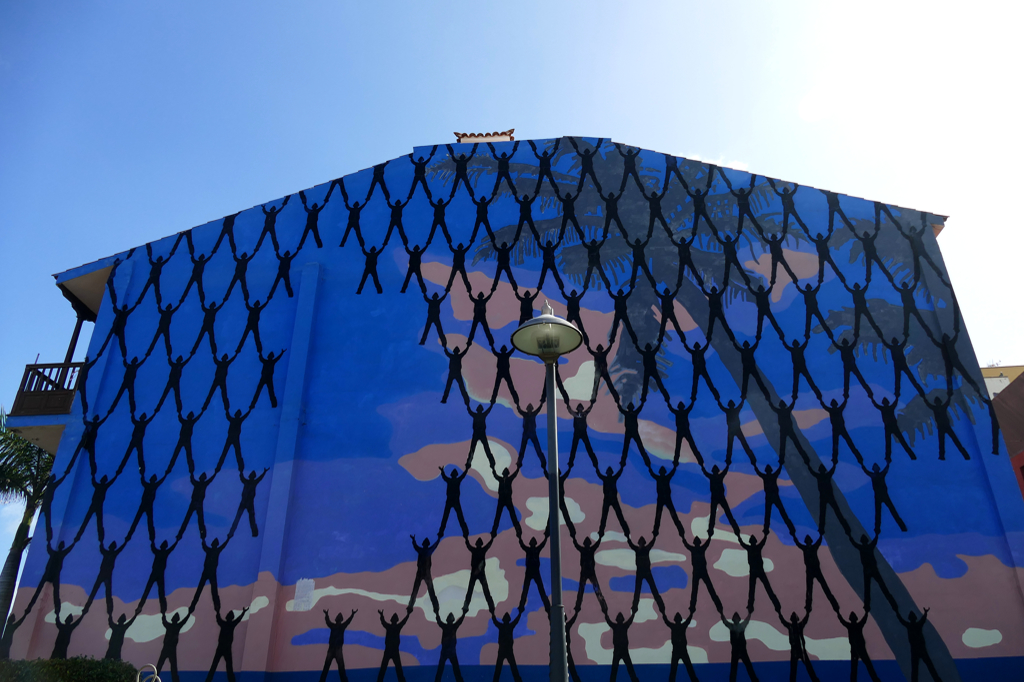
In his mural in Puerto de la Cruz, he shows how a human mesh closes the way to freedom and prosperity for the less fortunate ones through economic constraints and social prejudices. It comes as no surprise that this mural was created back in 2014 in the heyday of mass immigration to Europe. I’ve introduced other murals by Victor Ash in my posts Best Street Art in COPENHAGEN: The Open Air Gable Gallery in Nordvest and Street Art in SEVILLE: Arte Para Todos in the San Pablo District.
Miguel Ángel Belinchón Bujes aka Belin
I’m delighted to introduce another excellent mural by Miguel Ángel Belinchón Bujes aka Belin. I’ve introduced him in my post on the Best Street Art in Málaga where I even chose his homage to Picasso as the heading picture.
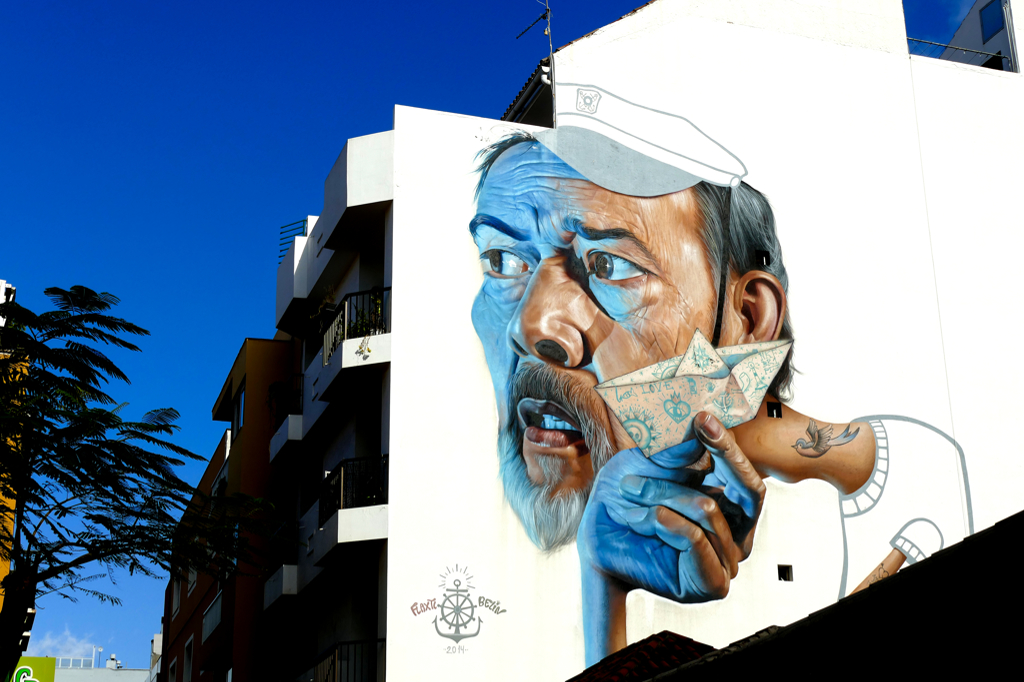
Belin is an artist from the city of Linares. Today, most of his paintings and sculptures are presented in galleries around the world. However, his work derives from urban art. It’s a steady dichotomy between tradition and contemporary. This applies to the motives as well as the techniques.
Interestingly, in his urban art, Belin connects hyperrealism with surrealism and neo-cubism.
fEO fliP
fEO fliP, one of Tenerife’s most creative sons, also left one of his complex, elaborate works of art on a wall.
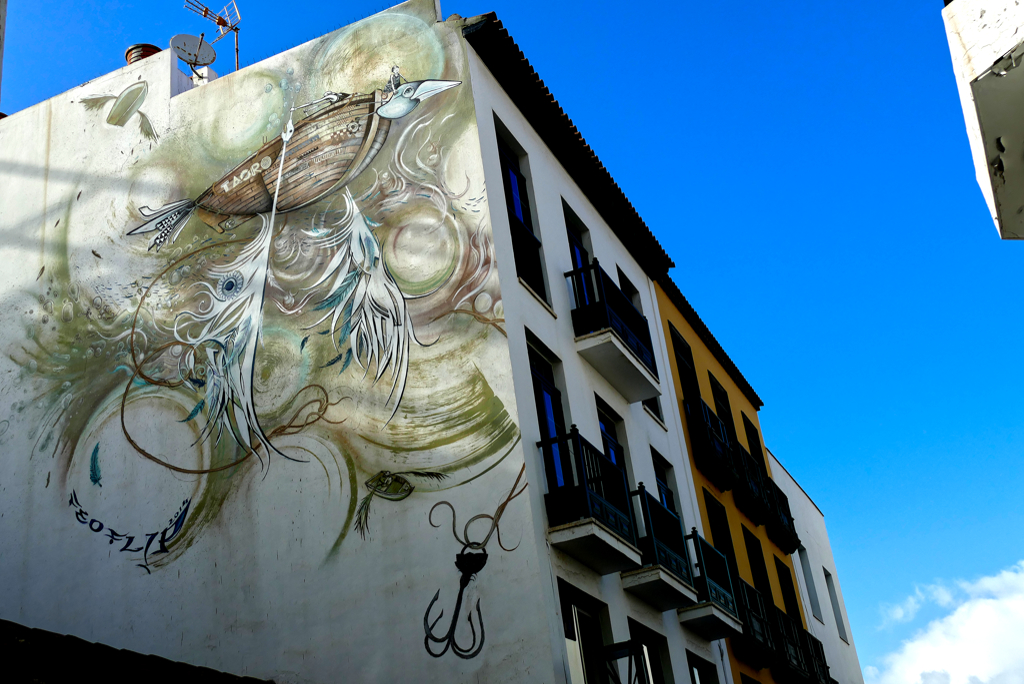
I introduce fEO fliP in detail in the San Cristóbal de la Laguna segment above.
Liqen
Liqen was born in 1980 in the Galician city of Vigo. He has gained international recognition for his intricate and surrealist murals.
His style is marked by meticulous linework and a fascination with natural forms. Many of his pieces merge human and animal elements, creating a sense of harmony between species while also carrying subtle social and environmental messages. Liqen’s murals can be seen as artistic expression and commentary.
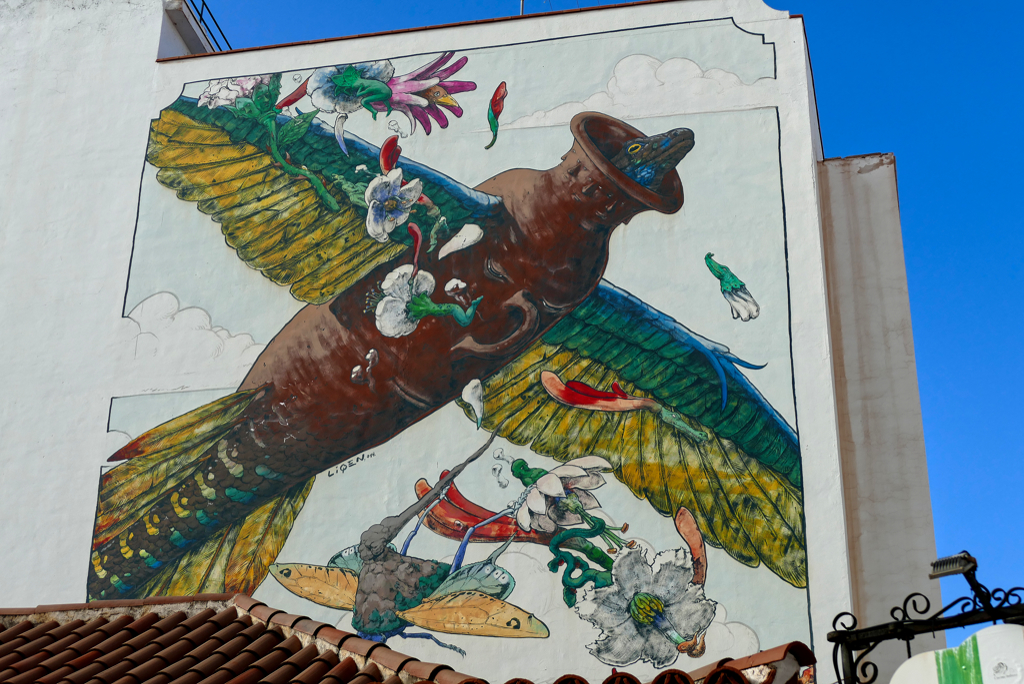
Liqen has painted murals across Spain, Italy, Mexico, and Morocco. Also, his work has also been exhibited in galleries such as the Arthobler Gallery in Porto and featured in various street art festivals.
Through his distinctive combination of technical skill, imagination, and environmental consciousness, Liqen has established himself as a street artist who not only captivates visually but also provokes thoughtful reflection on the natural world and humanity’s place within it.
I introduced Liqen’s iconic blue cat mural in my post Best Street Art in Porto.
Matías Mata aka Sabotaje al Montaje
Obviously, Matías Mata aka Sabotaje al Montaje also contributed to Puerto de la Cruz’s amazing open-air gallery.
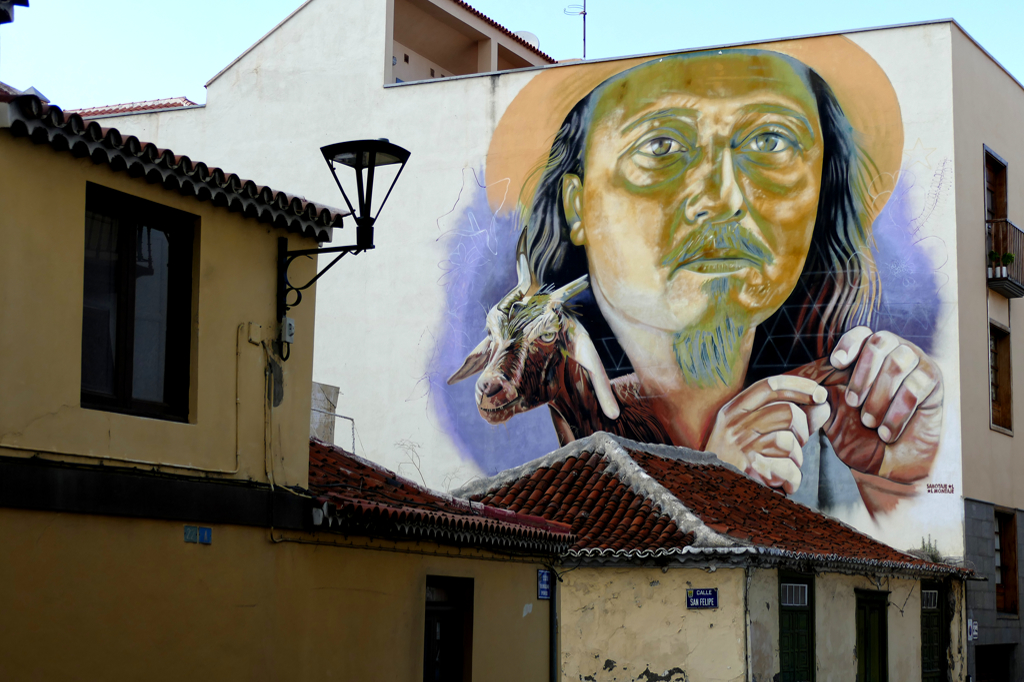
I introduced Matías Mata aka Sabotaje al Montaje in the section on street art in Santa Cruz above, and you’ll find another one of his amazing portraits in the section on street art in San Cristóbal de la Laguna.
Oakoak
Now we’re getting to French urban artist Oakoak. Born in Saint-Étienne he has been converting the streets into his canvas since 2006. What sets Oakoak apart is his ability to creatively interact with everyday urban elements—like cracks in walls, street signs, or bent poles—turning them into whimsical, comic-inspired scenes and ingenious pieces of art. As he transforms zebra crossings, bollards, and even a simple crack in a wall into an amazing sculpture, he also paints a smile on the bypassers’ faces.
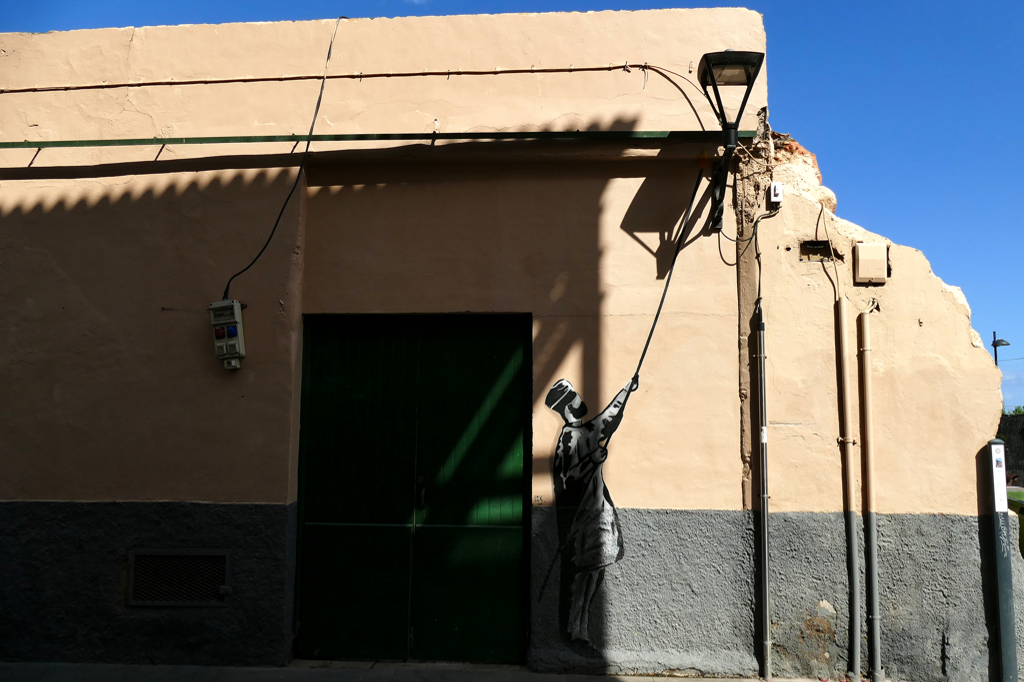
His work often draws on pop culture, including cartoons, video games, and superheroes, adding a lighthearted touch to the urban landscape. Using minimalistic drawings and clever placements, Oakoak surprises passersby with little moments of joy. A crack in the sidewalk might become a superhero’s battleground, or a bent pole could transform into a cartoon character, making ordinary streets feel magical.
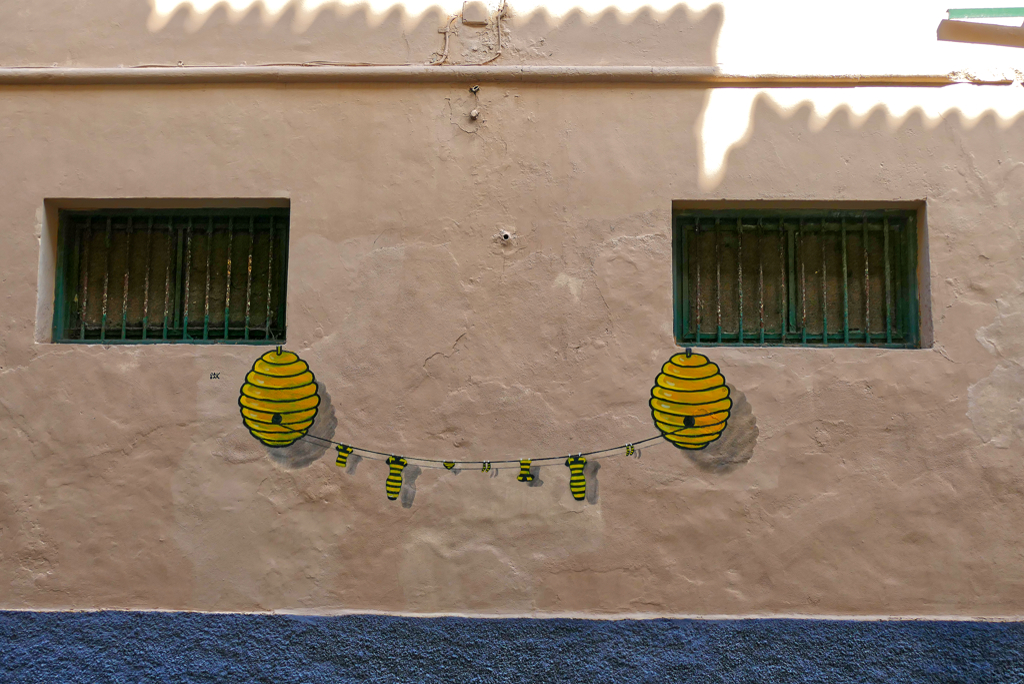
Since his works were shown in several solo and group exhibitions around Europe and North America and are featured in two books, Puerto de la Cruz can be very lucky to have a couple of his quirky pieces around town.
Víctor Pacheco aka KOB
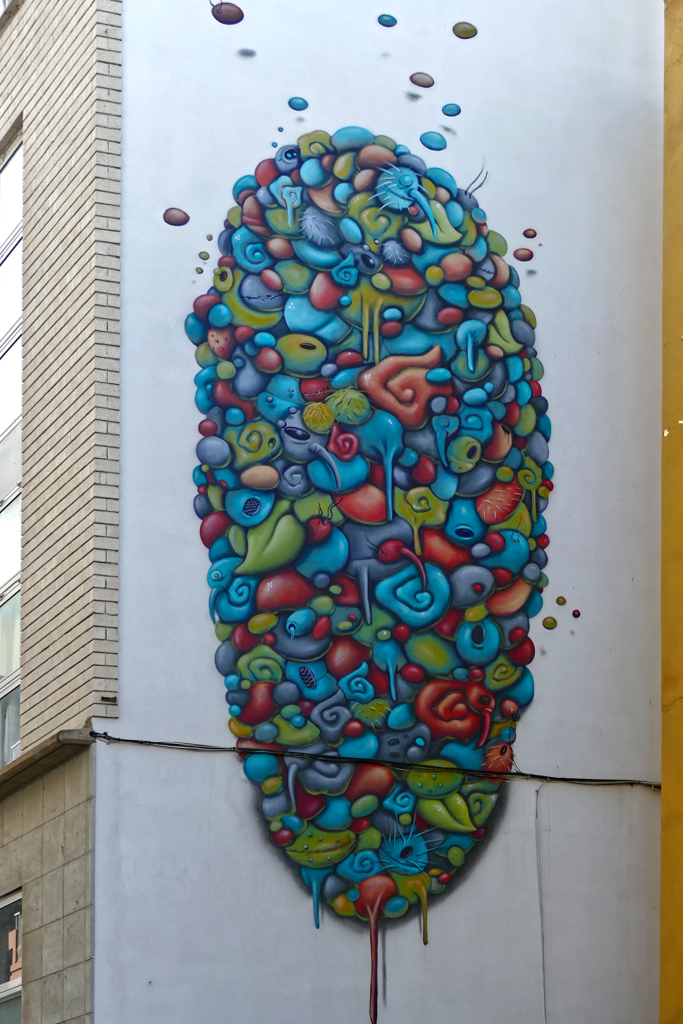
KOB is one of those great artists whose work you can identify as soon as you see it.
I introduced Víctor Pacheco in more detail above in the segment on street art in Santa Cruz de Tenerife.
ROA
If you have read some of my former posts on urban art, like for instance the one on Málaga or the one on Berlin, Mr. ROA is an old friend of yours.
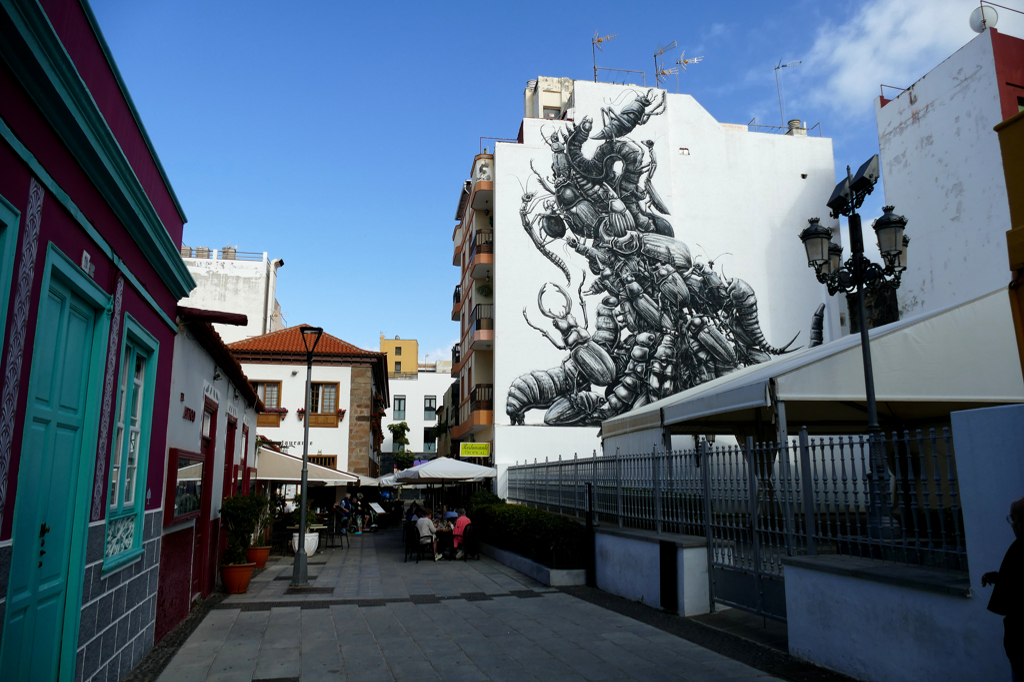
ROA is an enigmatic muralist from Ghent. His love for music, particularly hip-hop, pulled him towards graffiti. Like many muralists, he began by illegally spraying bridges and walls.
Today, ROA is mainly known for rodents, but also birds and other animals. He paints them, including the skeleton and intestines, which makes them look even more realistic. While he first painted buildings and walls in his hometown, you’ll find his distinctive pieces in black and white not only throughout Europe, but worldwide. So make sure to look for it, for instance, in Berlin, London, Madrid, New York, Paris, and Mexico City, to name just a few.
ROA insists on remaining anonymous in order to keep his work independent and his spirit unburdened. I’ve introduced other murals by Victor Ash in my posts Best Street Art in BERLIN, Best Street Art in MALAGA, and Best Street Art in PARIS.
Martin Ron
Martin Ron is an urban artist based in Buenos Aires, the capital of Argentina. In his hometown, he has decorated many facades with his larger-than-life murals.
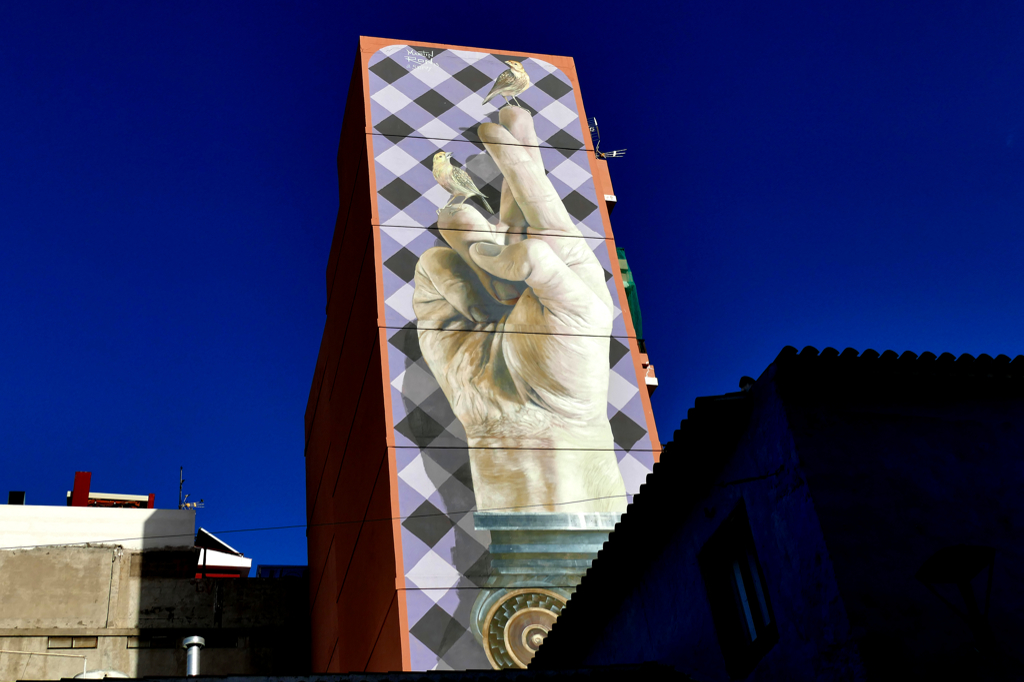
Although painted in a hyper-realistic fashion, his pieces often include dreamy and fictitious segments. Being a renowned street artist, basically around the globe, Martin Ron contributed a lovely piece to Puerto de la Cruz’s murals – paying tribute to its people.
Raul Ruiz aka El Niño de las Pinturas
Raúl Ruiz aka El Niño de las Pinturas was born in Madrid but grew up in Granada. That’s also where he eventually studied fine arts.
The most important features in his works are human figures. He’s highlighting their facial expressions such as fear, astonishment, sadness, or even impudence.
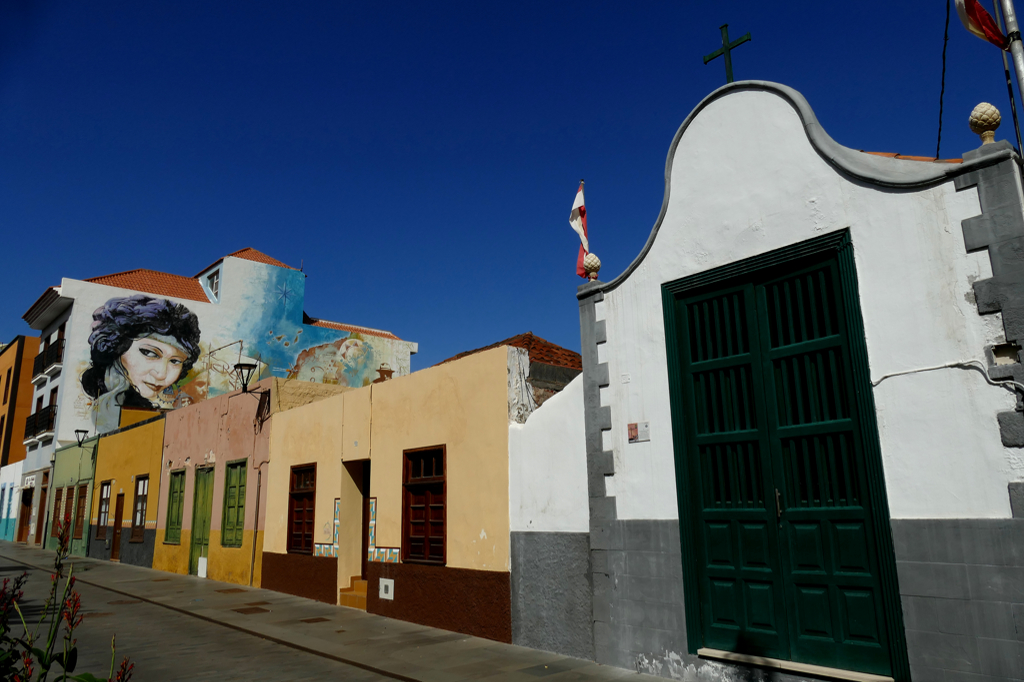
In his mural La Fuerza está en las Raíces, Ruiz combines the passion of feelings with poetry and quotes so gripping that no one remains oblivious.
Raúl Ruiz’s style is not fashionable graffiti, his goal is true street art. I’ve introduced some of his work in the post Street Art in SEVILLE: Arte Para Todos in the San Pablo District.
Juliana Serrano
Just like some other artists I’ve introduced above, Juliana Serrano not only paints walls but also people. Will say she has a tattoo studio in her hometown Puerto de la Cruz. Well, art is art, am I right?
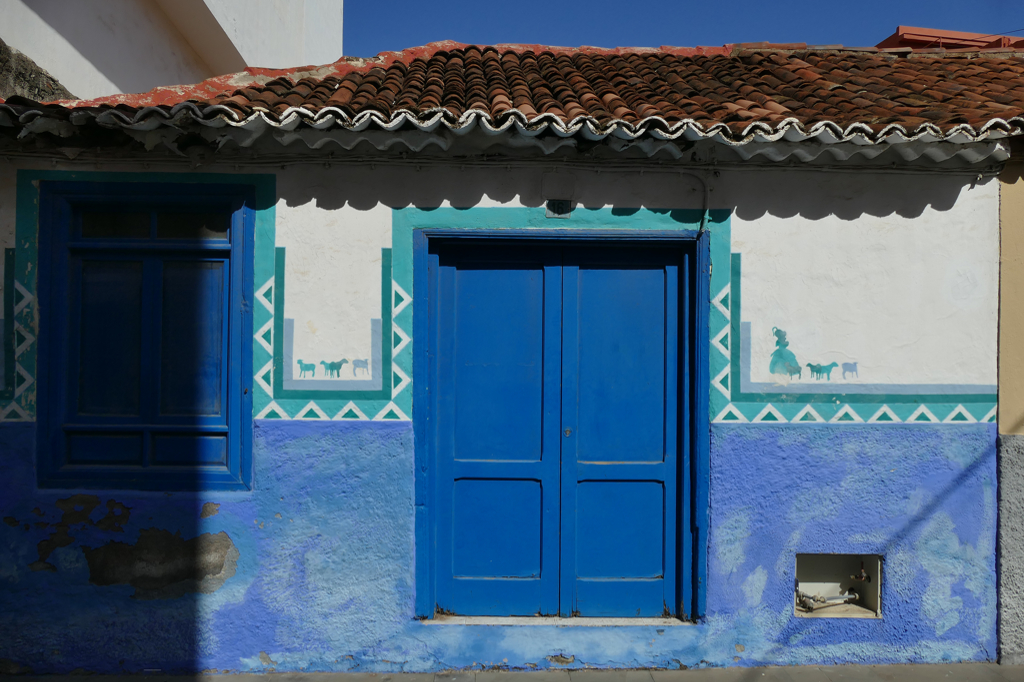
The bright colors of the houses lined up along the narrow streets of the La Ranilla neighborhood are truly outstanding. But what makes them extra special and true pieces of art are the tender patterns and little paintings you find mainly around the doors and the windows.
Serrano doesn’t choose these designs willy-nilly. Actually, her fine decors are inspired by the inhabitants’ personal story, their nickname, and other individual features.
Víctor Seus
Canarian artist and political activist Víctor Seus contributed a powerful mural dealing with the culture and heritage of Puerto de la Cruz.
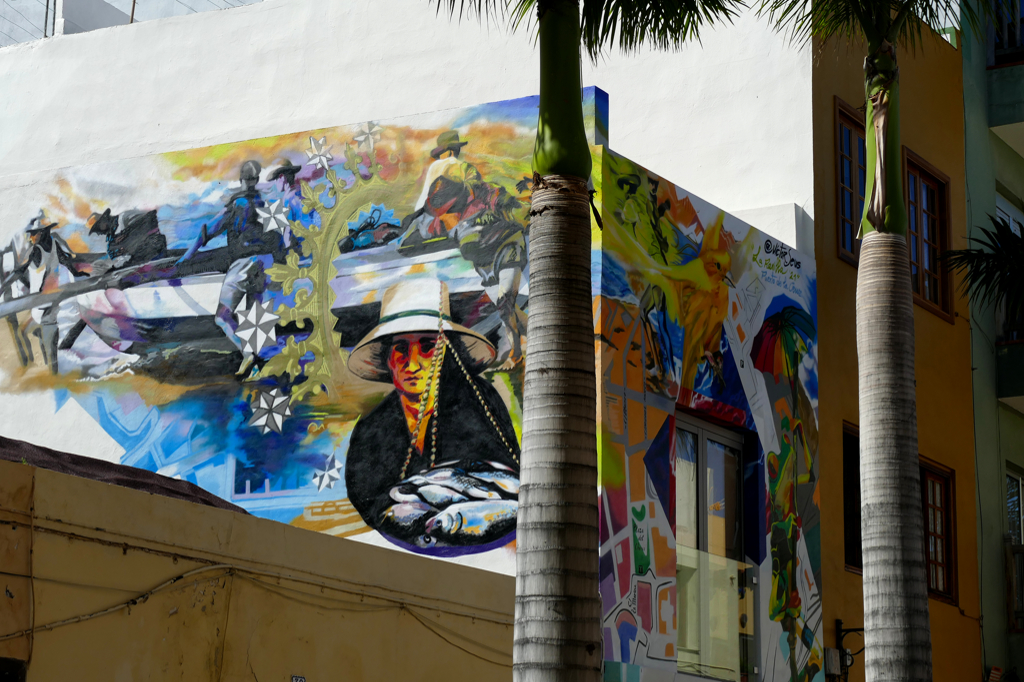
I introduced Víctor Seus in the section on street art in San Cristóbal de la Laguna above.
Sebas Velasco
So, I’m fond of street art and I love hyper-realist paintings. Sebas Valesco, born in the Spanish city of Burgos in 1988, combines both. As a matter of fact, looking at some of his larger-than-life portraits that he created in many places around the world, my heart skips a beat. His way of capturing individuals stricken by faith just doesn’t leave room for oblivion.
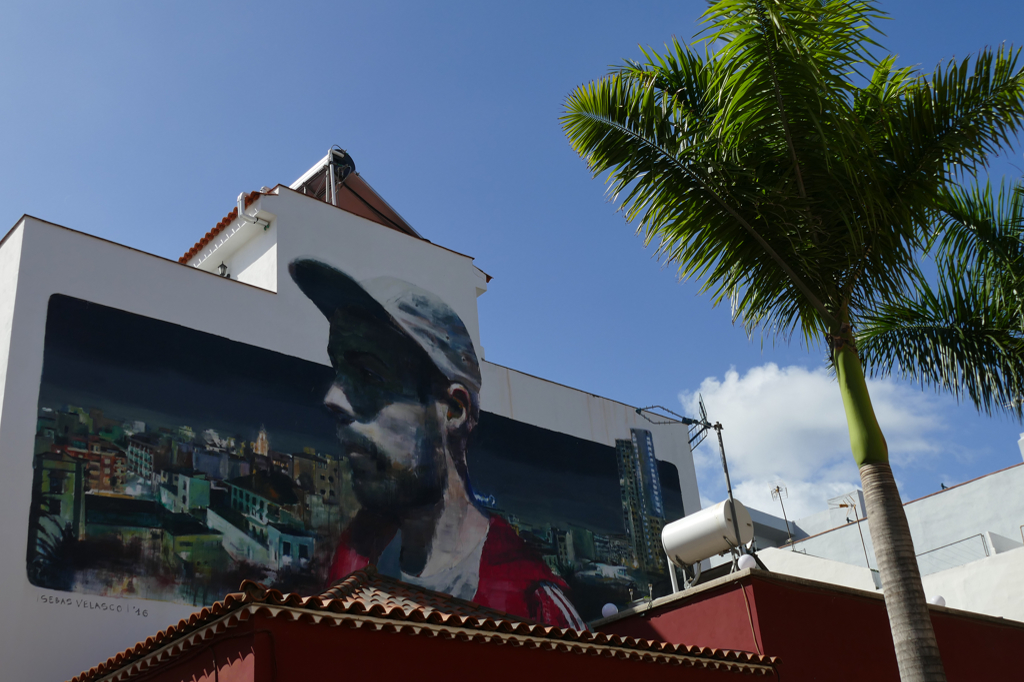
His piece Rebellion of the Dreamers shows a young man lost in an urban landscape. This dreamer searches for a way of dealing with the influence of foreign tourists on the development and traditions of his home, the Canary Islands.
Silvia Watercolor
Silvia Watercolor says she is addicted to creativity, to the harmony of shapes and colors, but also to the simplicity of complex things and everything that allows her personal world to thrive. She loves to inspire others to feel through art.
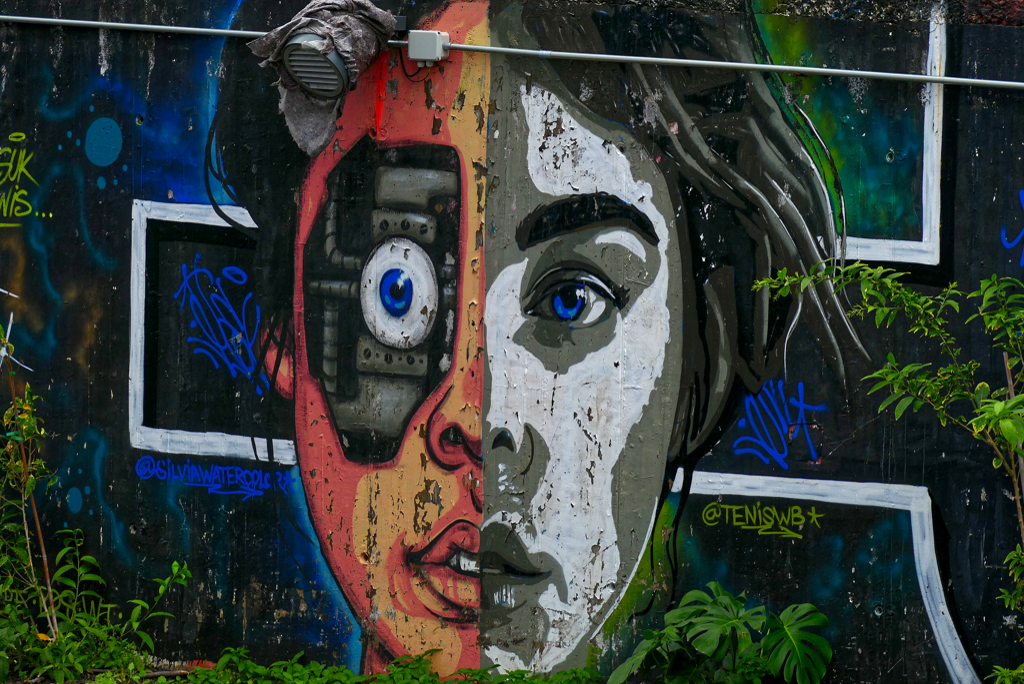
Nevertheless, very down-to-earth, she holds a degree in design and illustration from the Fernando Estevez School of Art and Design in Santa Cruz de Tenerife. After working as an
illustrator and graphic designer in Santa Cruz de Tenerife for ten years, she has been working in the same profession on the Spanish mainland in Málaga since 2015.
On Instagram
Just like in my previous posts on street art, I list the Instagram accounts of the artists featured in this post below. Unfortunately, not all have accounts, so some are missing:
| 4CON | @4c0n_/ |
| Erik Air | @erik_air/ |
| Tanausú Alemán | @tanausua/ |
| Victor Ash | @victor.ash.studio/ |
| Miguel Àngel Belinchón Bujes | @belin.es |
| Carmen Cologán | @carmencologan/ |
| Ione Dominguez | @ionedominguez/ |
| DRNUBAH | @drnubah/ |
| fEO fliP | @feoflip/ |
| Luis Eduardo Fierro | @luiseduardofierro69/ |
| Liqen | @liqen/ |
| César Manrique | @cesar_manrique_lanzarote/ |
| Matías Mata aka Sabotaje al Montaje | @instagram.com/sabotajealmontaje/ |
| Iker Muro | @mur0ne/ |
| Oakoak | @oakoak_street_art/ |
| Victor Pacheco aka KOB | @kobtropikal/ |
| ROA | @roa.streetartbelgium/ |
| Martin Ron | @ronmuralist/ |
| Raúl Ruiz | @elninodelaspinturas/ |
| Juliana Serrano | @artemucha_uma/ |
| Víctor Seus | @social_shaker/ |
| Txemy | @txemy/ |
| Sebas Velasco | @sebasvelasco1/ |
| Silvia Watercolor | @silviawatercolor/ |
| Shirley Wintsch | @whirleytimes/ |
How to Get Around
Exploring Tenerife by public bus is very easy and highly recommended. You spare yourself the terrifying narrow roads in the mountainous hinterland. You don’t need to look for a parking spot in cities like Santa Cruz de Tenerife. It’s comfortable, it’s reliable, it’s cheap – what’s not to like?
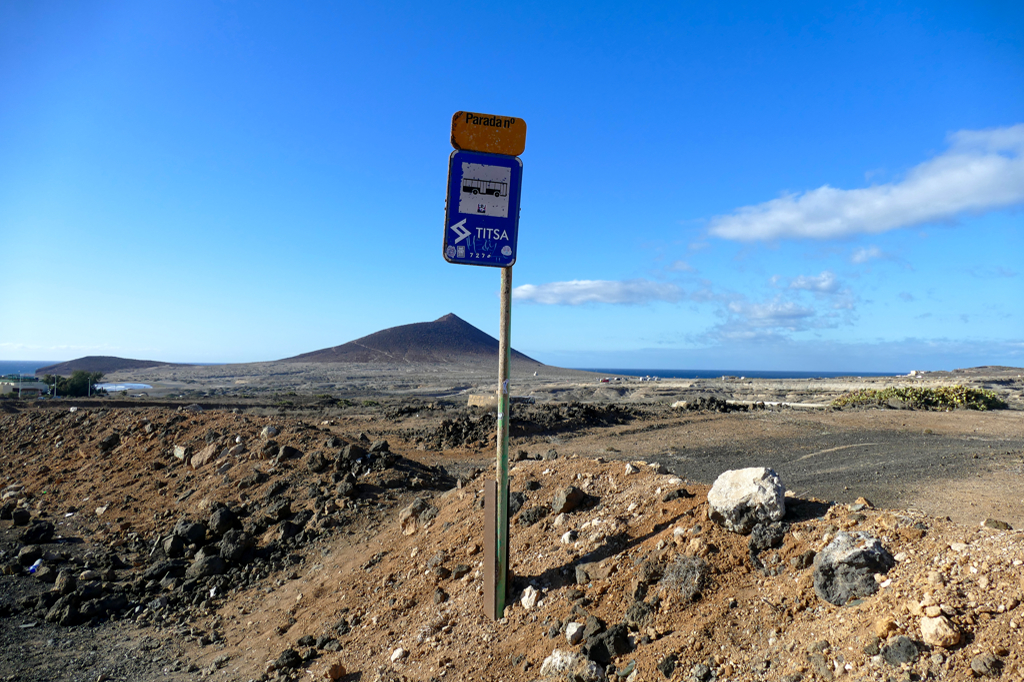
To take the bus, you can always obtain a ticket from the driver. Prices depend on the distance, obviously, and you can pay cash or by a bank card that’s equipped with NFC. You save 10 percent of the single ticket price if you buy a round-trip for the same day.
TITSA, the local bus company, has a great website where you’ll find all the connections, prices, and everything you need for an easy trip. There is even a section that’s especially catering to tourists.
Discounts and Deals
Now I’ll introduce some travel passes that are great for frequent travellers. To obtain all these passes, you need to get a ten+ chip card that you then charge. This card costs 2 €uros and you’ll get it at ticket machines and bus stations. Since you also charge them there, this is not such a biggie.
If you plan on travelling to a distant place or various times in one day, a Travel Card for one day might be your best bet. Starting with the first use, it’s valid for 24 hours for unlimited trips in buses and trams all around the island.
If you intend to travel a lot during your stay, you can obtain this Travel Card for seven consecutive days, and then it costs only 50 €uros, hence a bit over 7 €uros per day.
Note that both options are also available in the ten+ App.
If you travel only from time to time, you can charge your ten+ card with an amount of up to 100 €uros and then conveniently pay for all your trips with it. I used to charge mine with 20 €uros. Since the machine on the bus shows you the remaining credit on your card, you’ll always know when a recharge is necessary.
One Last Tip
Since taking the bus is such a great way to get around, many people do so. Therefore, you should make sure to be at the station at least ten to fifteen minutes before departure. Also, you shouldn’t just linger but stand in a queue, or possibly start one.
Map
This map should help you find the murals I’m introducing in this post. Clicking on the slider symbol at the top left or the full-screen icon at the top right will display the whole map, including the legend. The map is divided into three individual layers, which allows you to see murals in one specific city at a time. To switch between maps of the three individual places, just open the legend in the upper left corner, and you can hide or unhide the respective layer as you wish.
Impressive Street Art was only one of the amazing things I got to see on my visit to the island of Tenerife. To learn also about the other Canary Islands, check out my post ISLAND HOPPING in the CANARY ISLANDS, where you’ll find further valuable information that will make your own trip much smoother and thus, more enjoyable. Also, my post SPAIN – A Complete Travel Guide will help you prepare for your visit to the Iberian Peninsula as well as the Spanish Islands.
Pinnable Pictures
If you choose to pin this post for later, please use one of these pictures:
Did You Enjoy This Post? Then You Might Also Like These:
Best STREET ART in PALMA de MALLORCA
Best Street Art in MALAGA
Best Street Art in ROTTERDAM, Part 2: South of the Nieuwe Maas
Best Street Art in RIGA
One Day in NÎMES – What Not to Miss in the Most Roman City of France

Best Street Art in ROTTERDAM, Part 1: North of the Nieuwe Maas
Guide to PUERTO DE LA CRUZ – a Town Full of Contrasts
Best Street Art in CHELTENHAM
* This is an affiliate link. If you book through this page, not only do you get the best deal. I also get a small commission that helps me run this blog. Thank you so much for supporting me!