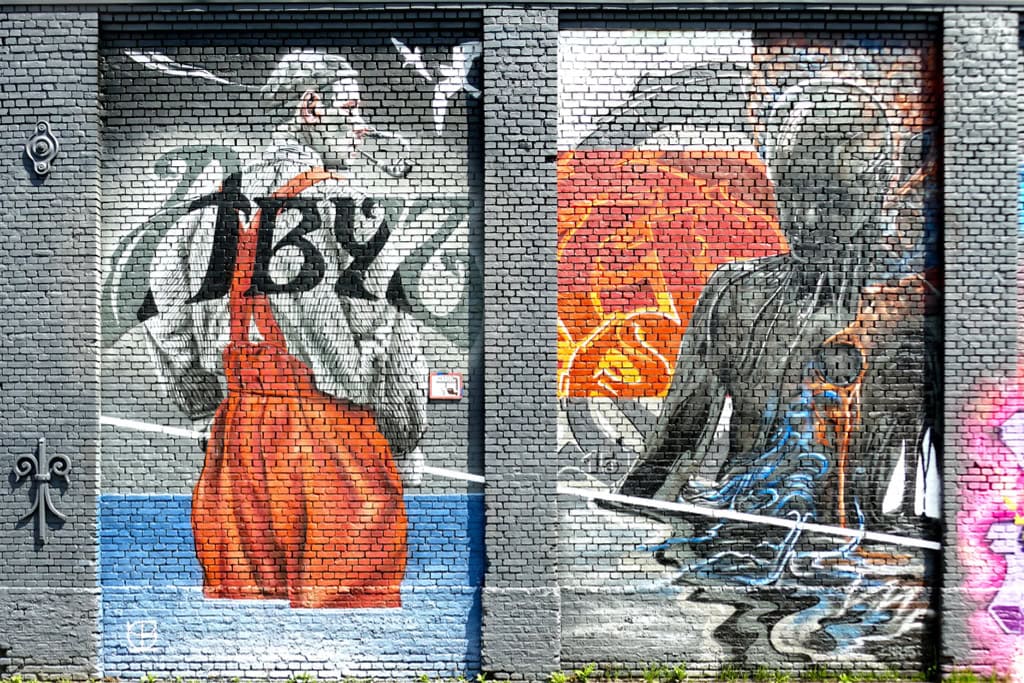
Anyone entering the area around Zomerfabriek in Antwerp’s Berchem district immediately feels its unique vibe. Where the old Nieuw-Zurenborg gasworks burned tons of coal until the mid-20th century, the blaze of top-notch urban subculture now glows brightly. I was lucky enough to visit Antwerp in early summer as the annual Meeting of Styles festival takes place. Hence, I saw the new works almost before the paint had even dried. Therefore, I can present you with the best street art currently adorning the walls of the Zomerfabriek.
And let me tell you: these murals are fresh in every sense of the word!
Zomerfabriek – Where Vibrant Creativity Hits Raw Brick
The Zomerfabriek in Antwerp’s Berchem district boasts a multifaceted history, which began as a municipal gasworks in 1900. For the following approximately 60 years, the site along Minckelersstraat served as Antwerp’s energy supplier. At its peak, it comprised three large gasometers. Active gas production finally ceased in 1960. In the following decades, the site’s function changed fundamentally. The halls were subsequently used solely for storage, workshops, and administration.

A new era began in 2008 when the City of Antwerp purchased the entire site and entrusted it to the Zomer van Antwerpen cultural project. Gradually, the old, soot-stained factory halls opened up to theater groups, artists’ studios, and rehearsal spaces. Then, the permanent summer cultural program was established under its current name in 2014. It’s become a cool, urban spot with a bar, live concerts, and workshops ever since. However, the absolute highlight of this transformation takes place every year in early summer. Since 2013, the area has hosted the legendary Meeting of Styles Belgium. On this occasion, around 100 national and international street artists come together for one weekend to create a true explosion of color on over 4,000 square meters of brickwork.

Extraordinarily, this gigantic open-air gallery is continuously evolving, because every year, the walls around Minkelersstraat and Vlijtstraat are completely redesigned. Old masterpieces give way to fresh styles. It’s a bit of a shame, but also always incredibly exciting.
Meeting of Styles Belgium
The Meeting of Styles Belgium festival, curated by the local organization Spray & Play, is one of the world’s most extensive street art projects. It originates in the German city of Wiesbaden, where the event was initially launched under the name International Wall Street Meeting in 1997. Eventually, it was reorganized under its current name in 2002.

The project’s fundamental philosophy is based on the idea of creating an intercultural platform for exchange as well as promoting street art as a legitimate art form. Its focus is on the deliberate juxtaposition of classic graffiti writers and contemporary mural painters. Furthermore, the event now takes place annually in dozens of major cities in Europe, Asia, Africa, and North and South America.
In Antwerp, on the last weekend of June, nearly 100 national and international artists gather at Zomerfabriek to collaboratively redesign a brick surface. Although the artists come from vastly different cultures and styles, the gigantic open-air gallery often appears surprisingly harmonious and cohesive.

This is due to the festival’s structural guidelines. The International Meeting of Styles sets an overarching theme for each global season, which the graffiti artists must interpret. Furthermore, the artists working on adjacent sections of the wall agree on a common color scheme for the background and transitions, ensuring that the individual murals blend seamlessly despite their distinct styles. Their pieces remain there for a year and are completely painted over again during the festival’s next edition.
A Walk Along the Wall
In this blog post, I’ll take you on a tour of this impressive site. While guiding you to the best works of the current season, I point out details easily overlooked and reveal why the walls of the Zomerfabriek tell stories that go far beyond the spray paint itself.
We’ll walk alongside the wall starting at the southwestern end of Krugerstraat, and I’ll briefly introduce you to the artworks and their creators. At the end of this post, you’ll find their Instagram accounts listed alphabetically.
Matiz
So let’s start at the corner of Krugerstraat and Pretoriusstraat, where you’ll spot a mural by Matiz. Matiz, whose first name is Matías, is a contemporary street artist, illustrator, and graphic designer from the Uruguayan city of Maldonado. Skate culture, classic comic books, and animated series are the base of his creative work. After studying graphic design at Universidad ORT Uruguay, he successfully bridged the gap between the energy of the streets and the precision of digital design.

Beyond his independent street art projects, he is a sought-after figure in the Latin American creative scene. He also works regularly for international brands and collaborates with design labels such as Mom Labs. In fact, Matiz is one of the most prominent voices in the Uruguayan urban art scene as he seamlessly fuses traditional graffiti, commercial illustration, and contemporary graphic design into a dynamic body of work.
Alain Welter
Alain Welter, also known by the pseudonym Mope, is a renowned Luxembourgish muralist, graffiti artist, and illustrator. Born in 1993, he is one of the most influential figures in his home country’s urban art scene. Having started spray-painting at the age of 16, he went on to study illustration design at the BTK in Berlin before returning to Luxembourg after graduation.

A colorful, clear visual language characterizes Welter’s distinctive style. In addition to facades, bridges, and barns, he also creates designs for unusual large-scale objects. This includes, for instance, buses for the Esch 2022 European Capital of Culture, postage stamps for the Luxembourgish postal service, and five gigantic cooling towers for a steel manufacturer. His work is regularly exhibited in galleries and at international urban art festivals, as well as in public spaces both in Luxembourg and abroad.
Dirtysix6
Guillaume Petit, better known as DirtySix, is a renowned graffiti artist and illustrator living in Lille in northern France. His artistic journey began in early childhood when he developed a deep passion for drawing. As a young teenager, he discovered hip-hop culture and found graffiti to be the perfect form of expression. Hence, he has been active in the international street art scene for over 20 years and regularly travels throughout Europe and the USA for urban art projects.

While many traditional writers focus primarily on lettering, DirtySix concentrates intensely on painting expressive characters and photorealistic portraits.
SENPAI
SENPAI is an up-and-coming street artist and graffiti artist, particularly active in Belgium’s vibrant urban art scene. His pseudonym is inspired by Japanese pop culture, which is significantly reflected in his work.

He has been dedicated to spray painting in public spaces since 2005. SENPAI’s unmistakable trademark is the fusion of classic graffiti lettering with elements of Japanese anime and manga aesthetics, obviously. Instead of purely abstract letters, he often integrates well-known pop culture characters, comic elements, or Asian characters into his colorful, dynamic murals.
Williann
Williann is a self-taught French street artist, illustrator, and muralist. Originally from the Alsace region, she presents her art in public spaces and also exhibits in galleries.
Her style unmistakably blends the retro feel of 1950s pin-ups with the aesthetics of 1920s black-and-white cartoons. She focuses on strong, often comic-book-inspired female characters, which she places in colorful, richly detailed scenes full of whimsy.

For about ten years, she has traveled the world as an established street artist. Her monumental murals have been featured at major festivals and projects in France, the Netherlands, Germany, Croatia, and even Cambodia.
Gamão aka Raxa Kuka
Gamão aka Raxa Kuka is a Brazilian graffiti artist from São Paulo, also active as a cultural organizer and activist. He uses urban art specifically for social work in the poorer, outlying districts of the metropolis. Instead of creating art solely for galleries, his focus is on supporting the community.

He organizes cultural projects, works as a teacher, and uses graffiti to enhance urban spaces and raise awareness of social injustices. One of his well-known projects is RaxaMóvel, a mobile art project in public spaces.
For his work and murals in these neighborhoods, he received the prestigious Brazilian Prêmio Sabotage in the graffiti category.
Nils Westergard
Nils Westergard is a Belgian-American street artist and filmmaker. He grew up near Washington, D.C., and now works in Richmond, Virginia, and Amsterdam. His artistic journey began in his teens when he sprayed bridges and tunnels with classic graffiti and stencils.

His trademark is oversized, photorealistic black-and-white portraits, often featuring dripping paint. Thematically, he explores intimacy, ego, social unrest, and power. He typically uses photographs of friends or people he meets on his travels as source material. In addition to his murals on buildings worldwide in the U.S., Europe, and Australia, he exhibits intricate, hand-cut stencil art in galleries and directs hip-hop music videos.
I’ve also introduced works by Nils Westergard in my posts Best Street Art in BERLIN and Best Street Art in ANTWERP – From Merksem to the City Center.
Ox-Alien
Ox-Alien is a Dutch street artist from Rotterdam. In the late 1980s, he started out with classic graffiti tags along railway lines before switching to street art and character design in 2000.
His unmistakable trademark is a flying, pink alien head. Because the left eye is drawn as an O and the right eye as an X, passersby on the street gave him his current artist name. He paints these vibrant, cartoonish figures with latex and spray paint, usually on dark backgrounds. Ox-Alien is a permanent member of Lastplak, an eleven-member Rotterdam-based artist collective that designs murals worldwide and has won the Dutch Street Art Award.
Leandro Raios
Leandro Raios is a Brazilian street artist, graffiti writer, and tattoo artist from Rio de Janeiro. He began his creative career in the graffiti scene of his hometown. His style is characterized by colorful and often photorealistic portraits as well as dynamic animal motifs.

In addition to spontaneous works in public spaces, he travels for international urban art projects. For example, he created large-scale murals at the renowned Meeting of Styles street art festival in Wiesbaden, which often address socio-political issues such as lobbying and corruption.
Besides his murals, he works in a studio and is active as a tattoo artist with the group Inside Home Tattoo.
ShogunOne
ShogunOne is a German graffiti artist and graphic designer from the German city of Düsseldorf. He has been active with spray paint since 1991.

His style blends architectural structures, typographic elements, and abstract forms with three-dimensional letter constructions. He experiments extensively with digital design and typography, but also incorporates illustrative figures into his geometrically clear works.
He sprays his murals and building facades throughout Europe and the USA, including in cities such as Florence, Zurich, Miami, and Hamburg.
A Squid Called Sebastian
Sebastian Daley aka A Squid Called Sebastian, is a Belgian-American painter, street artist, and tattooist. He was born in 1981 in Belmont near Boston and grew up immersed in the local hip-hop scene. In 1989, he moved with his family to the Belgian city of Ghent, where he still lives and works.

After graduating with a degree in comic book design, he initially worked for two years as a storyboard editor in advertising. Finding commercial work unfulfilling, he left the industry in 2010 to dedicate himself fully to his own art. Just six months later, he had his first solo exhibition.
His style blends his comic book roots with influences from the classical Renaissance and Surrealism, which he discovered while traveling through Europe. Dynamic, often melancholic figures and masked characters characterize his large-scale murals. The boundary between mask and face blurs, lending his work an emotional, narrative depth.
In addition to monumental murals at international festivals like Wynwood Walls in Miami and projects in Canada, he works in his studio on delicate ink and oil drawings. He also tattoos at the Belgian studio KILINIK.
I’ve also introduced A Squid Called Sebastian in my post Best Street Art in GHENT.
KBTR
The anonymous street artist KBTR has been a major presence in the cityscape of the Dutch city of Utrecht since around 2004. His pseudonym is derived directly from kabouter, which is Dutch for dwarf.

The artist’s trademark is a stylized garden gnome, often with a grumpy or humorous expression, wearing a red hat and a white beard. Over the years, this figure has evolved from a minor element accompanying classic graffiti tags into an independent, multifaceted character. KBTR often places his gnomes in hidden urban locations such as tunnels, bridges, or building facades.
He addresses socio-critical, pop-cultural, and humorous themes in his work. In addition to street art in public spaces, KBTR now also creates works on canvas and collaborates with other European artists. In 2012, his work was also documented in a comprehensive illustrated book.
Aerosol Kings
Aerosol Kings is a renowned Belgian street art and graffiti collective deeply rooted in Antwerp’s urban art scene. The crew was founded and significantly shaped by street artist Rise One, who has been active in the graffiti scene since 1998. The collective unites various top-tier writers and spray paint artists who collaborate to create monumental murals in public spaces.

Aerosol Kings’ pieces are characterized by extremely detailed and large-scale murals that often combine classic wildstyle graffiti lettering with three-dimensional, comic-like, or photorealistic characters, as well as pop art elements. In addition to their independent street projects and collaborations with other European street artists, the crew now runs a design studio. Under their brand, they implement commercial facade designs, spatial concepts for companies, and their own streetwear collections, thus successfully bridging the gap between the subcultural graffiti roots and contemporary urban art.
I’ve already introduced the Aerosol Kings in my post Best Street Art in ANTWERP – From Merksem to the City Center.
Djoels
Djoels is a tattoo artist and street artist from the Belgian town of Deinze. There, she runs the studio Tattoo Djoels Ink. She began tattooing professionally at the age of 19 and gained widespread recognition after winning the TV show Ink Master Meesters van de Lage Landen. It was the graffiti crew Lostflammos that introduced her to urban art.

Influenced by them, she evolved beyond classic lettering and now focuses primarily on large-scale, photorealistic portraits in public spaces.
Lost Optics
Lost Optics is the pseudonym of a Romanian street artist born in 1986. He lives and works in Bucharest. In 2001, he began with classic graffiti lettering in his hometown and has been working for about ten years as an international self-taught artist without formal art training. Constructivist and futuristic elements characterize his style.
La.kus
La.kus is a street artist who lives and works in the Belgian city of Ghent. The central motif of his murals is surreal animals whose altered anatomy symbolizes both the powerlessness and adaptability of nature. His projects range from large murals at skate parks and youth centers to custom interior designs.
APSET
APSET is the pseudonym of Greek street artist Stelios. His artistic career began in 1998 on the streets of his hometown of Thessaloniki.

Initially, he was focusing solely on classic hip-hop and street culture. Over the years, however, he has fundamentally professionalized his work, developing a strongly thematic approach and now combining sensitivity with logical concepts.
His visual style is characterized by monumental, color-intensive murals that often combine photorealistic elements with geometric forms and classic graffiti structures. APSET runs the design studio Off the Grid and, in addition to his independent public art projects, also undertakes large-scale commercial interior and facade designs. Furthermore, he is active as an organizer and artistic director for various Greek street art festivals.
CHUS
CHUS, whose first name is Matteo, is an Italian street artist who now lives and works in Denmark.

His creative career began in Italy, where he initially worked as a professional colorist for graphic novels at various Italian and British publishers.
After moving to Denmark in 2016, he quickly connected with the local urban art scene and discovered his passion for large-scale murals through the local graffiti culture. Since then, he has created murals throughout Europe and is a regular guest at international street art festivals in countries such as Germany, Spain, Austria, and Sweden.
His visual style blends classic graffiti influences with narrative, often surreal illustration, and is strongly influenced by the landscapes of his Tuscan origins. CHUS combines these natural elements with influences from psychology and the exploration of the human subconscious to evoke a sense of magic and wonder. In addition to his autonomous street art projects, he continues to work as an illustrator and designer, exhibiting studio work and canvases.
Nense Tango
Nense Gómez aka Nense Tango is a Chilean street artist born in 1993. He currently lives and works in Berlin.

His artistic career began around 2009 in the vibrant urban art scene of his hometown, Santiago de Chile. Through academic studies and the search for new forms of visual expression, he gradually moved away from classic graffiti aesthetics. Today, he is considered an integral part of a new generation of contemporary muralists whose style lies at the intersection of traditional painting and modern street art. His large-scale murals are strongly influenced by Futurism, Cubism, and abstract art, combining graphic and painterly techniques.
His often intensely colorful works address nature, human existence as a philosophical phenomenon, and the changes and emotional states of modern society. Among his best-known, internationally recurring motifs are expressive portraits of women and striking depictions of Doberman Pinschers. He participates in urban art festivals worldwide. Under the pseudonym Tangoyuzu, he is also active in the field of body art.
Daze
Chris Ellis aka Daze is an American graffiti pioneer and street artist from New York City, born in 1962.

He grew up in Brooklyn and began spray-painting the city’s subways in the mid-1970s while attending the High School of Art & Design. Along with other contemporary writers, he significantly shaped the golden age of New York subway graffiti.
Daze is considered one of the first artists of this movement to successfully transition from the streets to the established art market. As early as 1981, he exhibited at the legendary Mudd Club in New York alongside Jean-Michel Basquiat and Keith Haring. His painterly style on canvas often interweaves the raw energy of the urban landscape with figurative motifs. You’ll find his work in major collections worldwide, including the Museum of Modern Art in New York and the Groninger Museum in the Netherlands.
Toner
Toner, often also known as Toner2, is a French graffiti and street artist who currently lives and works in the Belgian capital of Brussels.

She discovered hip-hop and graffiti culture in the early 2000s as a teenager in public spaces. Fascinated by letterforms, typography, and calligraphy, she quickly developed a passion for classic graffiti writing. In 2004, she co-founded the graffiti crew OTZ with fellow spray painters.
Her murals and graffiti are characterized by dynamic letter constructions, clean lines, and high-contrast color combinations, which she primarily creates using spray paint in urban environments. In addition to her personal work, she regularly participates in street art events throughout Europe.
Elrond
Cristian Enriquez aka Elrond is a contemporary urban artist best known for his striking character designs and murals.

His frequently used suffix RFK stands for his graffiti crew. Elrond is active internationally, primarily in Spain and Italy. His style focuses heavily on illustrative character design and dark art elements, which he combines with classic graffiti techniques. His recurring motifs include expressive, often dark faces, skulls, and figures influenced by anime and comics, which he renders with dynamic color accents and clean outlines using spray paint. In addition to street art, he regularly participates in legal graffiti projects, group walls, and urban art festivals.
Rodrigo Simplez
Rodrigo Simplez is a Brazilian graffiti and street artist, as well as a tattooist, who lives and works in Curitiba in the South of Brazil.

His creative career is deeply rooted in the local graffiti culture, where he is active under the name Simpleztag.
Combinations of photorealistic elements, classic graffiti structures, and pop art define his style. In addition to his independent street art, Rodrigo Simplez also transfers his motifs and precise linework into tattoos, specializing in photorealistic and black-and-grey designs.
SIMO
Simon Mannaerts aka SIMO is a street artist, painter, and part-time bicycle mechanic who lives and works in Antwerp.

Inspired by the vibrant graffiti culture of his youth, he trained in fine arts and graphic design. His creative journey has taken him from intimate, delicate oil paintings and captivating studio portraits to monumental, large-scale murals in public spaces. He experiments with a variety of materials, from classic oil and acrylic paints to spray paint, both in urban environments and in his studio.
In his artwork, SIMO explores human psychology, the dynamics of movement, contemporary culture, and the anatomy and beauty of animals. Through his compositions, he seeks to express emotional states through color and line that often defy description in words. His sought-after, intricately detailed murals can be found in renowned street art projects and at international festivals throughout Europe.
Teazer
Teazer is an Australian graffiti writer and street artist, originally from Sydney and now living in Byron Bay. He began his career in 1989. Influenced by the New York style of the late 1980s, his main focus lies on dynamic, complex lettering. He often complements his letters with elaborate backgrounds and expressive comic and science fiction characters to create a stronger visual impact. As a member of international teams and crews, he is present at events worldwide. He creates his large-scale murals and productions in urban spaces.

Weam One
Weam One is an internationally active graffiti writer and street artist whose roots lie in the European style-writing scene, particularly in Berlin. His signature style is characterized by extremely clean lines, complex wildstyle interweaving, and high-contrast color choices. Weam One regularly collaborates with other well-known artists and crews on large-scale international projects and street art festivals.
Yemsi Yems
Yemsi Yems is a contemporary graffiti writer and urban artist. In addition to murals, painting on trains and in urban spaces is one of his main activities. He regularly collaborates with other street artists.
Rbel X
Rbel X aka Rbelx or Rblx is a multidisciplinary Belgian street artist, illustrator, tattooist, and muralist from Antwerp. His artistic roots lie in classic, letter-based graffiti. Over the years, he has evolved into a versatile visual artist and now runs his own creative studio for commercial designs under the brand Rbelx Designs, while also working as a tattoo artist at Gibztattoo studio.

Rbel X’s visual style is a dynamic blend of traditional graffiti lettering, graphic design, and contemporary illustration. His work encompasses both elaborate, complex name tags and detailed character portraits of well-known musicians and pop culture icons. Besides using spray paint on walls, he experiments extensively with mixed-media artworks in his studio, utilizing unusual materials such as vintage stamps.

He is firmly rooted in Antwerp’s urban art community and regularly participates in major street art events.
Derm
Derm is an internationally active street artist, best known as a permanent member of the renowned Bad Taste Crew. As is common in the traditional graffiti scene, he maintains strict anonymity.

Derm’s trademarks are surreal, futuristic modes of transportation, which he meticulously dissects and renders on walls in vibrant, high-contrast color combinations. Through the skillful use of three-dimensional shading and elements from comic book and science fiction culture, he imbues his large-scale murals with tremendous dynamism.
His artistic legacy spans several European countries, with a particularly strong presence in the Belgian and Dutch street art scenes. Furthermore, urban art projects took him as far as the Balkans, where he left behind lasting works on urban facades in Kosovo, among other places.
Fleks One
Fleks One is a Dutch graffiti writer and street artist originally from Eindhoven, who now lives and works in Taipei. He began spraying in the late 1990s and developed his own futuristic visual language from the classic New York style. Detailed robots, flying trains, and post-apocalyptic cyberpunk scenarios became his signature style. In addition to his independent graffiti work, he works on commissioned projects for studios and is represented at renowned street art festivals worldwide.

Malakkai
Isaac Malakkai is a Spanish illustrator and street artist, born in Almería and now based in Denmark. In the year 2000, he became active in urban art. Inspired by the desert landscape of his native Spain, he blends intricate linework with a soft, muted color palette.
Malakkai’s motifs range between realism and surrealism. His large-scale murals and fine studio illustrations are found in many cities around the world.
Darry Perier
Darry Perier is a French street artist and illustrator from Bordeaux.

Before moving to China for a year to teach illustration and graphic design, he studied illustration in England. Upon returning to France, he shifted his creative focus entirely to what fulfills him most, namely large-scale mural painting in urban spaces and working on canvases.
His visual style can be described as a retro-aesthetic, abstract blend that combines elements of graphic design with classic street art. In his vibrant murals, he fuses geometric shapes, sharp-edged patterns, and clear line structures with flowing portraits and human features. This combination of geometry and organic forms creates a captivating dynamic. Darry Perier paints facades and participates in international projects, exhibitions, and festivals throughout Europe.
Reves One
Reves One is a Belgian street artist, illustrator, and long-time graffiti writer. Born in Brussels, he is now living and working in London. He began his creative career at a young age through classic graffiti culture. In his distinctive style, he combines dark, atmospheric, and often cinematic portraits or surreal animal figures with saturated, vibrant contrasting colors and fluorescent accents. In addition to classic spray-can murals, Reves One experiments extensively with new media, linking his large-scale murals with augmented reality to animate the static paintings via smartphones.

Reves creates his often monumental works worldwide. In addition to his large-scale murals, he also participates in street art festivals. Also, he regularly collaborates with the artist Sidok.
On Instagram
To dig deeper into the subject and see more of the amazing art the above-featured artists have created, you can just check out their Instagram accounts:
Aerosol Kings
APSET
CHUS
Daze
dirtysix6
Djoels
Elrond
Gamão aka Raxa Kuka
KBTR
La.kus
Lost Optics
Isaac Malakkai
MATIZ
Nense Tango
OX-Alien
Darry Perier
Rbel X
Reves One
A Squid Called Sebastian
SENPAI
ShogunOne
SIMO
Rodrigo Simplez
Teazer
Toner
Weam One
Alain Welter
Nils Westergard
Williann
Yemsi Yems
There’s More
Even though the area around Zomerfabriek is undoubtedly the most important center of Antwerp’s street art, there is more around the city center as well as in the northern suburb of Merksem. You’ll find it in my post Best Street Art in ANTWERP – From Merksem to the City Center.
Then, to get many tips on what to see in Antwerp apart from urban art, please go to my post What to Do in ANTWERP in Three Days – The Obvious and the Unexpected. There, you’ll also find many practical recommendations that will make your own trip smoother and more fun.
Pinnable Pictures
If you choose to pin this post for later, please use one of these pictures:


Did you enjoy this post? Then You Might Also Like These:
Best Street Art in VALENCIA

Best Street Art in BERLIN

Best Street Art in LISBON – Part III: Moscavide
Street Art in SEVILLE: Arte Para Todos in the San Pablo District

Four Days in AMSTERDAM – Unique Things To See on a Long Weekend
Best Street Art in ROTTERDAM, Part 1: North of the Nieuwe Maas
BORDEAUX: Best Street Art on the Right Bank of the Garonne

One Day in NÎMES – What Not to Miss in the Most Roman City of France

Disclaimer: I am very appreciative that Visit Antwerpen supported my stay in Antwerp with a complimentary 72-hour Antwerp City Card. Nevertheless, this post was in no way influenced by my cooperation partners.