As the Republic of Venice built its palaces in the lagoon, another maritime power gazed out over the Mediterranean further west: Genoa. Here, nestled between steep hills and the open sea, a city arose that for centuries thrived on trade, ships, and the courage of its merchants.
So let me show you what not to miss on a visit since even today, Genoa feels like a hidden chapter of Italian history—less overrun than Venice, but all the more rugged, authentic, and surprisingly multifaceted.
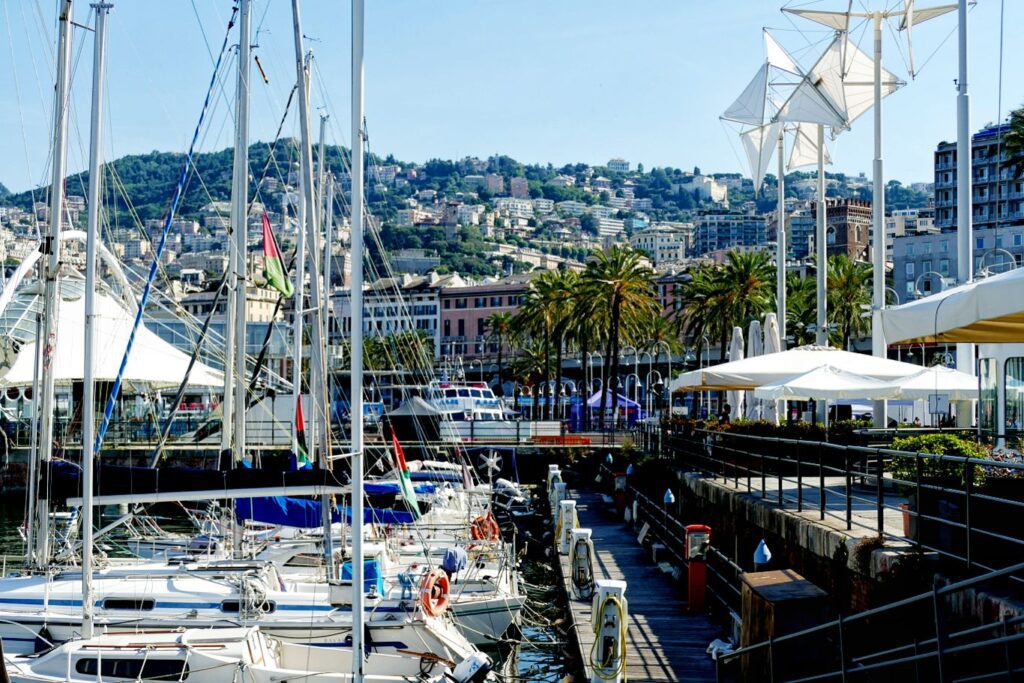
However, Genoa is not a place that reveals its charm and beauty right at first glance. But that is precisely its allure. Meander through streets between splendor and patina. Lose all sense of time and space in the maritime whirlwind of a glorious past and an enchanting present.
This is Genoa, the Queen of Liguria.
Genoa’s Past’N’Power
Genoa is Liguria’s alluring capital by the sea. Although today, it exudes a relaxed Mediterranean atmosphere, don’t be fooled: its history is anything but tranquil.
Even in antiquity, its natural harbor was a coveted trading hub. Phoenicians, Greeks, and later the Romans used it as a gateway to the western Mediterranean. But it wasn’t until the Middle Ages that Genoa truly flourished. As a powerful maritime republic, it competed with Venice, Pisa, and Amalfi for trade routes, wealth, and power.
Between the 11th and 15th centuries, Genoa developed into a veritable maritime superpower as Genoese merchants established trading posts from North Africa to the Black Sea.
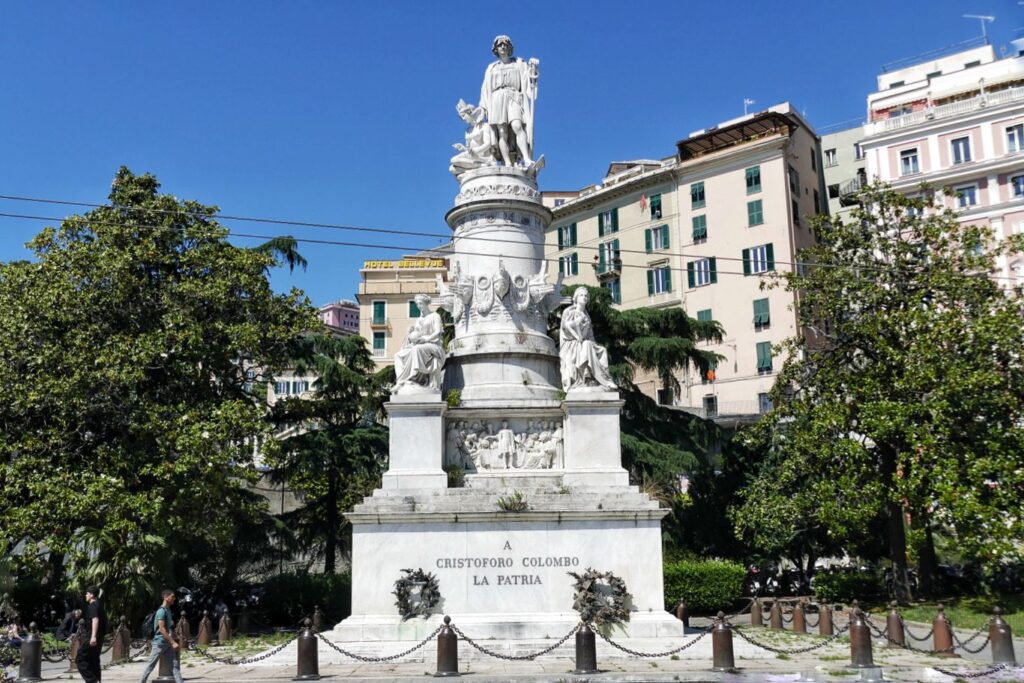
One name, of course, cannot be omitted: Christopher Columbus was born here in 1451. The fact that a Genoese man later discovered a New World while serving the Spanish crown is quite fitting for a city that has always thought beyond the horizon.
A few decades later, Andrea Doria shaped the city’s destiny. As an admiral and skilled politician, he reshaped the course of history in the 16th century, making Genoa a close ally of the Spanish Empire. This brought the city yet another Gilded Age.
But power rarely lasts. After internal conflicts, rivalries with other maritime powers, and the rise of new trade routes, Genoa gradually lost its importance. Ultimately, the city fell under the hegemony of larger powers, such as during the reign of Napoleon Bonaparte.
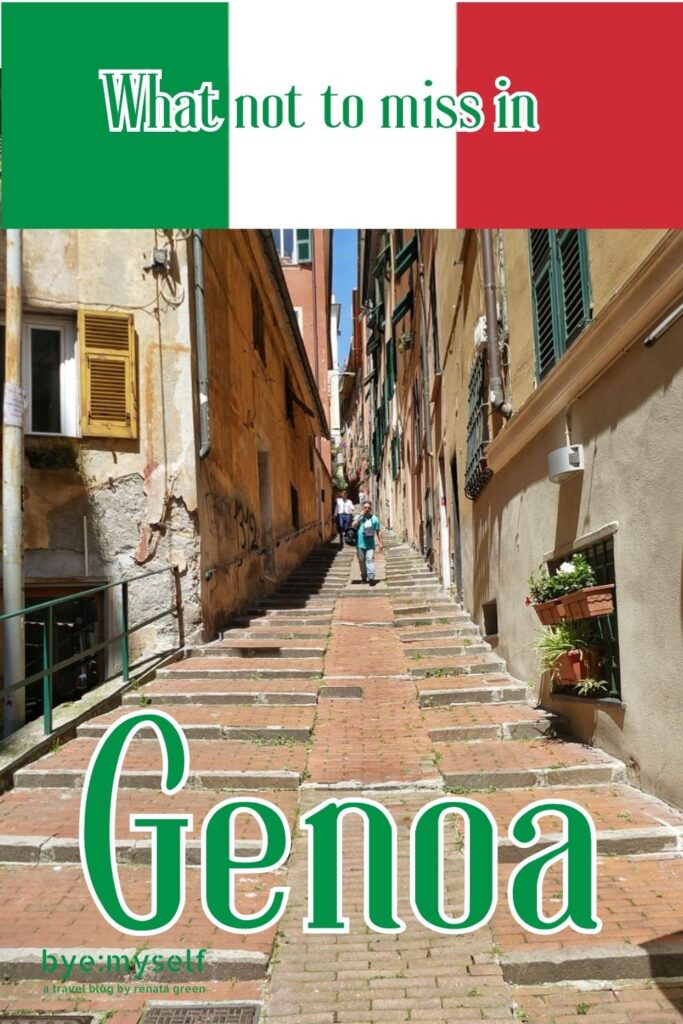
To this day, you can feel Genoa’s magnificent history in every narrow alleyway of the old town, between palaces and churches. Strolling through Genoa’s narrow, winding streets of the historic old town, known as the Caruggi, is like walking through a living history book.
Between Palazzi, Pizza, and Pizzaz: A Comprehensive Visit to Genoa
Yes, Genoa may be a history book, but this one is active, interactive, and vibrant! A walking tour quickly turns into an intense, jam-packed day. The city is atmospheric and full of contrasts between medieval alleyways, the so-called Caruggi, opulent palaces, and mesmerizing sea views.
The Salty Side of La Superba: Genoa’s Harbor Life
Obviously, I begin my introduction to Genoa at the port, the city’s former source of wealth and power. To this day, Genoa is called La Superba, the Proud One. This nickname was earned over centuries when the city not only gazed upon the sea but also ruled it. This title still lingers in the air, somewhere between faded maritime splendor and the bustling activity of a port. For even though the magnificent palazzi of the old aristocracy are a reminder of lordly glories and decadence, Genoa’s heart has always beat by the water.
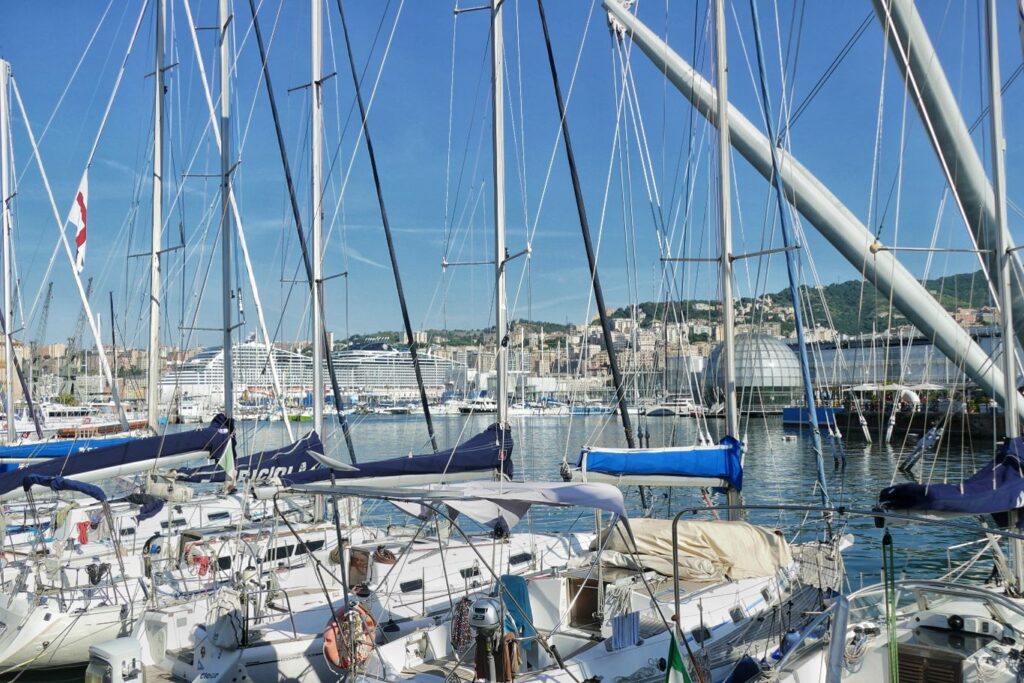
Ferries glide in from Corsica and Sardinia, loading cranes trace slow arcs across the sky, and the old docks have been transformed into promenades where locals and visitors share the same salty breeze. Somewhere between the historic trade routes and today’s leisure boats, Genoa reveals its true character. The sea has not only adorned this city. It built her, maintained her, and continues to shape her to this day.
Note, however, that while the actual industrial port is large, it’s largely uninteresting for visitors. So let’s head straight to the Porto Antico, the beautiful old port. It was redesigned by none other than Renzo Piano. You’ve encountered this grand master of Italian architecture in many of my posts, as he created, among other masterpieces, the Centre Georges Pompidou in Paris and the Stavros Niarchos Cultural Center in Athens.
A Sensitive Transformation
Renzo Piano was born in Genoa. His father was a building contractor, and his family was deeply involved in the construction industry.
Many architects would likely have created an iconic, large-scale project. Piano, however, worked almost like a restorer of the city’s memory. He didn’t want to reinvent the port, but rather to make visible the historical relationship between the sea, the city, the palazzi, and the caruggi. This is why the Porto Antico project is considered a masterpiece of urban repair—a transformation from a working and industrial port to a public urban space, without erasing its maritime past.
Renzo Piano did not reconstruct the Port of Genoa completely. Rather, his achievement lay in reconnecting a largely isolated industrial and port area with the city.
Well into the 20th century, the old port, while the historical heart of Genoa, had become increasingly inaccessible to the public. The modern container port had expanded further west, leaving behind outdated port facilities, warehouses, and vacant lots.
To mark the 500th anniversary of Christopher Columbus’s voyage, Renzo Piano was commissioned to redesign the historic port in 1992. He did not pursue a spectacular tabula rasa project, but instead sought to respect existing structures while creating new public spaces.
With the spacious waterfront promenade, Piano opened the port to pedestrians. Where there had once been work areas and restricted zones, versatile public spaces were created. Today, this seems commonplace, but at the time, it represented a fundamental shift in perspective.
Amazing Sights
An important part of the transformation was the Aquarium of Genoa, which is now one of the largest aquariums in Europe. For an entrance fee of around 30 €uros, you can visit it every day from 9 a.m. to 6 p.m.
Another one of the most famous landmarks is the so-called Bigo. The structure is reminiscent of the harbor cranes that once dominated the docks. Its panoramic elevator rotates 360° as it ascends, offering breathtaking views of the harbor, the old town, and the open sea. For only 6 €uros, definitely an activity not to miss.
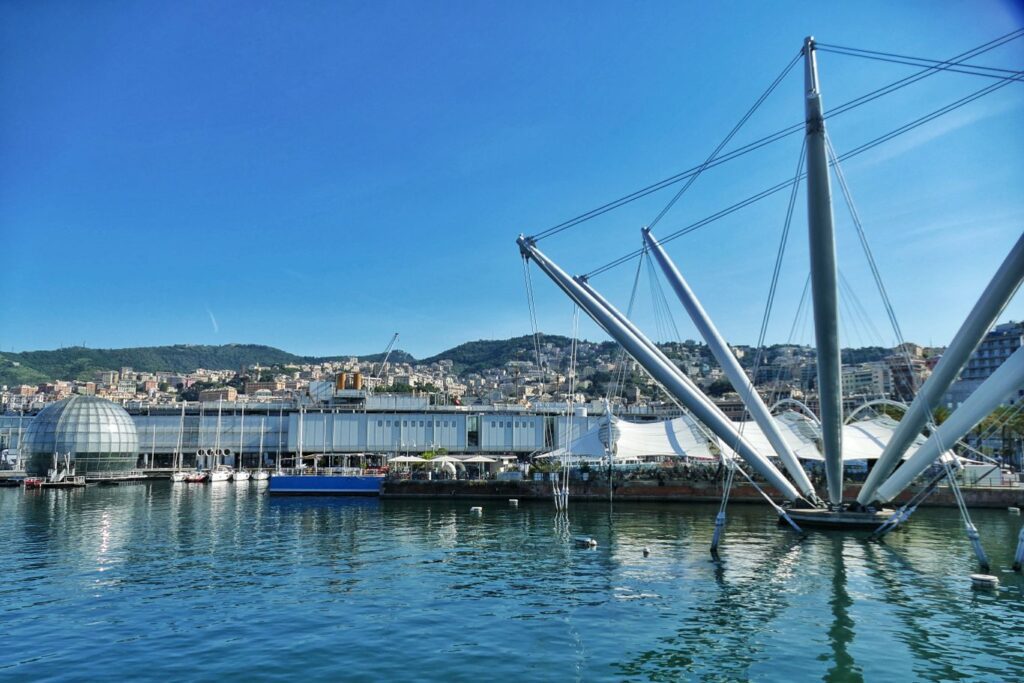
The so-called Biosfera was added only in 2001. It houses a tropical microclimate and forms a deliberate contrast between the historic harbor landscape and contemporary architecture.
An Exciting Maze: Genoa’s Caruggi
Before I dive into unrestrained praise of the beauty, the amazing vibe, the friendliness of the people, the proverbial Dolce Vita, and so much more, I want to preface this by saying that even in Genoa I couldn’t escape a familiar sensation. Port cities around the Mediterranean all share this rather raw charm. Whether Athens, Marseille, or Palermo – at first, I’m taken aback, feeling like a country bumpkin blinded by the big city lights. Small, naive, and a little intimidated. You wouldn’t assume that I grew up in a port city with one of the world’s most famous red-light districts.
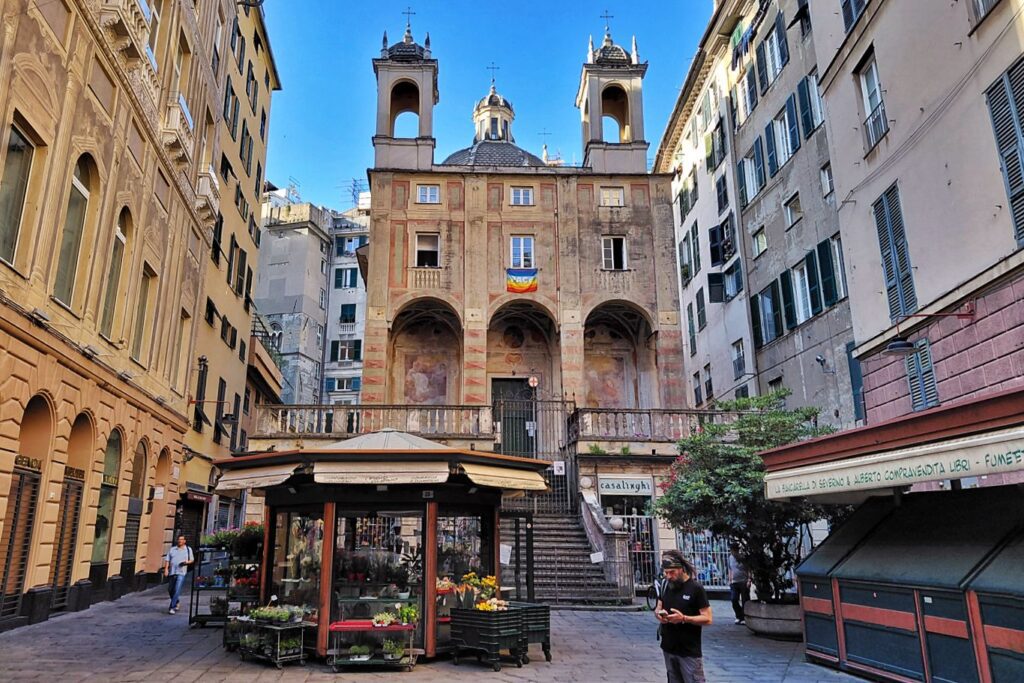
But northern European port cities are different, more industrial and less sordid. They don’t cling to the scent of the salt, tar, and the seven seas. And because of the climate, they aren’t as run-down as Mediterranean port cities. Yes, I readily admit that while Genoa’s Medieval architecture immediately captivated me, the maze of narrow streets in the old town initially intimidated me. The alleys are incredibly narrow. I have to crane my neck way back to see just a sliver of blue sky. If I spread my arms, I can touch the walls of the houses on both sides of the alleys. Tiny grocers and quirky shops selling everything imaginable and unimaginable line the streets. Also, there is an astonishing number of independent bookstores.
In the Shadows
The fact that activities are taking place in broad daylight that elsewhere only happen long after dark is a bit disconcerting at first. Are those ladies in short, tight faux-leather skirts actually…now, at midday? Do they really pursue their trade in the middle of the old town, in front of small cafes and bookstores? However, I seem to be the only one who is at first a bit thrown off by the raw mix of all those very different trades.
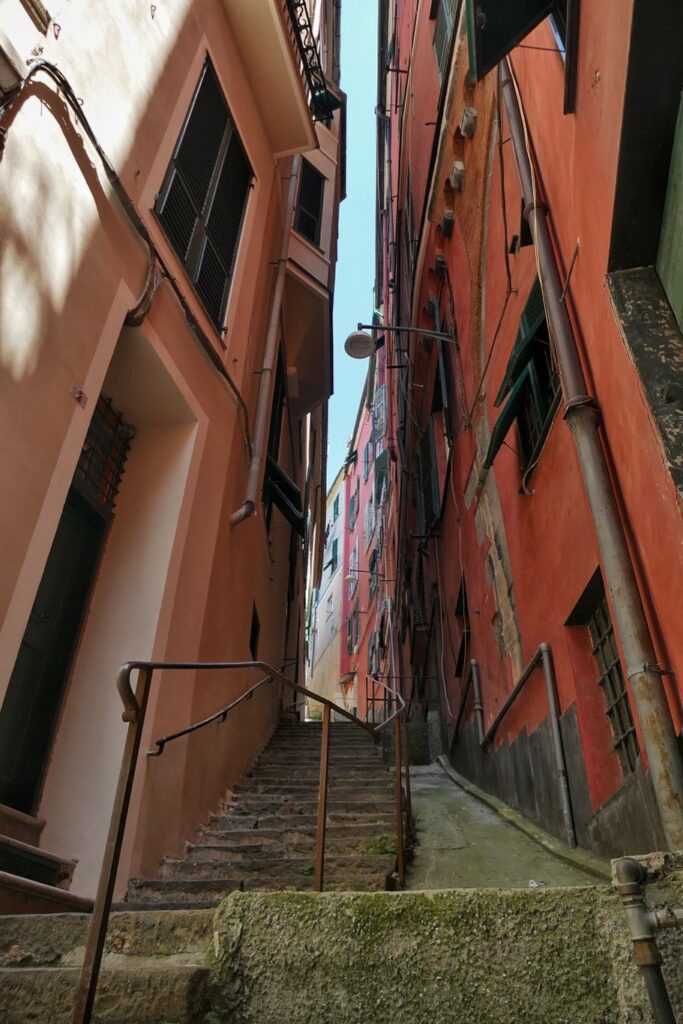
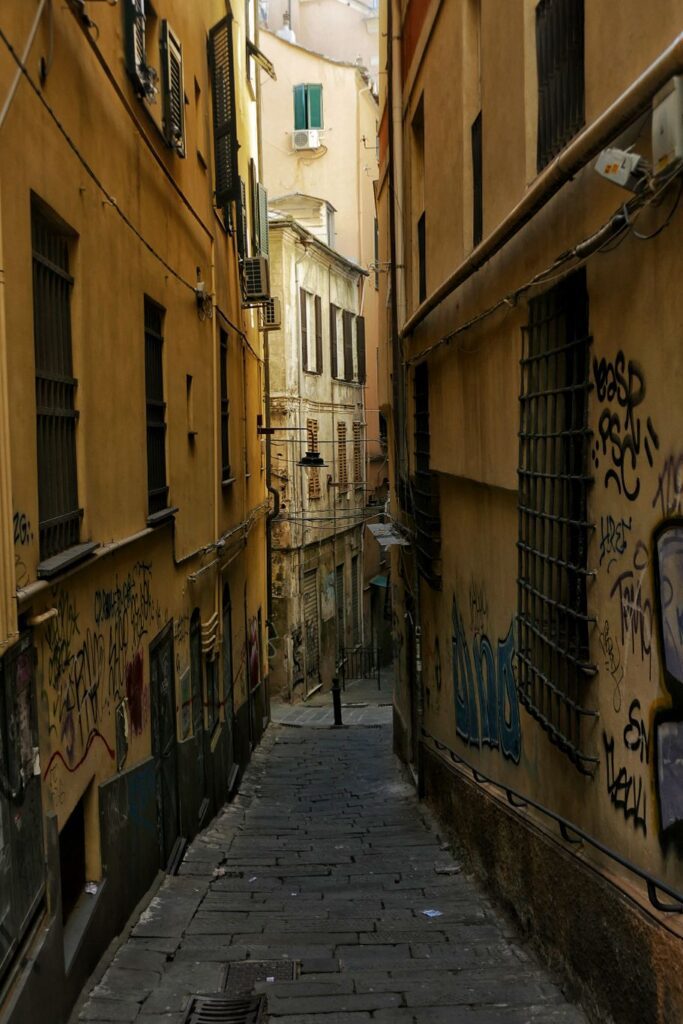
Regardless, the Caruggi’s dense network of dark, narrow alleyways seems to build a connection – or division – between the open harbor area and the elegant boulevards and majestic squares further uphill. This part of the city is less a backdrop than a biography.
Caruggi And Palazzi: Two Hearts Beat As One
The connection between the lavish Palazzi and crammed Caruggi is basically the key to understanding Genoa.
As a matter of fact, the narrow alleys of the old town, one of the largest medieval city centers in Europe, were built long before the grand Renaissance palaces.
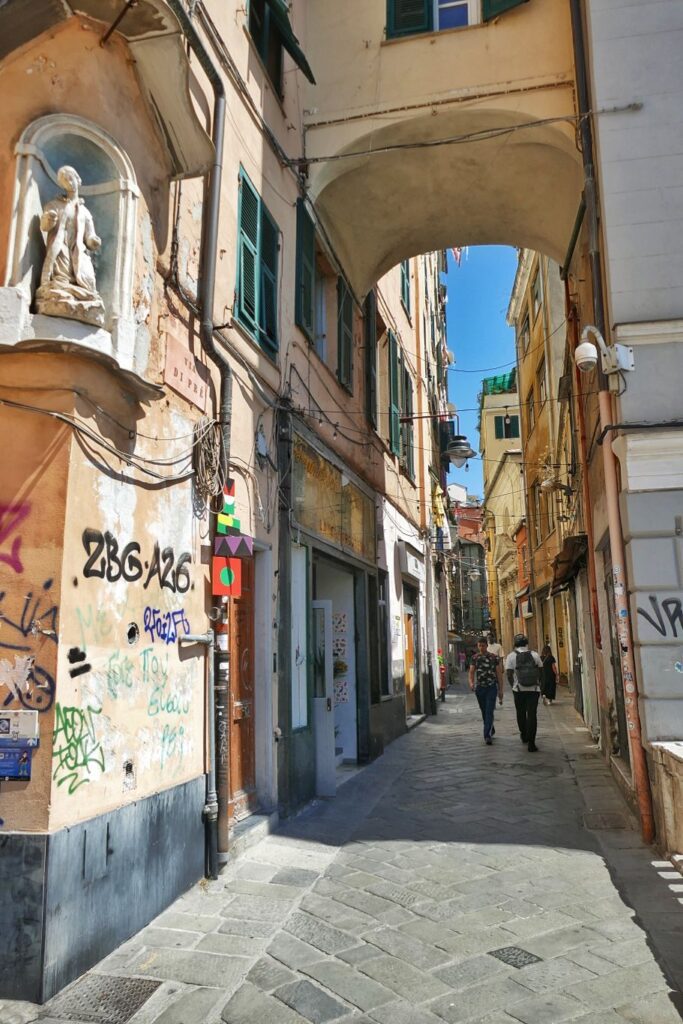
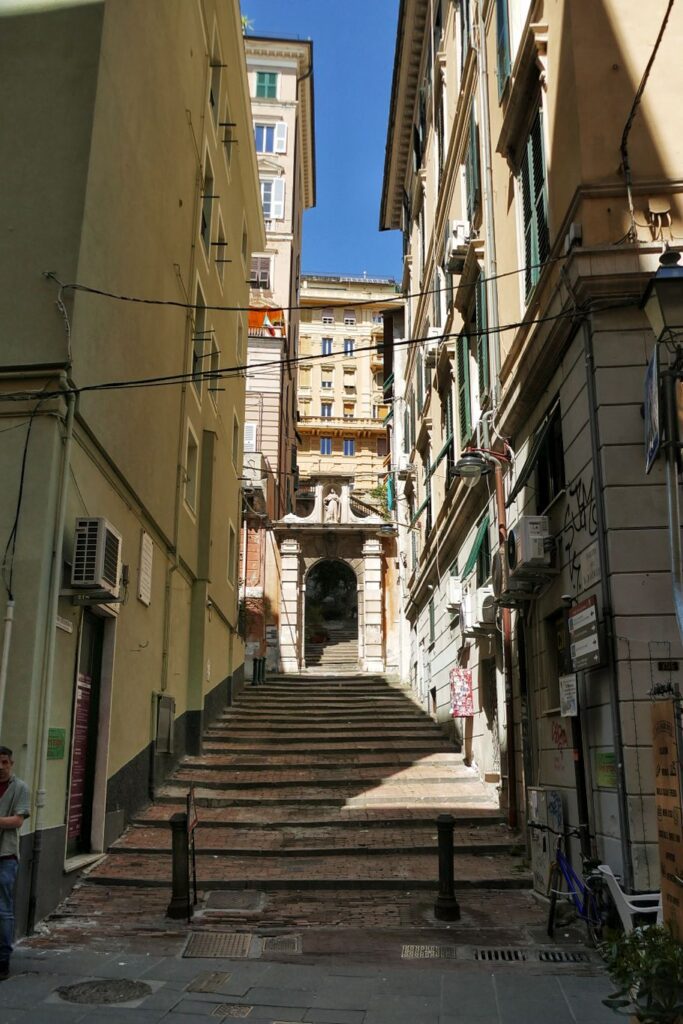
Unlike Rome or Paris, Genoa was never planned around a central royal palace. The political power was dispersed. Genoa existed in a tension between republic and oligarchy. Hence, the labyrinth of medieval neighborhoods developed right next to the palaces of the elite. It was clear that despite their existence in the shadows, the Caruggi were the economic heart of the city. After all, all the craftsmen, dockworkers, sailors, and small merchants lived here.
The Palazzi belonged to the same families whose businesses were conducted in the Caruggi and at the port. The distance between the elite and everyday business was therefore surprisingly short. While the palazzi represented financial power, humanism and Renaissance culture as well as aristocratic hedonism, the caruggi stood for seafaring, working class, and migration.
While the Palazzi displayed wealth, the caruggi were the machinery that generated that very wealth.
You can’t have one without the other.
My Home is My Castle: Genoa’s Palazzi dei Rolli
Genoa in the 16th and 17th centuries was neither a classic monarchy nor a mere trading city. It was politically an aristocratic republic led by a few families, and economically a hub between Mediterranean trade, the Spanish Empire, and European finance.
Historians often refer to the Siglo de los Genoveses, hence, the Century of the Genoese, because local financial elites played a key role in European capitalism at that time, which was based on Mediterranean trade. Genoese merchants owned trading posts from Crimea to North Africa!
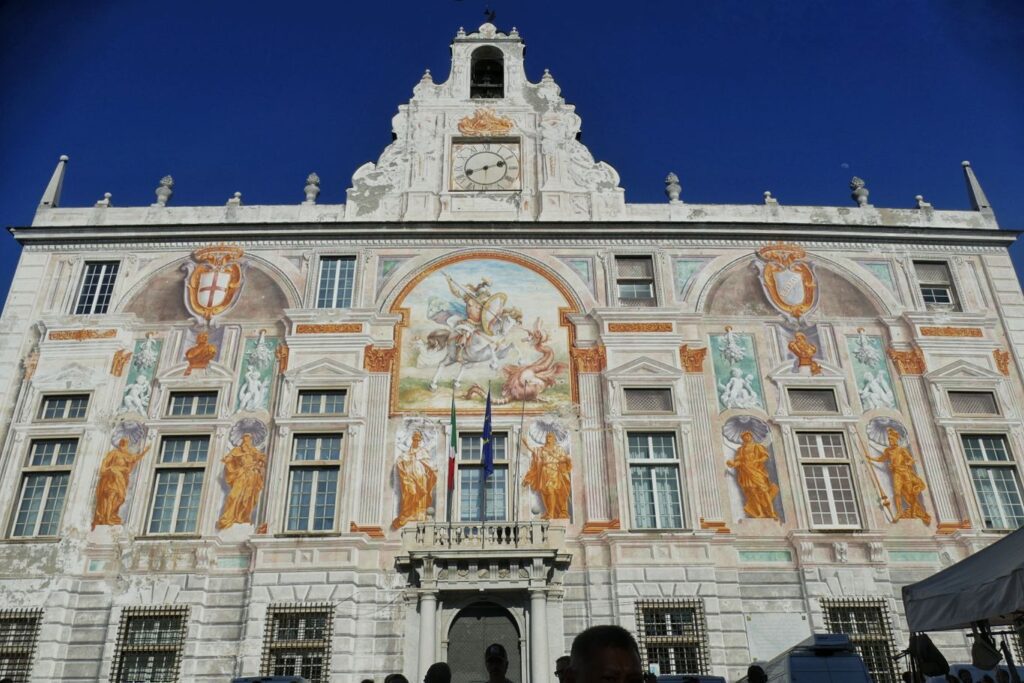
Yet, surprisingly, the real wealth did not primarily stem from trade, but from banking. In the 16th century, the Genoese became the bankers of Europe. Genoese families granted loans to kings and emperors. Their most important client was the Spanish crown under Charles V and later Philip II. Silver from the Americas flowed into Spain and was managed, lent, and invested by Genoese bankers.
Hence, the palazzi of Genoa are far more than just beautiful Renaissance and Baroque buildings. They are the tangible result of a unique political and economic order: the Republic of Genoa as the financial powerhouse of the Mediterranean.
No Kings
Interestingly, Genoa had no royal ruler. Instead, the wealthy families competed with one another, and their riches were displayed through architecture, through magnificent façades, courtyards, and art collections.
Since the state did not have a royal court, the republic distributed representation among private aristocratic palaces. For this purpose, they kept lists, known as Rolli, of which palazzi had to be used for state guests.
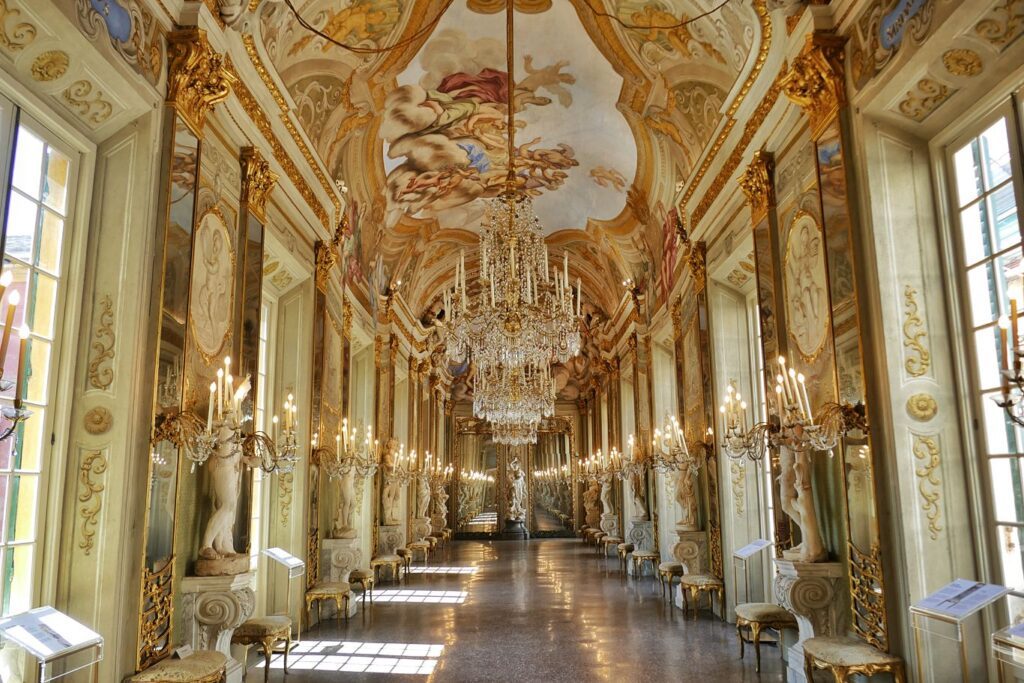
The palazzi are thus the architecture of an early capitalist elite. The Caruggi are the urban infrastructure from which this elite emerged and on which it remained economically dependent. It is precisely this juxtaposition that makes Genoa unique: The city still exhibits, almost unchanged, the spatial connection between port industry, finance capital, and aristocratic power.
Fun Fact
You might wonder why I visited the palaces on Via Garibaldi when every guidebook says they’re on Strada Nova. Well, Strada Nova, meaning New Street, was the historical name in the 16th century when the street was laid out as a prestigious Renaissance and Baroque thoroughfare.
Palazzo Spinola – Living Like in the 17th Century
The Palazzo Spinola di Pellicceria was built from around 1593 onwards for the influential Spinola family and exemplifies how a Genoese aristocratic residence functioned.
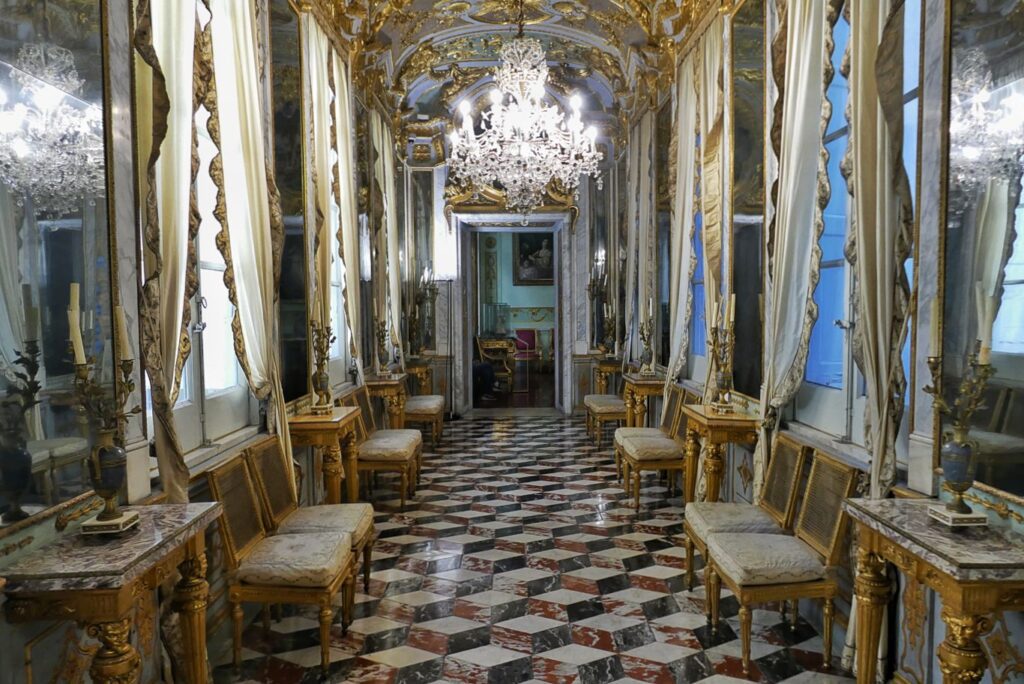
Unlike many other palazzi, its interior feels less like a museum and more like a frozen home. The furniture, paintings, and decor are largely original. It underwent extensive renovations in the 18th century, which is particularly evident in the richly decorated salons. Today, it houses the National Gallery of Liguria, featuring works by Rubens and van Dyck. The blend of art museum and authentic residential atmosphere makes it particularly fascinating. The Palazzo is open to the public and offers an ideal introduction to the world of Rolli palaces.
The Galleria Nazionale della Liguria in the Palazzo Spinola is open from Tuesday to Sunday between 9 a.m. and 7 p.m. The admission is 12 €uros. A combination ticket with the Palazzo Reale is available.
Palazzo Rosso – The Private Art Collection of the Super-Rich
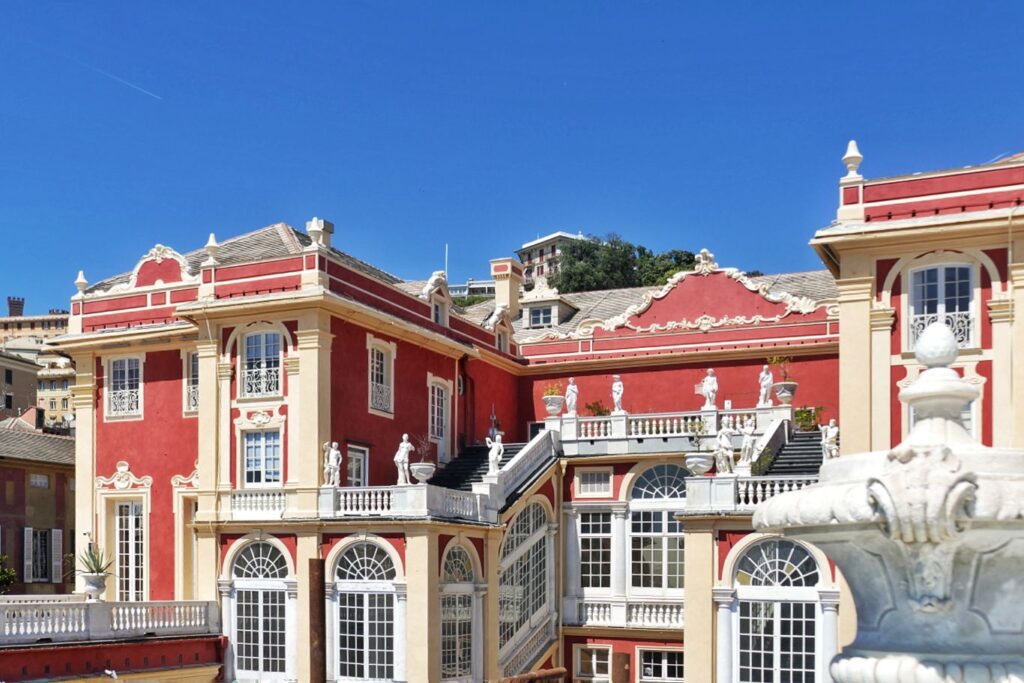
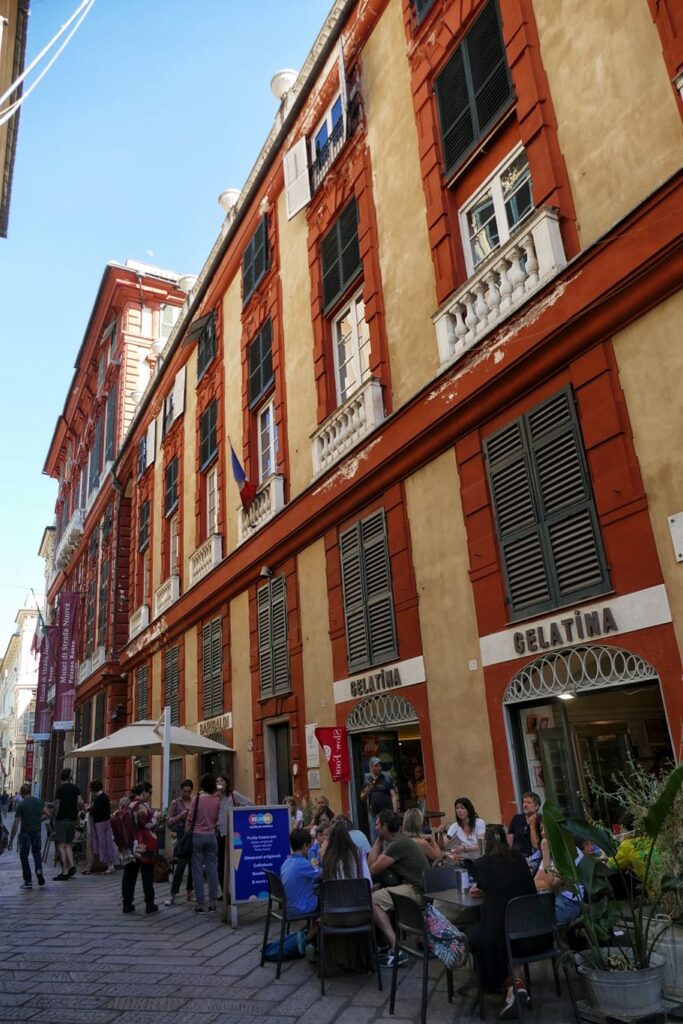
The Palazzo Rosso was built starting in 1675 for the Brignole-Sale family, one of the city’s wealthiest dynasties.
Its striking red façade not only gave it its name but also made it a prominent landmark. Inside, one immediately senses that this was not only a residence but also a place for collecting. Over generations, the family amassed an impressive art collection. Many rooms still contain original furnishings, lending a personal touch to the visit. The view from the rooftop terrace overlooking the old town is also particularly beautiful.
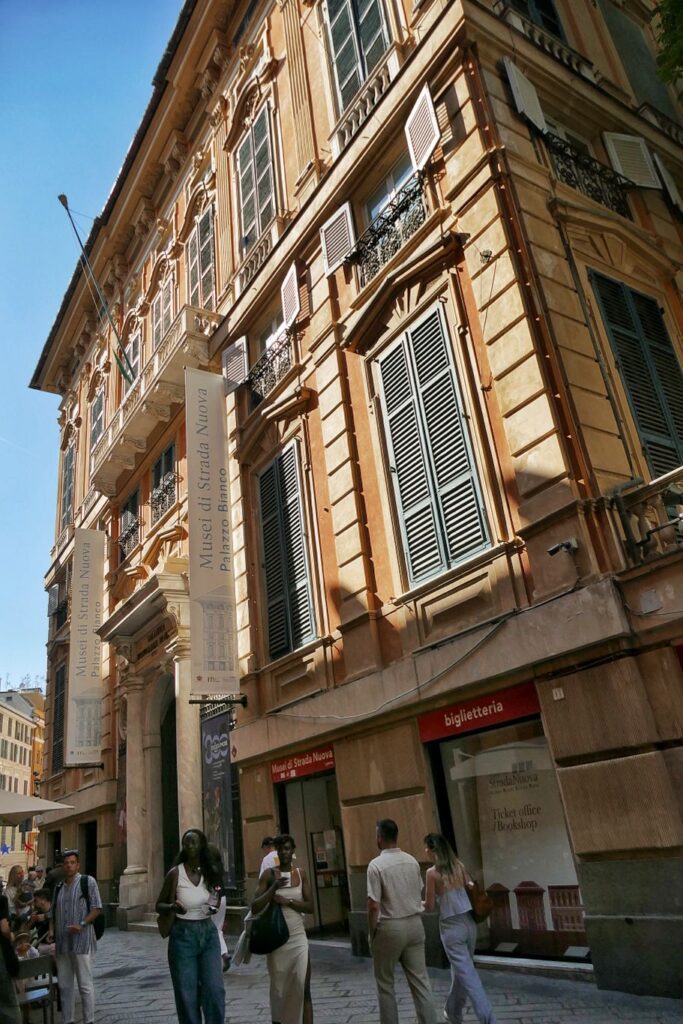
Palazzo Bianco – Clarity and Grand Names
The Palazzo Bianco dates back to the 16th century and was originally built for the Grimaldi family. Its current light-colored façade is the result of later renovations and, of course, the source of its name, the White Palace. Compared to the Palazzo Rosso, it appears almost understated, which makes it particularly interesting from an architectural perspective. Today, it houses a world-class art collection with works by Caravaggio, Veronese, and Van Dyck.
Palazzo Doria Tursi – Politics Meets Splendor
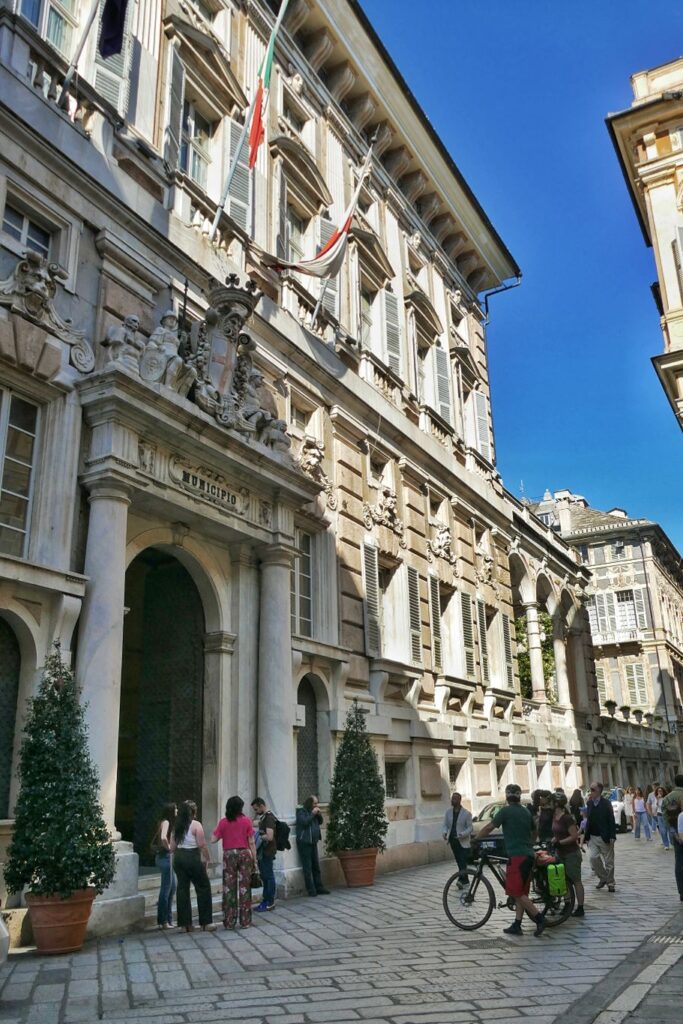
The Palazzo Doria-Tursi is the largest palace on Via Garibaldi and was built starting in 1565 for Niccolò Grimaldi, known under the nickname Il Monarca, hence, the Monarch. Its sheer size reflects the patron’s status. Later, the palace passed to the Doria family, who gave it its current name. Today, however, the building serves as Genoa’s City Hall. It provides a vibrant example of how historic architecture can be repurposed. Parts of the palace function as a museum and are open to the public. The open loggias and the expansive grounds are particularly impressive.
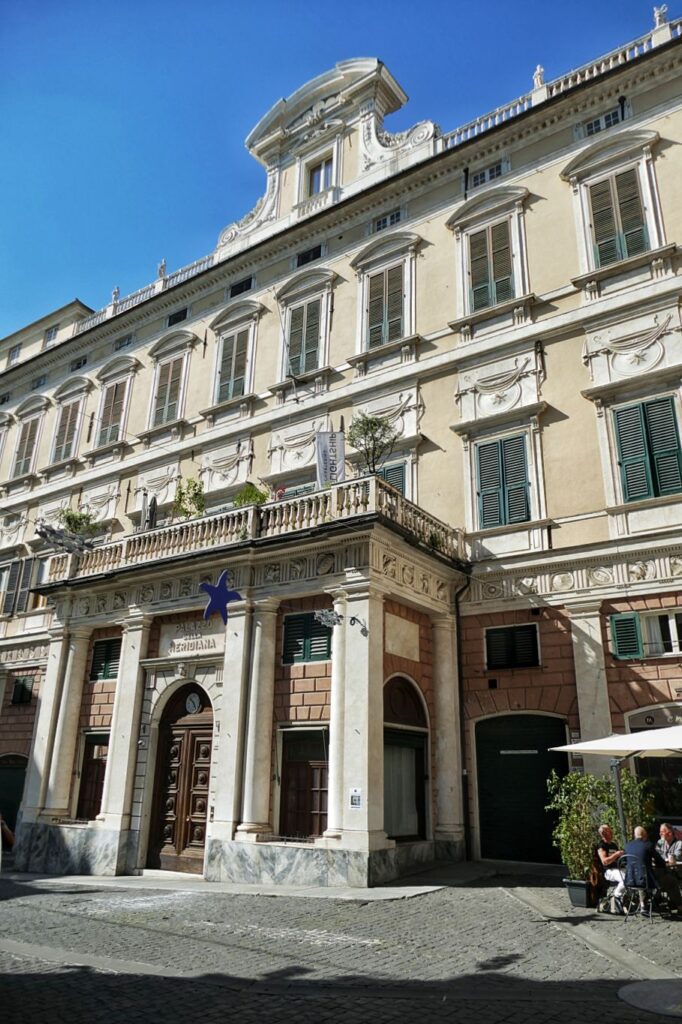
Palazzo della Meridiana – Preserving Art’n’Era
Built in the 16th century for the Grimaldi family, the Palazzo della Meridiana was later named after a sundial in its courtyard. It is one of the early examples of Genoa’s new, prestigious urban planning. Inside, frescoes by Luca Cambiaso and other important artists are particularly impressive. Today, the Palazzo is primarily used for exhibitions and events, giving it a less museum-like feel and more of a vibrant cultural venue. Visits are usually possible as part of events or during the era of the Rolli.
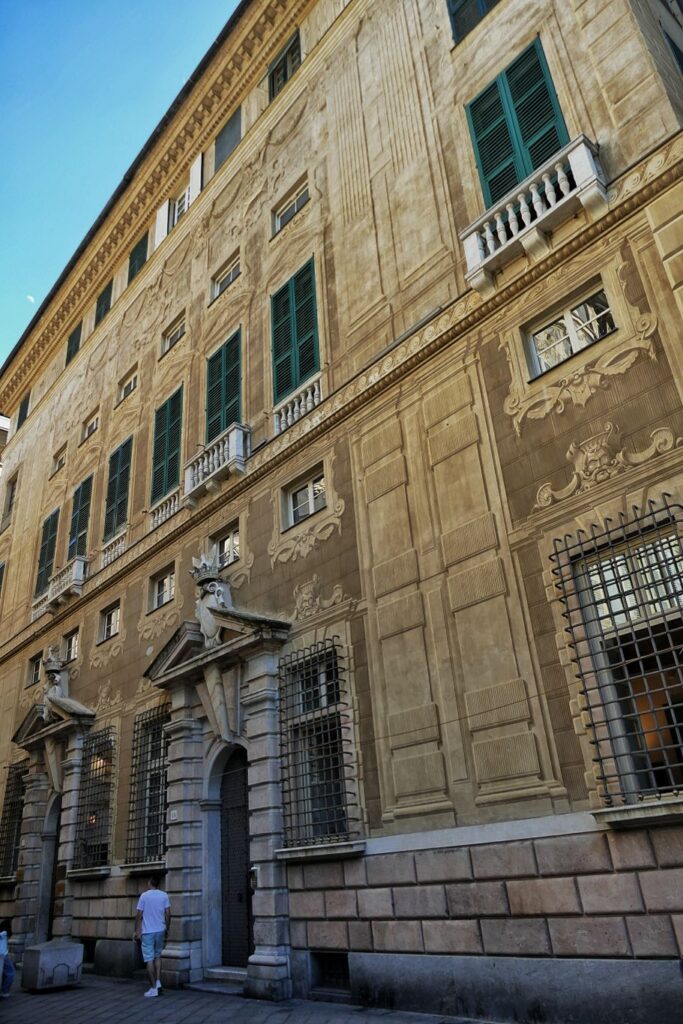
Palazzo Pallavicini-Cambiaso – Renaissance Elegance
The Palazzo Pallavicini-Cambiaso was built in the 16th century for the Pallavicini family and reflects the influence of the architect Galeazzo Alessi. The architecture is austere, harmonious, and typical of the high period of the Genoese Renaissance. Inside, one finds richly decorated rooms that reflect the owners’ wealth. Later, the palace passed into the hands of the Cambiaso family. Today, it is partly privately owned, which restricts access. It is usually only open for special occasions.
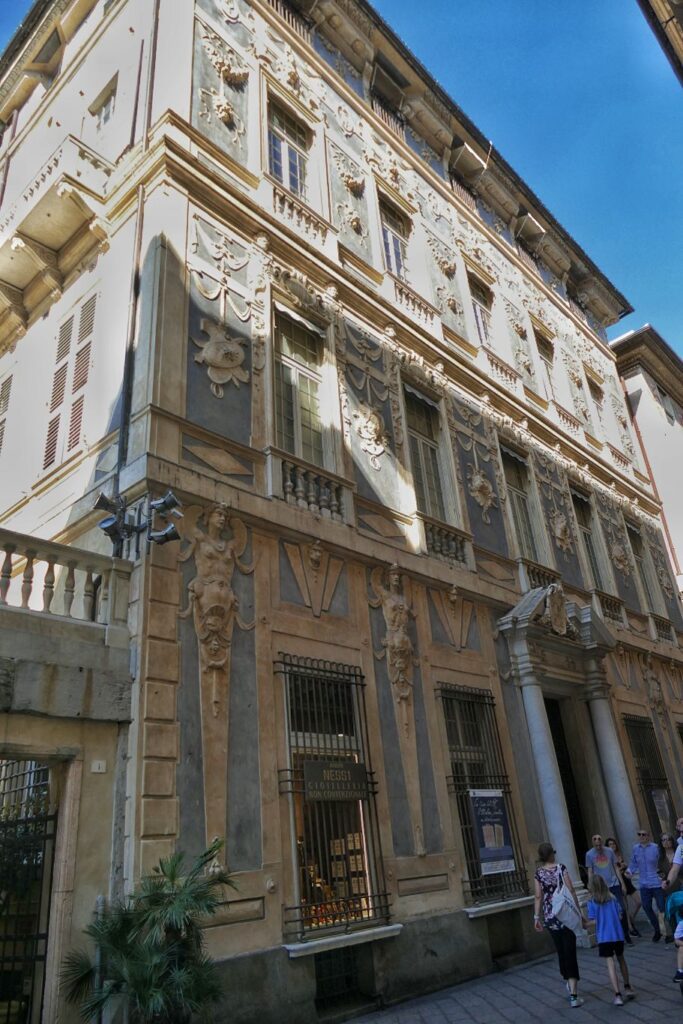
Palazzo Lercari-Parodi – Held by Giants
The Palazzo Lercari-Parodi immediately catches the eye with its unusual façade. Atlas statues appear to support the building. It was built in the 16th century for the Lercari family and later acquired by the Parodi family. The interior also features important frescoes, including some by Luca Cambiaso. The palace is an outstanding example of Mannerism in Genoa. Today, it is partly privately owned and is usually only open to the public on special occasions.
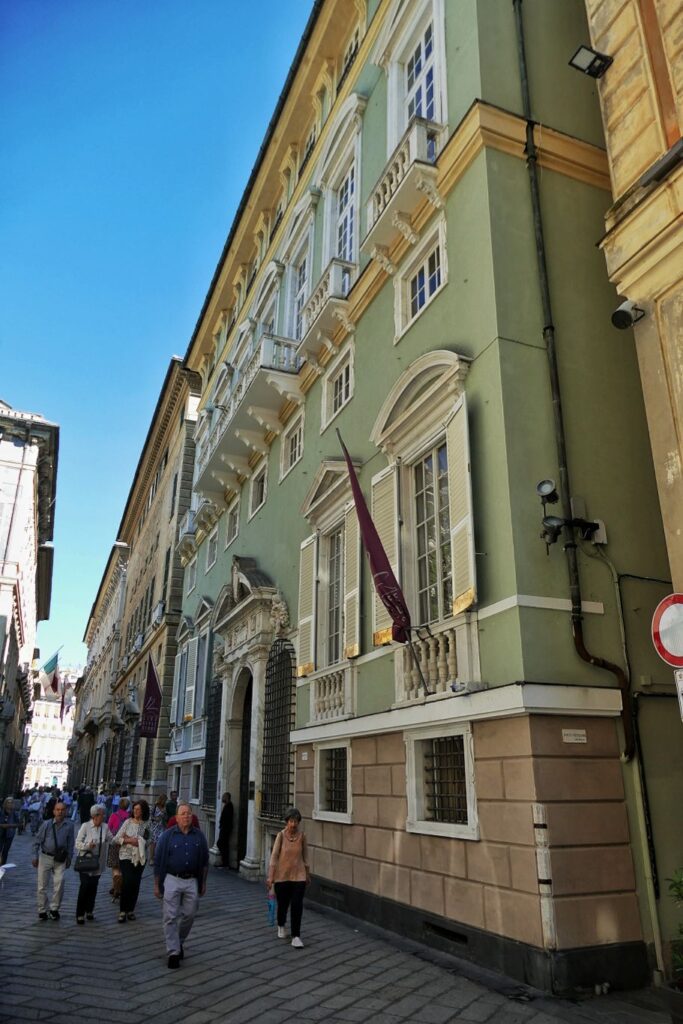
Palazzo Gio Battista Spinola – Terraces and Views
The Palazzo Gio Battista Spinola aka Palazzo Doria was built from 1563 onwards for the Spinola family and was one of the most prestigious Rolli palaces. Its hillside location allowed for a terraced garden, a true status symbol. After later renovations, the palace came into the possession of the Doria family. The combination of architecture and landscape is particularly captivating. Today, access is restricted and usually tied to events. Nevertheless, even a glance from the outside is worthwhile.
Palazzo Nicolosio Lomellino – The Secret Garden
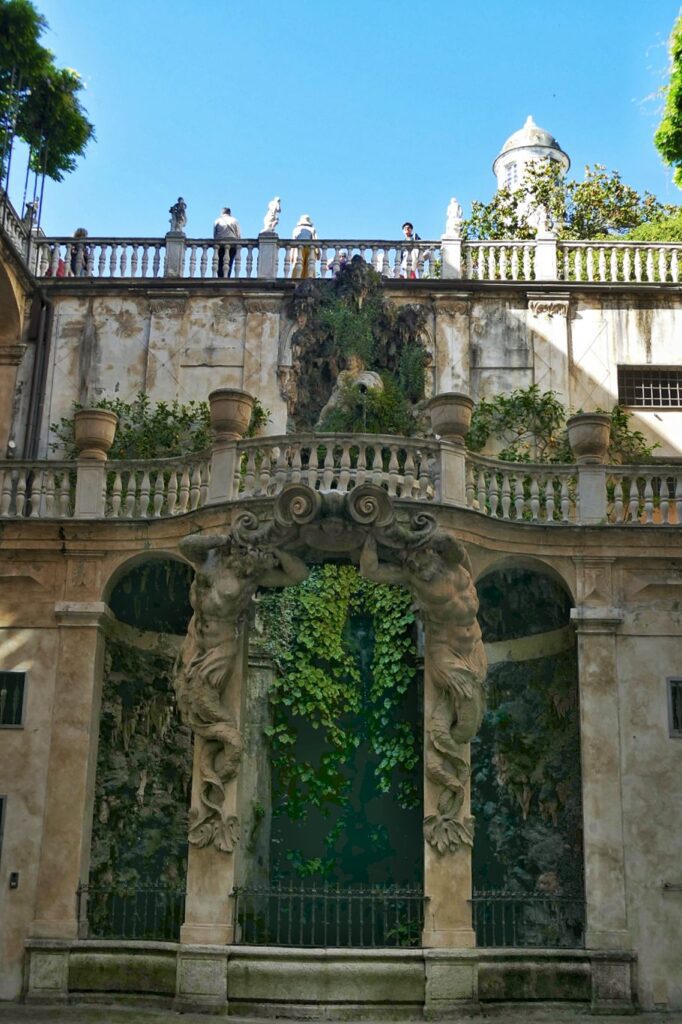
The Palazzo Nicolosio Lomellino, also built from 1563 onwards, is one of the most elegant palaces along the street. Rather understated from the outside, it surprises visitors inside with a spectacular garden full of grottoes, sculptures, and water features. This staging of nature as a work of art was typical of the period. The interiors are also richly decorated with illusionistic frescoes. The palace remains privately owned. Visits are possible as part of guided tours or during the so-called Rolli Days.
Genoa’s Living Rooms: Dolce Far Niente in the Piazze
As you get to the eastern end of Via Garibaldi, you basically enter Genoa’s living room. A row of squares merge one into the other, all offer spaces’n’spots to sit, relax, and watch people and life go by.
First, there is Piazza delle Fontane Marose. This square forms an important transition between the old town and the more prestigious areas of Genoa and is framed by magnificent aristocratic palaces. On the way to the majestic Piazza De Ferrari, the view opens up here for the first time from the narrow streets of the old town to the more spacious squares and boulevards of the city.
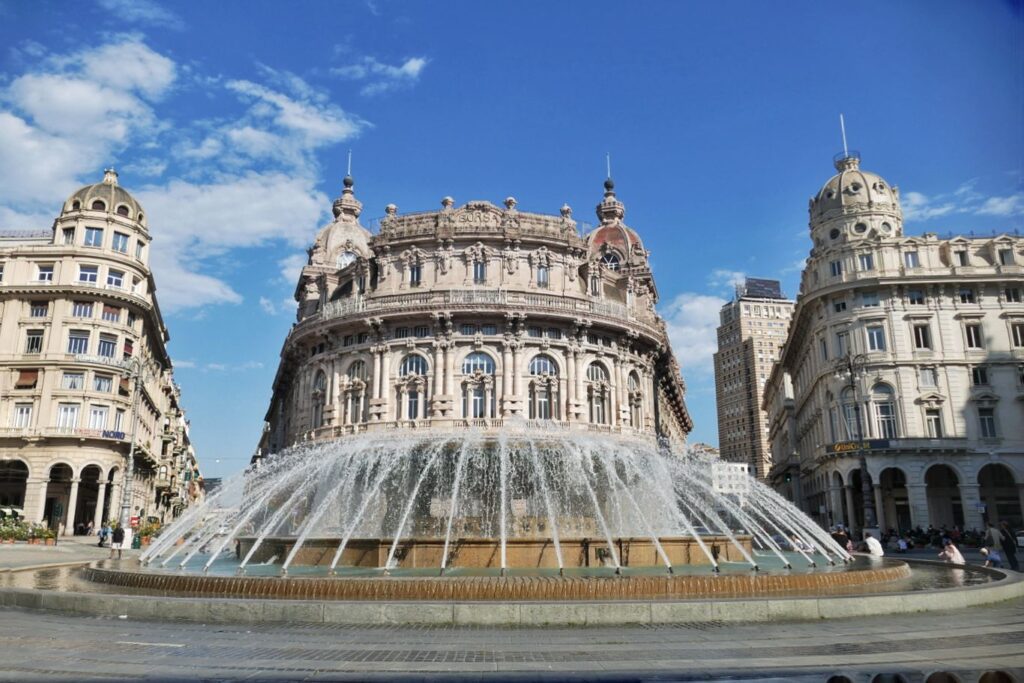
Piazza De Ferrari is Genoa’s shining architectural centerpiece and the city’s most important square. It is particularly famous for its monumental fountain, surrounded by significant buildings such as the Carlo Felice Opera House, the Palazzo della Regione, and the Stock Exchange. The square connects the historic city center with the newer districts and is a central meeting point for residents and visitors alike.
By the way, Piazza de Ferrari is by no means named after the car, but after Raffaele De Ferrari, a Genoese banker, politician, and philanthropist. He held the title Duke of Galliera and in 1875 donated a substantial sum of money for the expansion of the port of Genoa. The square’s official name is indeed Piazza Raffaele De Ferrari.
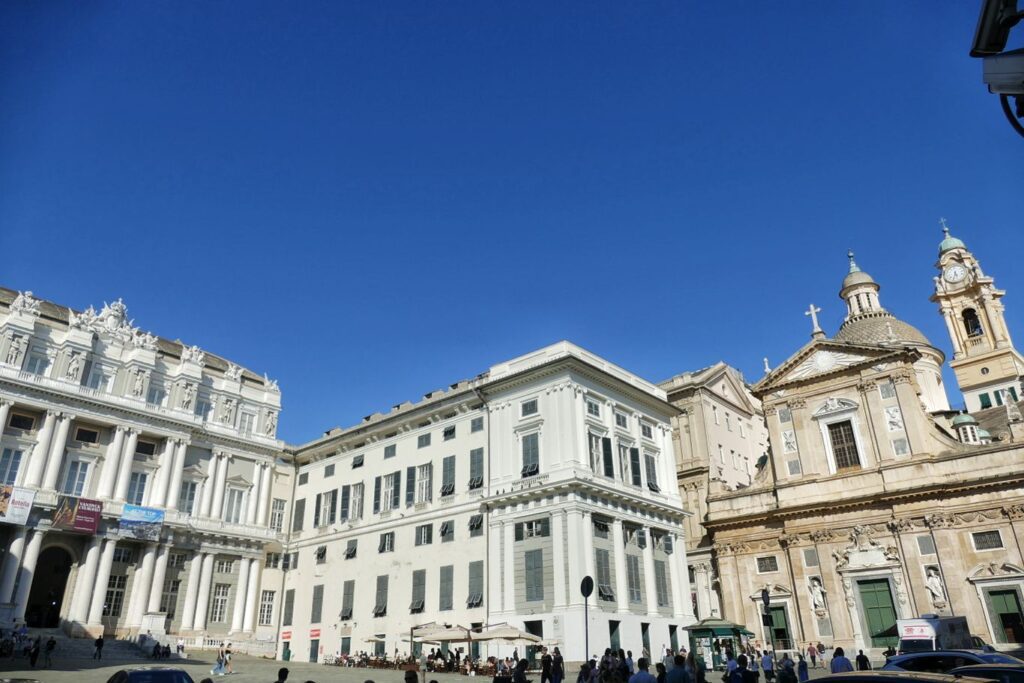
Just around the corner from Piazza de Ferrari lies the prestigious and historic Piazza Matteotti. Here stands the imposing Palazzo Ducale, for centuries the seat of the Doges and the center of political power in the Republic of Genoa. Together with the neighboring Church of San Lorenzo, the square forms one of the city’s most important historical spaces. Meanwhile, numerous charming bars invite you to enjoy a quick coffee or a leisurely aperitivo.
There’s More
Just a few steps from Piazza Matteotti rises the Cattedrale di San Lorenzo. Construction began in the 11th century in the Romanesque style and was expanded and remodeled several times over the centuries.
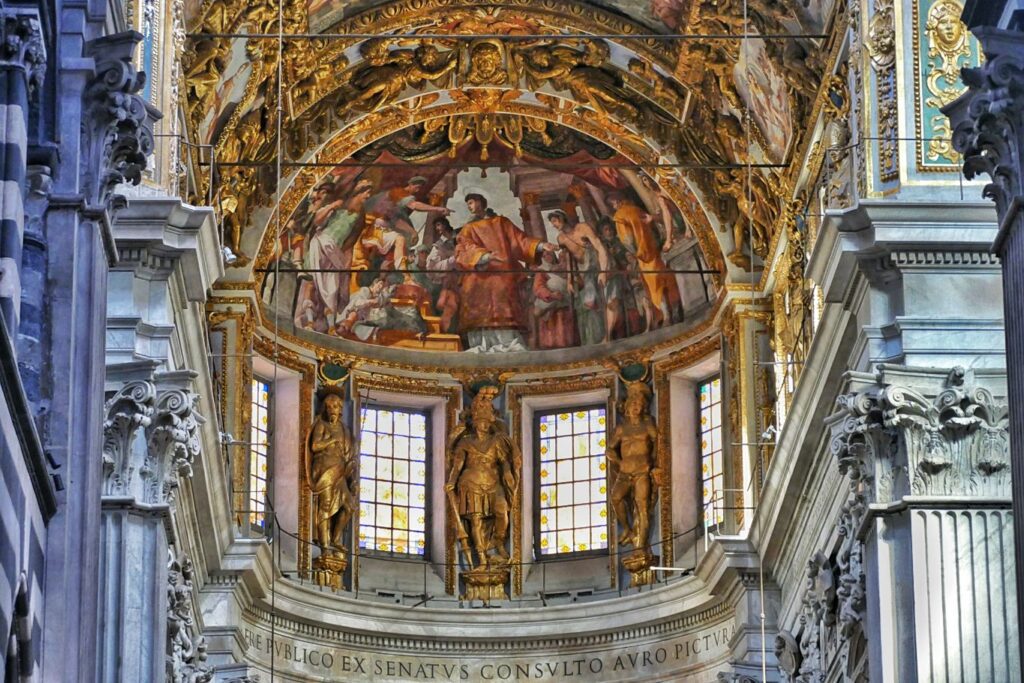
As a result, it now exhibits a blend of Romanesque, Gothic, Renaissance, and Baroque elements. The black and white striped façade from the 13th and 14th centuries is typical of Ligurian sacral architecture.
My personal favorite among Genoa’s houses of worship is the Basilica della Santissima Annunziata del Vastato. It stands at the Piazza della Nunziata.
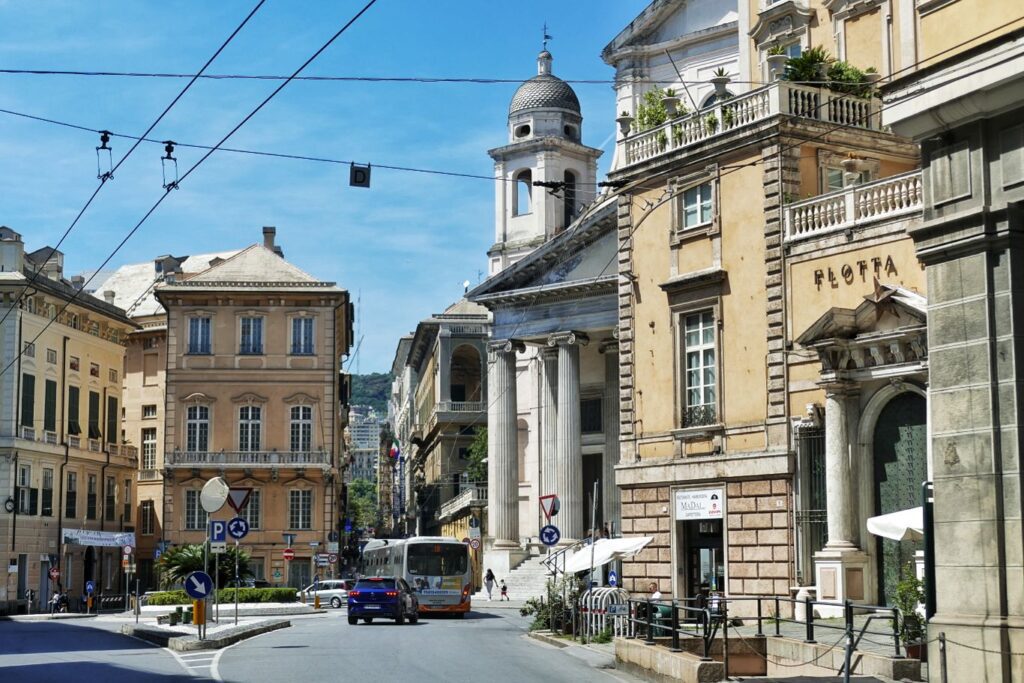
The church was built from 1520 onwards and expanded in the 17th century under the Genoese Lomellini family into one of the city’s most magnificent Baroque churches.
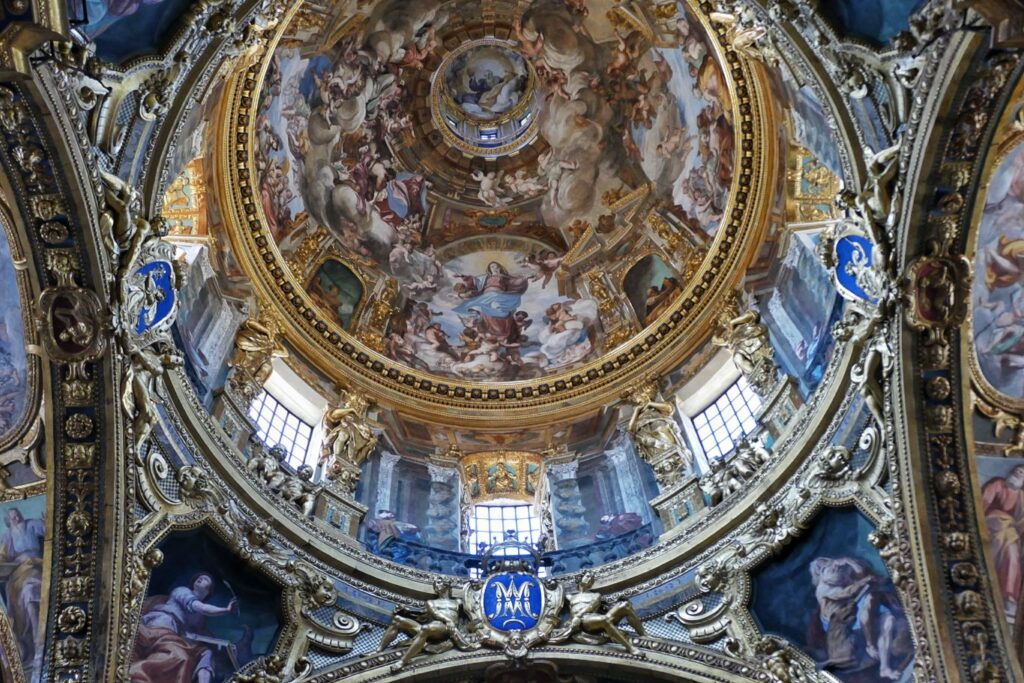
Behind its simple Neoclassical façade unfolds an exceptionally richly decorated interior with frescoes, marble, and gilded stucco, created by the most important artists of the Genoese Baroque.
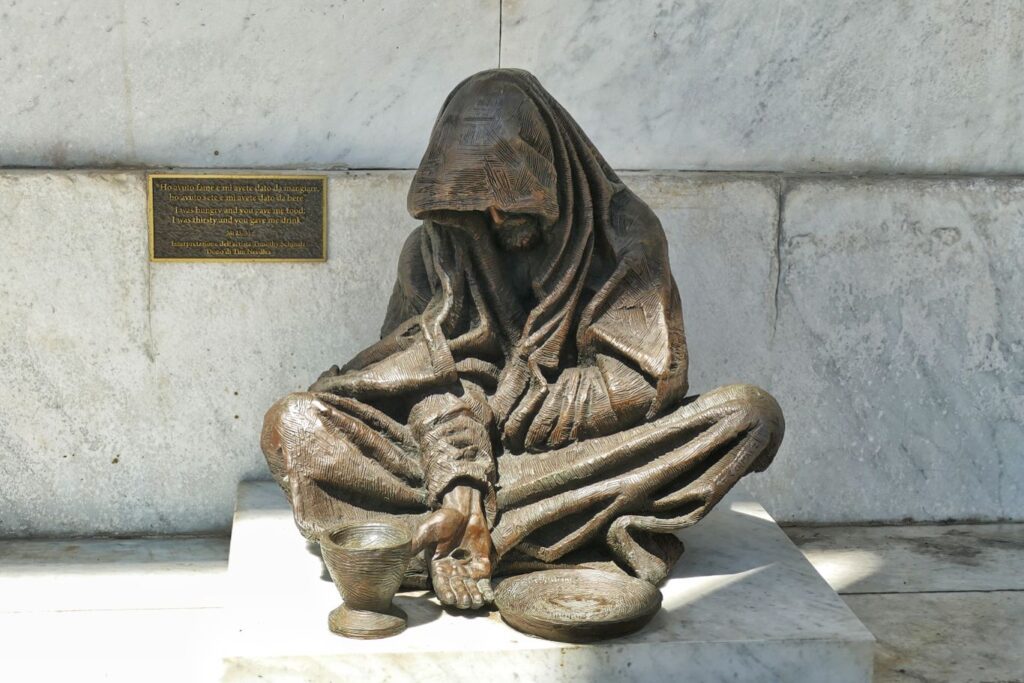
The addition Vastato recalls the once undeveloped land outside the medieval city walls on which the church was built.
A Great City on Many Levels: Genoa’s Lifts and Funiculars
The Palazzi dei Rolli are far from the only aspect that makes Genoa special. As a matter of fact, Genoa is a city that differs significantly from many other European cities because it is not situated on the flat coastline, but rather developed between the coast and steeply rising hills and mountains. This resulted in considerable differences in elevation between the port, the historic old town, and the higher-lying residential areas from an early stage.
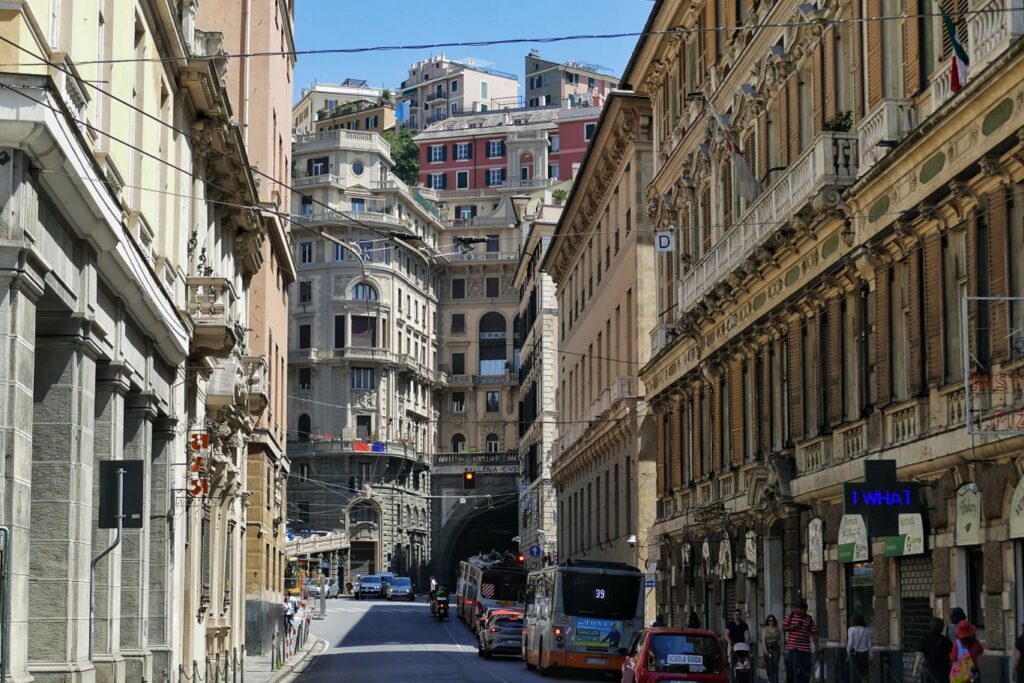
This became particularly apparent as a potential problem in the 19th and early 20th centuries, as the city grew and wealthier residents moved to quieter and more open locations above the old town. Districts like Castelletto developed on the hills above the city, offering more space and better views, but were difficult to access.
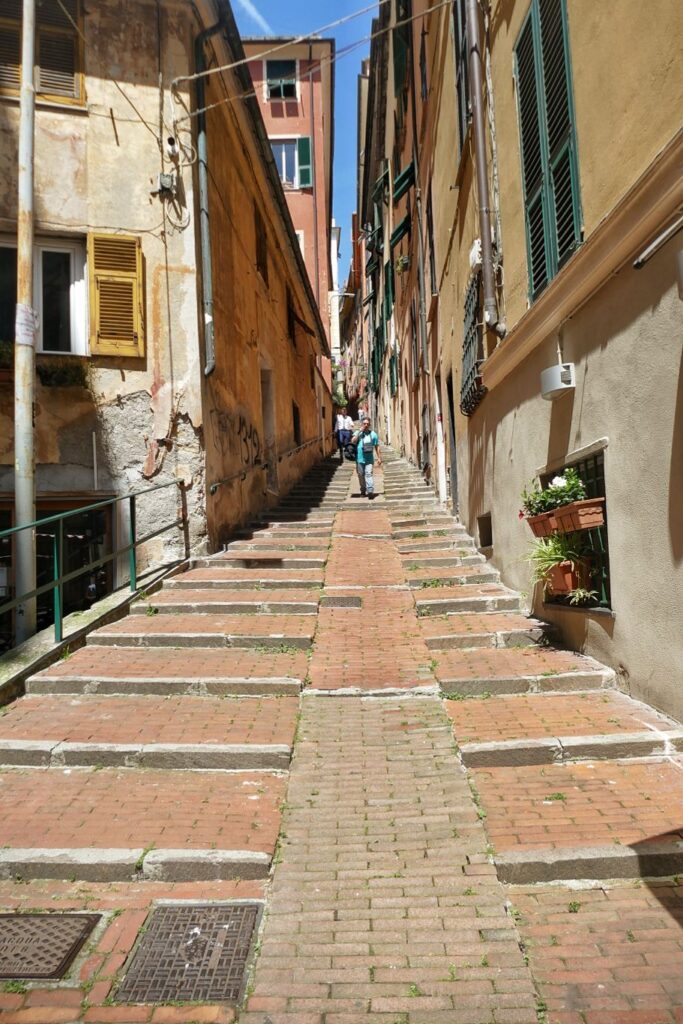
To overcome this topographical challenge, Genoa installed an unusually dense network of funiculars, elevators, and other vertical transport systems, which today form an integral part of its public transportation system. The Ascensore Castelletto Levante is a prime example. It connects the city center directly with the higher-lying Castelletto district, allowing for a quick change of elevation without long detours via steep streets or stairs. At the top is, among other things, the Spianata di Castelletto, a famous viewing terrace offering sweeping views over the rooftops of the old town, the harbor, and the sea.
Overall, this system demonstrates very well how Genoa has not fought against its unique geography but rather integrated it technically. The city essentially functions on several superimposed levels, connected by elevators and funiculars.
It is precisely this layered structure that makes Genoa so unique.
Going Up
The five most worthwhile elevators and funiculars in Genoa are led by the Sant’Anna Funicular. Dating from the late 19th century, it is one of Genoa’s oldest funiculars, easily connecting two vastly different levels of the city and still in daily use.
The Montegalletto Elevator is a true curiosity, as it initially travels horizontally like a small train before transitioning into a vertical elevator to overcome a difference in elevation.
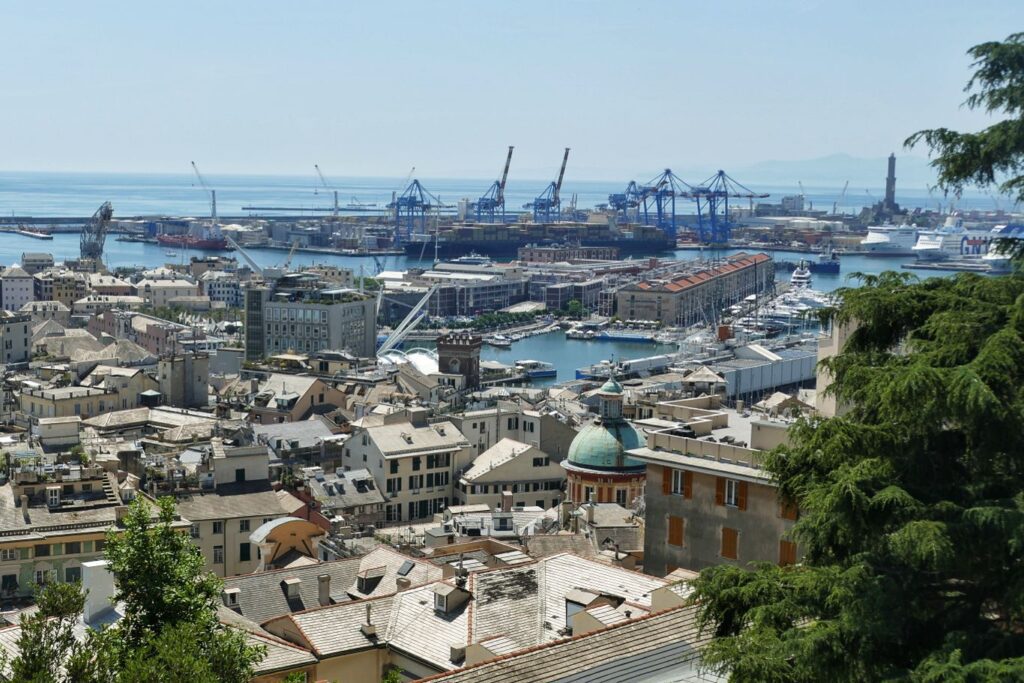
If you only have time for one hilltop, you should definitely take the Castelletto Levante Elevator, which connects the old town with the Castelletto district and takes you directly to the Spianata di Castelletto. From there, you’ll reach one of the best viewpoints overlooking Genoa.
The Castelletto Ponente Elevator is essentially the Levante’s twin, as it also runs between the city center and Castelletto, but along a slightly different axis.
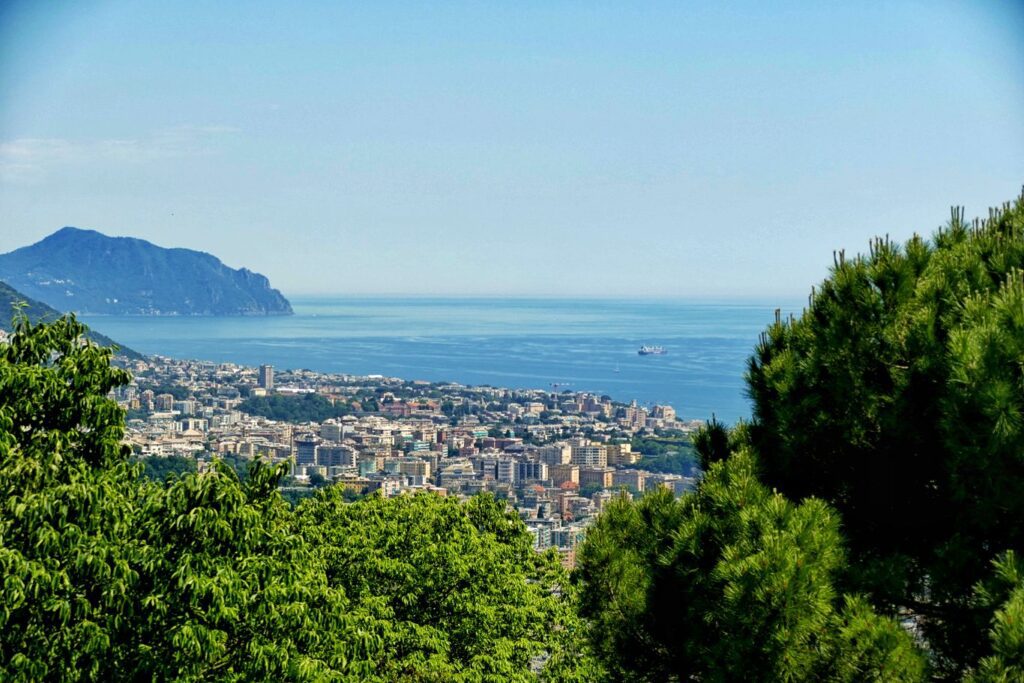
Finally, the Zecca-Righi funicular takes you to the even higher Righi region, from where you have a grand view of all the fascination pieces that form the city of Genoa, the Queen of Liguria.
Practical Information
How to Get There
Genoa Cristoforo Colombo Airport is located about 7 kilometers west of the city center in the Sestri Ponente district and offers international connections. The Volabus or Airlink bus connects the airport to the Genova Principe and Brignole train stations.
I know that Italian trains don’t have a great reputation. I can’t subscribe to that view. Having taken countless trains in Italy, I’ve never experienced any major disruptions or problems.
Compared to other European countries, train travel is very cheap—if you book well in advance, even in first-class coaches.
Also, Trenitalia, the national train company, has a very clear and well-functioning website. Here, you can make a reservation and, consequently, take advantage of great offers.
However, there’s one thing you have to be aware of when traveling to or from major Italian cities. They usually don’t just have one main train station, but rather several long-distance train stations serving different destinations. So when buying a ticket, always make sure to check the specific station in Genoa.
The Times They Are A-Changin’
Do you remember those days when you had to validate your ticket before boarding the train? I’ll never forget a trip from Venice to Florence when I realized about 90 seconds before departure that I hadn’t validated my ticket. Now I had the choice between racing to the machine on the platform and risking the train leaving without me. Or staying on the train with an invalidated ticket and risking the controller fining me.
What did I do? Well, with my heart pounding like crazy, I ran to the machine, had almost a heart attack when the train made this exhaling sound as if it was about to leave, yelled noooo, stamped the ticket, ran back, hopped on the train – off we went.
Well, good news: Those days are gone – at least when you buy your ticket online, which I highly recommend. Not only can you check in, hence, validate your ticket comfortably on your phone. You can also alter your booking before you check in!
That’s such a great service: You go online, choose your connection, and pay. Then you’ll get an email reminding you that your ticket isn’t valid until you check in online.
In fact, Trenitalia now handles check-in for you 15 minutes before departure. Until then, with flexible bookings, you have the freedom to rebook or even cancel.
Been there, done that, worked like a charm.
Therefore, I’d recommend refraining from checking in unnecessarily early.
Italian cities are also well connected to the national and European long-distance bus network, especially via providers like Flixbus. Although it’s a bit slower than taking a train, it’s often even more reliable and certainly much cheaper. As a matter of fact, on my last trip, I went from Venice to Genoa by Flixbus for as little as 15 €uros!
Buses usually stop at Genoa Principe train station, which allows for easy onward travel to the city center.
How to Get Around
The city center is easily explored on foot. Beyond that, more than 140 bus lines cover the entire city. These lines connect the districts along the coastline with those nestled in the numerous valleys and hills. A metro line links the city center with the Polcevera Valley. Funiculars and elevators provide quick access to viewpoints and higher-lying districts. A ferry service, the Navebus, runs between the Old Port and the western district of Pegli in just 30 minutes. From the sea, passengers enjoy magnificent views of Genoa while avoiding city traffic.
A single journey of up to 110 minutes costs around 2 €uros after validation. The 24-hour Genova Pass for 10 €uros quickly pays off. It is valid throughout the city for buses, subways, funiculars and elevators, the Navebus, and even Trenitalia’s regional trains!
Visiting Organized
Although I’m an avid solo-travelling woman, I sometimes like to join organized tours. This way, I get extended info about a place, and it’s fun to visit landmarks in the company of like-minded fellow travellers.
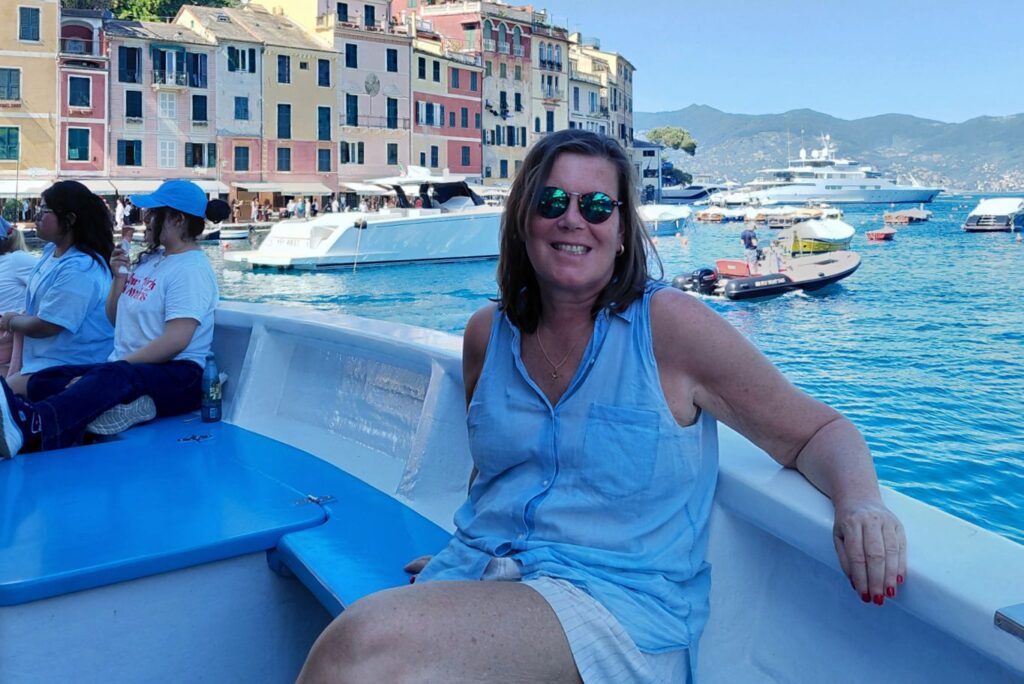
Especially in summer, Genoa can get really busy, and tickets to the most popular attractions like the boat tours tend to sell out well ahead. Therefore, booking tickets’n’tour in advance is definitely recommended*:
Where to Stay
The most authentic Genoa accommodations are found in the narrow streets of the old town or right on its edge, where small boutique hotels and simple B&Bs are tucked away in historic palazzi. Many accommodations are located in the heart of the labyrinth of caruggi, often in old city palaces with high ceilings and creaking staircases.
For something a bit quieter, but still very central, consider hotels around Piazza De Ferrari or towards Porto Antico. From there, you can reach the old town and the port in just a few minutes on foot, and you’ll find more comfort and better infrastructure, such as larger hotels or modern city hotels.
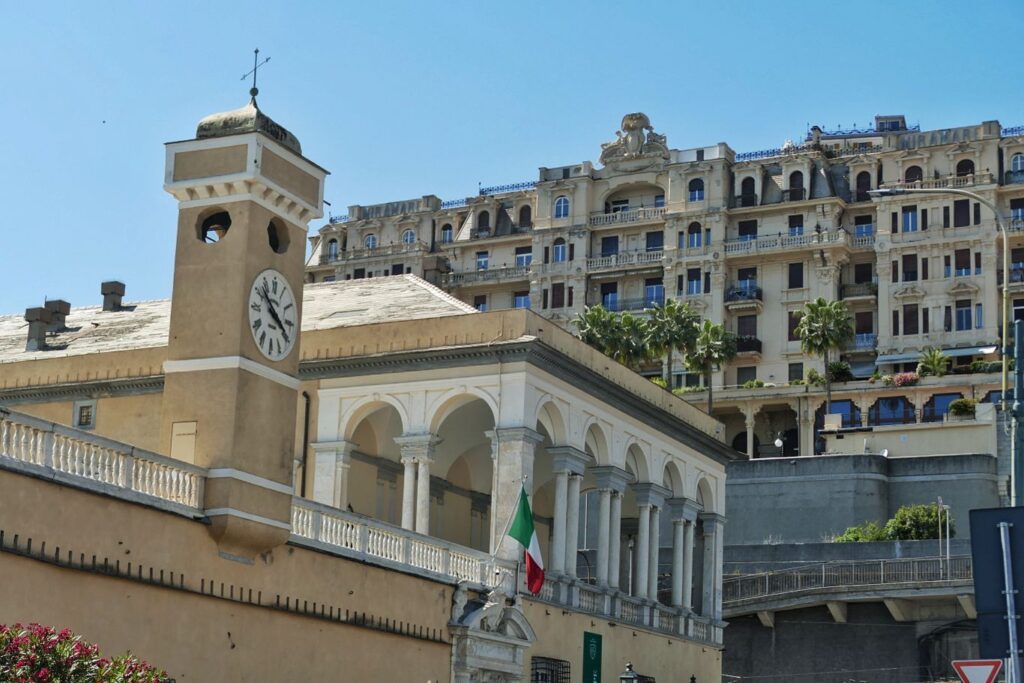
It stands behind the Palazzo del Principe, the main former residence of Andrea Doria and his family.
If you prefer more comfort or upscale accommodations, Genoa also offers several stylishly restored palazzi hotels and designer accommodations that combine historic architecture with modern amenities. Overall, the range of accommodations is surprisingly diverse, and on this map, you’ll find an accommodation according to your expectations, needs, and budget*:
Where to Eat
Where to Eat? Everywhere – it’s Italy, after all. Genoa’s cuisine is inextricably linked to the sea, the Ligurian hills, and a long tradition of simple yet richly flavorful everyday cooking. This is exactly what one would expect from a city that grew amidst its port, artisan workshops, and narrow streets. Many dishes appear simple, yet rely on a few high-quality ingredients.
A central dish is Pesto alla Genovese, renowned far beyond Italy’s borders, but in Genoa itself, it tastes noticeably fresher and greener than most exported versions. It is classically served with Trofie or Trenette Pasta and often combined with potatoes and green beans, typical of the region’s pasta tradition.
Another highly distinctive product is Focaccia Genovese. It’s less of a side dish and more of an integral part of daily life: enjoyed with coffee in the morning or as a quick snack during the day.
Also typical of Ligurian cuisine is the Farinata, a thin flatbread made from chickpea flour, water, and olive oil, baked in the oven. Slightly crispy on the outside and soft on the inside, it is often eaten fresh from the oven. It originates from a very old, simple culinary tradition and remains a classic street food in Genoa.
Overall, Genoese cuisine doesn’t appear elaborate or spectacular in the traditional sense. Its strength lies more in its simplicity: few ingredients, clear flavors, and a strong regional identity.
As a solo traveller, I’m not that keen on sitting down for a big lunch. Grabbing a snack to go is just fine. And in Genoa, those snacks are offered basically at every corner.
Another thing I love in Italy is the convenience food you get at supermarkets and smaller delis. There are various kinds of pasta, arancini, and gnocchi, there are pot roast and grilled chicken, accompanied by salad and roast potatoes. Everything is very tasty – and very Italian.
So if your accommodation has a microwave, buying food at supermarkets or delis is a great alternative. This way, you’ll get a full Italian meal and still save a lot of money.
Cash And Cards
Until now, 21 European countries have replaced their former local currency with the €uro starting in 2002. Obviously, Italy is one of them. The exchange rate is 1 US$ = 0.85 EUR as of June 2026. However, you can check today’s conversion rate on this page.
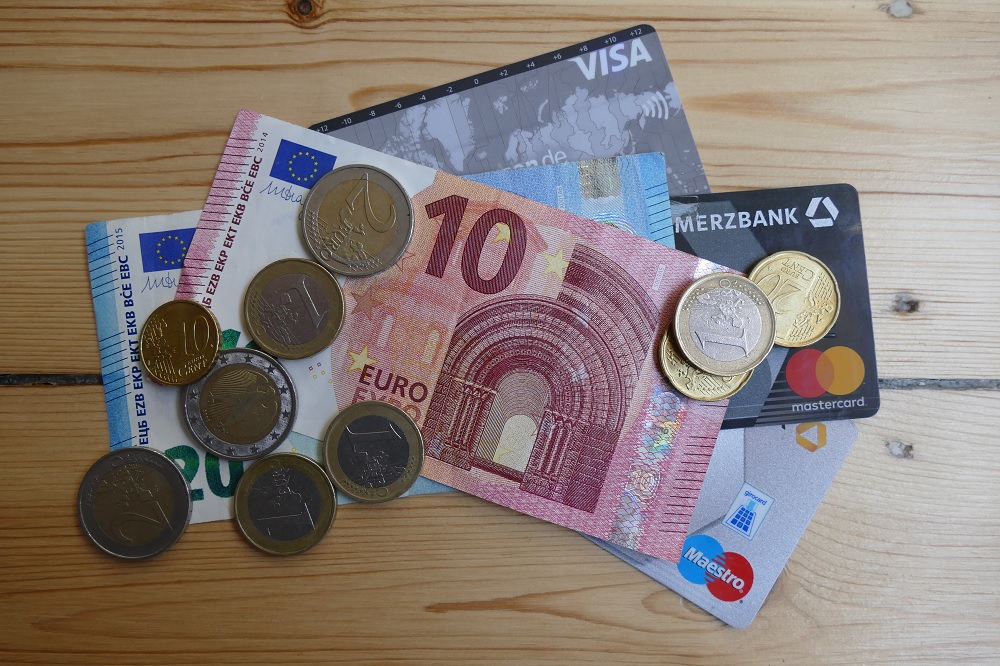
Mind you, paying by card is accepted basically everywhere.
Language
In Genoa, many people speak decent English. However, older people don’t really like to speak it, even when they are working in the service and tourism sector.
Zushini, Gnotchi, Raditcho – I’m bleeding from my ears as I hear these mispronunciations so often. Therefore, here are some general rules:
As in any other Romance language, C is hard when written before A, O, and U, hence, it’s pronounced K – as in Como. As for the letter G, it’s the same rule.
If followed by E or I, C sounds like tch as in witch and G like dj as in gene. Examples? Cinecittà and Genova.
Now, if a C is followed by E or I, but should be pronounced like a hard K, they slip in an H: Bruschetta, Zucchini, Gnocchi, Radicchio – Brusketta, Zukini, Gnoki, Radikio.
On the other hand, if C or G are followed by A, O, or U should be pronounced tch respectively dj, they slip in a – silent! – I: Ciocolata, Ciabatta – Tchocolata, Tchabatta respectively Formaggio or Mesaggio: Formadjo, Mesadjo – do not pronounce the I!
One Or Two?
What seems to be a bit tricky for foreigners is the Italian plural. Albeit it’s not that complicated. Apart from a few negligible exceptions, if a noun ends with an a, the plural ends with an e. In general, those are female nouns. Hence, one pizza becomes two pizze – and by no means pizzas! This also explains why I referred to squares above as Piazze: there are various of them.
A noun ending with an o gets an i at the end if it’s a plural. Those are male nouns. One gelato becomes various gelati.
Hence, if you order one sandwich, it’s a panino. If you order panini, they should give you at least two. I prefer tramezzini, anyway – therefore, I never order just one tramezzino.
Nouns that end with an e also have an i at the end. Those can be either female or male, but are far more seldom.
Connection and Communication
Since June 2017, no roaming charges have been applied within the EU with a European mobile phone contract. This applies in all 27 countries of the European Union, as well as in Great Britain, Iceland, Liechtenstein, and Norway, and to all contracts.
In case European roaming is unavailable, you can connect to the internet without any issue at basically every museum, eatery, café, and, of course, hotel.
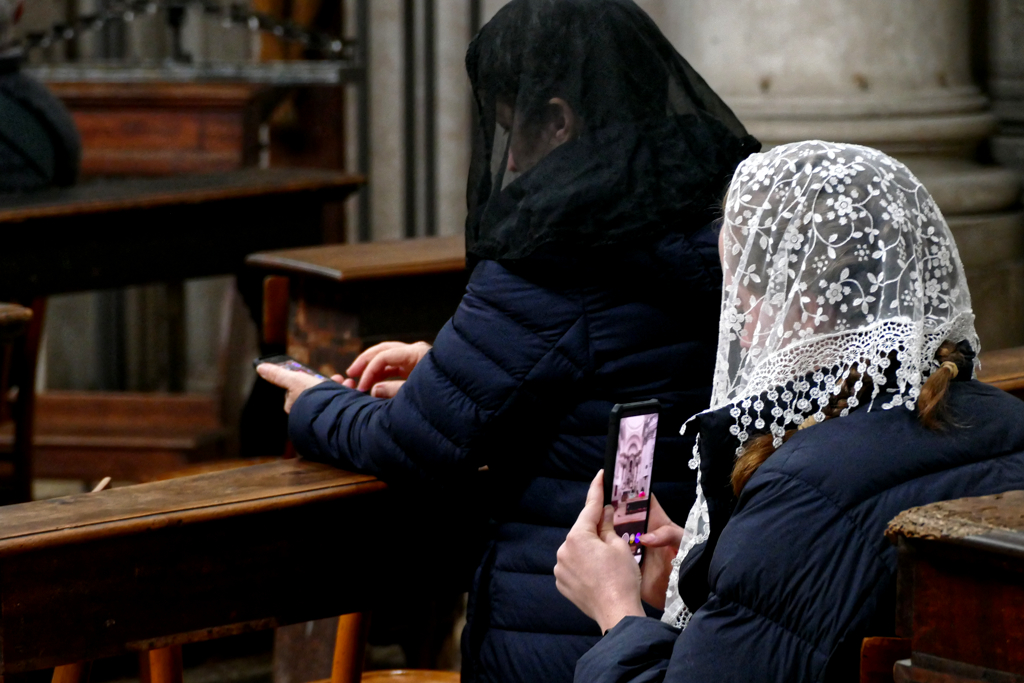
If you insist on being online 24/7, you can get a SIM card, obviously. There are prepaid SIM cards from various companies. For non-European travellers visiting Italy, the best SIM cards are Telecom Italia Mobile, in short, TIM. It is Italy’s largest mobile operator, with excellent coverage and data speeds. Their best plan should be TIM Tourist SIM, which supplies you bis 20 GB and 200 minutes to international numbers. It costs around 20 €uros and is valid for 30 days.
A good alternative is Vodafone Italy with their plan Vodafone Holiday. For 30 days, you get 30 GB and 300 minutes for calls, including international numbers, for around 30 €uros.
Finally, WindTre is a great option for budget-conscious travelers as their WindTre Tourist Pass offers 20 GB and 100 minutes for international calls and unlimited calls within Italy, all this also for 30 days.
However, e-SIM cards are the easiest way to stay connected as you arrange everything on the internet. Airalo’s plans start at 5 US$ for 1 GB and go up to 10 GB for 20 US$. Holafly’s unlimited data plans for Italy start at around US$19 for five days.
Get the Power
The standard voltage in Europe is 220 V, and the frequency is 50 Hz. In Italy, they use three plug types, namely C, F, and L.
However, nowadays, all these chargers have integrated adapters, and in general, the voltage and frequency don’t really matter. You only need an adapter for small appliances such as curling irons or hair dryers. But keep in mind that at basically every accommodation, you will have a hair dryer at your disposal.
You’ll find comprehensive travel info in my post World’s Most Complete Travel Information – an indispensable globetrotter classic.
Map
On this map, you’ll find all the wonderful places I’m introducing in this post.
Clicking on the slider symbol at the top left or the full-screen icon at the top right will display the whole map, including the legend.
Pinnable Pictures
If you choose to pin this post for later, please use one of these pictures:
Genoa is not only Liguria’s capital, but it’s also the perfect gateway for exploring this mesmerizing region on unforgettable day trips. In my posts BOCCADASSE, NERVI, CAMOGLI: Ligurian Coastal Escapes from Genoa and Take a Break: Day Trip from Genoa to CAMOGLI, SAN FRUTTUOSO, and PORTOFINO, you can choose between an excursion to the closest yet wonderful coastal towns and an exciting boat cruise to three of the most impressive spots along the Ligurian coastline.
Did You Enjoy This Post? Then You Might Also Like These:
How to Visit the Biennale di Arte in Venice in 2026
location location location – my adventurous accommodation choices

The Best Places to Visit in SICILY in One Week
A Day Trip to Isola delle Femmine: Coastal Trails And Crystal Waters
BOCCADASSE, NERVI, CAMOGLI: Perfect Escapes from Genoa along the Ligurian Coast
CINQUE TERRE – The World’s Most Picturesque Hiking Trails
How to Visit the Biennale di Arte in Venice in 2024
50 Most Beautiful Palaces in Venice
*This is an affiliate link. If you book through this page, not only do you get the best deal. I also get a small commission that helps me run this blog. Thank you so much for supporting me!