Basel is one of those cities that feels like it should be bigger than it is. Not in size – but in presence. Sitting right where Switzerland, France, and Germany meet, it exists in a constant cultural overlap: Swiss precision, French flair, and German structure all blending into something unexpectedly creative. Even if you spend just a weekend in Basel, you’ll quickly realize how much there is you simply shouldn’t miss – and in this post, I’m showing you the best of the best.
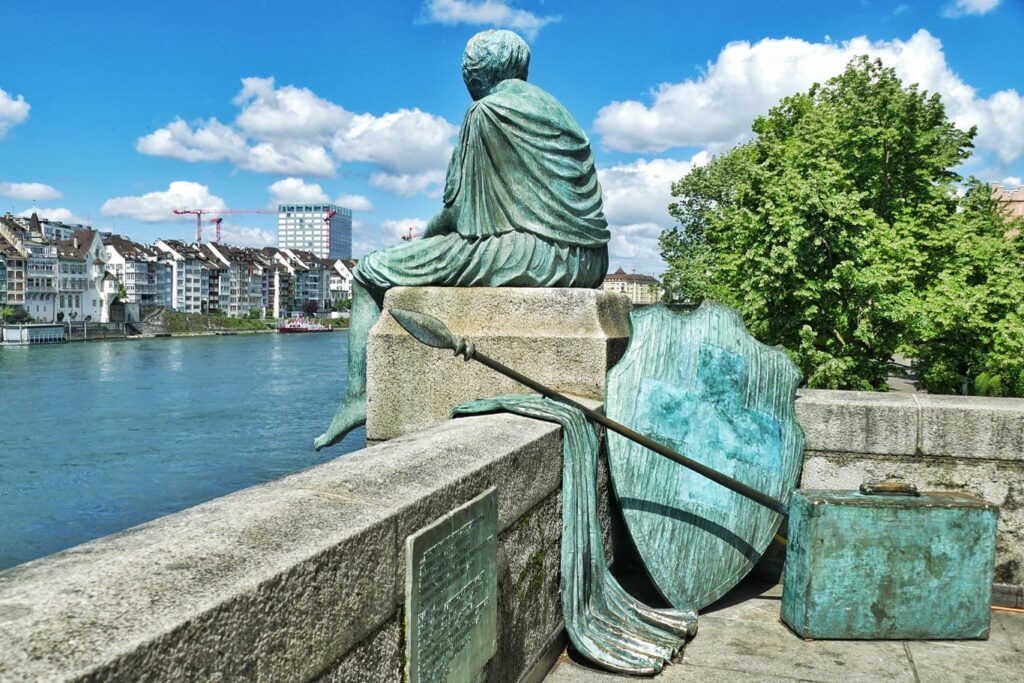
Back to Basel
I get off the train at Basel SBB station and am immediately overwhelmed by a feeling of insufficiency. Switzerland. Wealthy and quality-conscious. Reserved and elegant. Here, we Germans suddenly become Europe’s Americans: loud and boisterous, jovial and space-consuming. And poor, very, very poor. Not only is everything already much more expensive than elsewhere in Europe. In addition, they also have this currency, which is very close to the value of the Euro, but still slightly higher, so that everything is even more expensive than it already is in the first place.

So, why do I keep coming back here? Well, for one thing, there are logistical reasons: Switzerland is right in the heart of Europe, and I’m travelling from the north on my way to Italy. But far more important are my sentimental reasons. Switzerland is outstandingly beautiful. And Basel, in particular, is also an immeasurable treasure trove of art. There’s a reason why Art Basel made it not only across the Atlantic to Miami but also to Hong Kong in 2013.
Another reason for my enthusiasm for Basel lies in its geographical location at the tripoint of France, Germany, and Switzerland. Three completely different countries, harmoniously connected. As a matter of fact, you exit Basel Airport through three different doors to either Mulhouse in France, Freiburg in Germany, or Basel on the Swiss side, obviously. In this spot, borders connect instead of dividing. If you happen to choose the wrong exit, you won’t be threatened or harmed. Sadly, this is very different at many tripoints across the world.
For me, the tripoint of Basel reflects the beauty of European cooperation.
Fun Fact
Incidentally, there is a remarkably high number of such tripoints in the German-speaking part of Europe: Austria has nine, Germany has seven, and Switzerland has six.
Switzerland is Different
Why does tiny Switzerland stand out so much from the rest of Europe? Well, today’s Switzerland is the result of an unusual historical development that differs significantly from that of many other European states. Its origins lie in a loose alliance of small regions: In 1291, the so-called original cantons of Uri, Schwyz, and Unterwalden joined together in a defensive alliance. This alliance, from which the Swiss Confederation later emerged, was not a unified state for centuries, but rather a network of largely independent territories bound by common interests.

Only through external influences did a modern state begin to take shape. A decisive turning point was the French invasion of Switzerland under Napoleon Bonaparte, which led to the establishment of the centrally organized Helvetic Republic. However, as early as 1803, the system was loosened, granting the cantons greater autonomy. After the end of the Napoleonic era, Switzerland’s permanent neutrality was internationally recognized at the Congress of Vienna in 1815. With the Federal Constitution of 1848, Switzerland finally developed into a modern federal state.
Same Same But Different
This strong emphasis on regional autonomy is also reflected in the country’s cultural divisions. Switzerland is divided into three major cultural regions: German-speaking Switzerland, which comprises the largest part of the country and is economically dominant. The French-speaking Romandie lies in the west, and the Italian-speaking Ticino and parts of Graubünden are in the south. These parts are complemented by a fourth, considerably smaller language community called the Romansh, primarily based in the canton of Graubünden.

The existence of four national languages—German, French, Italian, and Romansh—is not accidental, but rather the result of geographical, historical, and political factors. For a long time, the Alps acted as natural barriers, allowing individual regions to develop relatively independently and maintain distinct linguistic influences. Instead of unifying this diversity, a conscious political decision was made to preserve and institutionally safeguard it. It is important to note that Switzerland is not a fully multilingual country in everyday life.
At the same time, direct democracy plays a central role: citizens can regularly vote on specific issues and thus directly influence legislation. For example, in 1992, the Swiss population voted against joining the European Economic Area.
Fun Fact
Switzerland only introduced women’s suffrage at the federal level in 1971, as one of the last countries in Europe. In the canton of Appenzell Innerrhoden, however, women were only able to vote at the cantonal level in 1991!
Art in Basel
In a country associated with order, neutrality, and restraint, its cultural history acts as a quiet counterpoint. In Switzerland, art is constantly emerging that doesn’t loudly attack this surface, but rather subverts it with irony and a wink. As if superficial stability creates space for creative instability.

Art is understood as an experimental setup in the real world. Hence, the number of innovative and eccentric Swiss artists is absolutely mind-blowing. Already a hundred years ago, the Dada movement started at Zurich’s Cabaret Voltaire. These pioneers were followed by conceptual artists like Pipilotti Rist, Peter Fischli and David Weiss, Roman Signer, Urs Fischer, Dieter Roth, and musicians like Dieter Meier.
Now you’re probably eager to see Basel’s incredible art treasures for yourself. No problem, amazing examples are all around. So, put on some comfortable shoes and let’s go!
Tinguely in Basel
In Basel, Jean Tinguely perfectly exemplifies this approach to art. His works are not just objects. They are mesmerizing systems that transmit messages through movement and noise.

Strolling through Basel, you encounter Tinguely again and again in the form of movement, sound, and playful stimulation. Although born in the Swiss town of Fribourg, he received his training in Basel and remained loyal to the city throughout his life. In fact, hardly any other artist has shaped the cityscape in such a distinctive and charming way.

Moving Art
Tinguely’s work thrives on the idea that art doesn’t have to be static. His machines rattle, turn, and sometimes seem almost defiant. This is precisely where their poetry lies. A particularly accessible place to experience this is the Museum Tinguely, obviously. The building, designed by Mario Botta, houses works from all phases of his career. Here, you can marvel at his playful wonder machines from Tuesday to Sunday between 11 a.m. and 6 p.m., Thursdays until 9 p.m. for an entrance fee of 18 CHF.

But Tinguely doesn’t belong only in museums. Even at EuroAirport Basel-Mulhouse-Freiburg, travelers are greeted by one of his kinetic works, whetting their appetite for more. And right in the heart of the city, the famous Tinguely Fountain in Theaterplatz surprises. Metal figures dance in the water as if they have developed a life of their own.

It’s a work that seamlessly integrates art into everyday life: playfully, yet full of depth.
Creative Companions
Tinguely’s life and work are also closely intertwined with those of other artists. His relationship with Niki de Saint Phalle, with whom he shared a close personal and artistic connection, was particularly formative. Her colorful, sensual figures form a fascinating contrast to Tinguely’s mechanical constructions. Together with her, he created the famous Stravinsky Fountain in Paris. I introduce it in my post What Not to Miss in Paris: 20 Must-Dos, Not Only for First-Timers.

Less prominent, but an equally important part of his biography, is his first marriage to the artist Eva Aeppli. Her works create a quiet, almost melancholic counterpoint to Tinguely’s noisy machines.
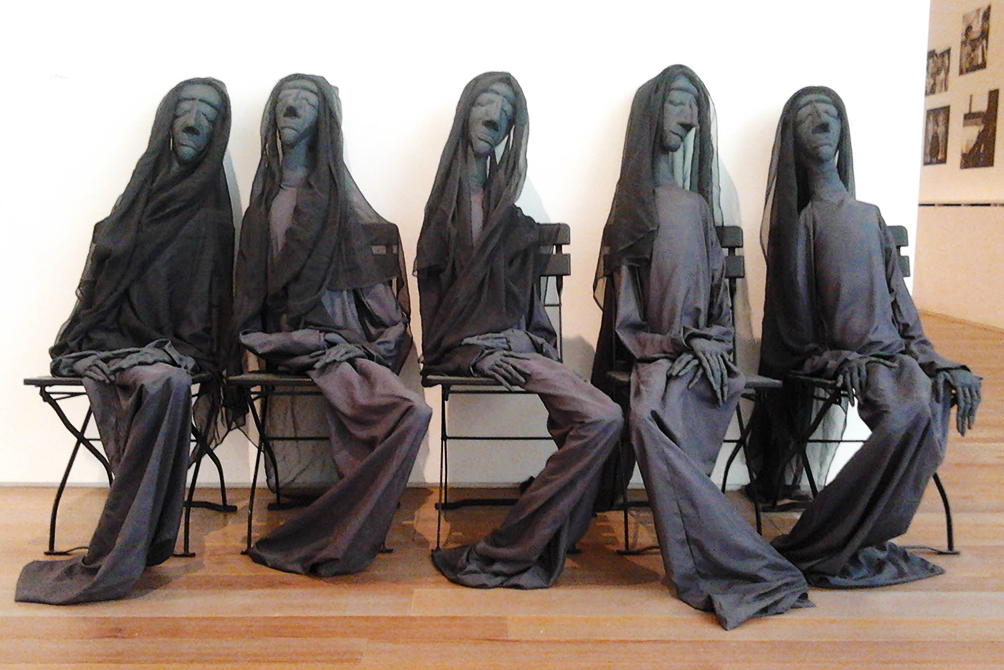
Basel honors this extraordinary artist not as a monument, but as a vibrant part of the city. His works invite viewers to pause, observe, and smile with fascination. This is precisely where Tinguely’s enduring power lies: he made the world a little more dynamic.
Kunstmuseum Basel: One Museum, Three Venues
If you had to pick a must-see among Basel’s nearly 40 museums, it would undoubtedly be the Kunstmuseum, hence the Museum of Fine Arts. It is one of the oldest public art museums in the world and is closely linked to the history of the city of Basel itself. Its roots reach back to the early 17th century, when the city acquired the collection of Basel’s mayor, Basilius Amerbach, in 1661. This collection formed the core of what later became the museum.

Over the centuries, the collection grew steadily, and in the 19th century, it became a public museum that no longer merely reflected the interests of private collectors, but was a cultural institution for the city’s community.
A Significant Development
In the 20th and 21st centuries, the museum gradually developed into the current ensemble of three buildings, each representing different periods and artistic traditions. The historic main building on St. Alban-Graben houses the classical collection from the Renaissance to early modernism and thus forms the museum’s art historical foundation. The adjacent new building expands this collection to include modern art and allows for larger, more flexible presentations. With the third building on St. Alban-Rheinweg, the museum finally opens itself completely to contemporary art. There, it is often presented in an installation-based, experimental, and process-oriented fashion.

The Kunstmuseum Basel is therefore not merely a repository. The system of three interconnected spaces makes the different states of art visible: historically rooted, modern in transition, and contemporary in experimentation.
Sounds compelling? It absolutely is!
As I said at the beginning: Even if you don’t visit any of Basel’s other museums, you can’t miss the Kunstmuseum.
Plan Your Visit
The two main venues at the St. Alban-Graben are open from Tuesday to Sunday from 10 a.m. to 6 p.m. On Wednesdays, they are closing only at 8 p.m. Admission is CHF 30.

The contemporary part next to the Rhine River does not have regular opening hours. It opens depending on the program. Therefore, admission is not automatically included in the standard ticket, but depends on the specific exhibition.
Fondation Beyeler
The Fondation Beyeler is one of Switzerland’s most important art museums and is located in Riehen, just a few minutes from Basel’s city center.

The museum, which opened in 1997, is based on the private collection of Basel gallery owners Ernst and Hildy Beyeler, who built an internationally renowned collection of classical modern and contemporary art over decades. Yet, the Fondation Beyeler is particularly known for its temporary exhibitions.
The experience therefore depends a lot on what kind of art you prefer. I’ve seen some fantastic exhibitions there, but also quite a few that didn’t exactly blow me away. Before you make the trip just for one exhibition, check what’s currently on.

Architecturally, the museum was designed by the renowned Italian architect Renzo Piano, who also created the Centre Georges Pompidou in Paris, the Stavros Niarchos Foundation Cultural Center in Athens, and restored the old harbor in his hometown Genoa. The building is set within a spacious park with meadows, trees, and ponds. Large glass fronts seem to create a seamless transition between the interior and exterior spaces.
The Fondation Beyeler is open 365 days a year from 10 a.m. to 6 p.m., and until 8 p.m. on Wednesdays. The general entrance fee is 25 CHF.
Out of Basel: Crossing Borders
Especially if you’ve already made the trip to the Fondation Beyeler in Riehen, I highly recommend a roughly one-hour walk across the border into Germany, particularly on a nice day. Starting in 2015, this hiking trail, which winds through fields and past vineyards, was decorated by Tobias Rehberger’s fantastic art project 24 Stops. Unfortunately, it was only designed to last for ten years and has been gradually dismantled since October 2025.
Nevertheless, the walk is worthwhile; you simply cross the border and find yourself in Weil am Rhein. I’d daresay that 95 percent of Germans have never even heard of this town. Yet, it’s home to one of Europe’s greatest cultural institutions, the Vitra Campus.
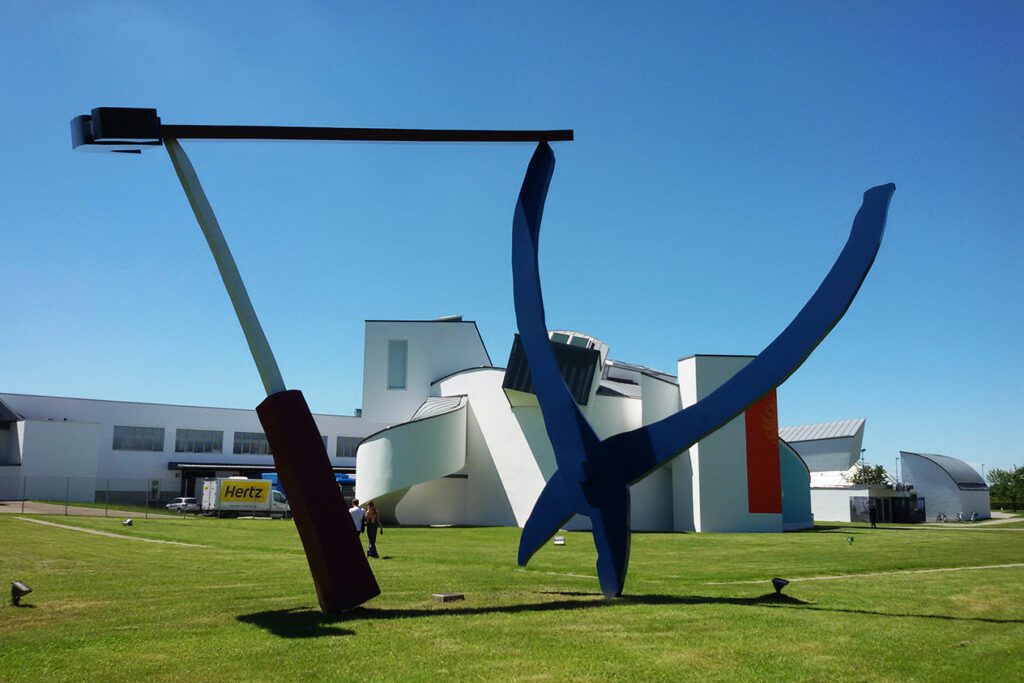
Vitra is an internationally renowned manufacturer of designer furniture based in Switzerland. The company has collaborated with prestigious designers and architects for decades, producing numerous iconic pieces that are now considered classics of modern design. The Vitra Campus is an important part of the brand. It is a remarkable ensemble of modern architecture.
Art in the Streets of Basel
Those who only experience Basel through its museums are missing a significant part of the city. Public art is an integral part of everyday life here: in squares, courtyards, on traffic islands, and along the paths through the neighborhoods.

After the iconic Tinguely Fountain, it’s worth taking a closer look, because Basel is, in the truest sense, an open-air city gallery. Those who pay attention will effortlessly collect their own little open-air art collection.

What’s particularly fascinating is how diverse the art appears here. Some works make striking statements and immediately draw attention, while others are only discovered upon closer inspection.


(The photo of the Hammering Man was optimized using AI)
Take a Close Look
Monumental sculptures meet poetic details, historical works stand alongside contemporary interventions. It’s precisely this juxtaposition that makes the hunt for art in Basel’s streets so exciting.

Instead of a hero or historical event, Ilya Kabakov erects a Monument to a Lost Glove. The installation makes it clear that even a randomly discarded object can trigger memories, fantasies, and entire life stories.
I’ve also featured the magnificent works in which Kabakov and his wife Emilia create monuments to everyday heroes in my posts on Essen and the current Biennale di Arte. They are definitely worth checking out.
You’ll find the most interesting works on the map at the end of this post.
Opening hours? 24/7!
Admission? CHF 0.00!
Art on the Walls of Basel
I’d argue that by now, there’s no city in the world that doesn’t boast at least some murals. And Basel, too, showcases its creative side not only in museums and squares, but also on large walls, underpasses, and hidden corners of the city. Anyone looking for street art here will find far more than just quick tags or random scribbles.

Monumental murals lend Basel a fascinating contrast. Amidst the historic old town, elegant architecture, and well-maintained streets, vibrant, colorful motifs suddenly appear—sometimes abstract, sometimes political, sometimes playful, sometimes photorealistic. They bring color to the urban landscape and often tell stories about identity, society, or life in the city.

What’s particularly appealing is that many of these works aren’t located in the traditional city center, but in neighborhoods you wouldn’t necessarily visit otherwise. A stroll through former industrial areas, along railway lines, or through lively residential neighborhoods quickly becomes a mini-adventure.
Dreispitz – Between Tracks, Art and New Beginnings
In my tireless hunt for street art, I’ve already taken you to the most hidden, deserted, and sketchy corners of cities. Whether in high-rise housing estates in Amsterdam, Copenhagen, Seville, Lisbon, or Marseille: the art was beautiful, the surrounding area less so.

Even in Basel, you have to take the tram out of the city center to see the best murals. But even though the Dreispitz neighborhood is further out, it’s not abandoned. On the contrary, it’s up-and-coming. Infact, it is one of Switzerland’s most exciting urban development districts. Known today as a cultural, educational, and commercial hub, the area owes its name to its distinctive triangular shape.

Originally, it was agricultural land which developed at the beginning of the 20th century into a major material storage site and later into a bonded warehouse with its own rail infrastructure. For decades, warehouses, railway tracks, and logistics companies shaped the area.

Following structural changes, the Dreispitz increasingly lost its original function. Since the early 2000s, the formerly enclosed industrial area has been gradually transformed into an open and diverse urban district.

A significant milestone was the establishment of the so-called Arts Campus. This has been joined by other cultural institutions. Former warehouses and industrial spaces have been repurposed and now offer room for studios, exhibitions, and creative projects.
Old Town And the River Rhine
Do I hear you complaining that this introduction should traditionally have been at the beginning of our visit to Basel? Agreed, but we’re in Switzerland, and as you have learned, beneath the squeaky clean surface, a simmering layer of disobedience and rebellion festers. And so, I’ve put the cart before the horse and will now take you on a final tour through Basel’s charming old town and along the Rhine’s lovely river promenade.
As they say: it’s last but not least!

The tour begins at the Spalentor, Basel’s most beautifully preserved city gate. Built in the 14th century as part of the medieval city fortifications, its two round towers, clock tower, and colorful tiled roofs make it one of Basel’s most picturesque sights.

From here, a series of delightful streets and alleyways stretch eastward to the historic center. Keep your eyes peeled, as there are many charming old houses, small shops, and the occasional surprising piece of public art to discover! Just look at the Mark Jenkins’ installation that I’ve introduced above!

Once you arrive at the Market Square, Basel’s iconic buildings await you. With its bright red facade, richly decorated frescoes, and distinctive tower, the Town Hall is one of the city’s most beautiful buildings. Built in the early 16th century, it remains the seat of Basel’s government.
Going Up
For the best views, however, head uphill from the Market Square towards the Basel Minster. It is one of Basel’s most important landmarks, and with its red sandstone walls and two towers, it dominates the city skyline on the Rhine.

Even more iconic is the Minster’s terrace, also known as the Pfalz, located behind the church. From here, one has arguably the most beautiful view of the Rhine and Kleinbasel on the opposite bank.
Like a magnet, the Rhine, the lifeline of many cities in Germany and Switzerland, draws visitors down to the river promenade.
Along the Rhine to the Mittlere Brücke
An idyllic stroll to the Mittlere Brücke, which translates to Middle Bridge, leads along Augustinergasse and Rheinsprung. Alongside beautiful rows of historic houses stands the famous pair of buildings known as the Blue and White Houses. Built between 1763 and 1775 in the elegant Baroque style, they were designed by the architect Samuel Werenfels. They were commissioned by wealthy members of the Sarasin family, who had amassed a great fortune through silk ribbon production.

Just a few minutes’ walk away, Basel’s most famous Mittlere Brücke spans the Rhine, offering fantastic views of both sides of the Old Town. The best vantage point is from the center of the bridge, looking towards the Basel Minster.

Instead of walking across the bridge, you can also take a ferry. These ferries aren’t a typical means of transport, but rather unique landmarks of the city. They have connected Greater Basel and Lesser Basel for centuries, but today they are primarily a popular tourist attraction.
Along the Rhine to the Schwarzwaldbrücke
Honestly, I prefer the route from the Minster towards the Schwarzwald Bridge. Right behind the Wettstein Bridge lies the St. Alban Tal. This neighborhood is one of Basel’s most charming areas and is often called Little Venice. This nickname becomes immediately apparent as soon as you stroll along the small canals and past historic buildings. Small bridges, winding alleyways, and the gentle lapping of the water create an almost fairytale atmosphere.

The heart of the area is the St. Alban Pond, an artificial canal that was used to power mills as early as the Middle Ages and now flows idyllically through the district. Lovingly restored houses, old commercial buildings, and shady paths line the water, inviting you to take a relaxing walk.

Among the main attractions is the Basel Paper Mill, an interactive museum where visitors can experience traditional papermaking firsthand. Nearby is the St. Alban Gate, one of the best-preserved city gates of the medieval fortifications, offering an impressive glimpse into Basel’s history.
My Tip
The Rheinbad Breite is one of Basel’s most popular river bathing spots. Unlike traditional swimming pools, it’s located directly on the riverbank in the Breite district, allowing visitors to drift with the natural current. A particularly characteristic feature is the so-called Rhine swim, where you enter the water upstream and then relax and float back downstream.

From October to March, the Rheinbad Breite transforms into a unique wellness oasis, as the Sauna am Rhy opens its doors for the colder months.
Bus Auf der anderen Seite des Rheinufers erwartet dich junges, lebendiges Basel mit Cafés, Bars und
Relaxing And Recovering at the Mövenpick Hotel Basel
And once we’re on the topic of wellness and relaxation, I’d like to recommend the perfect home away from home for your trip to Basel, namely the Mövenpick Hotel*, located just minutes from the main station and basically every place of interest imaginable.

After a long day full of the stark contrast to the tranquil image, pristine clichés, and perfectionist everyday life and Switzerland’s provocative and sarcastic contemporary art scene, I return to the Mövenpick Hotel*, and there, tranquility, cleanliness, and perfection immediately envelop me like a warm, soft bathrobe. That’s when I truly appreciate traditional Swiss virtues!
The Mövenpick Hotel Basel* is a haven, a serene counterpoint to the city’s playful energy. An oasis where you can recharge.

Architect Matteo Thun used materials full of quiet elegance for his design. This sleek understatement continues inside. It’s a place that grants guests enough space to arrive, to respire, and to relax. Especially in a city as culturally rich as Basel, this form of hospitality takes on an almost understated quality.
The name Mövenpick behind it all is more than just a detail. Mövenpick is indeed a Swiss invention, born in the 1940s when Ueli Prager had the idea of making high-quality dining more accessible. Less formal, yet with a clear commitment to quality. Over the decades, this has become a brand that has almost reached institutional status, even beyond the borders of Switzerland.

And the name? Mövenpick alludes to the seagull selectively pecking a morsel from the water. It’s an image that seems a little out of time, however, it is still absolutely appropriate.
Practical Information
Know Before You Go
As previously explained, Switzerland is not a member of the European Union. This special status has some practical consequences for tourists. While travel is straightforward, as Switzerland is part of the Schengen Area, there are some differences compared to the EU that should be considered. The currency in Switzerland is the Swiss franc, which often makes travel more expensive, as the overall price level is significantly higher than in many EU countries. Furthermore, EU roaming regulations do not apply there, so mobile data and calls can incur additional charges.
Switzerland also operates independently under customs law, as it is not part of the EU Customs Union. Therefore, customs checks and duty-free allowances may be relevant when entering or leaving the country. Overall, Switzerland remains a very accessible and attractive destination for travelers, but requires a bit more attention to costs and practical details than EU countries.
How to Get There
Basel is located in the border region of Switzerland, Germany, and France and is therefore very well connected to the European transport network. The city is easily and quickly accessible from many directions.
EuroAirport Basel-Mulhouse-Freiburg is only about 20 minutes from the city center. From there, bus number 50 takes you directly to Basel SBB, the main train station.

Basel is one of Switzerland’s most important railway hubs and is very well integrated into the European high-speed rail network. There are direct train connections to Germany, France, the Benelux countries, and other European cities. The city has three train stations: Basel SBB, Basel Badischer Bahnhof, and Basel SNCF, which are closely interconnected and offer fast connections to the city center.
Basel is also connected to the European long-distance bus network, particularly through providers like Flixbus. There are direct connections to many German and French cities.
How to Get Around
Basel is a compact city that’s easily explored on foot. The Old Town, the Rhine promenade, and many cultural hotspots are all within easy walking distance. The city is particularly pleasant to discover on foot along the Rhine.
Cycling is also playing an increasingly important role in Basel. There are well-developed cycle paths and numerous rental options for bicycles and e-bikes. The topography is mostly flat, which further facilitates cycling.

At the same time, Basel boasts a very well-developed and reliable public transport network that covers the entire city and the surrounding area. The backbone of mobility in Basel is its dense network of trams and buses. Many lines run every couple of minutes during the day, and somewhat less frequently in the evenings.
A major advantage for overnight guests is that Basel accommodations automatically provide the Basel Card, which allows free use of public transport within the city limits. It also offers discounts at many museums and attractions.
All other visitors can purchase single tickets, day tickets, or multi-journey tickets from vending machines, via app, or at sales points.
Vising Organized
I’m an avid solo-travelling woman. Since solo travel doesn’t equal solitude, I love to join organized tours here and there. They allow me to meet fellow travellers – for just a short moment or a lifelong friendship.
Especially if you have only a short time for exploring Basel, an organized activity will enable you to see the most in a relatively short period of time. However, make sure to book the activities of your choice well ahead, especially during the high season*:
Where to Stay
I have described the Mövenpick Hotel Basel*, which perfectly complemented my stay, in detail above. However, if it should be booked out, you can look for accommodation that suits your expectations, needs, and budget on this map*:
What to Eat
Swiss cuisine is strongly influenced by regional traditions, blending Alpine heritage with influences from neighboring Germany, France, and Italy. The culinary offerings are correspondingly diverse, ranging from rustic to ultra-modern.
Typical Swiss dishes often feature simple, high-quality ingredients. Cheese dishes like fondue and raclette are well-known examples, particularly popular during the colder months. Rösti, a crispy fried potato specialty, is also considered a classic Swiss dish and is frequently served as a side.
In the cities, a vibrant international culinary scene has developed, encompassing everything from street food to fine dining. Switzerland is renowned for its high culinary standards, reflected in its many excellent restaurants.
Basel occupies a special place within Switzerland, as it borders France and Germany. This location significantly shapes the local cuisine.
In addition to classic Swiss dishes, Basel boasts a thriving bistro-style and upscale dining scene, often with French influences. Simultaneously, there is a lively array of cafés, bakeries, and modern restaurants with an international focus.
Seasonal specialties and regional products, such as those from the Basel countryside or the Jura Mountains, are also typical of Basel and are frequently used in upscale cuisine. Game plays a particularly important role in autumn, while light, fresh dishes dominate in summer.
The Rhine riverbank is another culinary hotspot, where numerous small restaurants and food stalls can be found during the warmer months. Here, dining is often combined with a relaxed, urban atmosphere right on the water.
Cash and Cards
Until now, 21 European countries have replaced their former local currency with the €uro starting in 2002. As I already mentioned, Switzerland is not one of them. The exchange rate of the Swiss Franc is 1 CHF = 1.27 US$, respectively 1 CHF = 1.09 €UR as of July 2026. However, you can check today’s conversion rate on this page.
Obviously, you can also pay by credit card, as well as contactless, practically everywhere.
Language
So you arrive in Basel, in the German-speaking part of Switzerland, with the German you learned in school – and you don’t understand a word! Nevertheless, at least the written version is exactly as you learned it.
Well, you should know that Swiss German, locally called Schwyzerdütsch, varies significantly from Standard German in everyday use. The vocabulary, pronunciation, and even some grammatical structures differ so markedly that even most native German speakers have difficulty understanding. However, apart from a few die-hard Alpine folk, every Swiss person will be able to switch to Standard German immediately.
By the way, the situation is quite different with Swiss French and Italian. These language variants differ only slightly from the standard languages of France and Italy, respectively. Therefore, French and Italian speakers can generally communicate in Switzerland without major problems.
Say It Right
In this post, I’m writing out some of the German names of brands and places. Obviously, you will notice that there are letters that might not exist in other languages.
Firstly, there is the letter ß, which exists only in the German alphabet. It’s by no means a B – it’s a so-called sharp S. You pronounce it like the double S in kiss. So, although the German word for street, Straße, looks quite exotic, it is simply pronounced Shtrasse. Mind you, when an S stands before a T, it becomes sh instead of s.
Then, there are three more vowels, ä being the easiest one since it’s pronounced like an open e as in head. For some foreigners, ö and ü might be a bit tougher. Ö is pronounced more or less like the e in her. Finally, Ü sounds a bit like the u in huge.
Connection and Communication
Since June 2017, no roaming charges have been applied within the EU with a European mobile phone contract. However, this does not apply to Switzerland. Therefore, mobile internet can quickly become expensive, which is why a local SIM card or eSIM is usually worthwhile for visitors.
Within Switzerland, there are three major mobile network operators: Swisscom, Sunrise, and Salt. Salt is generally the cheapest option and works well in urban areas like Zurich, Basel, and Geneva, but its coverage can be somewhat weaker in remote regions.
For short stays, all three providers offer prepaid plans that you can use without a long-term contract. You can usually activate them directly at the airport, in mobile phone shops, or sometimes online. A particularly convenient feature is that eSIM options are now widely available, eliminating the need for a physical SIM card.
The standard voltage in Europe is 230 V, and the frequency is 50 Hz. In Switzerland, they use three plug types: C and J, with the latter being one of these uniquely Swiss features.
Since now, all these chargers have integrated adapters, in general, the voltage and frequency don’t really matter. You only need an adapter for small appliances such as curling irons or hair dryers. But keep in mind that at basically every accommodation, you will have a hair dryer at your disposal.
You’ll find comprehensive travel info in my post World’s Most Complete Travel Information – an indispensable globetrotter classic.
Map
On this map, I’m showing you where to find the spots you should not miss during your visit to Basel. Clicking on the slider symbol at the top left or the full-screen icon at the top right will display the whole map, including the legend.
Pinnable Pictures
If you choose to pin this post for later, please use one of these pictures:


If you have only a day in Basel, my post 24 hours in Basel provides the perfect itinerary!
Did You Enjoy This Post? Then You Might Also Like These:
Best Things to Do in AIX-EN-PROVENCE in One Day
United Colors of Biennale – Visiting the Biennale di Arte in 2017
TORCELLO – a church, a bridge, and 15 residents
Two Days in MARSEILLE – What Not to Miss in the Belly of France
Weekend in VALENCIA. Ten Reasons Not to Miss Out on a Visit
BORDEAUX: Best Street Art on the Right Bank of the Garonne
How to Avoid Copyright Infringement: Unexpected Traps
Best Street Art in LISBON – Part I: Graça And Beyond
Disclaimer: I was invited to stay at the Mövenpick Hotel Basel. Also, Basel Tourismus supported my blogger trip by supplying me with a Museum Card. However, all opinions on these services are mine and weren’t by any means influenced by my cooperation partner.
*This is an affiliate link. If you book through this page, not only do you get the best deal. I also get a small commission that helps me run this blog. Thank you so much for supporting me!