So you’re looking for a city trip to a place that’s as trendy as Amsterdam, but without the crowds? A place bursting with Flemish architecture and history like Brussels, but without the hectic pace of a capital city? And one with the creative energy and outstanding design of Copenhagen, but without the Scandinavian price tag? Don’t look any further, as Antwerp unites all those strong suits and still keeps a very laid-back vibe.
In this comprehensive guide to Antwerp, I show you what to see and do in three days – the obvious as well as the very unexpected.
- This is Antwerp
- A Grand Entrance – Antwerp Centraal
- Diamonds Are Forever
- A Shtetl in Metropolis
- Gateway to the World
- Scheldt River and Port of Antwerp-Bruges: An Economic Engine
- The Gilded Age
- The Pillars of Spiritual And Secular Power
- The Pillars of Art And Science
- The Pillars of the Upper Class
- Peter Paul Rubens – Antwerp's Favorite Son
- Virgin Mary Everywhere
- Urban Art
- Practical Information
- Map
- Pinnable Pictures
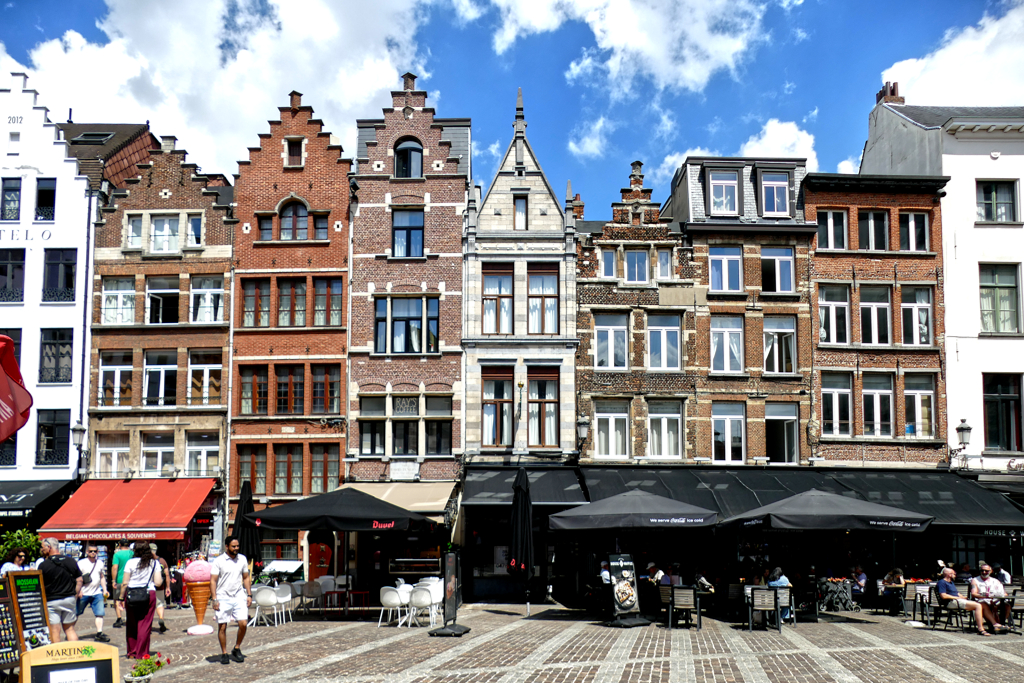
This is Antwerp
Antwerp is Belgium’s largest city – yes, it indeed has more inhabitants than Brussels – and home to Europe’s second-largest port. Culturally, it is famed for its historic old town and its vigorous arts and fashion scene. Last but not least, Antwerp has been a global center for the diamond trade for centuries.
Already at this point, you can see how much Antwerp has to offer.
And you’ll be surprised how much is yet to come!
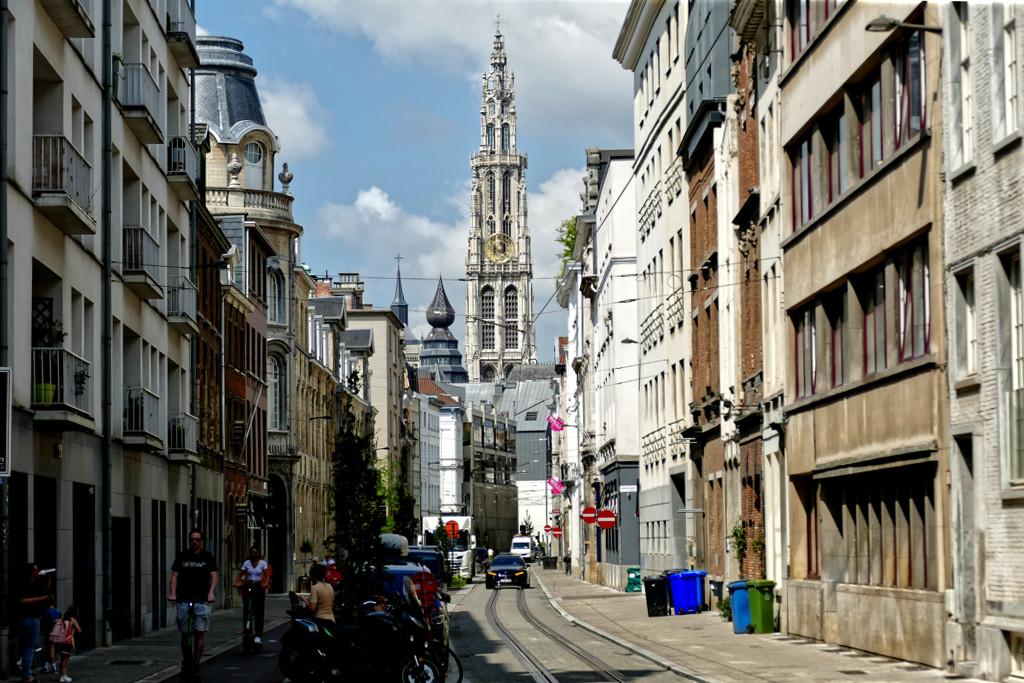
Particularly due to its location on the Scheldt River, Antwerp developed into a major trading city during the Middle Ages. As early as the 12th and 13th centuries, the city attracted merchants from all over Europe.
Then, in the 16th century, Antwerp experienced its greatest period of prosperity. The city became one of the most important trading and financial centers in Europe. Spices, fabrics, precious metals, and other goods were traded here. This prosperity enabled rapid development into a center for art, printing, and science. Famous artists such as Peter Paul Rubens shaped the city’s cultural life.
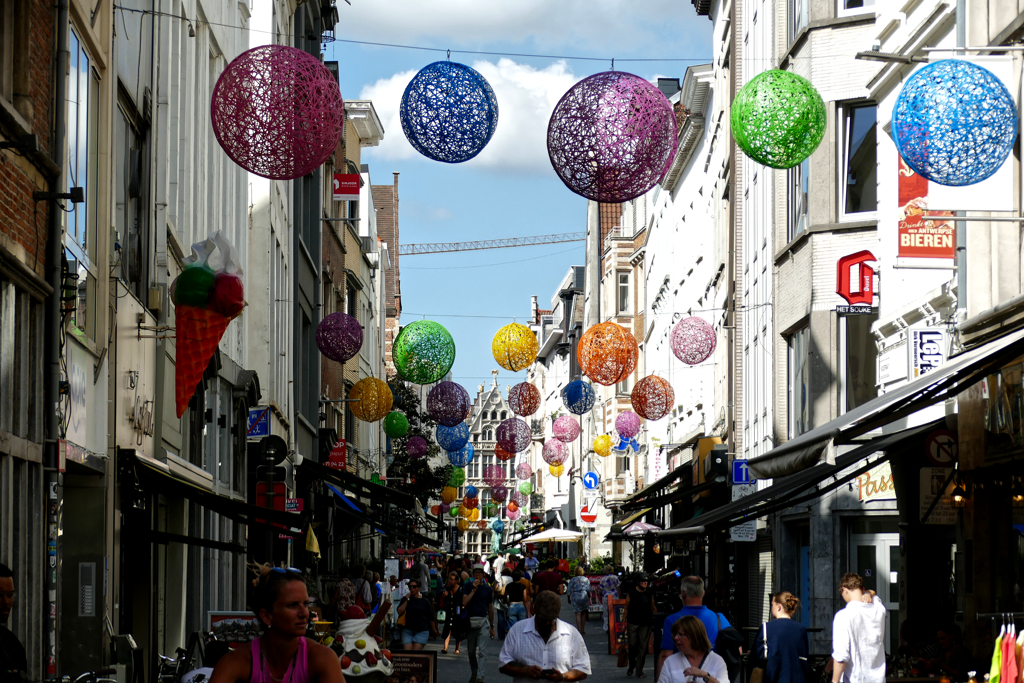
However, this golden age came to an end in the late 16th century. During the Eighty Years’ War between the Netherlands and Spain, Spanish troops besieged Antwerp in 1585. Many Protestant merchants and craftsmen fled the city. Also, with the blocking of the Scheldt, Antwerp lost a large part of its trade.
It wasn’t until the 19th century that the city began its economic recovery. After Belgium gained independence from the Kingdom of the Netherlands in 1830, the port was expanded. Over time, it developed into the second-largest seaport in Europe.
A Grand Entrance – Antwerp Centraal
Anyone travelling to Antwerp by train immediately experiences the beauty and grandeur of this city in its purest form. As the train’s brakes squeal and you climb the steps from the platform, you’re not entering just another functional train station. You’re stepping into a veritable railway cathedral. No traveller can resist the charm of Antwerp Central Station, built between 1895 and 1905.
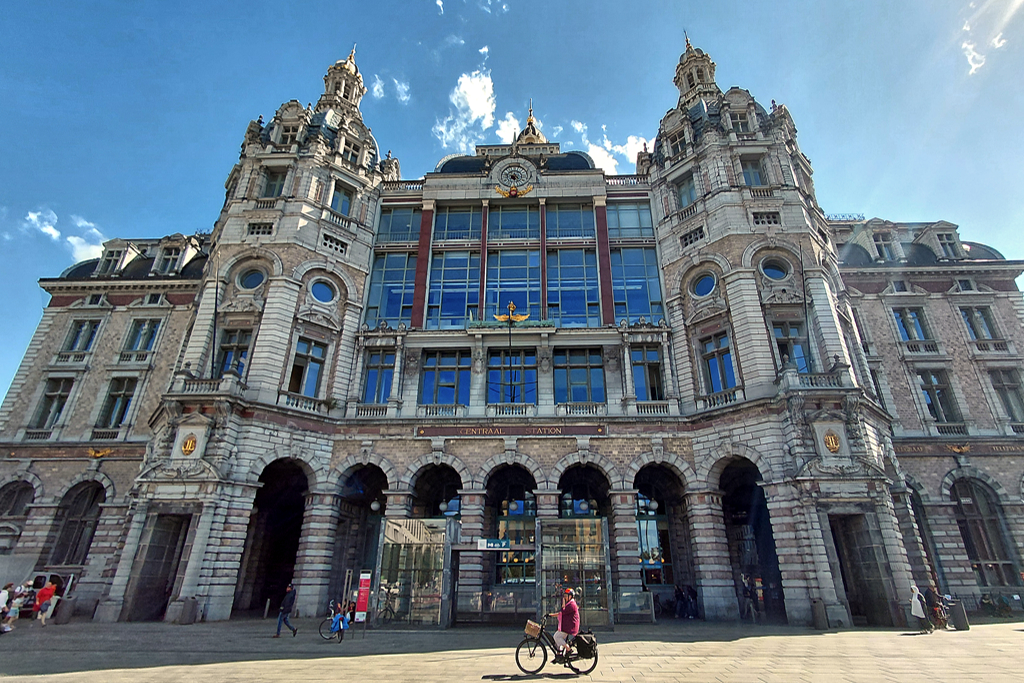
High above, a monumental, light-filled hall of iron and glass stretches out. It was originally designed to contain the steam from the locomotives. Continuing towards the exit, you find yourself beneath a colossal, 75-meter-high dome. In fact, it’s modeled after none other than the Pantheon in Rome! Twenty different types of marble and magnificent staircases reflect the splendor of the turn of the century.
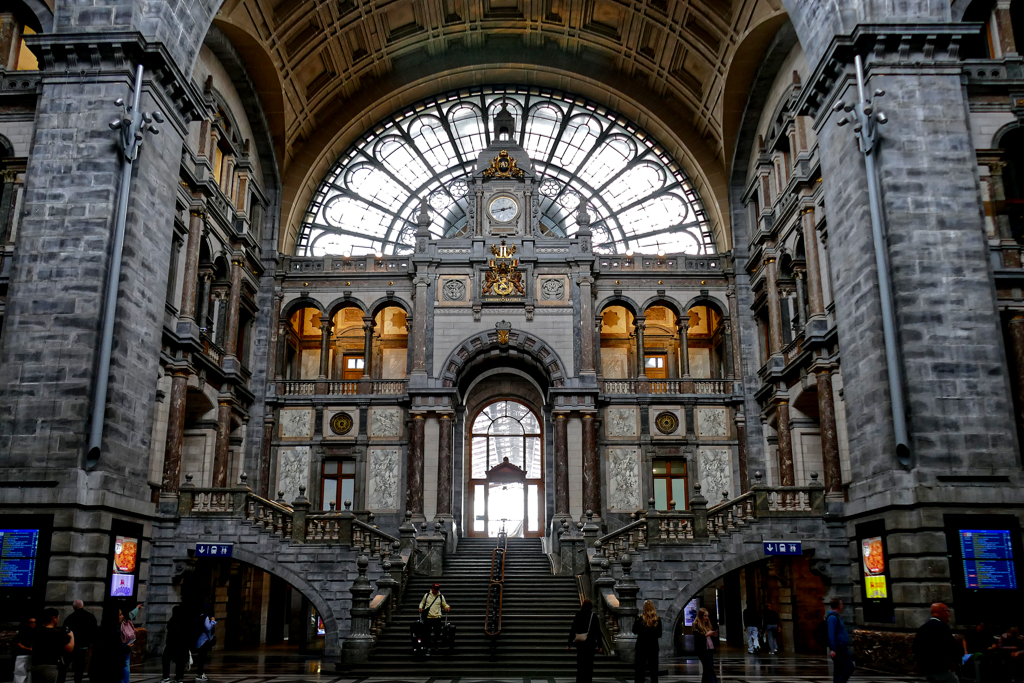
The station perfectly demonstrates that even functionally conceived architecture can be an immaculate work of art, and Antwerp shows its guests immediately on arrival: You have come to a very special place.
Trivia
Antwerp Centraal is breathtakingly beautiful. Yet, for some reason, Newsweek only ranked it as the fourth most beautiful train station in the world. Supposedly, the neo-Gothic St. Pancras International in London, the Grand Central Beaux-Arts Terminal in New York, and the Victorian Chhatrapati Shivaji Terminus in Mumbai, which even made it onto UNESCO’s World Heritage List, outrank it.
Diamonds Are Forever
The metro stations beneath Antwerp Centraal are named Astrid and Diamant. The first bears the name of the Swedish princess and wife of King Leopold III, Astrid of Belgium.
The reason for the latter’s name becomes immediately evident as you exit the station heading south. Here, you find yourself right in the heart of Antwerp’s diamond district. Mind you, over 80 percent of the world’s rough diamonds are traded within just a few city blocks!
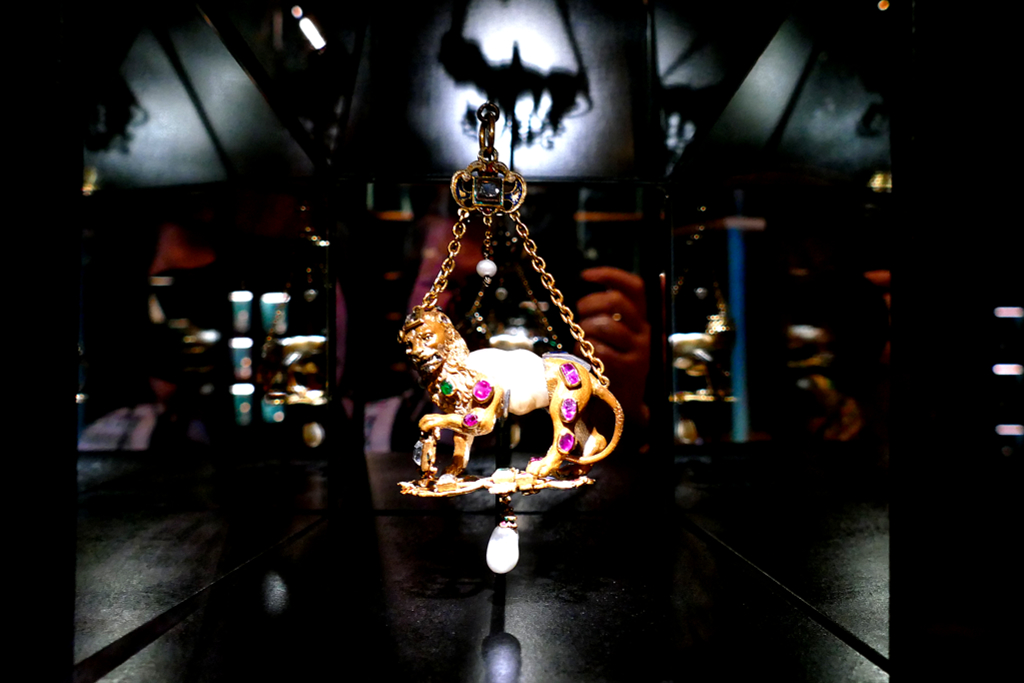
But how did this come about? Well, Antwerp’s diamond boom arose from a mix of favorable economic, technological, and political developments. As early as the 15th century, the city was already one of the most important trading centers in Europe. Then, ships brought rough diamonds from India, at that time the most important source region, to Europe. Thanks to its advantageous location and well-organized trade structures, Antwerp quickly developed into a major hub for the diamond trade.
Also, the Flemish diamond cutter Lodewyk van Bercken invented a more precise grinding wheel. His technological innovation allowed diamonds to be processed with greater accuracy. This resulted in even greater brilliance and a substantial increase in value. Obviously, this contributed to further fame.
However, after the Spanish conquest of Antwerp in 1585, the city lost its leading position. Many merchants and diamond dealers left for Amsterdam, which then became the most important European center of the diamond trade in the 17th century.
Back in Business
It wasn’t until the 19th century that Antwerp began its resurgence. Crucial to this were the discovery of large diamond deposits in South Africa starting in 1867. Important assets such as a close-knit network of experienced dealers and highly skilled diamond cutters, along with the corresponding administrative logistics, evolved.
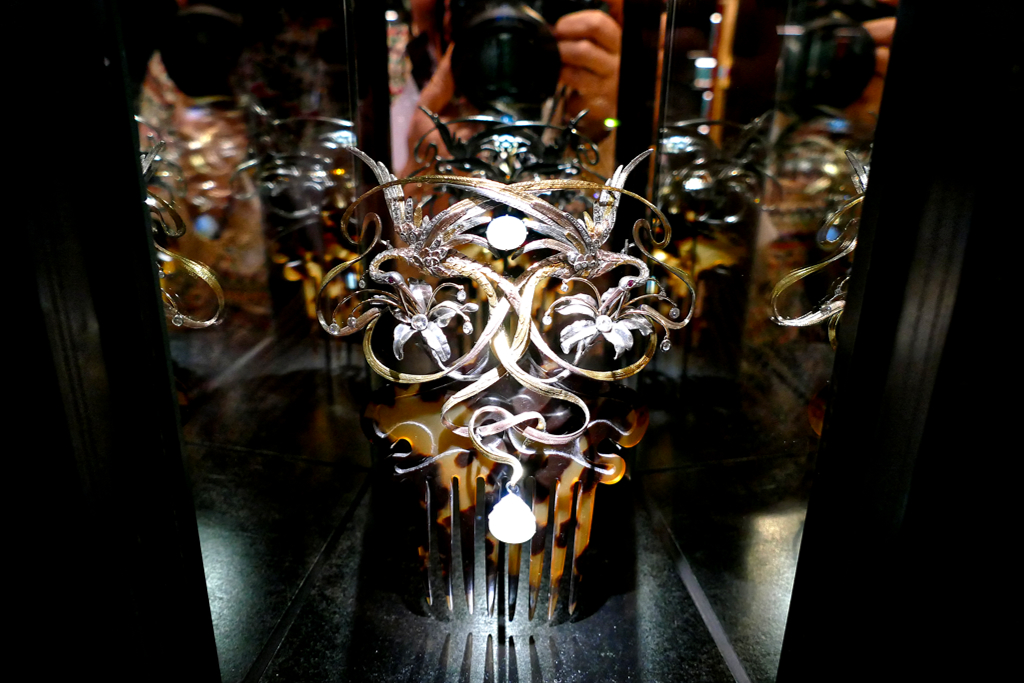
While the Orthodox Jewish community originally played a central role in the diamond trade, traders from the Indian region of Gujarat have gained increasing significance since the end of the 20th century.
Today, a large portion of the cutting and polishing work is carried out in India. Also, Dubai has become a substantial trading hub. Nevertheless, Antwerp remains one of the most important international epicenters for high-quality diamonds.
DIVA Museum – where Gems Take Center Stage
Just as you visit the Eiffel Tower in Paris, the Colosseum in Rome, or Buckingham Palace in London, the DIVA Museum is one of Antwerp’s landmarks that no visitor should simply walk past.
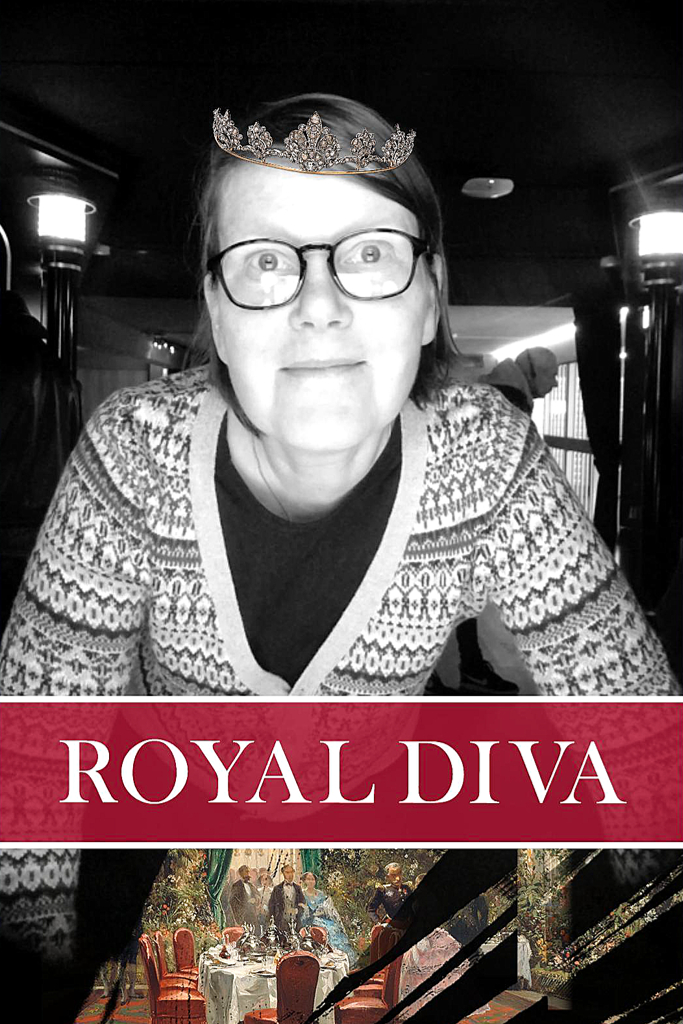
Antwerp has been the global capital of the diamond trade for nearly six centuries. Obviously, this calls for celebration, and the DIVA Museum is dedicated to this glittering heritage. The museum is located in the historic city center near the Grote Markt. This is actually the very district where goldsmiths, silversmiths, and gemstone dealers began settling as early as the 15th century.
The museum opened in 2018, formed by the merger of the former Antwerp Diamond Museum and the Sterckshof Silver Museum. Its permanent exhibition showcases around 650 artifacts spanning from the 15th century to the present day. The tour takes you through seven themed rooms that trace the journey of a gemstone from raw material extraction in the mine and the craftsmanship of cutting and polishing to its finished, luxury shape. Moving away from conventional display cases, the museum’s concept focuses on creating an atmospheric experience through soundscapes, multimedia installations, and interactive stations.
A section of the exhibition is also dedicated to the perfection of diamond cutting. After all, the famous Antwerp Cut has set the global standard for brilliance for centuries.
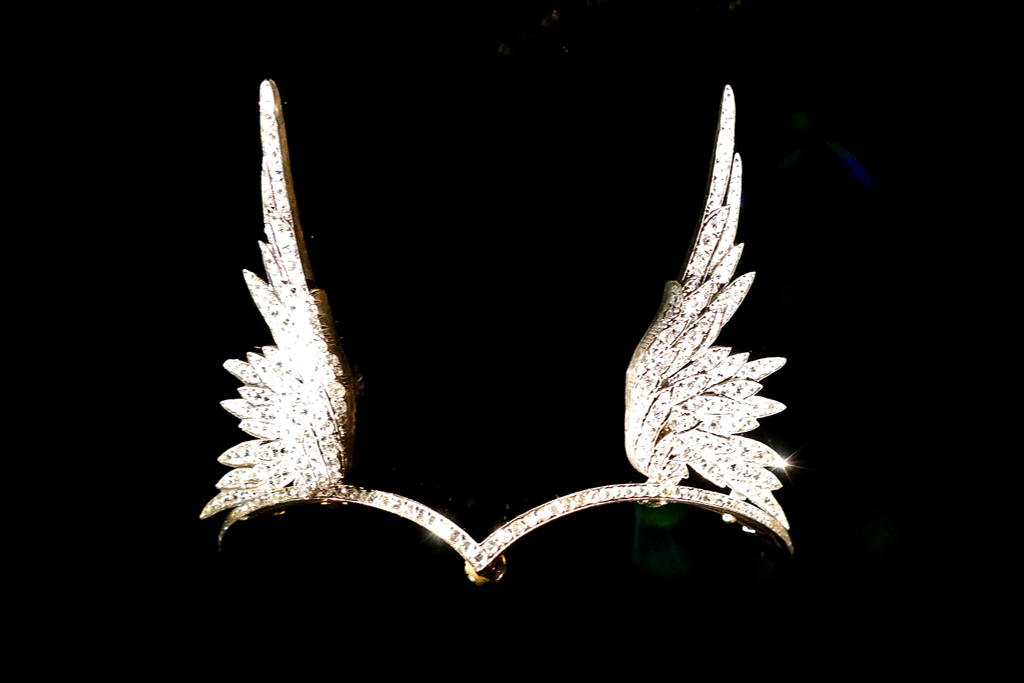
In addition to its sparkling exhibits, the complex houses a modern workshop. There, the traditions of silversmithing and jewelry making are kept alive through workshops and seminars.
The museum is open Thursday through Tuesday from 10 a.m. to 6 p.m., and the admission fee is 12 €uros.
Context
All that glitters: Amidst all the enthusiasm for these sparkling stones, the dark side of the diamond trade is easily overlooked. Alongside legitimate trade flows, rough diamonds also pass through Antwerp from regions where mining is linked to human rights violations, forced work, and child labor. Particularly on the African continent, the extraction of these stones is directly tied to armed conflict, exploitation, and state corruption. The industry’s oversight mechanisms suffer from significant shortcomings. The Kimberley Process, intended to curb the trade in so-called conflict diamonds, addresses the problem only insufficiently. Furthermore, rough diamonds often change hands multiple times via unclear supply chains before reaching the trading and cutting centers in Antwerp. This structure makes tracing the goods difficult.
Ultimately, the process culminates in the Antwerp diamond district with a luxury product whose supply chain is, in many instances, rooted in violations of fundamental human rights.
A Shtetl in Metropolis
I grew up as a liberal, non-religious free spirit. Because of this, I don’t have to uphold any religion or doctrine and can effortlessly approach the world in all its magnificent diversity with curiosity and an open mind. I’m also a bit of an amateur anthropologist with an unbridled interest in archaic phenomena and cultish religions such as Orthodox Muslims, Mormons, or Mennonites. And Ultra-Orthodox Jewish life has always held a great fascination for me as an observer. Therefore, the powerful presence of the large Jewish community was an intriguing aspect of my visit to Antwerp.
In fact, with around 20,000 Orthodox Jews, Antwerp is often called the Jerusalem of the North. This vast Orthodox community is the result of a historical development that began in the late 19th century. At that time, many Jews from Eastern Europe fled discrimination and pogroms. Like other European port cities, Antwerp was an important stopover for emigrants to the New World. Some of these emigrants, however, chose to settle permanently in the city.
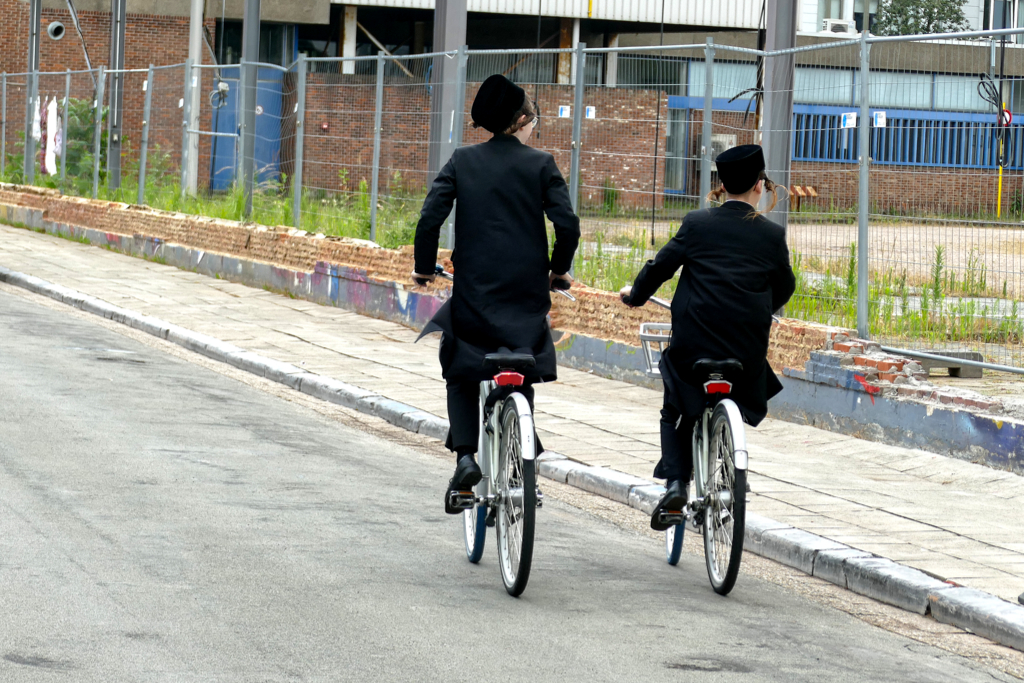
At the same time, Antwerp developed into one of the world’s most important centers of the diamond trade. This offered merchants and artisans excellent economic opportunities. As the community grew, synagogues, religious schools, and kosher shops were established, enabling a strictly religious life. This made Antwerp increasingly attractive to ultra-Orthodox families.
During WWII, a significant portion of the Jewish community was deported and murdered.
But after 1945, survivors returned, and more Orthodox Jews from Eastern Europe settled in Antwerp. The still-operative diamond industry and the existing religious infrastructure facilitated the community’s resurrection.
Gateway to the World
Jews are by no means the only local population group with a long history of migration. Due to Antwerp’s status as a major European port city, migration, alongside trade, has been inextricably linked to the city’s faith. In the golden 16th century, the metropolis experienced its first major wave of immigration, with merchants and traders arriving from all over Europe.
In contrast, the decades between the 1870s and 1930s marked a dramatic turning point. During this period, the city developed into one of the continent’s central ports of emigration. Over two million people, primarily from Eastern and Central Europe, passed through Antwerp. They were fleeing poverty or political persecution and hoping for a better life in the New World. Many of these people, however, remained permanently in the city. This was often due to a lack of funds for the passage, and this finally also contributed to the development of the noteworthy Jewish community.
Today, Antwerp presents itself as a super-diverse metropolis where people from over 160 nationalities live together. Almost half of the population has a migration background. They shape the modern, international cityscape.
Red Star Line Museum
The Red Star Line Museum is dedicated to the moving phenomenon that is migration. It stands in a historically authentic location: the former passenger terminals of the shipping company of the same name. Between 1873 and 1934, emigrants were medically examined, disinfected, and registered in this very building.
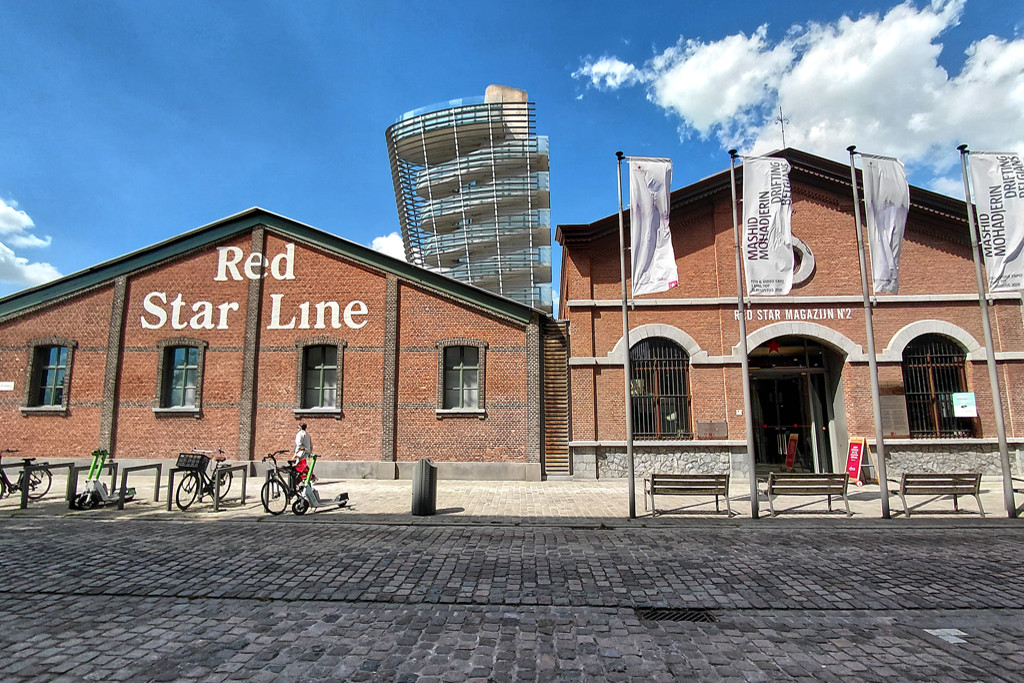
The permanent exhibition focuses on the passengers’ personal stories. Letters, photographs, and personal belongings bring them to life.
In addition to moving everyday narratives of anonymous families, the Red Star Line Museum also sheds light on the lives of prominent migrants. For example, the famous physicist Albert Einstein traveled on board the Red Star Line several times in the 1920s and 1930s. On a return trip from the USA in 1933, he learned during the crossing of the Nazi searches of his home. Upon landing in Antwerp, he officially surrendered his German passport and left Europe for the USA for good. Also, the world-famous composer Irving Berlin, then five years old and named Israel Baline, fled the pogroms in the Russian Empire with his family. They crossed the Atlantic from Antwerp, too.
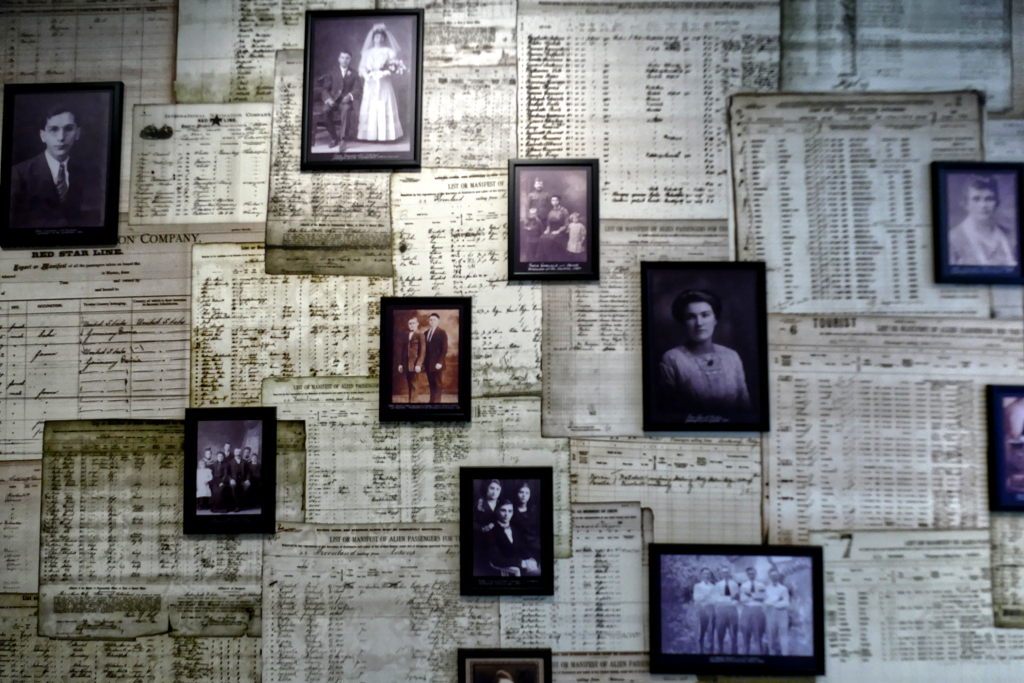
In addition to exploring the transatlantic migration of the 19th and 20th centuries, the museum also draws a connection to the present day by addressing the global refugee and migration movements of our time.
The Red Star Line Museum is open from Tuesday to Sunday between 10 a.m. and 5 p.m. Admission to the permanent exhibition is 10 €uro. It is recommended to book tickets in advance on their website.
My Tip
You can climb up the striking observation tower totally free of charge. From there, you have a wide view over the Scheldt River and the port area.
If the topic of emigration resonates with you as much as it does with me, I recommend reading my post From North German Ports to the Americas: Migration in the 19th and 20th Century.
Scheldt River and Port of Antwerp-Bruges: An Economic Engine
The topic of emigration has been very close to my heart for as long as I can remember. That’s partly due to my own family story. But of course, it’s only a minor factor when it comes to the Port of Antwerp-Bruges. First and foremost, this second-largest industrial port in Europe is a cash cow.
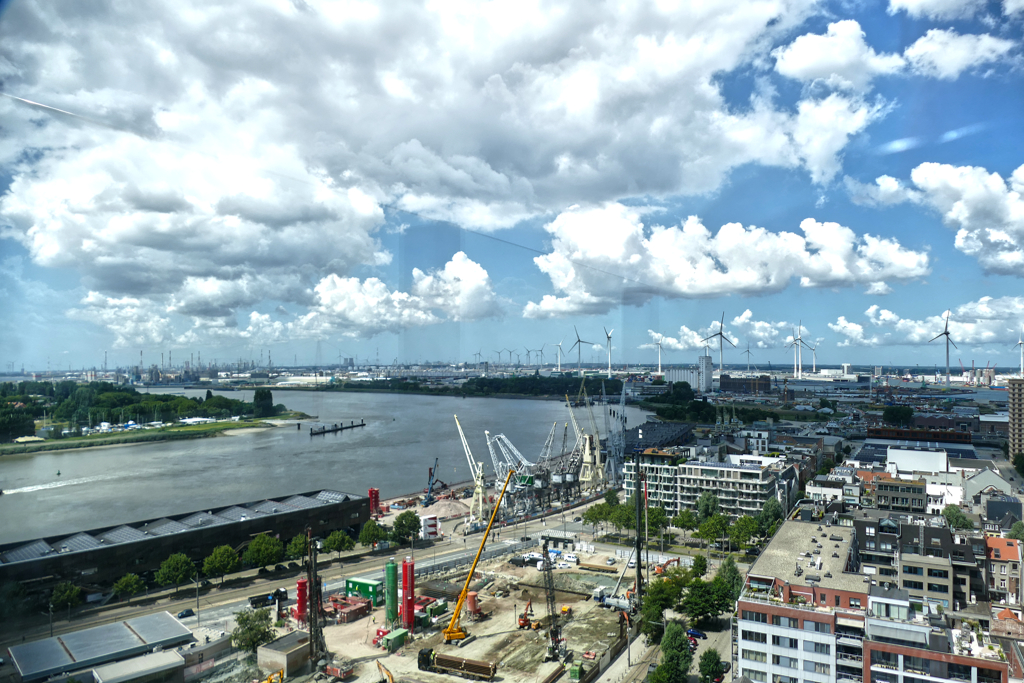
The main reason for Antwerp’s rise to one of the world’s most powerful trading metropolises is, at the end of the day, the Scheldt River. This lifeline of the city, a navigable tidal river, connects the center directly to the North Sea. Thus, despite its inland location, Antwerp is a strategic hub for international maritime traffic.
The Port of Antwerp-Brugs, the second-largest seaport in Europe after Rotterdam, stretches directly along its banks. With a throughput of one hundred million tons of goods annually, it is one of Belgium’s most important economic drivers. It is also a world leader in the chemical and petrochemical industries.
MAS – Museum aan de Stroom
Obviously, a seaport is always a big deal, especially for visitors from out of town. So, if you want to observe the gigantic container ships and the bustling activity up close, you’ll find excellent vantage points in the port district.
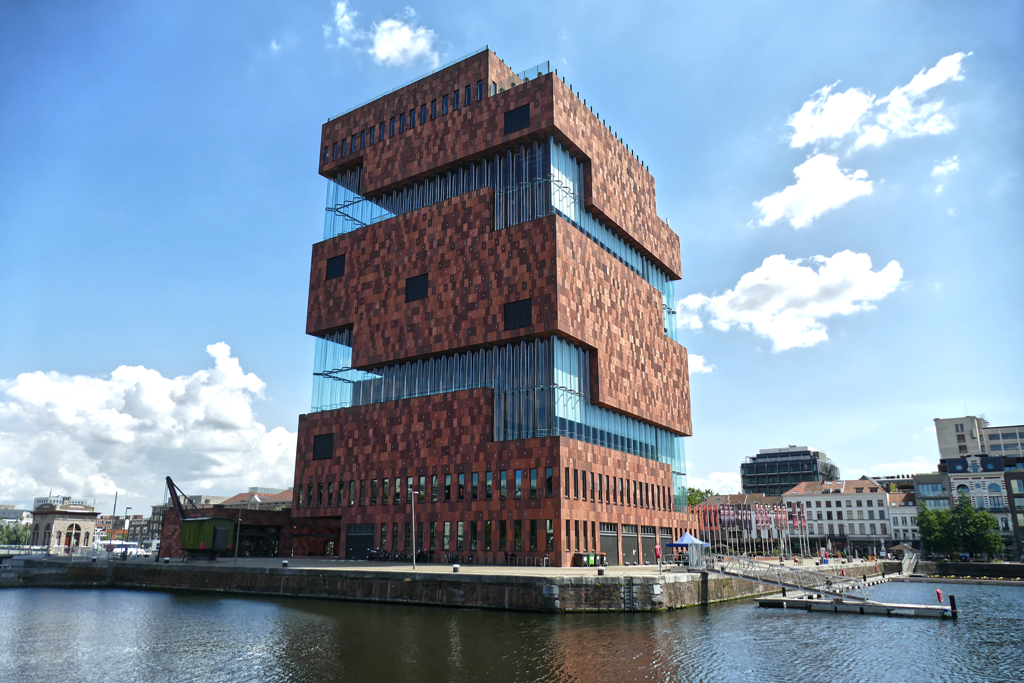
The tower consists of stacked, rotated blocks arranged in a staggered pattern. Around 3,000 small aluminum hands adorn the red natural stone façade, serving as a symbol of the city.
One particularly popular and easily accessible platform is the roof of the Museum aan de Stroom, or MAS for short. At a height of 60 meters, you have an unobstructed 360-degree view of the city, the Scheldt River bend, and the harbor basins to the north.
Plan Your Visit
The best part is that access to the rooftop terrace is independent of the rest of the museum’s operations. The space on the tenth floor is generously open to visitors from Tuesday to Sunday starting at 9:30 a.m. During the winter months from November to March, the Panorama Roof closes at 10 p.m. At other times of the year, you can go up to the roof until midnight and admire a fantastic sunset or even the harbor basin at night.
Nevertheless, different conditions apply for visiting the actual exhibition halls and the various themed galleries. The museum archives, the storage area, and the galleries are open from Tuesday to Sunday between 10 a.m. and 5 p.m. A regular ticket costs 12 €uro. As capacity is limited to a fixed number of visitors to protect the exhibits, it is recommended, mainly during peak season, to book tickets in advance on the MAS’s website.
Fun Fact
The small hands on and around the MAS refer to the legend of Brabo. The giant Antigon would cut off the hands of sailors who failed to pay a toll. The hero Silvius Brabo defeated the giant, severed his hand, and threw it into the Scheldt River. This gave rise to the name Antwerp, which derived from the Dutch hand werpen, meaning hand throwing.
Havenhuis – a Masterpiece by Zaha Hadid
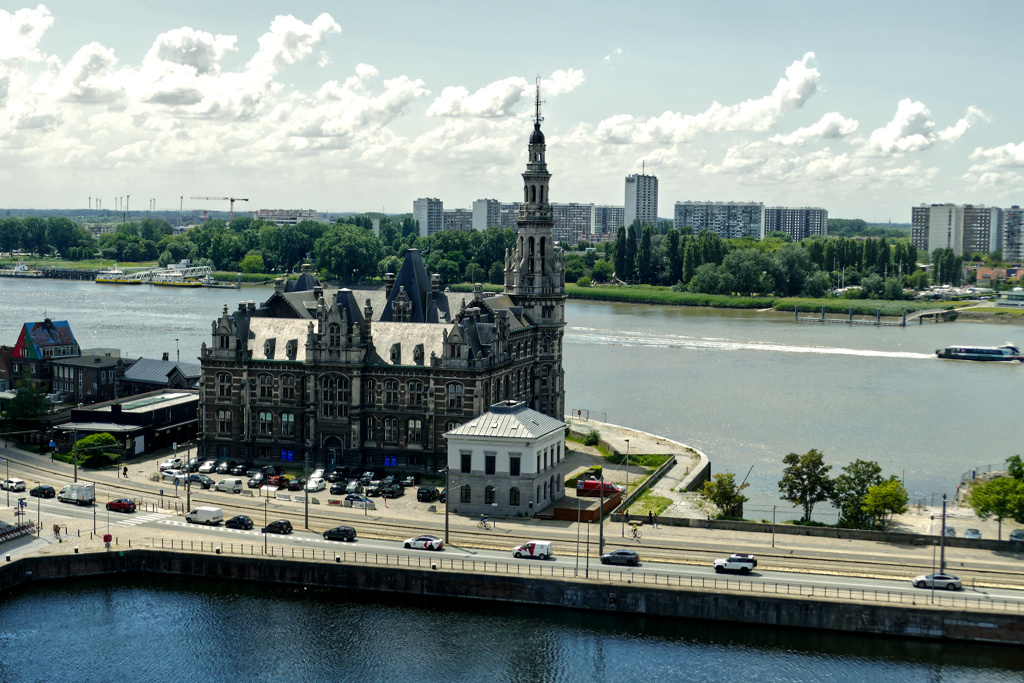
Another architectural gem of the port is the so-called Havenhuis, which serves as the official headquarters of the port authority. Designed by the renowned architect Zaha Hadid, this spectacular building combines a former, listed Hanseatic-style fire station with a futuristic, glass-roofed structure. This structure fittingly hovers like a giant cut diamond above the historic foundation. We’re in the diamond capital, after all.
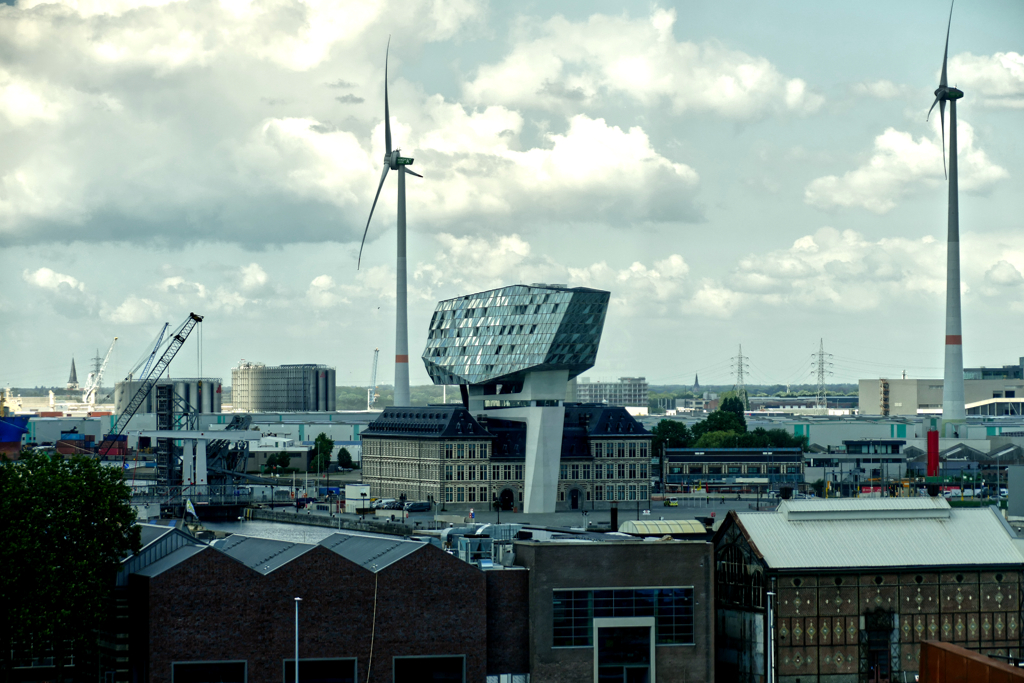
As a symbolic gateway to the port district, the Havenhuis exemplifies Antwerp’s ingenuity in seamlessly blending its rich maritime past with contemporary architecture.
My Tip
If you don’t want to walk all the way to the Havenhuis, climb the tower of the Red Star Line Museum, from where you have an unobstructed view.
Sint-Annatunnel: a Low Highlight
Another lady, Saint Anne, has also left her mark on Antwerp’s harbor area. The Sint-Annatunnel proves that a practical structure, besides being functional for everyone, can also be a quirky tourist attraction. It is an underpass beneath the Scheldt River, connecting the city center with the quieter left bank since 1933.
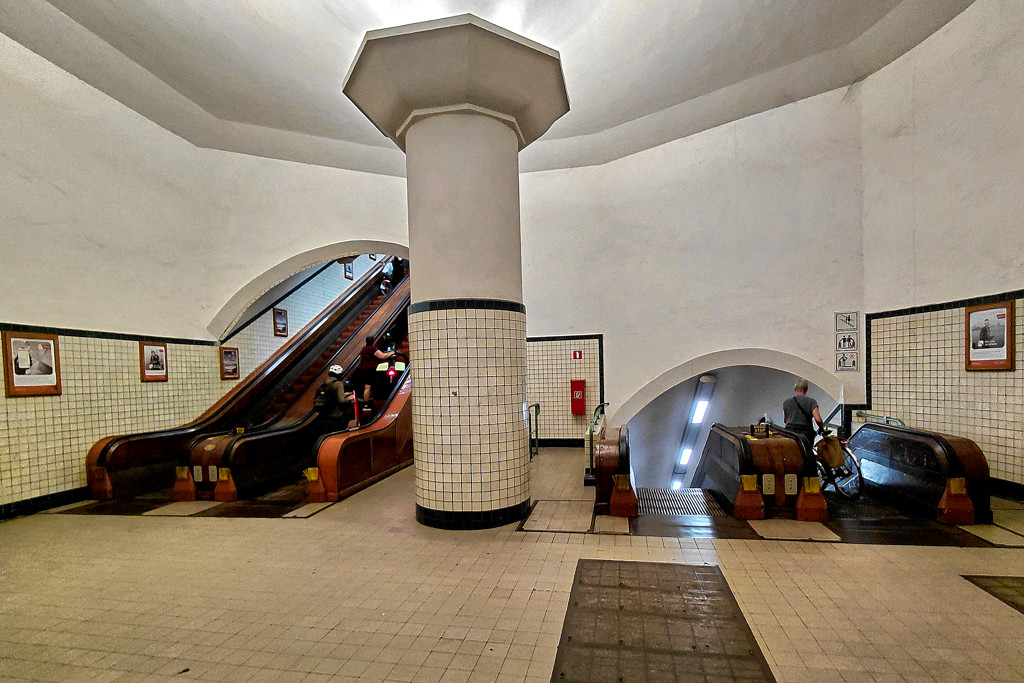
The nearly 572-meter-long tunnel is fully tiled, free for pedestrians and cyclists. It offers a very safe and wonderfully nostalgic atmosphere away from the hustle and bustle of modern city traffic.
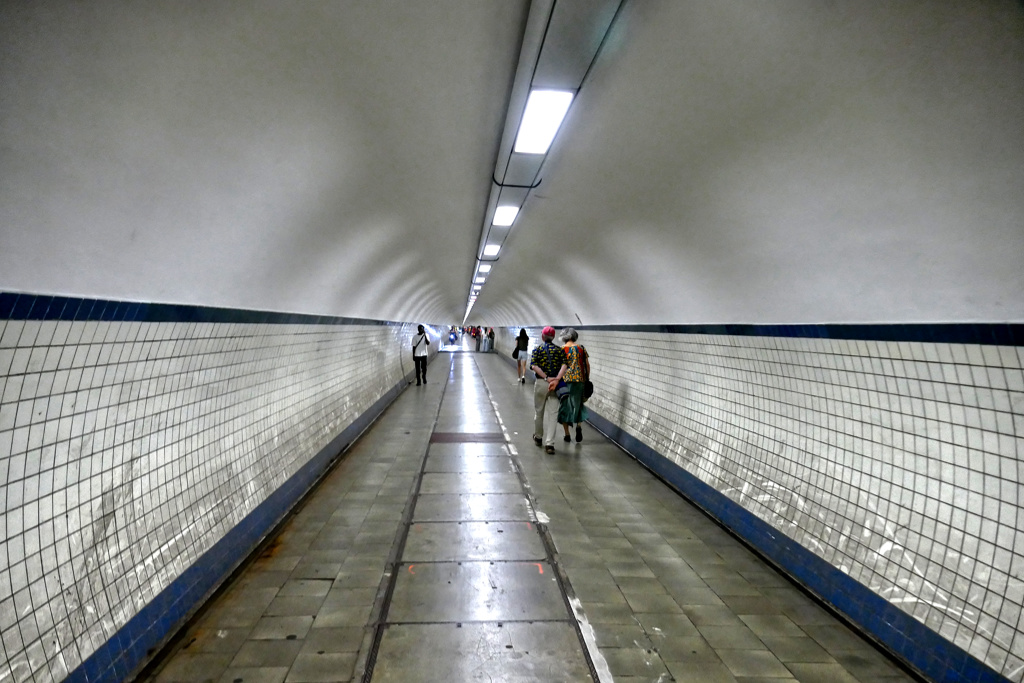
After passing through the tunnel, one of the most stunning panoramic views of Antwerp’s skyline rewards you on the other side of the river.
Fun Fact
I’m based in Hamburg, and we actually have a very similar tunnel that leads from the port to the other side of the Elbe. If you have any doubts, check out my post Guide to HAMBURG, the self-proclaimed Gateway to the World!
The Gilded Age
The Scheldt River and the port take us back several centuries to when they formed the crucial foundation for trade, globalization, and art in the gilded 16th and early 17th centuries. This was long before Antwerp’s diamond rush, by the way.
So let me take you on a tour of the city center, where we’ll encounter witnesses of the three central pillars of this era: spiritual and secular power, commerce and science, and finally, the wealthy upper class.
The Pillars of Spiritual And Secular Power
Onze-Lieve-Vrouwekathedraal
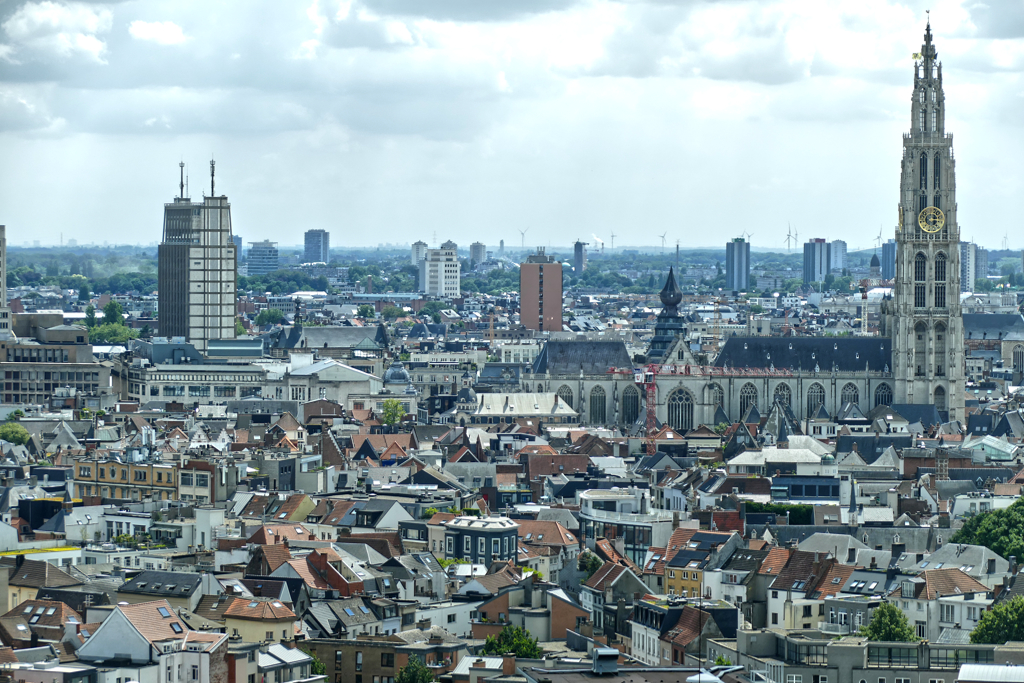
The Cathedral of Our Lady is Antwerp’s most significant church; its distinctive tower has defined the city skyline for centuries. Construction began in 1352 in the Brabantine Gothic style and spanned nearly 170 years. Although two towers of equal height were originally planned, only the 123-meter-tall north tower was completed; it ranks among the tallest church towers in Belgium.
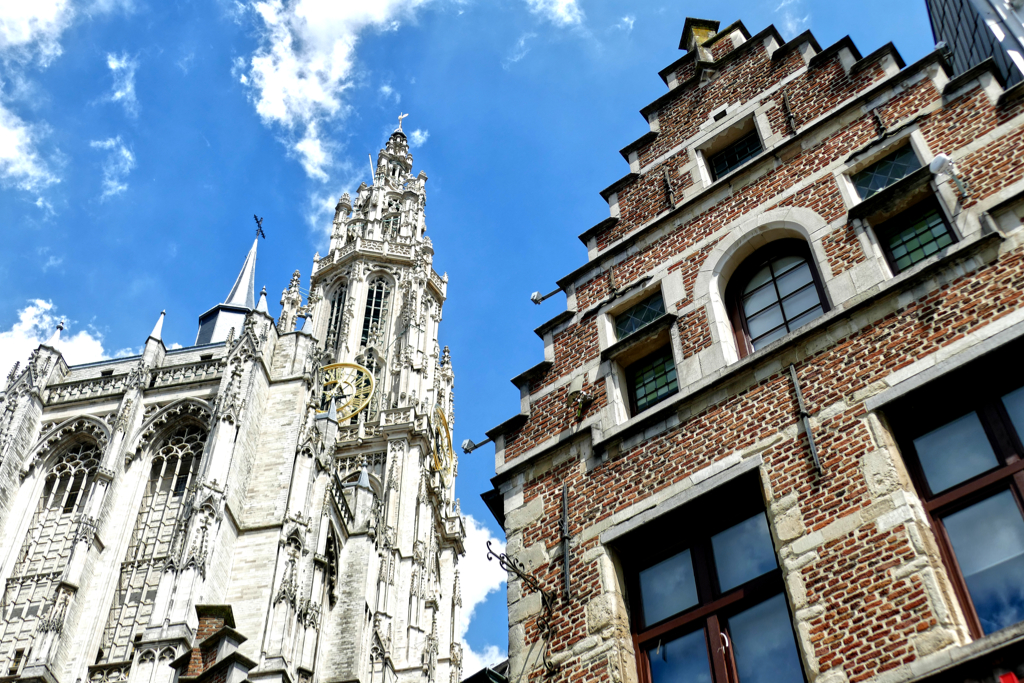
The cathedral suffered severe damage on several occasions throughout its history. Numerous artworks and furnishings were lost during the so-called Iconoclastic Fury, which was a wave of Calvinist Protestant riots in the summer of 1566 across modern-day Belgium and the Netherlands. Crowds stormed Catholic churches and destroyed religious statues, altars, and artwork. Anyway, fires and riots during the French Revolution caused further destruction of the Onze-Lieve-Vrouwekathedraal. Consequently, many elements of the current interior date from later periods of reconstruction.
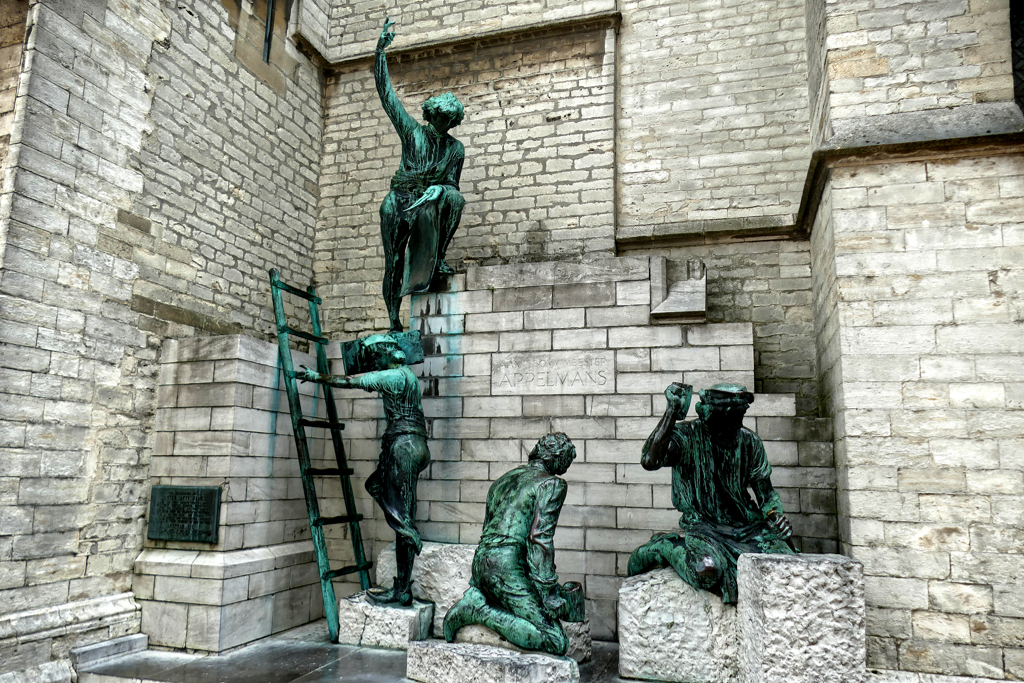
Amazing Art
The cathedral is particularly renowned for its art collection. Most notably are four of Peter Paul Rubens’ most important works. They make the cathedral a major destination for art enthusiasts.
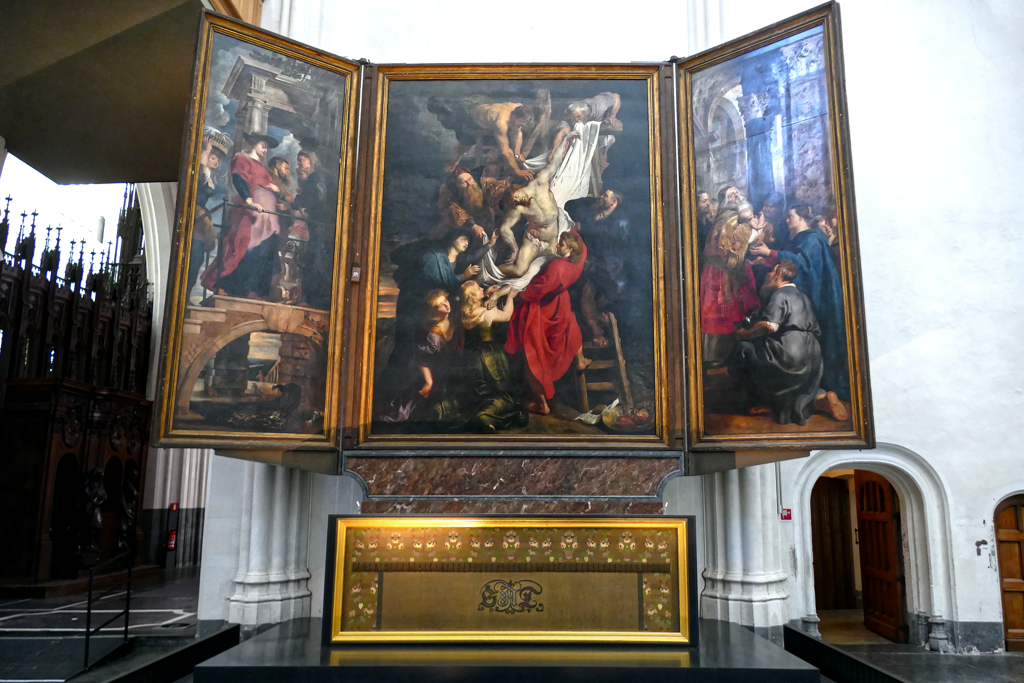
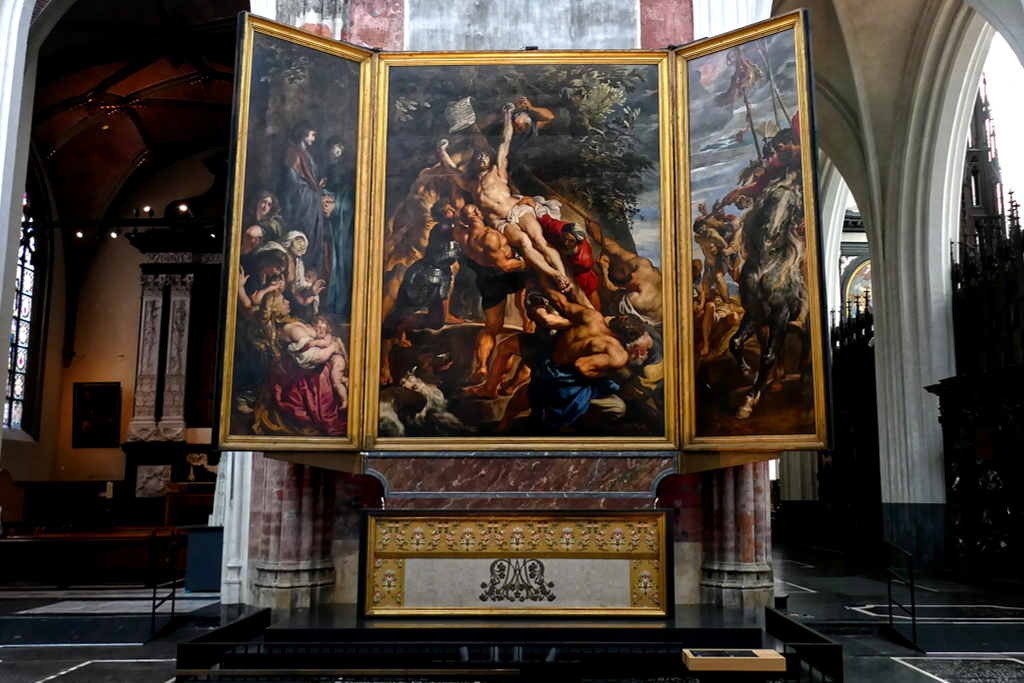
During your visit, be sure to take note of the magnificent contemporary artworks on display. After a long period without new acquisitions, the cathedral resumed adding works by contemporary artists to its permanent collection in 2015.
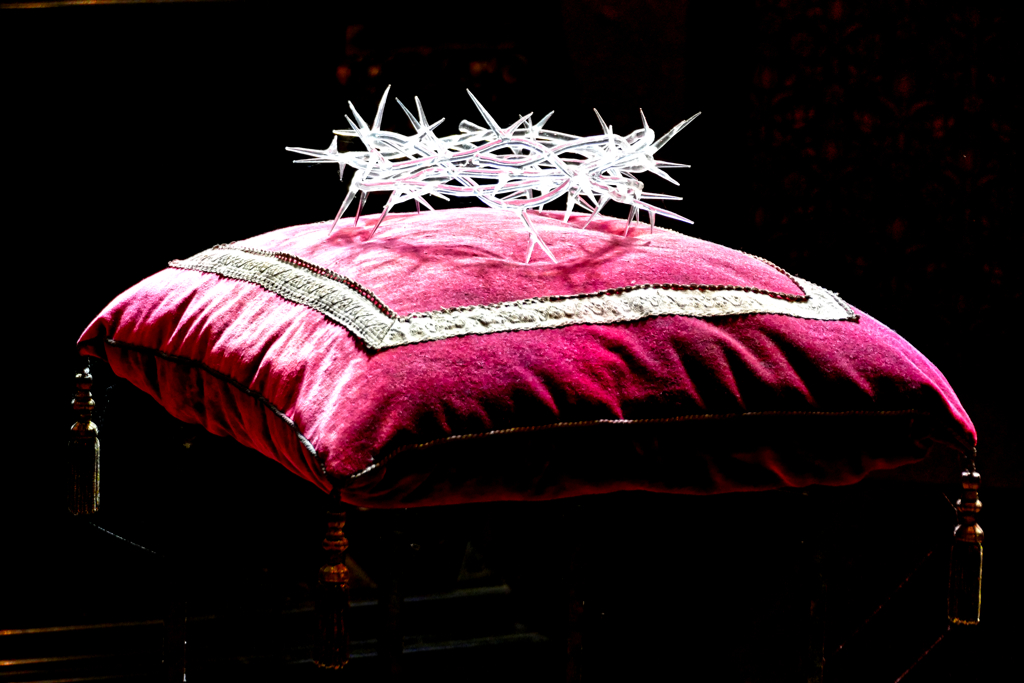
This initiative aims to continue the centuries-old tradition of each era contributing its own artistic language to the house of worship.
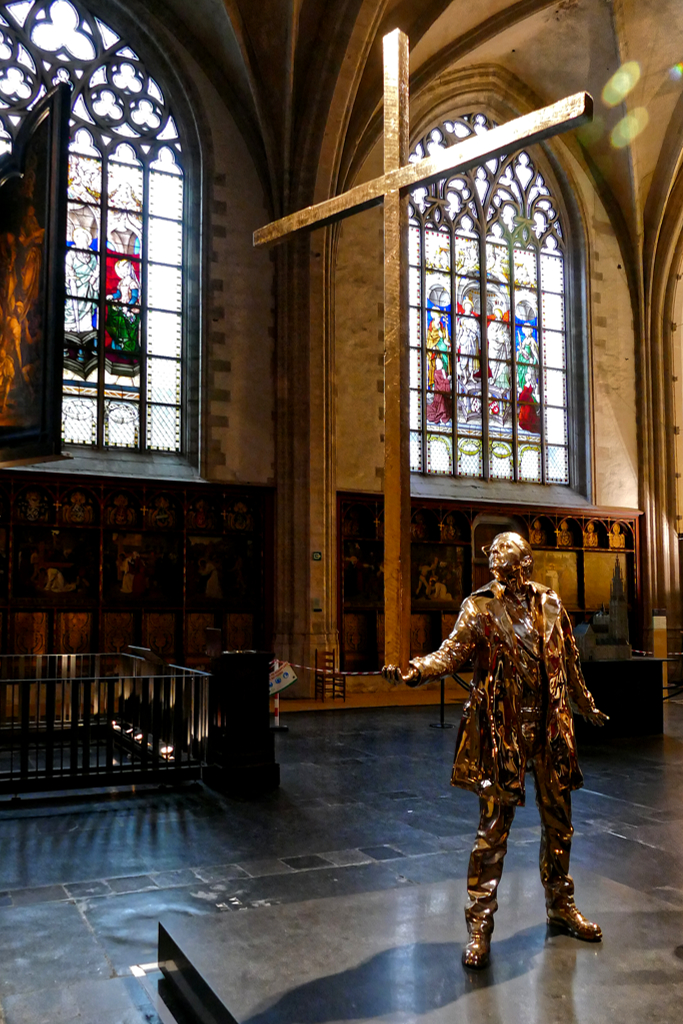
The most famous modern work is The Man Who Bears the Cross by the Belgian artist Jan Fabre. Fabre’s bronze sculpture is a self-portrait balancing seemingly effortlessly a large cross on his outstretched hand.
Onze-Lieve-Vrouwekathedraal is open from Monday to Friday between 10 a.m. and 5 p.m., Saturdays until 3 p.m., and Sundays from 1 p.m. to 5 p.m. The general admission is 12 €uro.
Art at the Doorstep
Watch your step as you leave the cathedral: Lying beneath a blanket of cobblestones are Nello and his dog Patrasche. They are the main characters from the novel A Dog of Flanders by the British author Ouida.
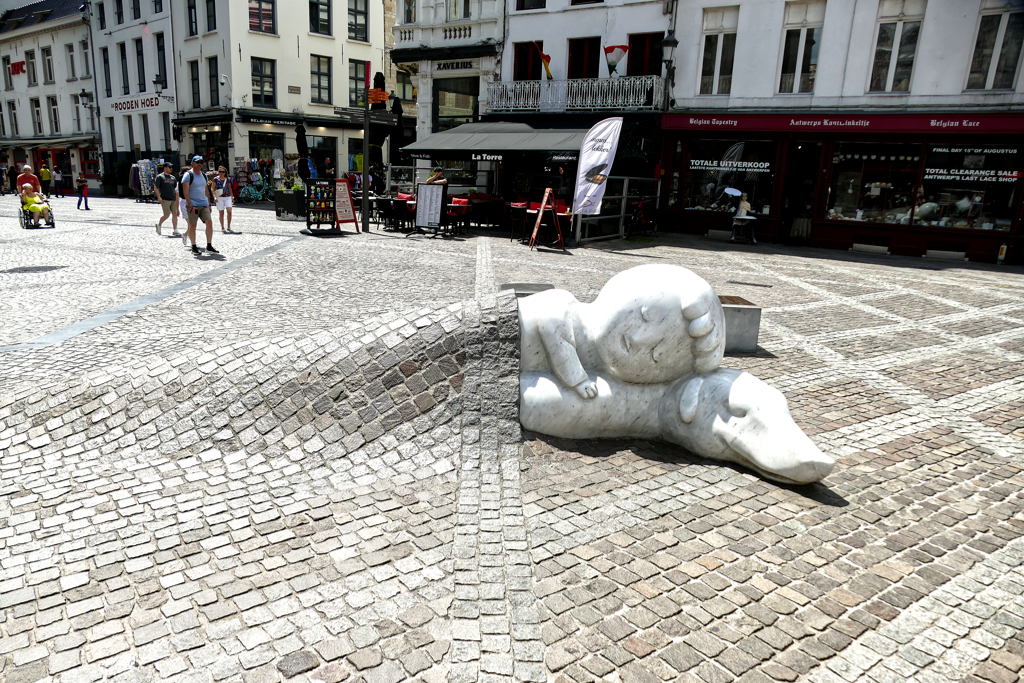
Set around Antwerp, the story recounts the friendship between the poor orphan boy and his loyal dog.
Handelsbeurs
In addition to ecclesiastical power, Antwerp also wielded enormous economic power in the 16th century. The Handelsbeurs, hence, the Trade Exchange, serves as a reminder of this to this day. It was, after all, the world’s first commodities exchange built specifically for international trade. This distinction earned it the title Mother of all Stock Exchanges. It is no wonder, then, that its design later influenced stock exchange buildings in cities such as Amsterdam and London.
The Handelsbeurs was constructed in 1531 based on plans by the city architect Domien de Waghemakere. At the time, Antwerp was the economic hub of Europe. Merchants from Italy, Spain, Portugal, England, and Germany gathered here to trade spices, textiles, metals, sugar, and gems, obviously. Unlike modern stock exchanges, the initial trading focused not on shares, but on commodities, trade contracts, and financial instruments.
As Antwerp’s authority declined following its conquest by Spanish troops in 1585, the Handelsbeurs also lost its superiority. Many merchants migrated to Amsterdam, which emerged as Europe’s new commercial metropolis in the decades that followed.
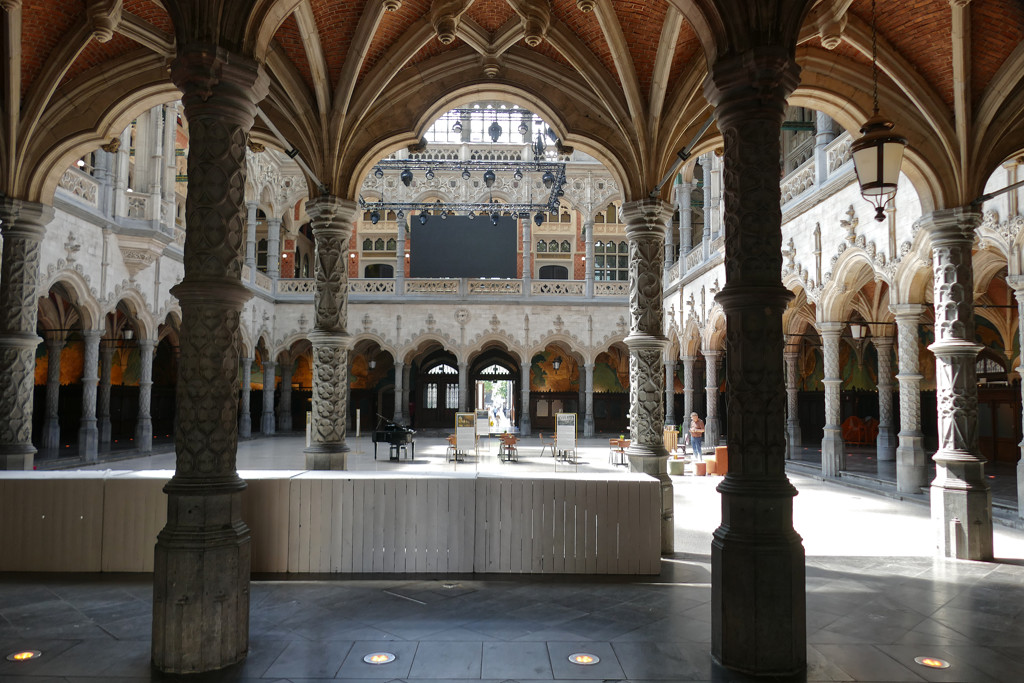
A severe fire completely destroyed the original building in 1858. Therefore, the Handelsbeurs you see today was built in 1872 in the Neo-Gothic style, based on designs by architect Jos Schadde. From the outside, the building appears relatively underwhelming, yet behind the façade lies a light-filled, majestic courtyard.
The building actually functioned as a stock exchange until 1997. Following the merger of the Antwerp and Brussels exchanges, the Handelsbeurs stood vacant for over twenty years and fell into increasing disrepair. After undergoing extensive restoration in 2019, it now serves as a venue for concerts, exhibitions, receptions, and conferences.
Stadhuis
Obviously, of the trilogy of ecclesiastical and economic power, political dominion cannot be missed. This was found in the Antwerp Town Hall. As a matter of fact, it ranks among the most significant secular Renaissance buildings in Northern Europe and marks a decisive turning point in the region’s architectural history. Completed in 1565 based on designs by architect Cornelis Floris de Vriendt, the building represented a deliberate cut from the previously dominant Gothic style in favor of Italian-inspired Renaissance.
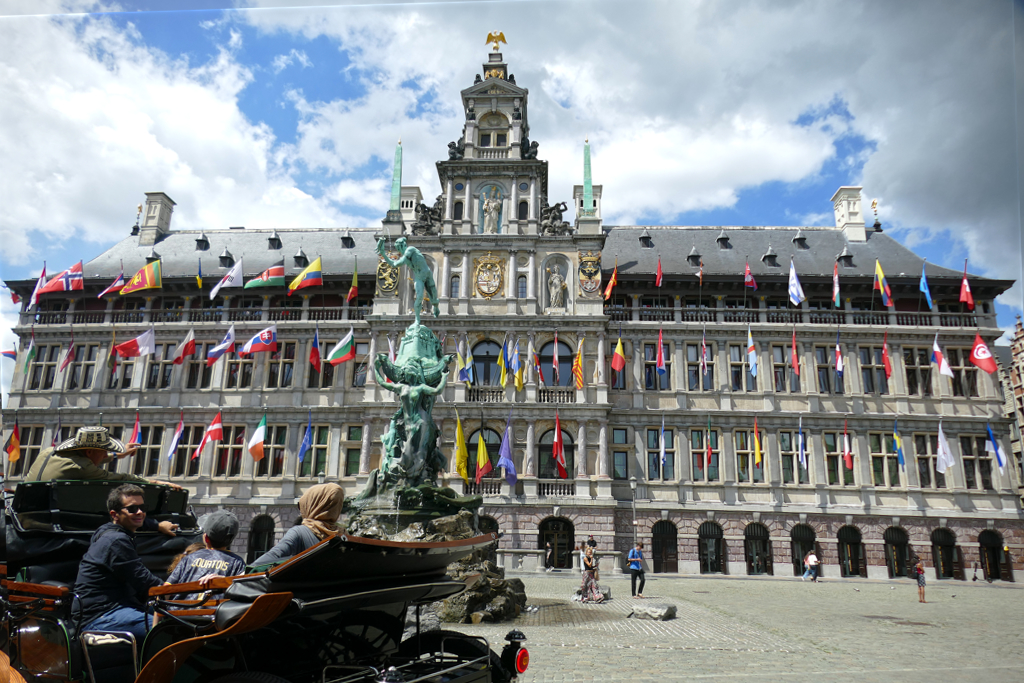
The symmetrical façade combines classical Renaissance elements with Flemish traditions. A stately central avant-corps rises in the middle, featuring the coats of arms of the former Duchy of Brabant, the Spanish Crown, and the city of Antwerp. After all, the Town Hall was intended to be more than just a mundane administrative building. Above all, it was meant to indicate Antwerp’s prosperity and stature as a leading European trading metropolis. At a time when merchants from across Europe conducted business there, the building became a stone symbol of prosperity as well as the growing self-confidence of the citizenry.
Resiliance
During the so-called Spanish Fury, hence, the sacking of Antwerp by mutinous Spanish soldiers, the Town Hall was severely damaged by fire in 1576. Obviously, the Spanish Fury ranks among the darkest chapters in the city’s history, as it also marked the beginning of its economic decline.
Yet, just a few years later, the Town Hall was faithfully reconstructed. Today, together with the magnificent guildhalls and the Brabo Fountain, it forms the heart of the Grote Markt. In addition, since 1999, it has been part of the UNESCO World Heritage site comprising the Belfries of Belgium and France.
Vleeshuis
For me, the Vleeshuis is perhaps the most unusual landmark in Antwerp, simply because of how its purpose has changed in modern times. This former meat hall now houses the Vleeshuis | Klank van de Stad museum, which tells the story of music and sound in Antwerp. The fact that this former meat hall is now dedicated to a completely different subject impressively demonstrates how historic buildings have adapted to new uses over the centuries without losing their historical significance.
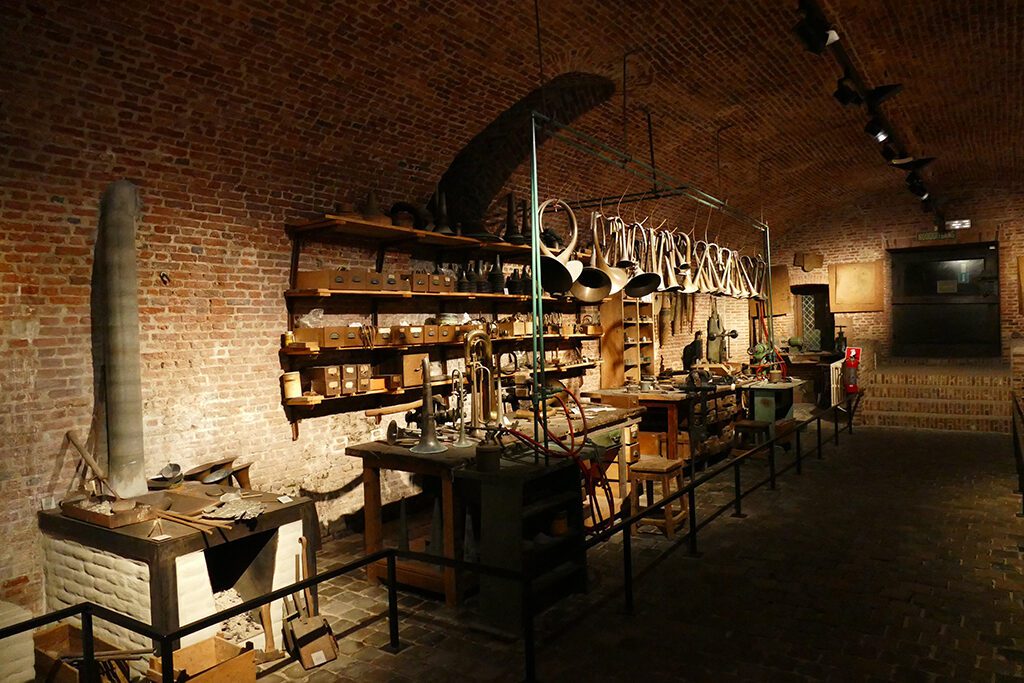
And the Vleeshuis certainly possesses historical significance. It is one of Antwerp’s oldest surviving secular buildings and an impressive testament to the power and prosperity of the medieval guilds. Completed in 1504 based on designs by city architect Herman de Waghemakere, it served as a prestigious market hall for the butchers’ guild. Its distinctive façade pattern was intended to visually evoke bacon and meat by alternating red brick and light-colored natural stone. In fact, the Vleeshuis is one of the most famous examples of Late Gothic architecture in Antwerp.
Only members of the butchers’ guild were permitted to sell their goods in the Vleeshuis. Mind you, guilds regulated not only the quality, pricing, and training associated with their trades but also wielded considerable political and economic influence. They provided social security for their members, organized festivals and processions, and represented their interests before the city administration.
They formed the backbone of the city’s economic life and shaped its public appearance. A legacy still evident today in the magnificent guildhalls on the Grote Markt.
Unfortunately, the Vleeshuis Museum is currently, as of summer 2026, closed due to extensive restoration work. I will update the post as soon as there are any changes.
The Pillars of Art And Science
Sint-Carolus Borromeuskerk
My happy place in Antwerp is undoubtedly Hendrik Conscienceplein. Despite its central location, it feels tucked away and is much quieter than the other squares. It is by far the most atmospheric of Antwerp’s Old Town courts. The enclosed Baroque architectural ensemble surrounding the square dates back to the early 17th century and is closely linked to the Jesuits.
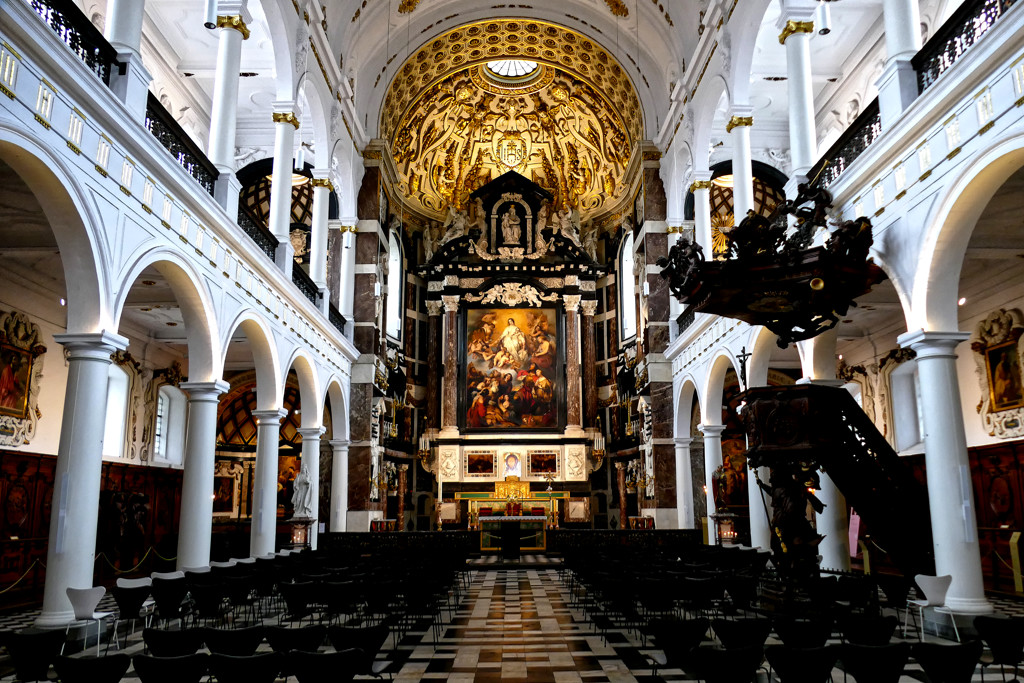
Indeed, it was originally known as Jezuïetenplein, hence, Jesuit Square. After the Jesuits built their church, a professed house, and other order buildings there starting in 1615, an area with an almost Italian feel formed the forecourt to the magnificent Church Sint-Carolus Borromeuskerk. Completed in 1621, it ranks among the most significant Baroque churches in the Low Countries. Its façade is particularly striking. Designed in the spirit of the Counter-Reformation, it was intended to make the power and beauty of the Catholic faith perceptible. The Jesuits modeled it after their order’s mother church in Rome.
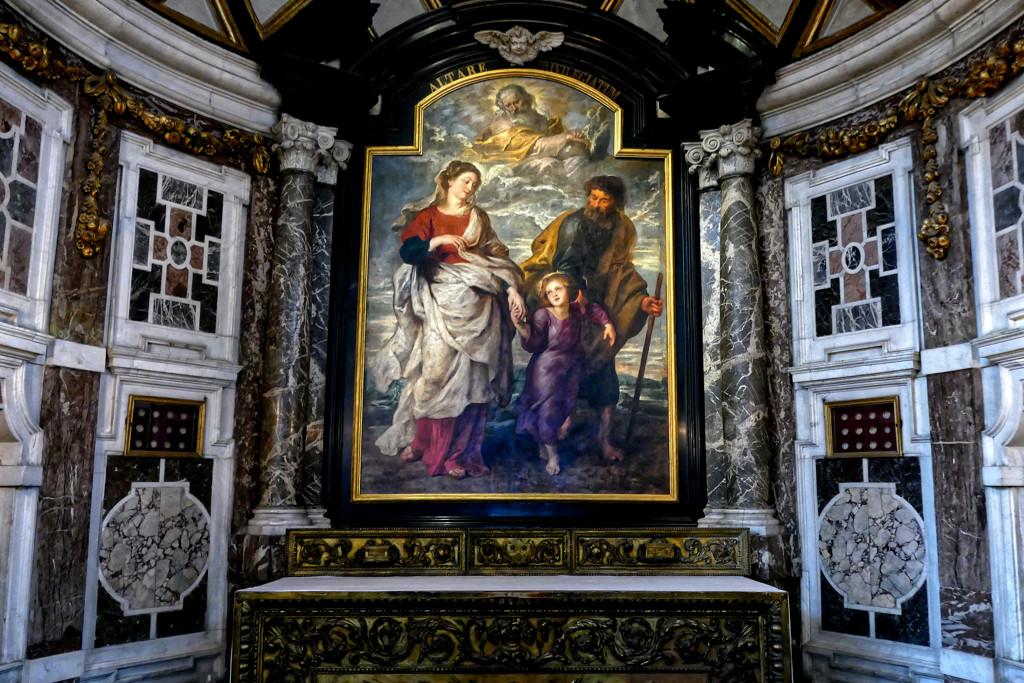
Peter Paul Rubens served as an artistic advisor and created paintings and decorative schemes. No expense was spared. The church was conceived as a heaven on earth to celebrate the triumph of Catholicism. Such opulence was only affordable because the city’s elite generously chipped in.
Rubens and his workshop, which also included the young Anthony van Dyck, painted 39 monumental ceiling canvases for the nave. These were completely destroyed in 1718 during a devastating fire caused by a lightning strike. Nevertheless, the church still breathes Rubens’ Baroque spirit to this day.
Hendrik Conscience Heritage Library
The former Jesuit Sodality stands on the square’s southern edge. Following the suppression of the Jesuit Order in 1773, the building’s use changed several times. In 1879, the City of Antwerp established the city library in the building. Today, it is the Hendrik Conscience Heritage Library. Also, the square itself was named in honor of Hendrik Conscience in 1883. Conscience was one of the most important Flemish writers of the 19th century. His best-known work is De Leeuw van Vlaanderen, which translates to The Lion of Flanders. A statue in front of the library shows you what he looked like.
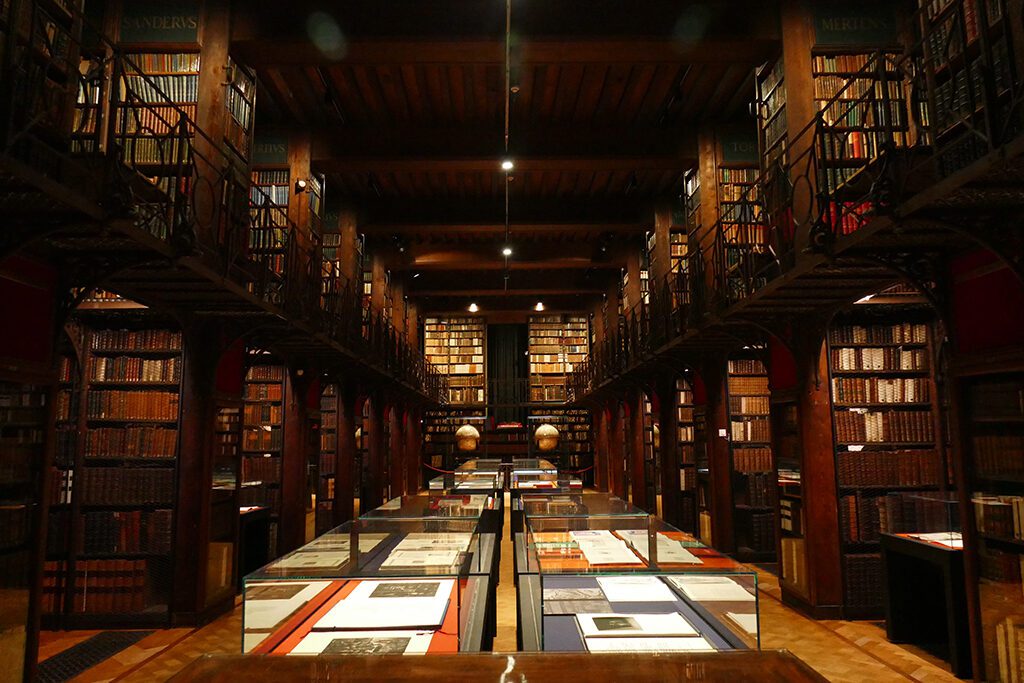
Hendrik Conscienceplein is thus not only architecturally interesting but also reflects the transformation of Antwerp: a place that evolved from a Jesuit center of religious power into a hub of knowledge and culture.
The Pillars of the Upper Class
Speaking of the wealthy bourgeoisie that made the construction of the magnificent Sint-Carolus Borromeuskerk possible in the first place, Nicolaas Rockox comes to mind. He was, in fact, one of Antwerp’s most influential citizens during the Baroque era. Not only did he serve as mayor on several occasions, but he also played a pivotal role in the city’s political, economic, and cultural life. He acted as a humanist, antiquarian, coin collector, and patron of the arts. Not only did he commission numerous paintings from Peter Paul Rubens, but he also maintained close friendships with scholars such as Abraham Ortelius and Justus Lipsius. Rockox played a key role in re-establishing Antwerp as a cultural hub following the difficult decades of the Eighty Years’ War.
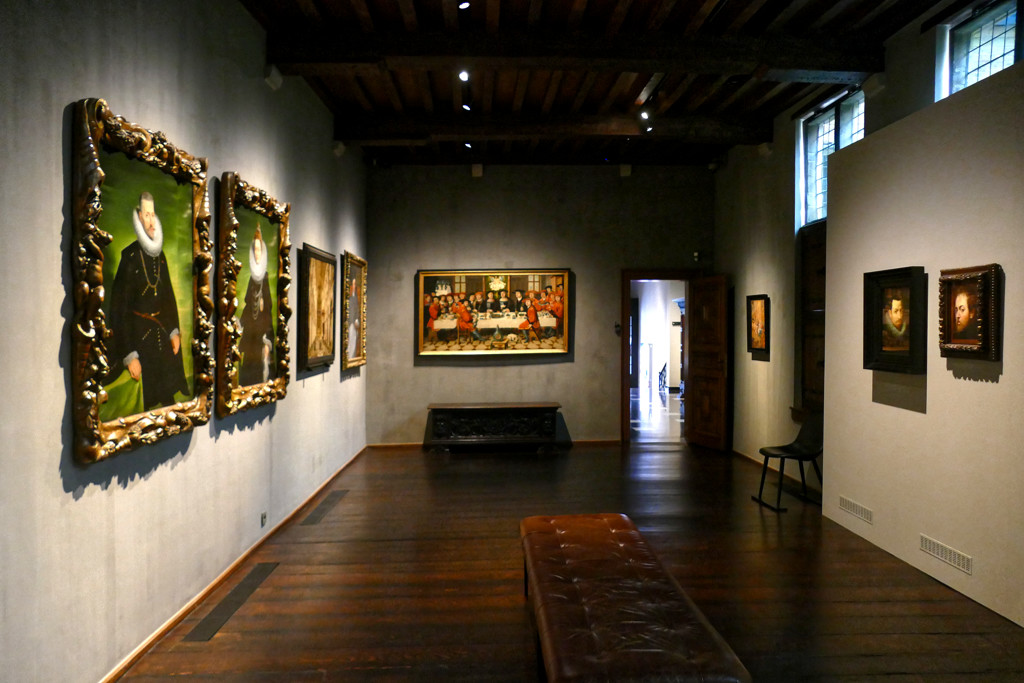
In 1603, he acquired the house known as Den Gulden Rinck along with an adjacent building, commissioning their conversion into a grand Renaissance-style town mansion. The property featured a cabinet of curiosities, an inner courtyard, and a garden containing precious and at the time extremely rare plants such as oleander, agaves, and citrus trees.
The painter Frans Snijders subsequently moved in alongside Rockox. Snijders ranks among the most significant Flemish Baroque painters, renowned above all for his monumental still lifes, animal studies, and scenes of hunting and market life. He collaborated regularly with Rubens and Anthony van Dyck. While they often painted the human figures, Snijders would add the animals, fruit, or game.
The Snijders&Rockoxhuis
Following Rockox’s death, the houses changed hands several times. In the 20th century, they were restored and eventually combined into a single property.
Today, the former homes of these prominent Antwerp figures serve as a museum. It offers insight into the lives of wealthy Antwerp citizens during the 16th and 17th centuries. Unlike many historic house museums, it showcases not only the architecture but also the social milieu of its former inhabitants. The rooms are furnished with paintings, furniture, sculptures, textiles, and decorative arts that recreate the atmosphere of a Baroque patrician residence.
You can visit the Snijders&Rockoxhuis from Tuesday to Sunday between 10 a.m. and 5 p.m. for a general entrance fee of 10 €uro.
Peter Paul Rubens – Antwerp’s Favorite Son
I have mentioned him in passing so often in this post, and now it is finally time to put him center stage. After all, Peter Paul Rubens shaped the artistic landscape of Antwerp like no other. Yet he was born in 1577 in Siegen, Westphalia, where his Protestant parents had fled from Antwerp. However, following his father’s death, his mother returned to Antwerp with the children in 1589. There, Rubens was baptized a Catholic and received a humanist education. He completed his artistic training under local masters and, in 1598, was admitted as a master to the Antwerp Guild of Saint Luke.
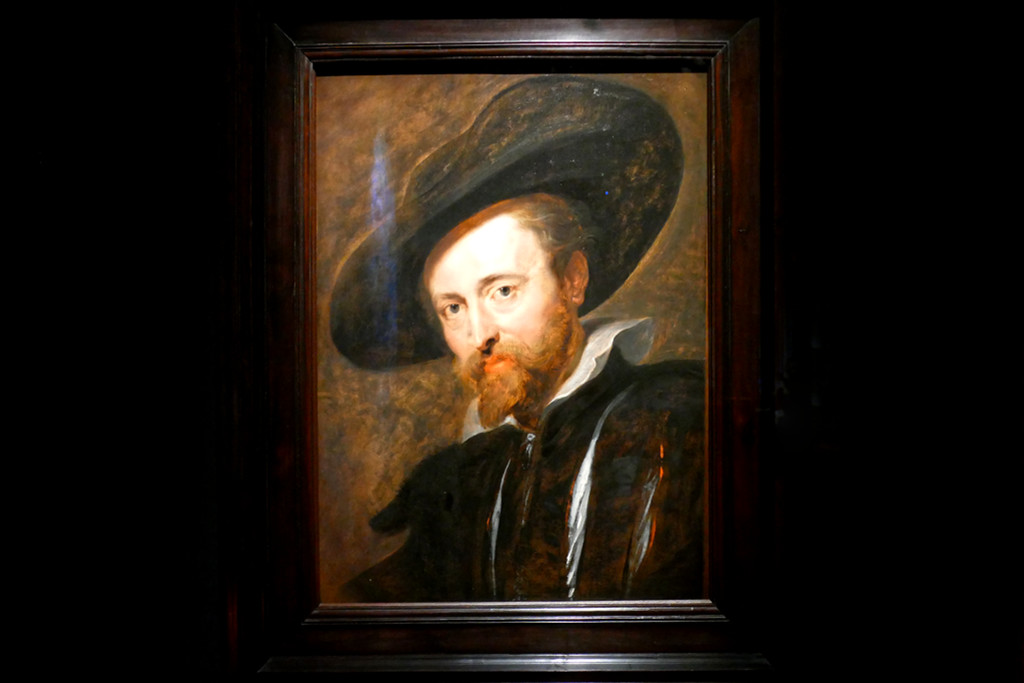
From 1600 to 1608, Rubens worked in Italy as court painter to the Duke of Mantua, Vincenzo I Gonzaga. During this period, he intensively studied the works of the Italian Renaissance as well as ancient sculptures. Upon his return to Antwerp, Archduke Albert VII of Austria and Isabella Clara Eugenia of Spain appointed him court painter. How so? Well, they were the governors of what were then the Spanish Netherlands.
Rubens secured the privilege of not having to reside at the court in Brussels. He stayed in Antwerp. In 1609, he married Isabella Brant, with whom he had three children. Following her death in 1626, he married sixteen-year-old Helena Fourment in 1630. She served as both muse and model for numerous later works.
Rubens established a highly efficient workshop in Antwerp where assistants and pupils, such as Anthony van Dyck and Jacob Jordaens, executed his designs. This enabled him to create a vast number of altarpieces, portraits, and monumental painting cycles for European princely courts.
Side Hustle
In addition to his artistic work, Rubens was also active as a diplomat in the service of the Spanish Crown. He negotiated peace treaties between Spain, England, and the Netherlands, earning him a knighthood from both King Charles I of England and King Philip IV of Spain.
Rubens’s significance for Antwerp lies in his role as a driving force for the city during the Counter-Reformation – and not only artistically but also economically and politically. Following the iconoclastic riots and the economic decline caused by the closure of the Scheldt, his visual style shaped the reconstruction of Catholic Antwerp. His monumental altarpieces in the Cathedral Onze-Lieve-Vrouwekathedraal set new standards for religious art. Through his diplomatic connections and the international success of his workshop, he drew the attention of European courts to Antwerp, establishing the city as a leading center of the Baroque.
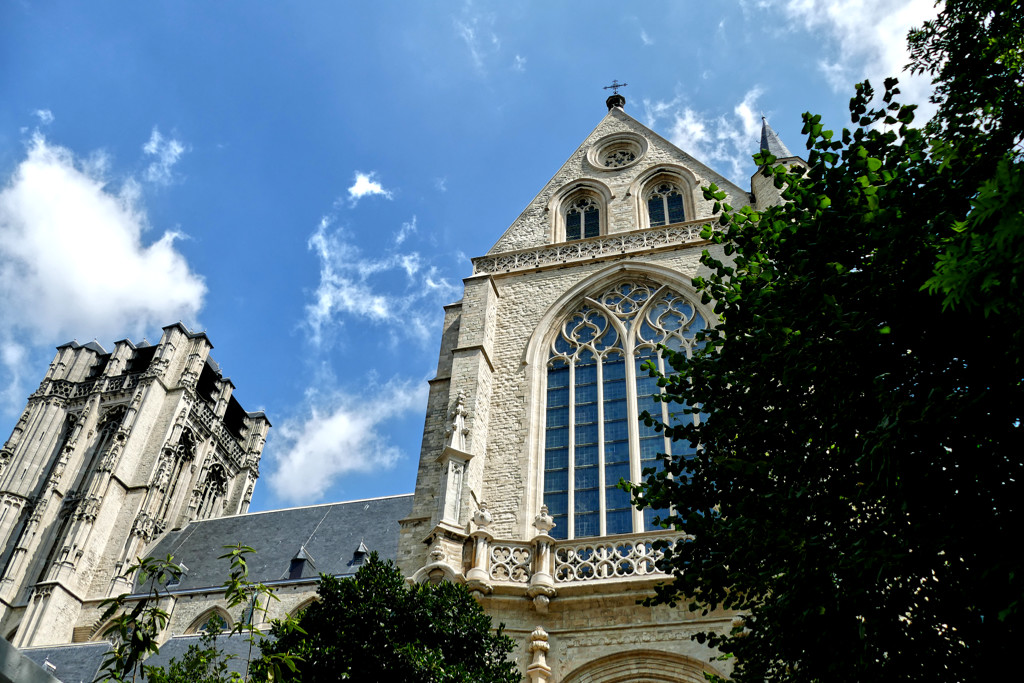
Peter Paul Rubens died on May 30, 1640, and is buried in the Church Sint-Jacobskerk.
Rubenshuis – An Artist’s Palace
Shortly after his appointment as court painter and his marriage to Isabella Brant, he purchased the estate in 1610. He remodeled the existing Flemish house according to his own designs, transforming it into an Italian Renaissance-style palazzo. For the time, it was truly extraordinary for a painter to live and build like a wealthy nobleman, since artists were still regarded as mere craftsmen by medieval standards!
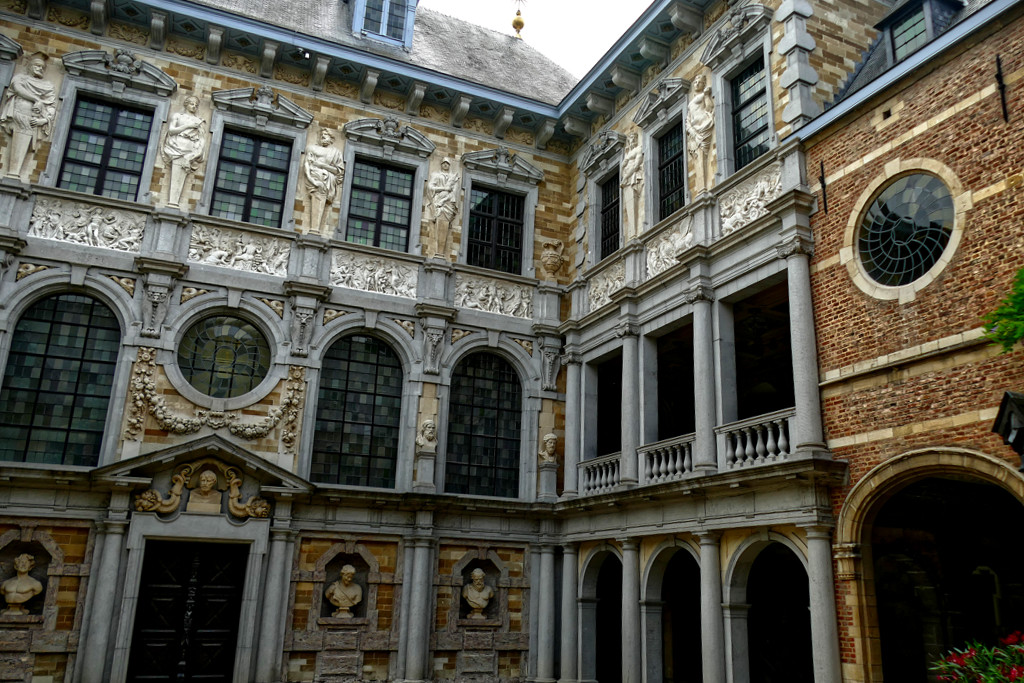
The building served not only as a home but also as a highly efficient art factory. Rubens created the designs in his studio, which his numerous apprentices and assistants then executed. Interestingly, he was also assisted by fellow renowned painters who specialized in specific subjects, such as Jan Brueghel the Elder in flowers or Frans Snyders in animals. Rubens often applied only the final brushstrokes himself. This workflow enabled the immense economic productivity that secured his wealth.
Rubens at the Royal Museum of Fine Arts Antwerp
Obviously, works by Rubens can be found in many churches and collections around the world. However, the Koninklijk Museum voor Schone Kunsten Antwerpen, KMSKA for short, indisputably houses the most significant collection globally. The museum holds monumental altarpieces, portraits, oil sketches, and smaller devotional paintings that convey the full scope of Rubens’ versatility.
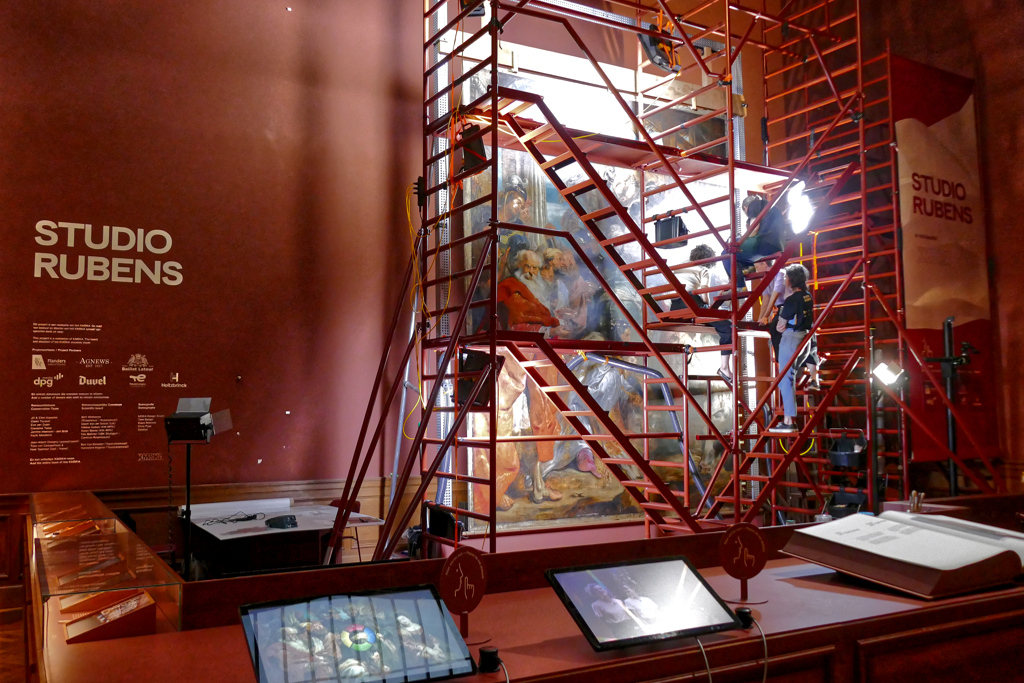
This collection reveals Rubens not only as a painter of religious and mythological scenes but also as an innovative workshop director and a defining figure of the Flemish Baroque. Part of the Rubens holdings originated with the Antwerp Guild of Saint Luke, of which Rubens was both an honorary member and secretary.
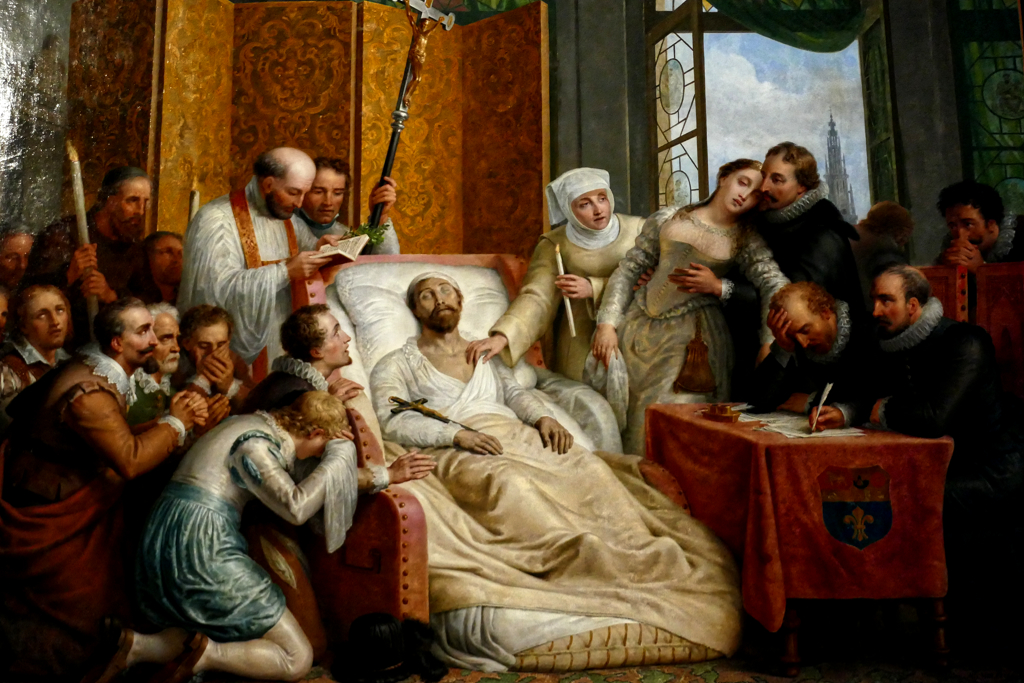
The KMSKA collection comprises around 8,400 works spanning the 14th to the 20th century, offering a comprehensive overview of the evolution of art in the Low Countries alongside selected international works.
There’s More
Its primary focus is, of course, Flemish painting. Yet, it is far more than just a dusty museum of Old Masters, as the collection also places significant emphasis on modern art and contemporary works. Their collection of Belgian Symbolism is particularly extensive. It is complemented by works from international artists such as Amedeo Modigliani, Marc Chagall, Auguste Rodin, and Alberto Giacometti.
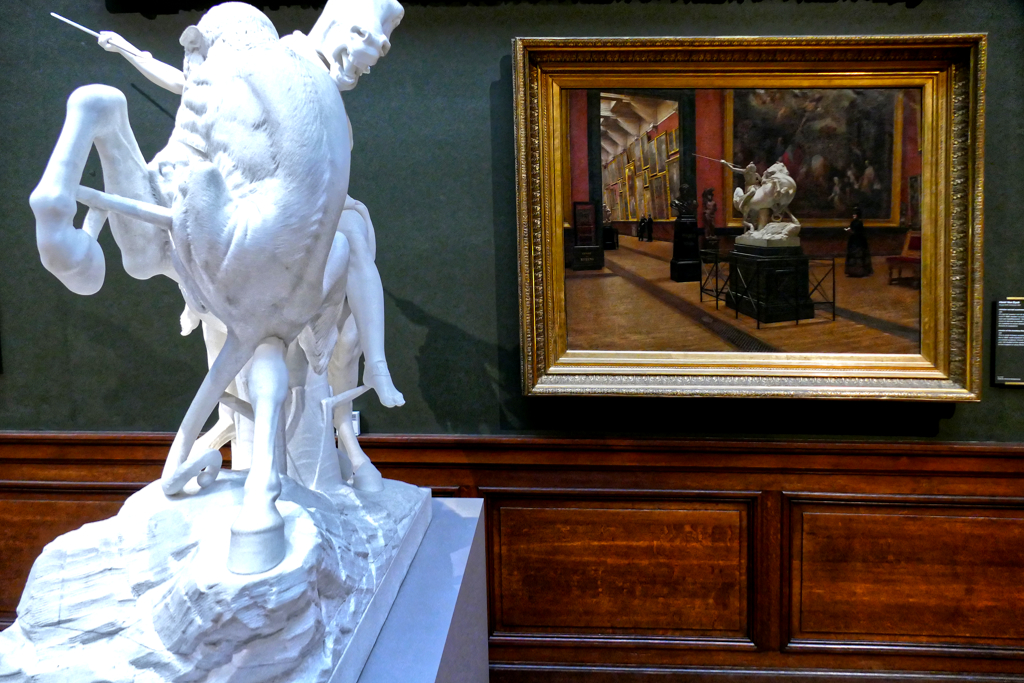
The museum’s new wing also regularly hosts temporary exhibitions and presentations of contemporary art. I was fortunate enough to visit during a temporary exhibition of Antony Gormley, which was undoubtedly a cultural highlight of my trip to Antwerp.
The KMSKA is open daily from 10 a.m., closing at 5 p.m. on weekdays. On Thursdays, it stays open until 10 p.m., while on weekends and public holidays, it remains open until 6 p.m. General admission is 20 €uro.
Virgin Mary Everywhere
While walking around, you have surely noticed the statues of the Virgin Mary adorning the corners of many buildings. Devotion to the Virgin Mary has a centuries-old tradition in Antwerp. She has been the city’s patron saint since 1124. Numerous churches and chapels, including the city’s most important church, the Cathedral of Our Lady, have been dedicated to her. Antwerp became a stronghold of the Catholic Counter-Reformation, particularly following the religious wars of the 16th century. During this period, statues of Mary were deliberately placed in public spaces to give visible expression to the Catholic faith. Consequently, many of the surviving Baroque statues date back to the 17th century.
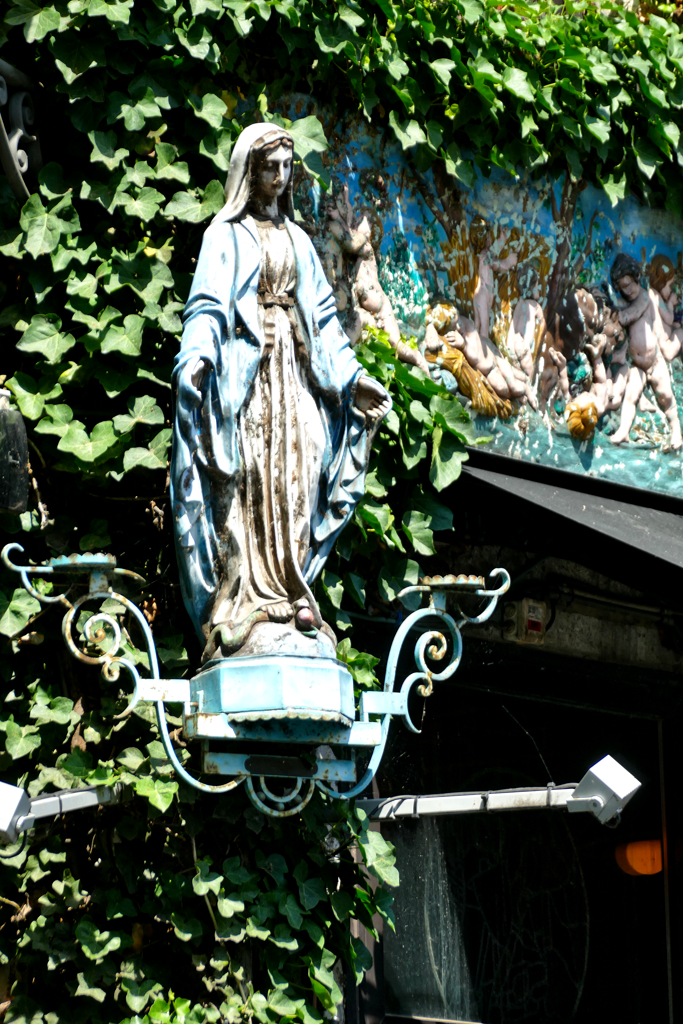
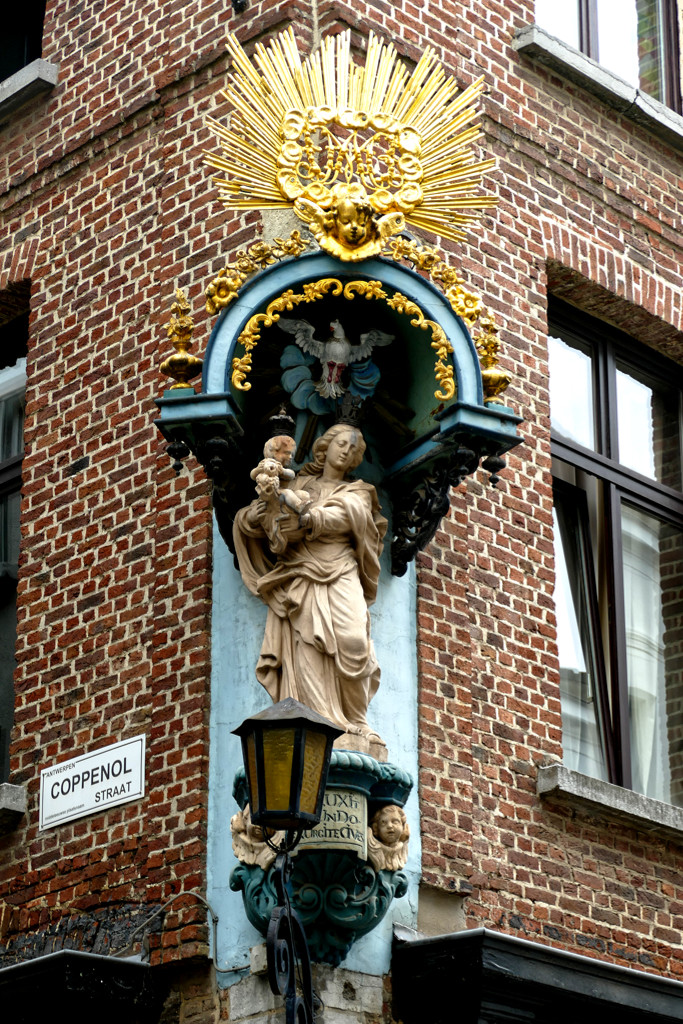
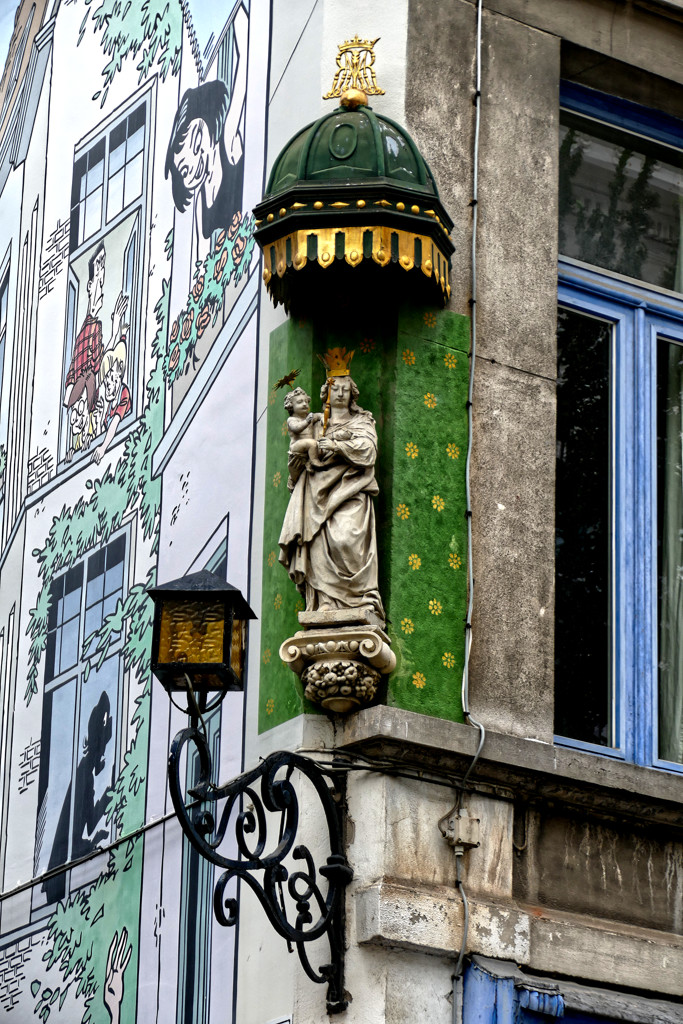
For the local residents, however, these Madonna statues held practical significance alongside their religious importance. While homeowners had them installed out of piety, the niches were often illuminated at night, meaning the statues also helped light the streets.
To this day, nearly 200 statues of the Virgin Mary and various saints can be found in the historic city center, many of which are protected as heritage monuments.
Urban Art
Of course, the Madonna shrines are a form of ancient urban art in their own right. Yet, as is the case throughout the Low Countries, a vibrant street art scene has also emerged amidst Antwerp’s centuries-old facades. Unlike in neighborhoods such as Berchem or Merksem, the works in the city center aren’t just massive murals. Instead, they are scattered across side streets, courtyards, and unassuming walls. Many murals are created as part of officially sanctioned projects and are deliberately integrated into the cityscape.
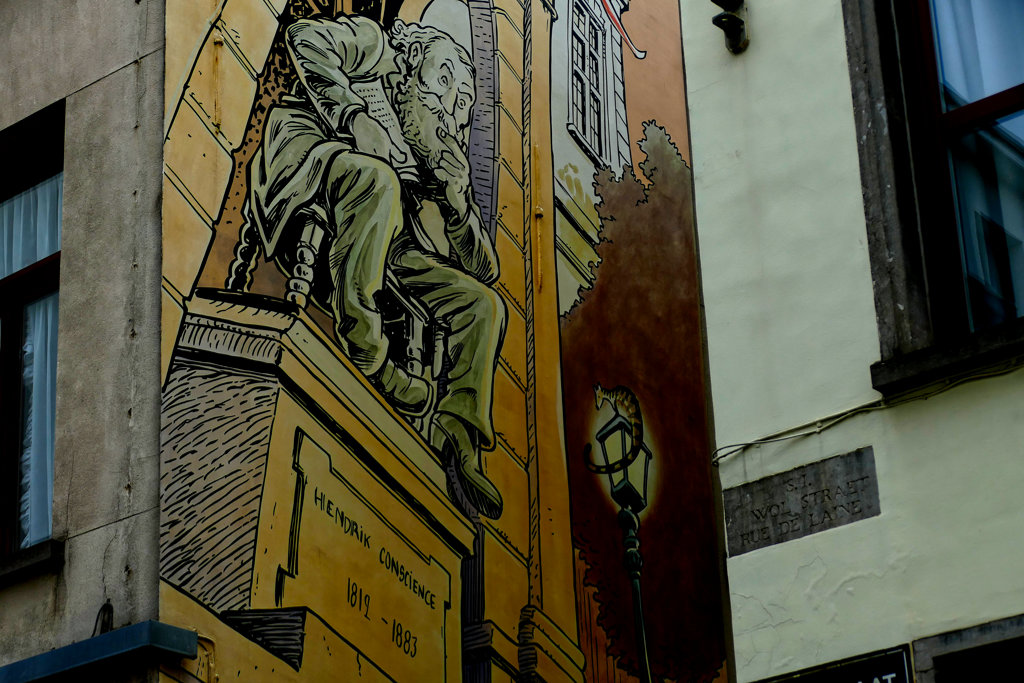
Interestingly, the City of Antwerp has been pursuing an active street art policy for years. Legal projects receive support and documentation. Also, there are designated areas where artists can freely spray’n’paint. This has fostered a dynamic scene that constantly produces new pieces and keeps the urban landscape in a state of flux.
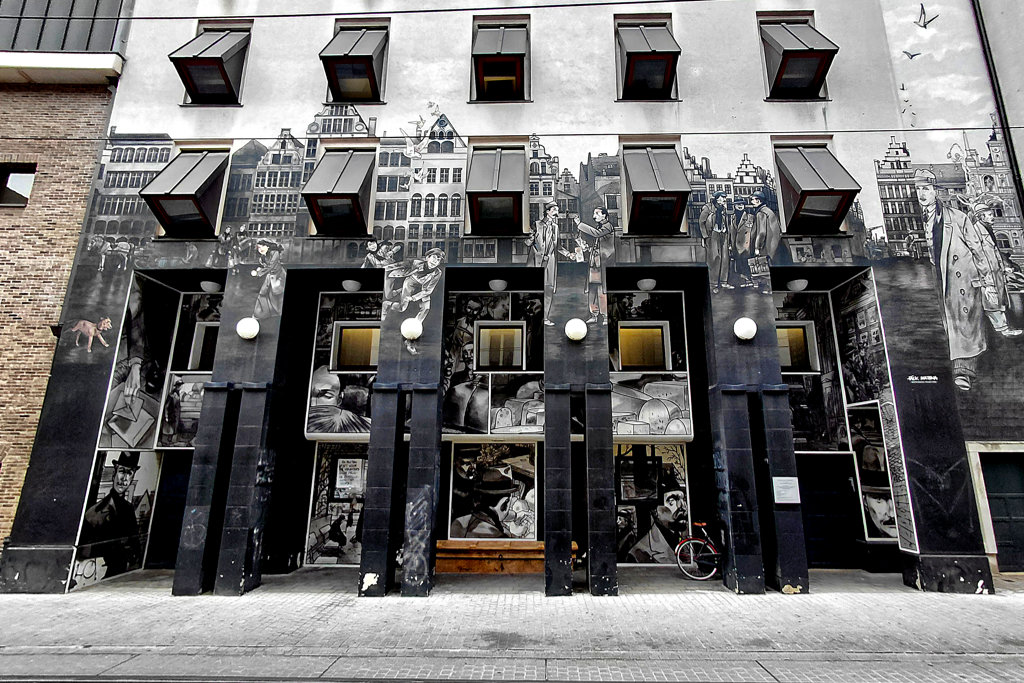
If you explore the Old Town with an observant eye, you’ll frequently stumble upon surprising artworks nestled between famous landmarks. These pieces are often just as worth seeing as the historic monuments.
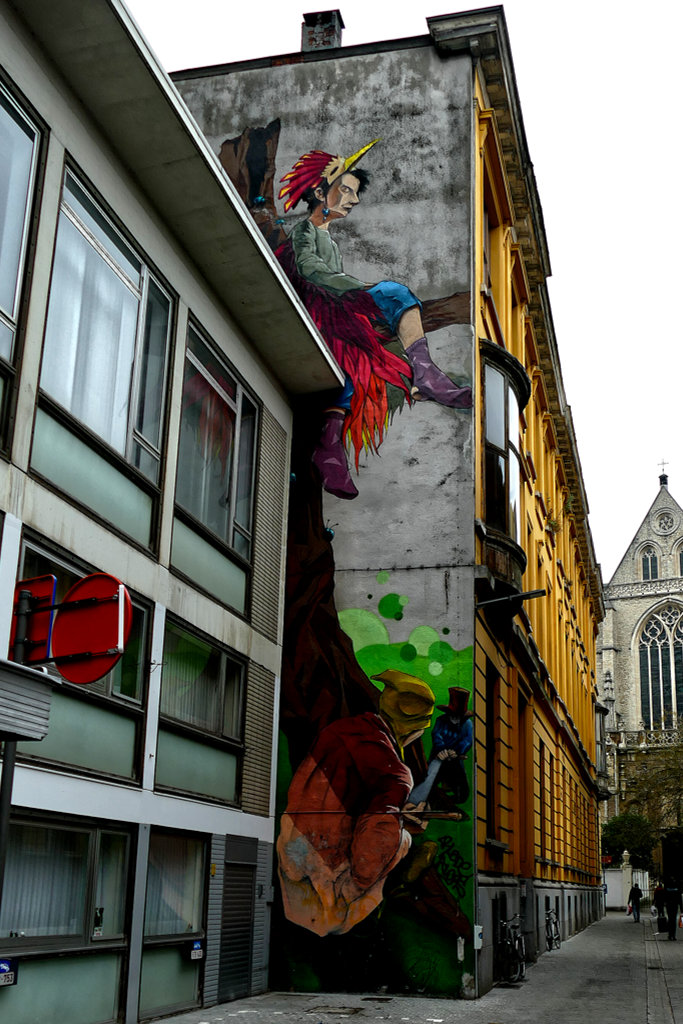
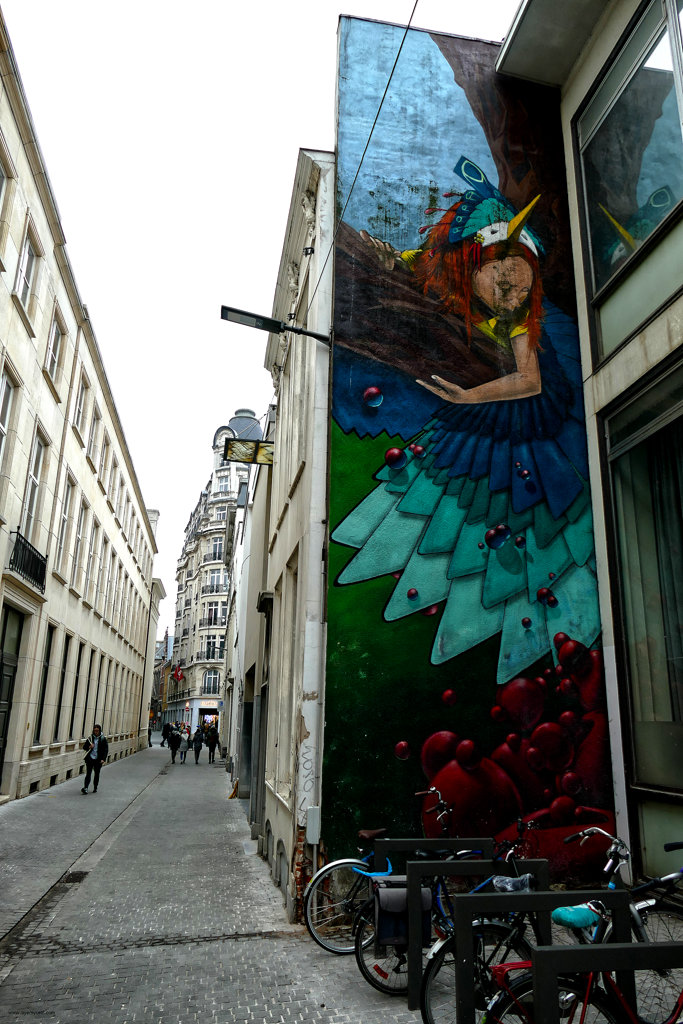
The mural on the left depicts a girl playing with a pair of wings. On the opposite wall sits a boy on the branch of an oak tree, wearing a bird mask.
However, the highest concentration of large murals is found in the outer districts. Listing even just the best ones would go beyond the scope of this guide. But don’t worry, I’ve documented them for you in my posts Best Street Art in ANTWERP – From Merksem to the City Center and Best Street Art in ANTWERP – Fresh Murals at Zomerfabriek. There you’ll also find a map showing their exact locations to make your own street art hunt easier.
Practical Information
How to Get There
Air Travel
Antwerp has an international airport located about 5 kilometers southeast of the city center. However, it is relatively small and primarily serves regional and business flights. While there are scheduled connections to some European destinations as well as seasonal holiday flights, the number of flights is significantly smaller than that of the airports in Brussels or Amsterdam. The direct train connection to Schiphol Airport is a major advantage.
In any case, you can reach the city center from Antwerp Airport by tram or bus in about 15 to 20 minutes.
Land Travel
Antwerp is one of Western Europe’s key railway hubs and is excellently integrated into the European high-speed rail network. The central station, Antwerpen-Centraal, is served by both Belgian intercity trains and international high-speed services, making it the most convenient way for many travelers to reach the city.
Direct international connections are available to destinations such as Brussels, Amsterdam, Rotterdam, Paris, and Lille. In addition, there are fast connecting services to almost all major European cities, for example, to London via Brussels, Cologne, Frankfurt, Berlin, Zurich, or Luxembourg.
My Tip
Antwerp has two train stations: Antwerpen-Centraal and Antwerpen-Berchem. The first is the main one, where all trains stop. However, some trains also halt at Berchem, which, for example, was much closer to my accommodation. So it might be worth checking if your train stops there as well.
Long-distance buses are an affordable alternative to trains. They are an especially attractive option for travelers on a budget. Compared to trains, however, long-distance buses often take significantly longer, particularly on longer routes.
The main operators are FlixBus and BlaBlaCar Bus, connecting Antwerp to destinations such as Amsterdam, Rotterdam, The Hague, Paris, Lille, Luxembourg, Cologne, Frankfurt, London, Prague, and Berlin. Depending on the route, there are multiple daily services with hourly departures on high-demand routes.
Most international long-distance buses stop at the Antwerp Rooseveltplaats bus station, located just north of the Old Town and within easy walking distance of the Antwerp-Centraal railway station.
My Tip
If you plan to visit multiple cities in Belgium or the Benelux region, Antwerp is the perfect gateway to Brussels, Ghent, Bruges, Mechelen, Leuven, Rotterdam, or Amsterdam. Thanks to frequent, reasonably priced train services, these destinations are even suitable for day trips.
How to Get Around
Antwerp has a local transport network consisting of trams and buses. It is easy for foreigners and first-time visitors to find their way around as timetables and network maps are displayed at every stop. Additionally, Google Maps shows the best route between two locations. That said, I must mention that there were frequent service cancellations, diversions, and delays during my stay.
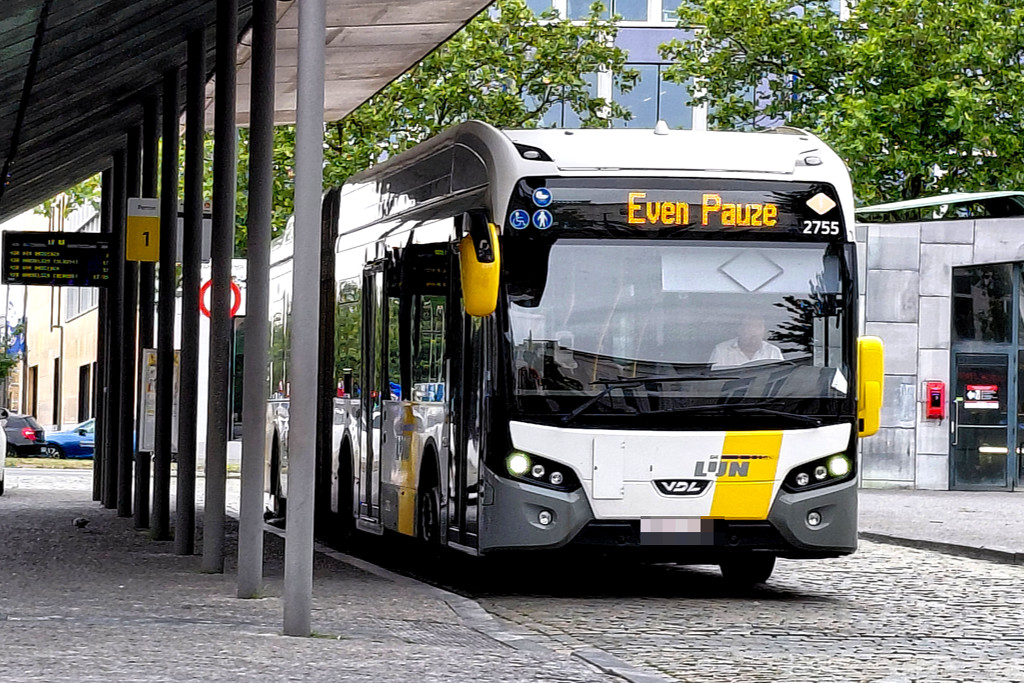
Generally, contactless payment is the most convenient way to buy a ticket. Simply tap your bank card, smartphone, or smartwatch against the reader on board the vehicle. A single journey costs 3 €uro and is valid for 60 minutes. There is no fare capping.
You can save money by purchasing a day pass for 9 €uro, which is valid for 24 hours from the time of activation on all De Lijn vehicles across Flanders. The same applies to the 3-day pass, which costs 18 €uro.
Keep in mind that you must also check in with a physical ticket, whether it is for a single journey or a multi-trip pass. To do this, simply tap the ticket against the reader on the bus or tram. Checking out, as is required in cities like Amsterdam or Rotterdam, is not necessary.
Walking’N’Cycling
The very center of Antwerp is small enough to explore easily on foot. However, since city trips always involve a lot of walking, you are especially glad at the end of a long day to be able to hop on a bus or tram, even if it is just for two or three stops.
Of course, you can also explore Antwerp by bike. There are various providers that rent out both standard bicycles and e-bikes. However, I would recommend this primarily for trips outside the city center, as many streets and alleys are crowded with pedestrians.
Visiting Organized
Although I’m an avid solo-travelling woman, I sometimes like to join organized tours. This way, I get extended info about a place, and it’s fun to visit landmarks in the company of like-minded fellow travellers.
In a busy city like Antwerp, booking tickets’n’tour ahead is recommended. Especially during high season, pre-booking online will guarantee your spot at the activity of your choice*:
Where to Stay
Antwerp offers a wide range of accommodation, spanning everything from stylish boutique hotels to luxurious five-star establishments.
Those wishing to stay in the heart of the action will find numerous upscale hotels around the Grote Markt, the Cathedral of Our Lady, and the Fashion District. All within walking distance of key sights, museums, and restaurants. Hotels in the historic center offer a particularly exclusive atmosphere, while modern design hotels with harbor views have sprung up in the up-and-coming Eilandje district near the MAS museum. The Zuid district also impresses with its stylish boutique hotels and vibrant art and dining scene.
Thanks to the city center’s compact layout, most attractions are easily accessible on foot, meaning the choice of hotel depends primarily on the desired ambiance – whether it be historic charm in the heart of the Old Town, contemporary design by the harbor, or elegant tranquility in one of the leafy residential neighborhoods. It is precisely this diversity that makes Antwerp an attractive destination for travelers who value comfort, style, and a distinctive atmosphere.
You’ll find accommodation that suits your needs and budget on this map*:
What to Eat
Culinary-wise, Antwerp is as diverse as its inhabitants. Alongside classic Flemish cuisine, the city’s food scene is shaped by international influences, fine dining, and a vibrant café culture. Visitors should therefore sample both traditional specialties and modern interpretations.
Among the best-known dishes are stoofvlees, a slow-cooked beef stew made with dark Belgian beer, and vol-au-vent, a puff pastry case filled with chicken fricassée. Moules-frites, hence, mussels with fries, are another staple. Belgian fries are considered a culinary institution in their own right and are traditionally served with a wide array of sauces.

At the same time, the cuisine reflects the port city’s international character. A wide selection of Middle Eastern, Asian, and African restaurants can be found around the historic center, particularly in the Quartier Zuid and the multicultural district near the train station.
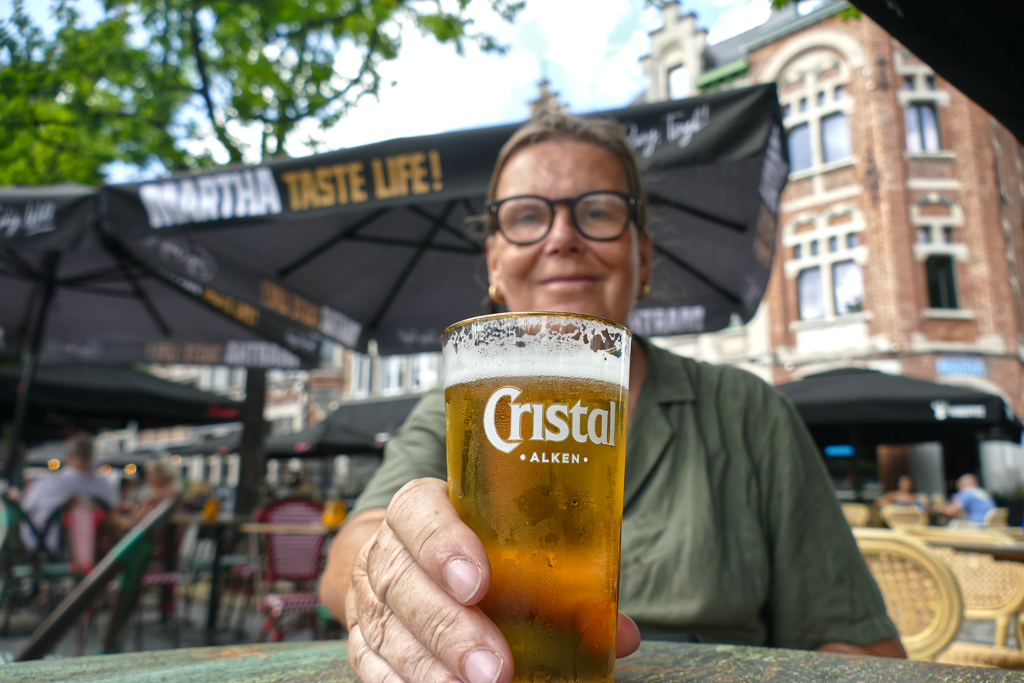
Belgium is renowned worldwide for its beer culture, offering hundreds of different varieties, ranging from fruity lambics and robust Trappist ales to unique regional specialties.
Cash, Cards, and Deals
In May 1998, the heads of the member states of the European Union agreed – nota bene in Belgium – on the implementation of the €uro.
Until now, 21 European countries replaced their former local currency with the €uro starting in 2002. Obviously, Belgium is one of them. The exchange rate is 1 US$ = 0.84 EUR as of September 2026. However, you can check today’s conversion rate on this page.
Credit cards are far more accepted than cash. Also, keep in mind that there are not as many ATMs as in other European countries. Therefore, as you finally come across an ATM, there might be a pretty long queue.
You can save a lot of money on your visit to Antwerp with the City Pass. It grants you mostly free – and sometimes at least reduced – admission to numerous attractions. You also get unlimited use of public transport. The pass is available in three versions:
| 24 hours | 48 hours | 72 hours | |
| Antwerp City Card | 45 €uros | 55 €uros | 65 €uros |
The pass is digital. Once activated, you use it via the app on your smartphone. Since it becomes valid immediately, you should only activate it when you are ready to use it for the first time.
However, before purchasing the Antwerp City Pass, keep in mind that museums in Belgium offer age-based discounts that are not tied to EU citizenship or residency. Adults under 26 often pay half price, while admission is even free for those under 18.
Language
The existence of three official languages in Belgium, namely Dutch, French, and German, is the result of two historical events. On the one hand, there was a centuries-old ethnic border. Eventually, there was a border shift after WWI.
The French-speaking population of approximately 39 percent in the south of the country arose because the Wallonia region had been under the influence of France and Roman culture for centuries. When Belgium seceded from the Netherlands in 1830, it was the French-speaking elite who led the revolution and established French as the official language of the state and the upper classes. Nevertheless, the 60 percent of speakers in the north retained their own language. The tiny German-speaking group of just under 1 percent in the east, however, only became part of Belgium over a century later, in 1919, through the Treaty of Versailles, which granted the German minority Belgian citizenship overnight.
Being the central spot of the European continent and home to Europe’s second-largest harbor, most people speak decent English.
Since it’s always nice to be able to say at least some pleasantries in the local language, you might want to pick up some words in Dutch online with Babbel. The first lesson, which already covers all the hellos and thank yous, is even free.
Stay Connected
Since June 2017, travelers with a mobile contract from an EU country have been able to use their phones in Belgium without incurring additional roaming charges. This rule applies throughout the European Union, as well as in Iceland, Liechtenstein, and Norway. After Brexit, providers continue to offer EU roaming, though this now depends on the specific contract rather than statutory regulations.
If EU roaming is not available, finding Wi-Fi is rarely an issue. Most hotels, museums, cafés, restaurants, shopping centers, and many public spaces offer free Wi-Fi, making it easy to stay online during your visit.
For visitors from outside Europe, purchasing a prepaid SIM card is easy. Belgium’s three national mobile network operators are Proximus, Orange Belgium, and BASE. All providers offer prepaid SIM cards with generous data allowances and nationwide 4G coverage, as well as expanding 5G coverage. These SIM cards are available at provider stores, electronics retailers, supermarkets, and Brussels Airport. Prices and data allowances change frequently, but most prepaid packages aimed at tourists cost between 10 and 25 €uro and provide enough data for a typical city break.
An even more convenient option is an eSIM, provided your smartphone supports it. Providers such as Airalo, Holafly, Nomad, and Saily offer data plans for Belgium and Europe that you can purchase and activate online before your trip. Prices generally start at around 5 USD for 1 GB, with larger packages and unlimited data plans available for longer stays. For travelers visiting multiple European countries, a regional Europe eSIM is often the most cost-effective choice.
Map
On this map, you’ll find all the wonderful places I’m introducing in this post.
Clicking on the slider symbol at the top left or the full-screen icon at the top right will display the whole map, including the legend.
Pinnable Pictures
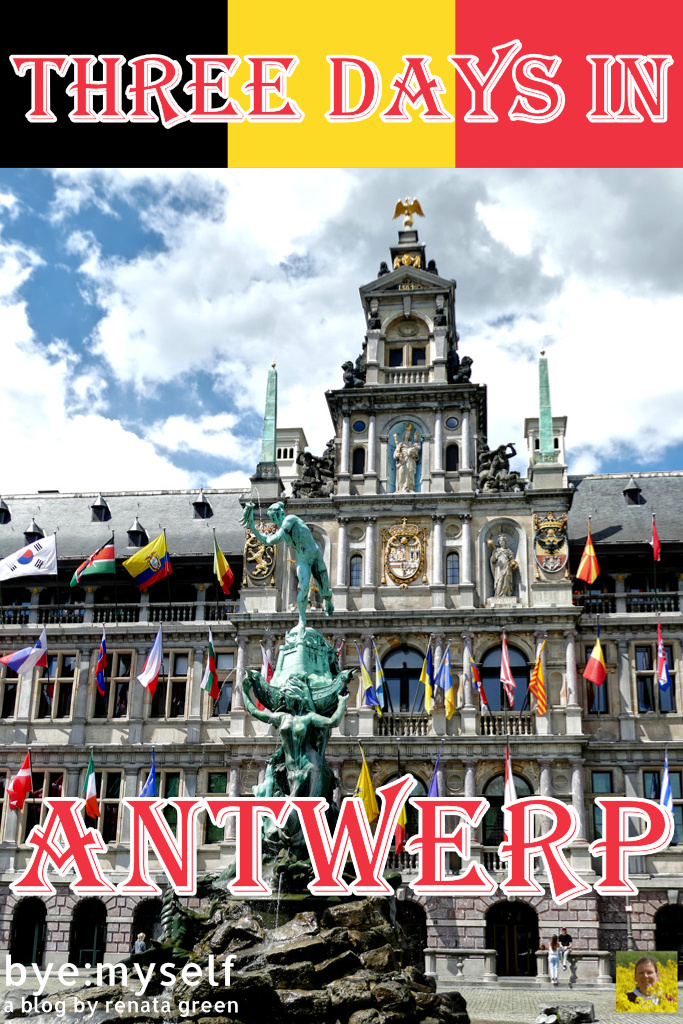
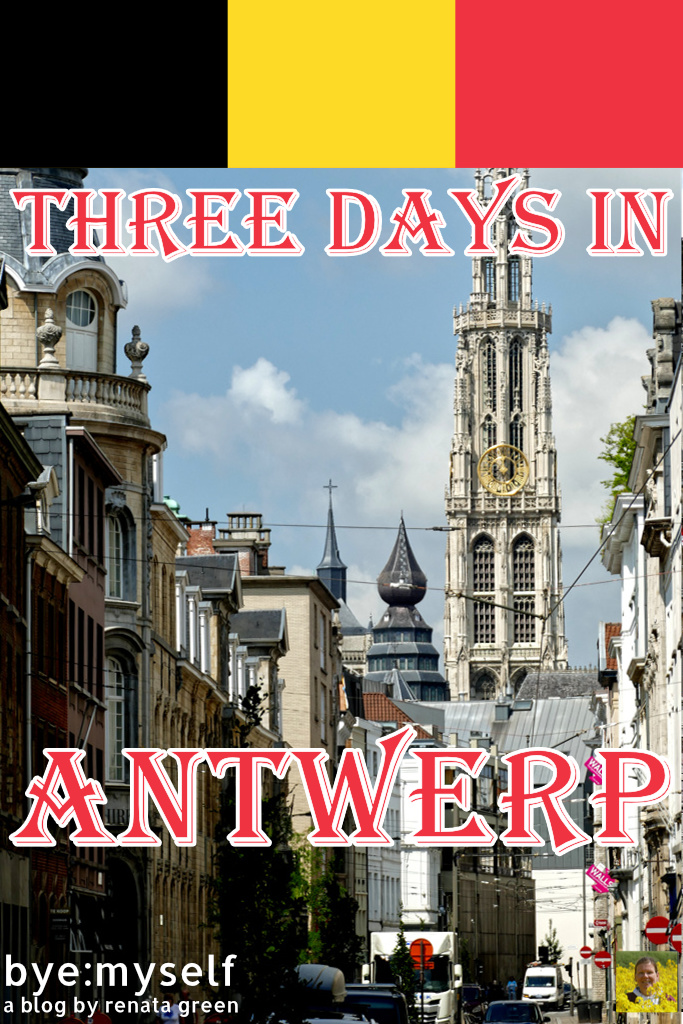
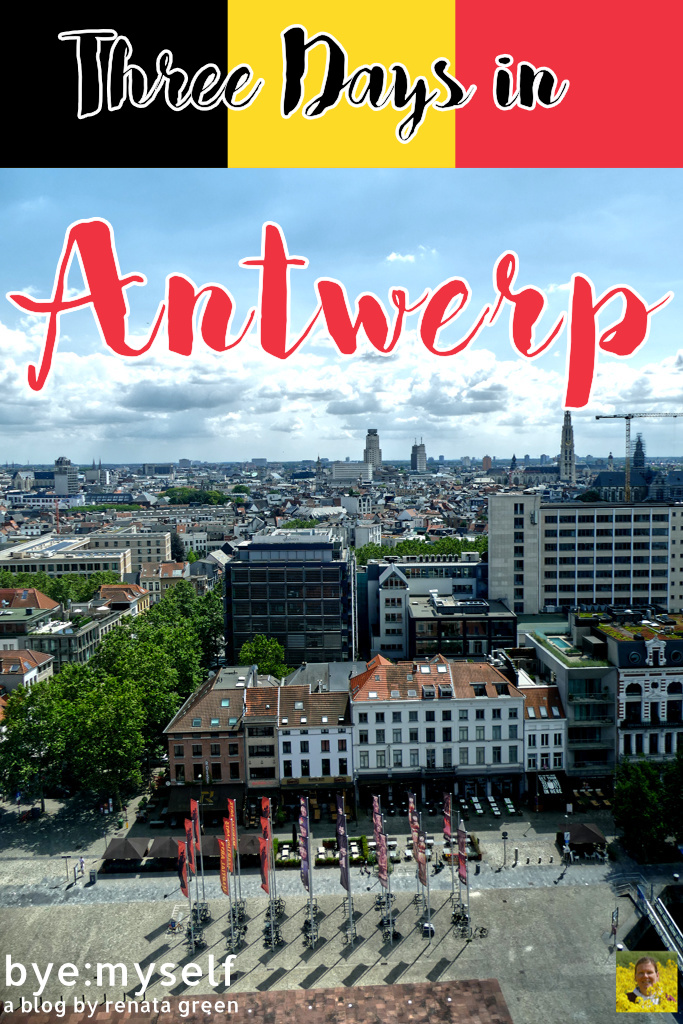
If you choose to pin this post for later, please make sure to use one of these pictures:
Did You Enjoy This Post? Then You Might Also Like These:
What to Do in ANTWERP in Three Days – The Obvious and the Unexpected
The Best Murals Along Brussels’ Comic Book Route
Best Street Art in ANTWERP – From Merksem to the City Center

Best Street Art in BRUSSELS
Best Street Art in GHENT
What to Do on a Day Trip to BRUGES

Best Street Art in ANTWERP – Fresh Murals at Zomerfabriek
Weekend in GHENT – Medieval Heritage Meets Metropolitan Vibes
Disclaimer: I appreciate that Visit Antwerpen supported both of my blogger trips by supplying me with a 72-hour Antwerp City Card. However, all opinions on these services are mine and weren’t by any means influenced by my cooperation partner.
* This is an affiliate link. Hence, if you book through this page, you not only get the best deal. I also get a small commission that helps me run this blog.
Thank you so much for supporting me!