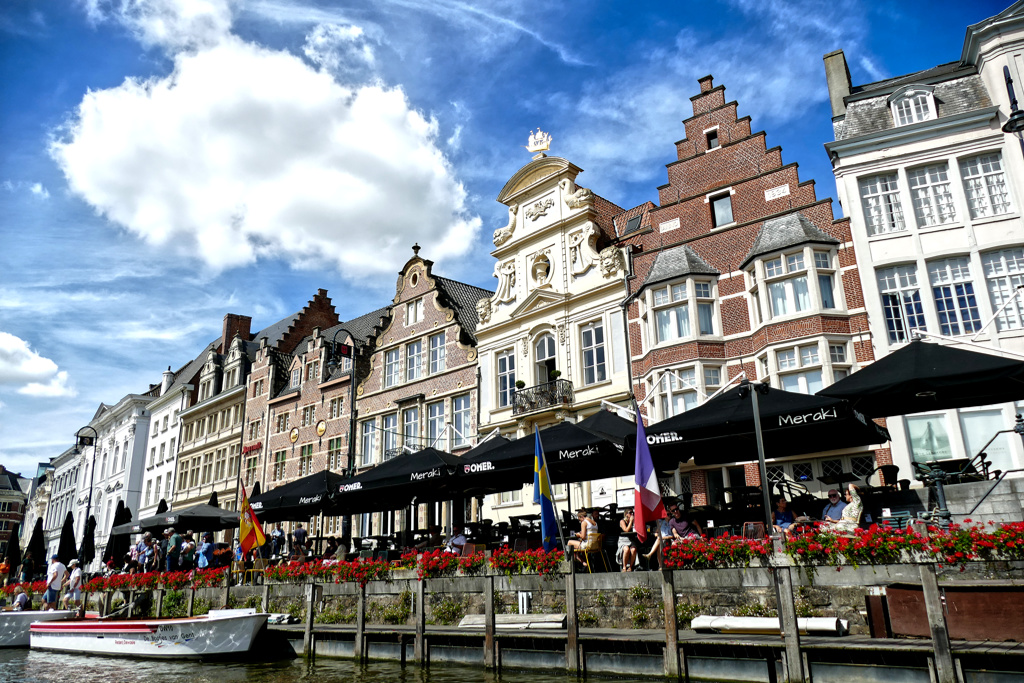
Nobody told me that two days might be rather short for a visit to Ghent. In fact, few cities blend centuries of rich heritage into modern urban life as effortlessly as Ghent. Massive medieval structures, picturesque canals, and centuries-old guildhalls form one of Belgium’s most atmospheric historic centers. Yet, behind its magnificent facades, Ghent is a vibrant university city boasting a truly unique energy. Less crowded than Bruges and far more laid-back than Brussels, it strikes the perfect balance between tradition and modernity.
- Ghent – Right in the Middle
- Coming a Long Way
- Gravensteen, the Castle of the Counts
- Around Sint-Veerleplein
- Burgstraat
- Leie And Lieve
- Korenlei | Graslei | Kraanlei
- Vrijdagmarkt – Thank God it's Friday
- Sint-Baafsplein and the Three Medieval Towers
- Metselaarhuis
- Hotel d'Hane-Steenhuyse
- Museum Arnold Vander Haeghen
- Modern Times at the Citadelpark
- Street Art
- Practical Information
- Map
- Pinnable Pictures
Ghent – Right in the Middle
Ghent lies in the heart of Belgium, and Belgium is the center of Europe. Thus, the city could hardly be more centrally located. After Antwerp, Ghent is the country’s second-largest city. If you’re now thinking, But Renata, wait a minute, what about Brussels?, let me tell you that Belgium’s capital has less than 200k inhabitants, which pushes it far down in the official ranking.
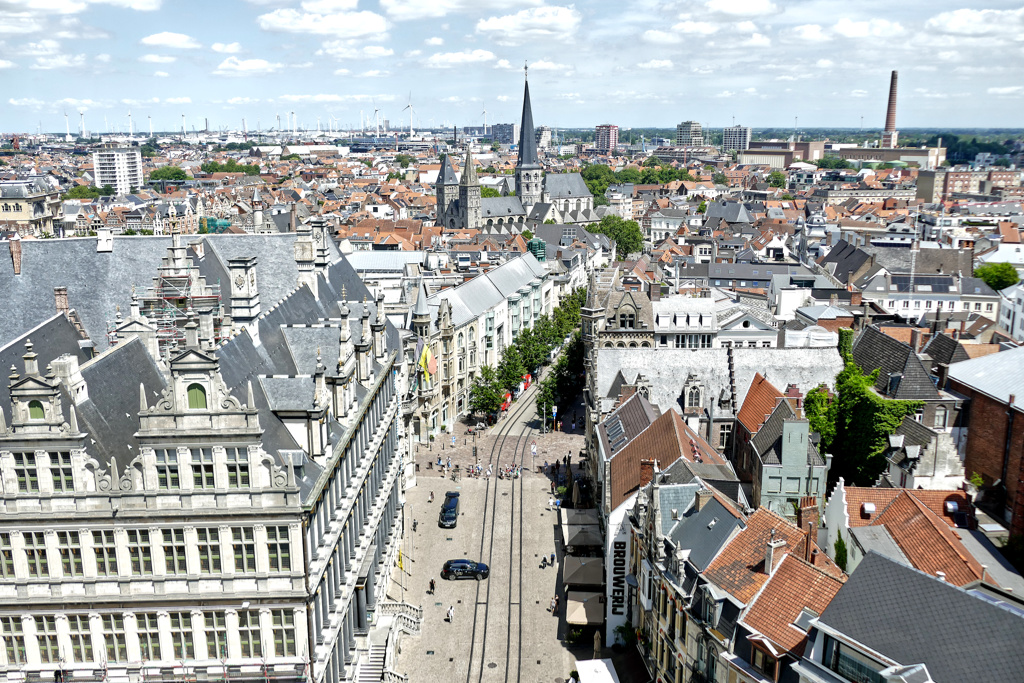
Anyway, since Ghent is only about 50 kilometers from Antwerp, Bruges, as well as Brussels, it’s also an ideal base for exploring all of Belgium’s iconic cities. However, make sure to plan enough time for Ghent since I’d argue that it is just as picturesque as Bruges, although thankfully it hasn’t suffered nearly as much from the current übertourism as its smaller sister to the west. Furthermore, despite its impressive historical architecture, Ghent has retained the welcoming atmosphere of a modern metropolis. So whether you spend a weekend strolling through Ghent’s cobblestone streets, taking in the views from dizzying towers, exploring museums, or relaxing on waterfront terraces, the city reveals a different side at every turn.
Coming a Long Way
Ghent originated in the early Middle Ages at the confluence of the Scheldt and Leie rivers. In 630, St. Peter’s Abbey was founded there, around which the first settlement developed. Nothing remains above ground of the very first wooden or early medieval structures of the abbey; the complex was destroyed and rebuilt several times over the centuries in the Baroque style.
During the Middle Ages, Ghent grew into a significant trading and cloth-making city. The processing and trade of wool, in particular, brought the city great wealth.
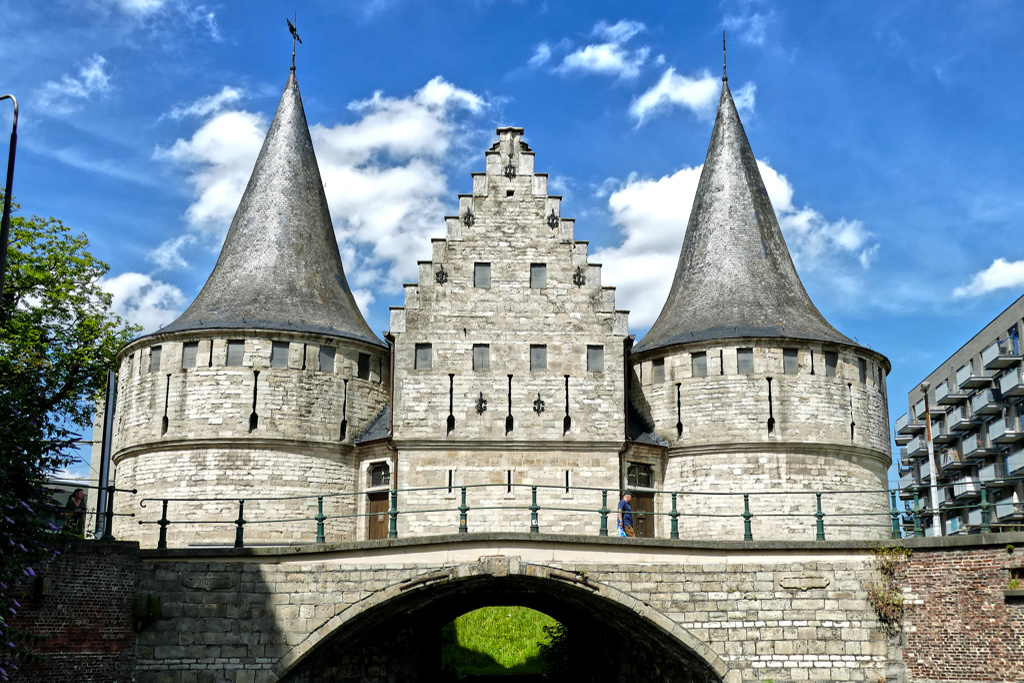
Ghent – the overlooked queen. While Ghent was never the capital of present-day Belgium – since the founding of the Belgian state in 1830, that title has gone to Brussels, obviously – it was one of the most important cities in Europe during the Middle Ages. Its wealthy citizenry and craft guilds wielded considerable political influence. In the 13th and 14th centuries, an estimated 65,000 people lived there. According to historical estimates, this made Ghent the second-largest city north of the Alps after Paris, and even larger than London! And quite honestly, if you stroll through the city center with your eyes open on a city break, you’ll still see and feel Ghent’s importance at every turn.
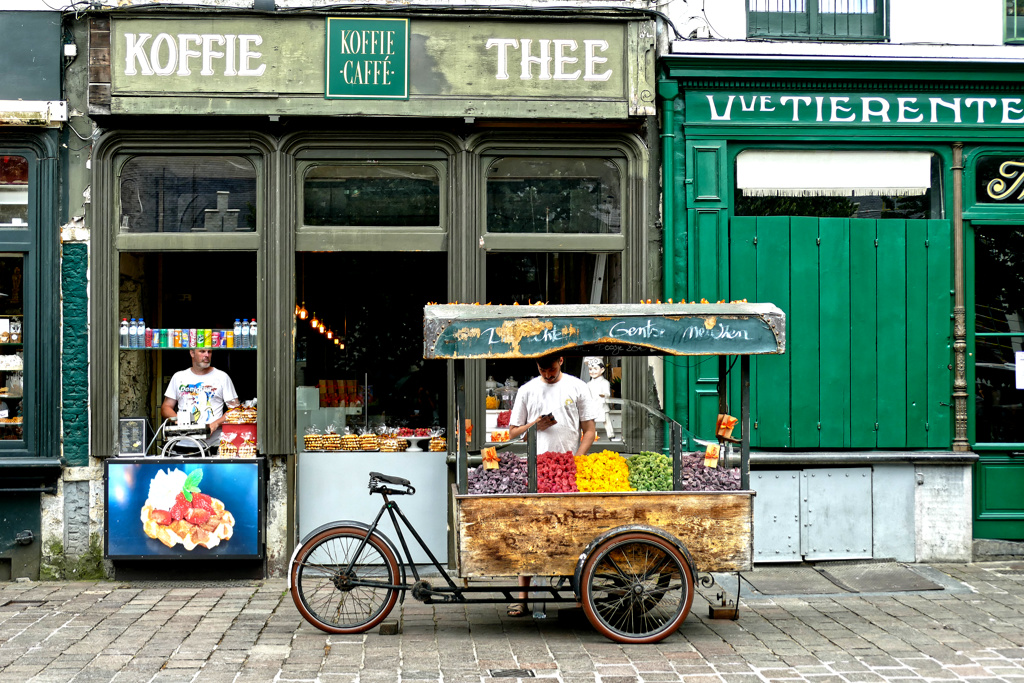
Among the oldest still-standing, massive stone buildings in the city are parts of the imposing Gravensteen, the Castle of the Counts, dating back to the 12th century. This, along with the central location of this impressive fortress, makes Gravensteen the perfect starting point for a comprehensive tour of the city.
Gravensteen, the Castle of the Counts
I’m always incredibly impressed when a centuries-old historical building just stands there in a city. The fact that there’s a Colosseum right in the middle of Rome, completed around 80 AD, blew me away. In Nîmes, you can find an amphitheater that’s only a few years younger. Don’t you think that’s magnificent and almost miraculous? And although, in comparison, the Castle of the Counts Gravensteen is practically a baby, I still find a medieval castle from 1180 just as impressive.
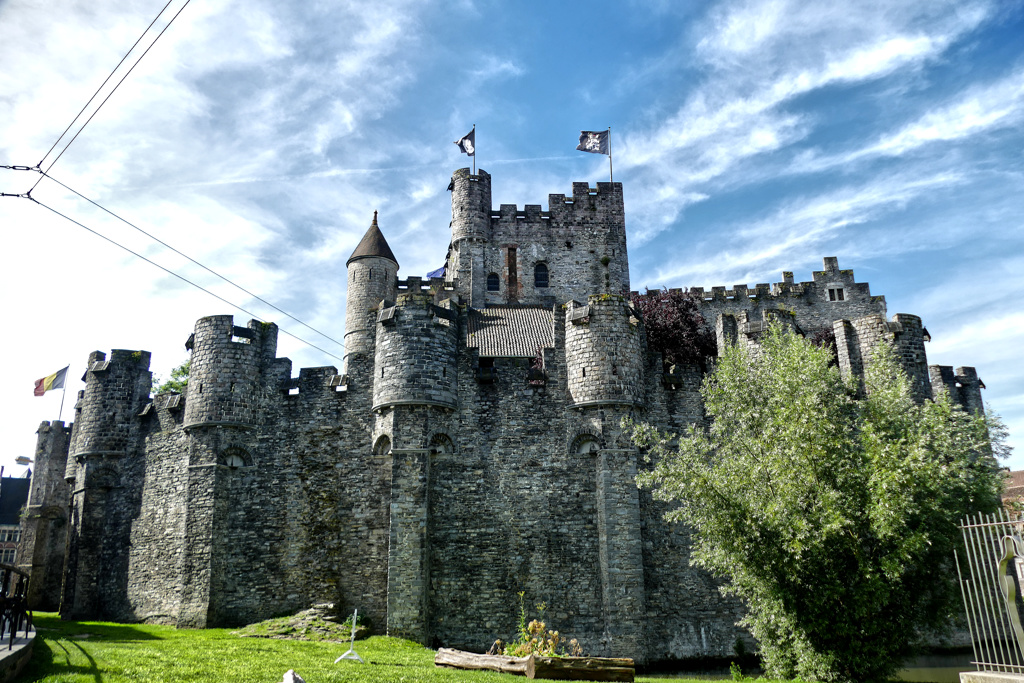
Philip of Alsace, Count of Flanders, commissioned the citadel which stands right in the center of town. The stone fortress with its mighty keep, surrounding curtain wall, and moat not only provided protection. Above all, it demonstrated the power of the Counts of Flanders. Philip of Alsace had seen castles in the Middle East during his participation in the Second Crusade. Their architecture influenced Gravensteen’s building style.
As they say: My castle is my home – or was it the other way around?
Until the 14th century, the castle served as the residence of the Counts of Flanders. With the relocation of the counts’ court to the nearby Hof ten Walle, it lost this function. Subsequently, it served as a courthouse, prison, and mint, among other things. In the 19th century, the medieval complex became part of a cotton mill. Workers’ housing was built within and directly adjacent to the walls.
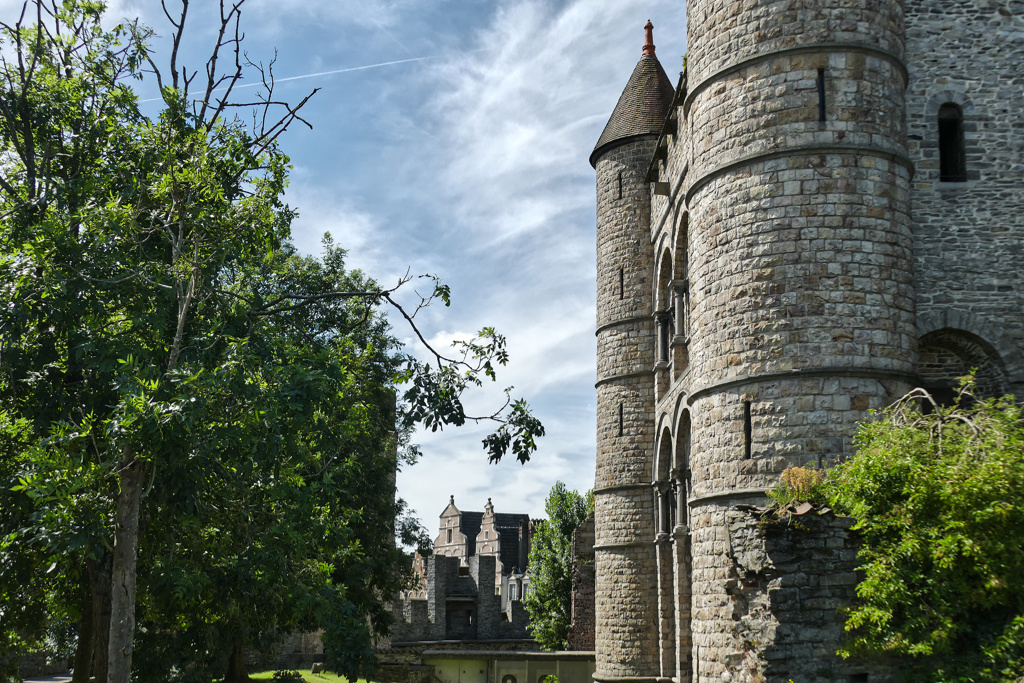
Around 1900, the city of Ghent acquired Gravensteen and undertook extensive restoration. The restoration focused heavily on preserving the castle’s medieval appearance and removed the later industrial structures. Its current appearance is therefore not only an unaltered medieval testament but also the result of this comprehensive restoration.
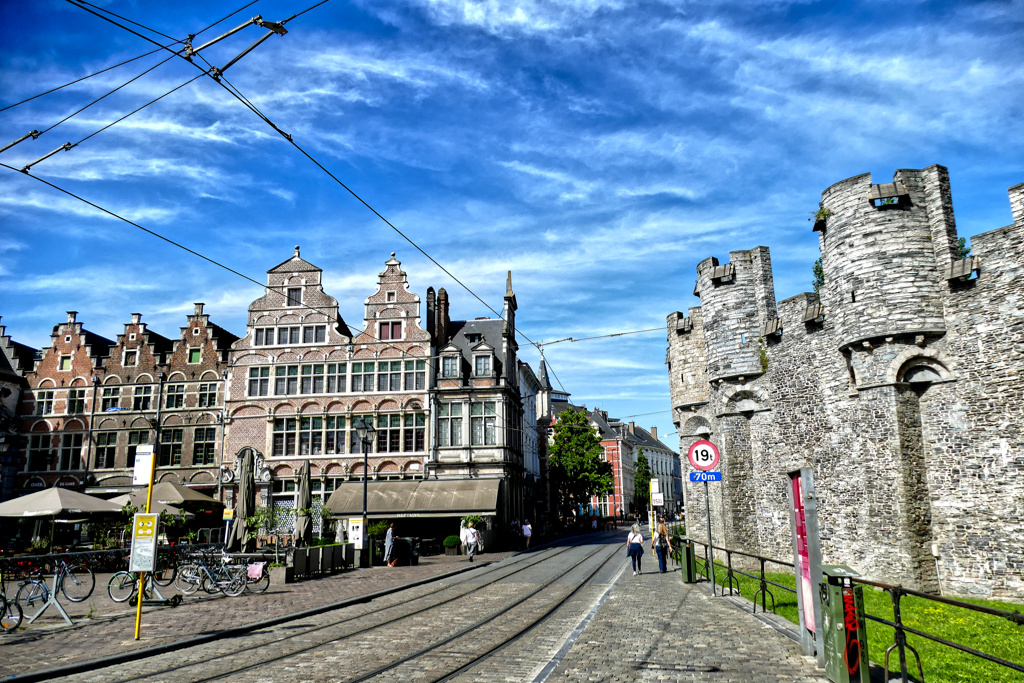
Today, with its defensive walls, towers, interior spaces, and keep, Gravensteen conveys the impression of a medieval count’s castle and houses, among other things, a collection of historical weapons and armor.
You can visit Gravensteen, the Castle of the Counts, every day of the week from 10 a.m. to 6 p.m. for a general entrance fee of 15 €uro.
Around Sint-Veerleplein
After a thorough visit to the castle, don’t rush off immediately. Just before Gravensteen lies the historic Sint-Veerleplein. In the Middle Ages, this square formed the outer area in front of the fortified entrance to Gravensteen. A wall and a gate separated the castle from this outer bailey. Today’s Sint-Veerleplein essentially corresponds to this former outer courtyard. Its location directly in front of the residence of the Counts of Flanders made it a place where secular power and the urban life of Ghent directly intersected. Also, the square lies at the historic confluence of the Leie and Lieve rivers. Thus, it was part of Ghent’s characteristic network of waterways. They played a central role in the city’s trade and economic development. However, the square also has a less glorious history, as people accused of witchcraft were executed here between the 14th and early 18th centuries.
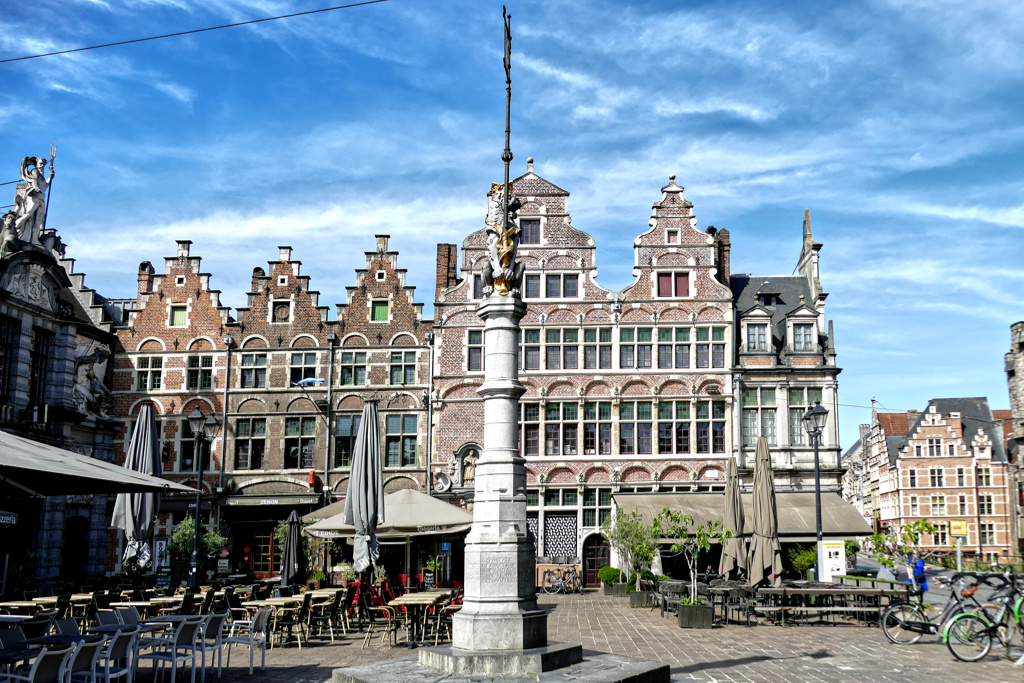
Today, primarily characterized by its restaurants and cafes dominate the Sint-Veerleplein. Its central location makes it an excellent starting point for a walking tour. Later, you can return for a short break or an evening drink. Sint-Veerleplein is and always will be the heart of Ghent.
Burgstraat
Before continuing your walk towards the center, take a short detour across the small bridge west of the castle. This is where Burgstraat begins. It once was the grand entrance to the mighty Gravensteen Castle. Even today, a magnificent row of houses testifies to the wealth of the Flemish bourgeoisie between the 16th and 18th centuries.
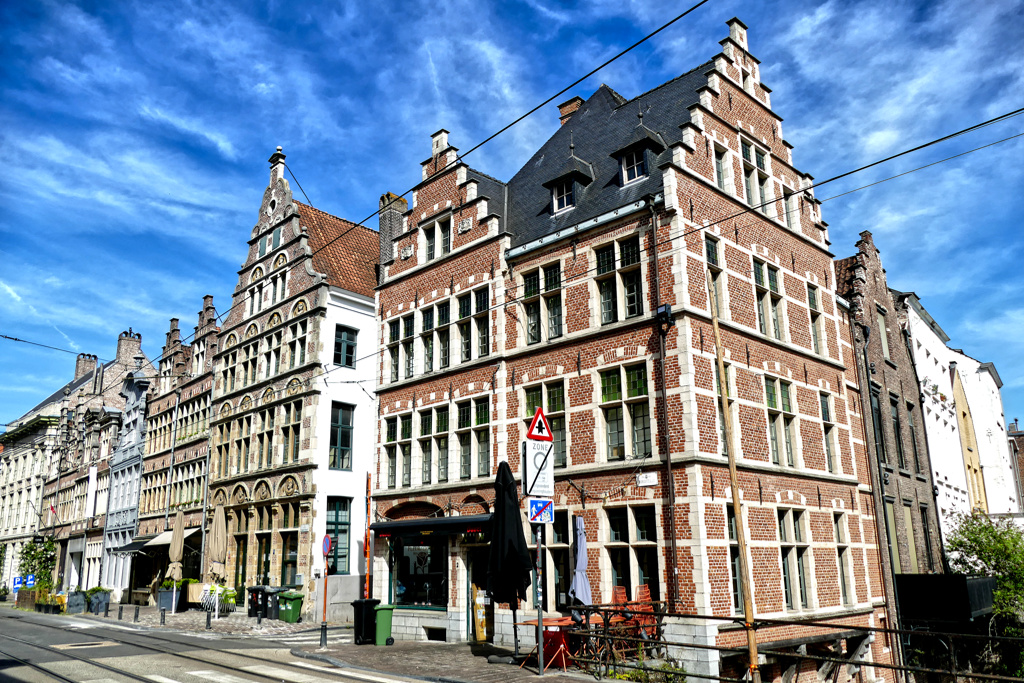
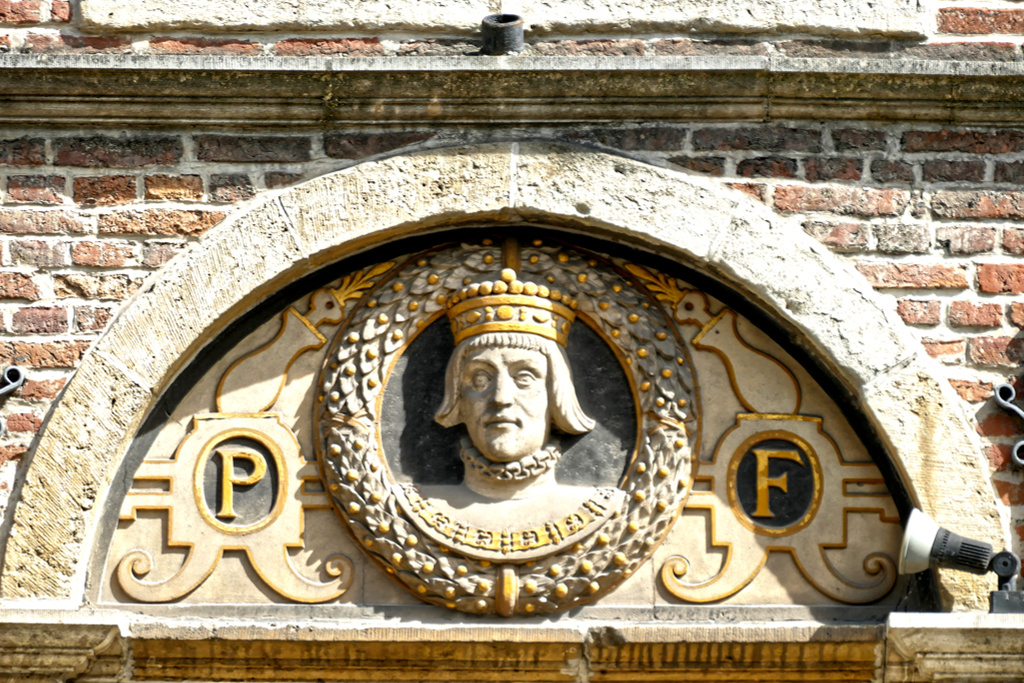
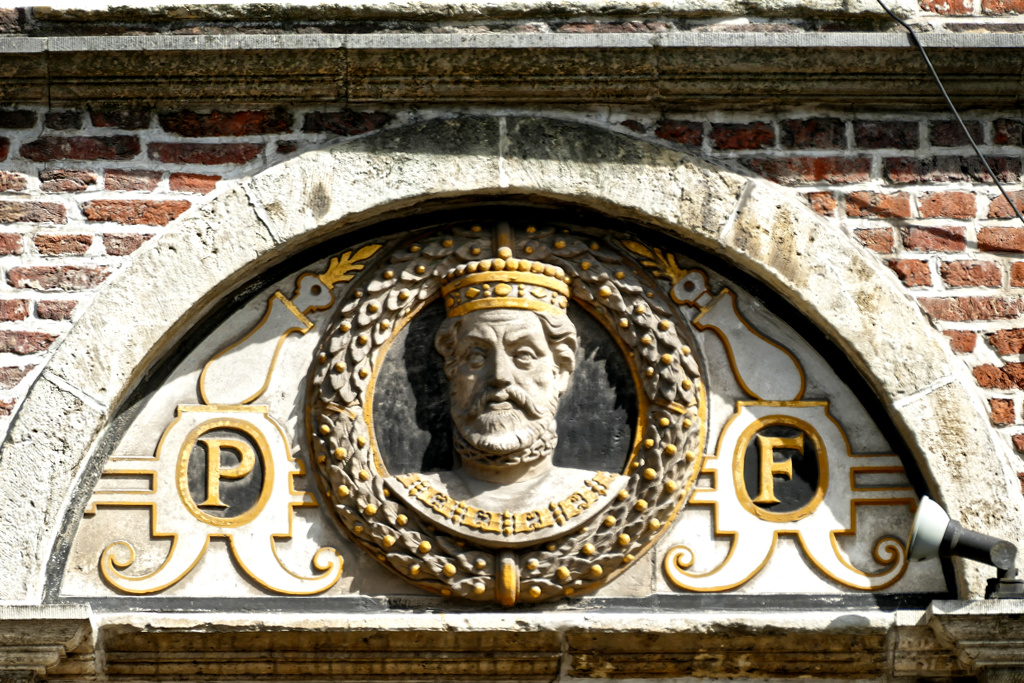
Next to the corner house Huis Het Trompetje stands the famous Huis der Gekroonde Hoofden, hence the House of the Crowned Heads. It was built in 1560 in the opulent style of the Flemish Renaissance. Its facade is striking for its interplay of light sandstone and red brick, supported by five large round arches on the ground floor and crowned by curved volute gables.
The 14 medallions, which gave the building its name, depict the busts of the Counts of Flanders, from Baldwin I to Philip II. They are a clear declaration of loyalty to the rulers during a time of political turmoil.
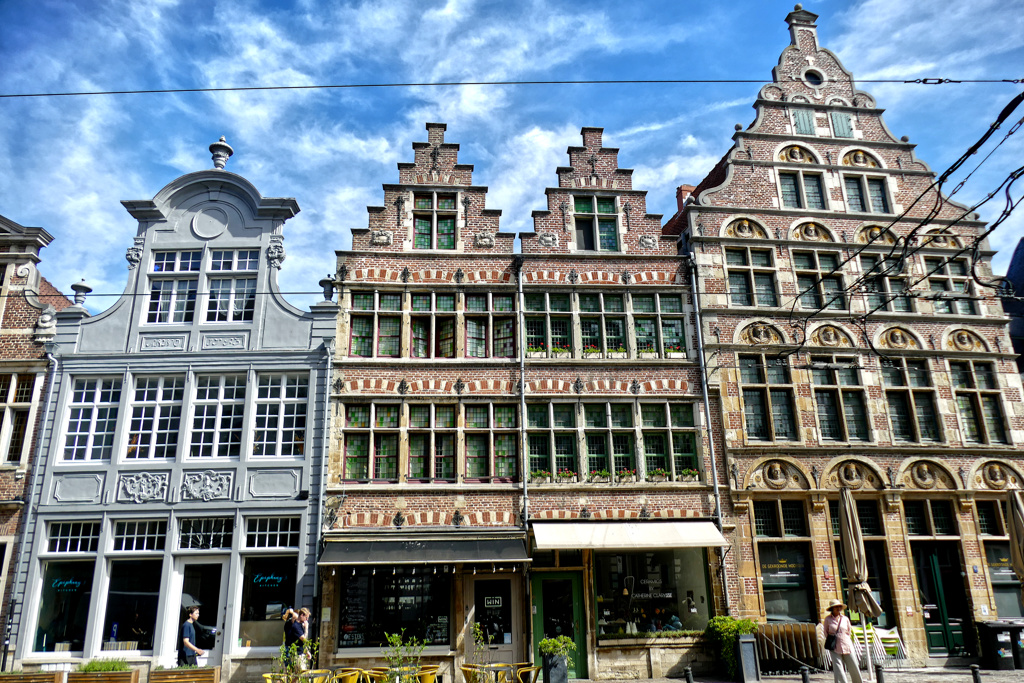
To its left stands a striking twin building dating from the early 17th century. It is a prime example of traditional Flemish architecture. Its symmetrical facades feature the typical so-called bacon layers, horizontal layers of light-colored stone set into the red brickwork. The stepped gables rise in a staggered pattern, with large casement windows ensuring maximum light in the rooms.
A white gabled house completes the impressive row of buildings. It must have been built in the late 17th or early 18th century under the influence of Flemish Baroque. In deliberate contrast to the straight stepped gables of the neighboring house, it has an elegantly curved bell gable and a light-colored facade.
Leie And Lieve
You’ll have to cross a lot of bridges during a visit to Ghent. Two rivers and numerous small canals crisscross the city. The Lieve and Leie meet at Sint-Veerleplein. These waterways have shaped Ghent not only geographically, but above all economically. However, they are two distinct waterways with different functions.
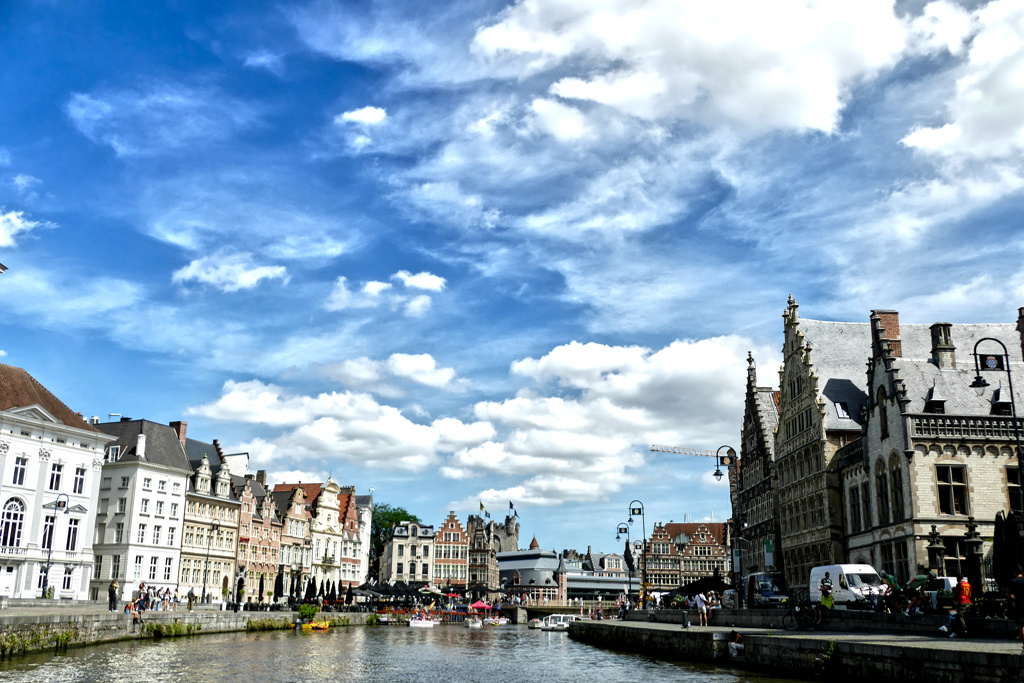
The Leie is a natural river that originates in northern France. Together with the Scheldt, it determined the location and development of the city. The name Ghent derives from the Celtic word Ganda, which actually means confluence. The original settlement core of Ghent is located at today’s Portus Ganda, where the Leie and Scheldt meet. The Leie was also an important transport and trade route. Its significance is particularly evident at the Graslei and Korenlei, the city’s medieval harbor.
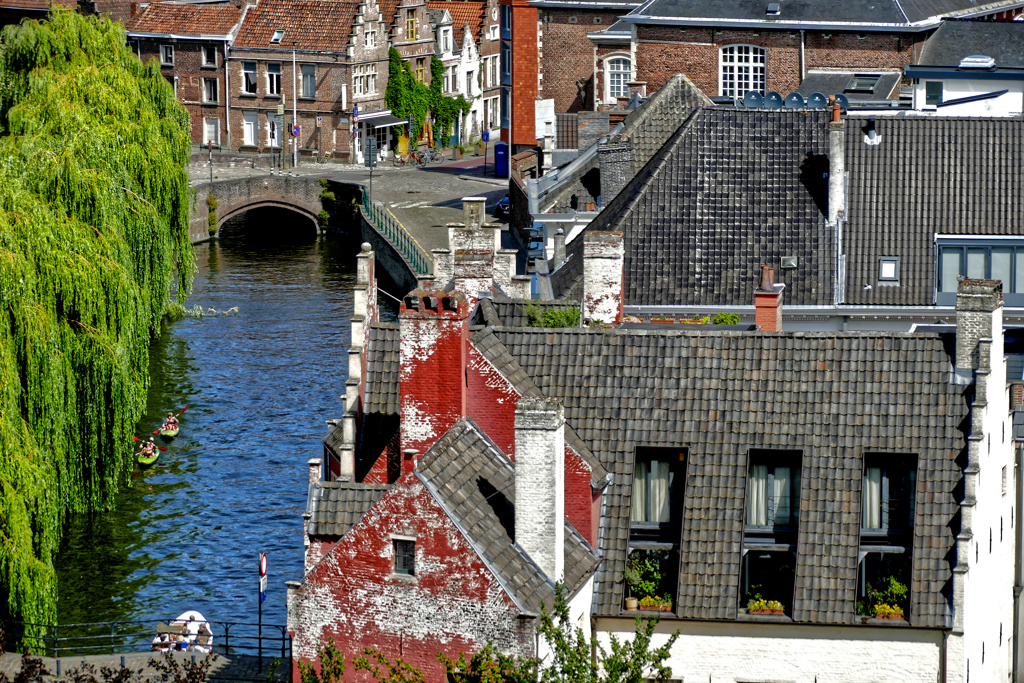
The Lieve, on the other hand, is an artificial waterway. It was created in the mid-13th century when Ghent needed direct access to the North Sea. The city lies relatively far inland and was difficult for larger seagoing vessels to reach. Therefore, the Lieve was constructed as a connection between Ghent and the Zwin estuary. This made it important for Ghent’s medieval trade. Today, the Lieve is just a narrow waterway.
Row. Row, Row Your Boat
Indirectly, the waterways remain beneficial to Ghent’s economy to this day, though they now primarily serve to transport tourists rather than goods. A boat trip is undoubtedly one of the highlights of any visit to Ghent. It offers a completely different perspective on the majestic guildhalls of Graslei and Korenlei, Gravensteen, the medieval Rabot gate, and much more. During the relaxing journey, the guides entertain and inform with knowledge, charm, and humor.
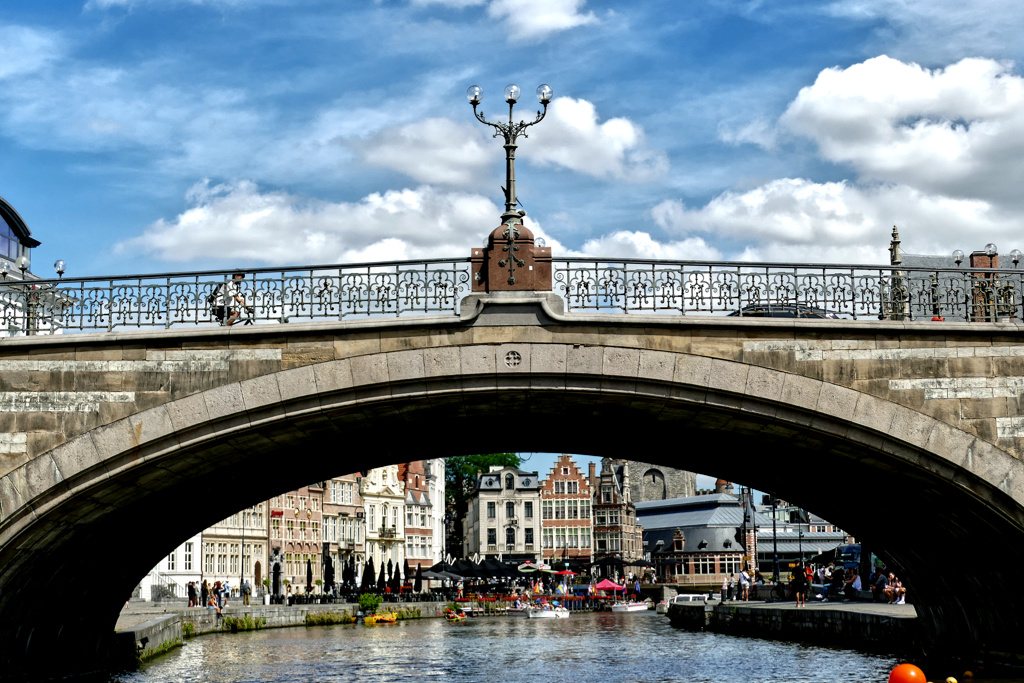
In the historic center, four large, traditional shipping companies share the business, so advance booking is generally unnecessary. Especially during peak season, boats depart very frequently, about every 20 minutes, between 10 a.m. and 6 p.m. You can simply buy your ticket directly at the dock and hop on the next boat. A standard ticket usually costs around 12 €uro.
From April to October, the convenient hop-on hop-off water tram also operates. It stops at six stations around the main sights of the old town.
Korenlei | Graslei | Kraanlei
A boat trip in a beautiful city like Ghent is, of course, not just for its own sake. Primarily, it offers you the opportunity to glide leisurely past the city’s stunning buildings. The Leie River is flanked by, among other things, the two riverside promenades, Korenlei and Graslei. In fact, these are among Ghent’s most important historical sites, as they mark the area of the medieval port, which had been developing since the 11th century. From here, a large part of the city’s trade was conducted. The grain trade, in particular, made these two quays an economic center of Flanders.
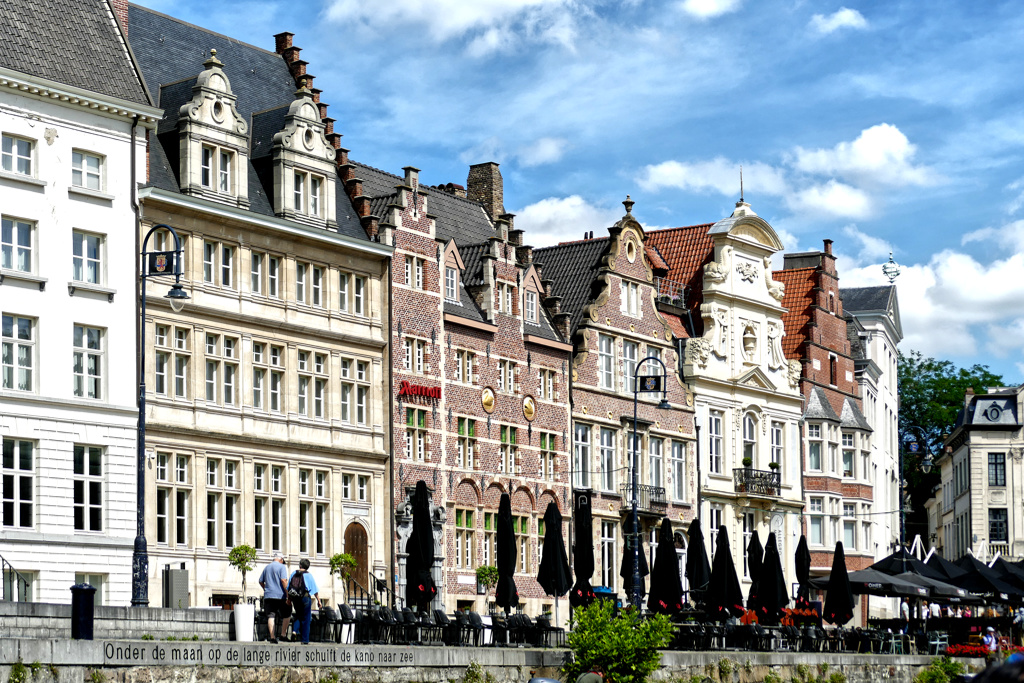
The Korenlei is located on the left bank of the Leie, and the Graslei on the opposite bank. Their names reflect their former economic function. Koren means grain or fodder. The grain trade in Ghent was subject to a special staple right. Imported grain had to be offered for sale in the port of Ghent, and merchants had to leave a quarter of their cargo there. This allowed the city and merchants to control and tax the grain trade.
Fun Fact
In the 16th century, the Huis De Zwane served not only as an inn for sailors and boatmen, but also as a brothel. The two gilded swans above the windows were a telling advertisement for the often illiterate sailors of the time. The swan swimming to the left symbolized the presence of prostitutes. The swan swimming to the right signaled an abundance of alcohol. Two swans swimming away from each other represented an establishment that offered full entertainment.
The row of houses along the Graslei is particularly worth seeing. The buildings date from different centuries and reflect the economic importance of the port. Among the most striking structures is the medieval Korenstapelhuis, whose stepped gable dates back to the 13th century. Also located on the Graslei is the Guildhall of the Free Boatmen, while the official grain measurer’s house was once located in the so-called Cooremetershuys. These buildings were therefore by no means merely representative burgher residences, but were directly connected to the commercial and guild functions of the port.
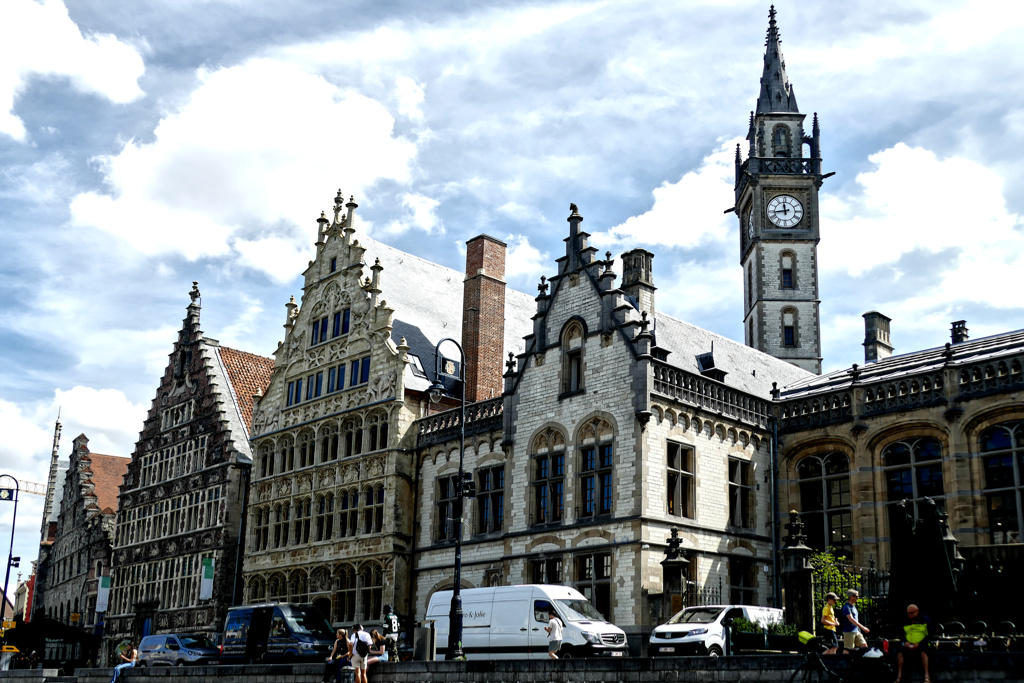
The ensemble was restored, particularly in the late 19th and early 20th centuries. Today, the Graslei and Korenlei are among Ghent’s most popular hangouts.
The Linking Part
The Kraanlei is directly adjacent to the Korenlei. Its name recalls the cranes used to lift goods from ships and bring them onto the quays. It was thus also an important part of Ghent’s medieval port and trading district. It marks the transition from the impressive medieval harbor ensemble of Graslei and Korenlei to Gravensteen and the old Patershol district.
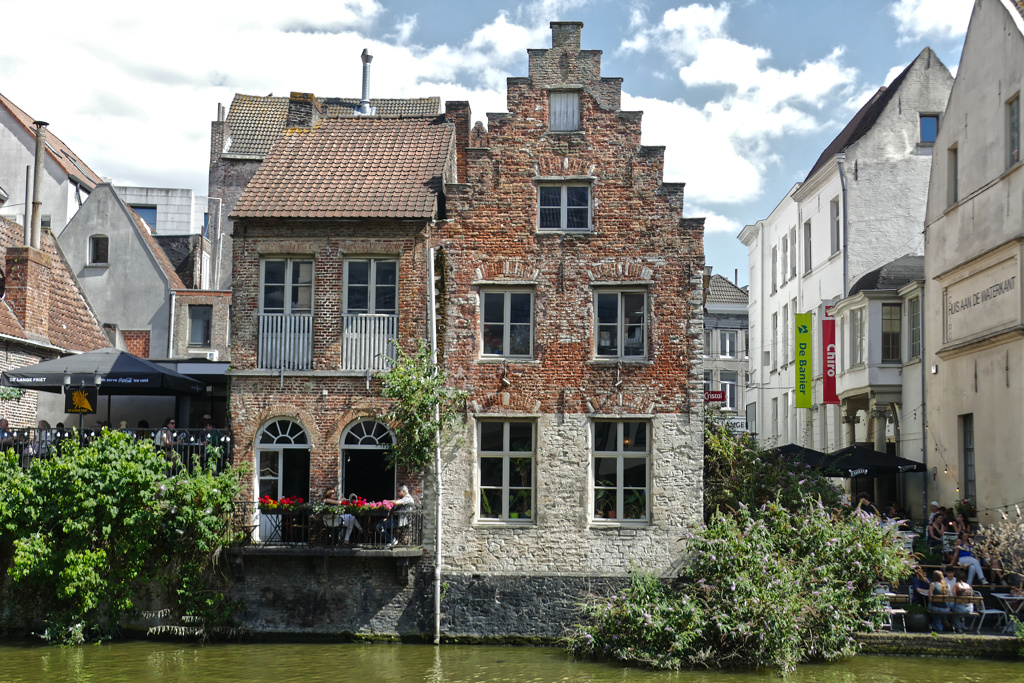
While Graslei and Korenlei are now more characterized by their grand historical panorama and restaurants, the Kraanlei has a more intimate feel, resembling a historic commercial and residential street.
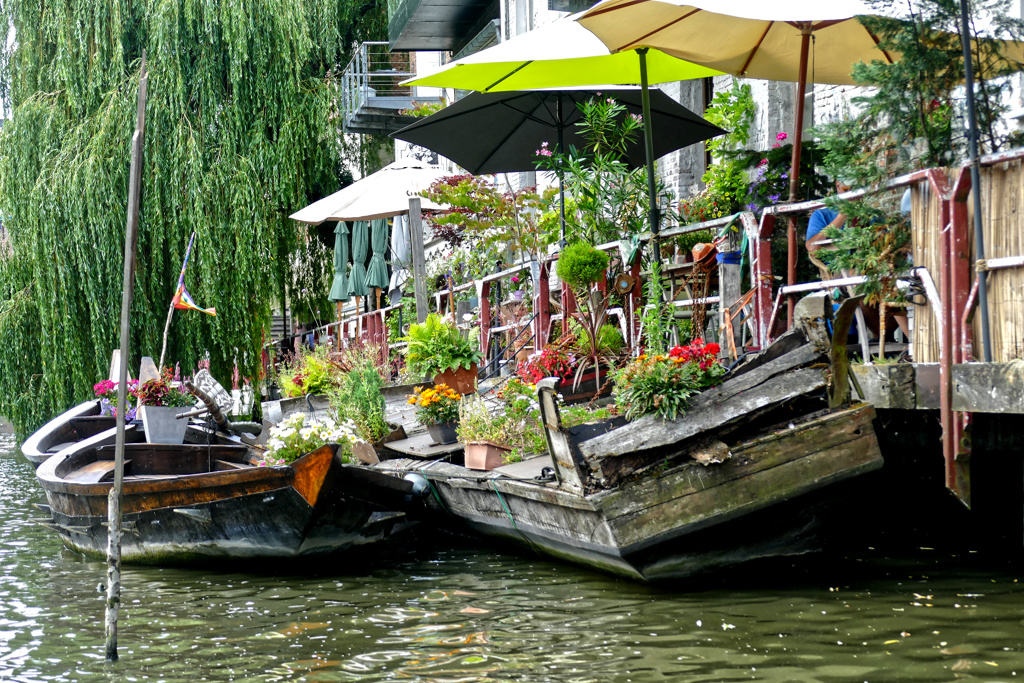
The Kraanlei was particularly important for trade in wine, fish, grain, and other goods that entered the city via the Leie River. This trade is also reflected in the architecture. The narrow, tall houses along the waterfront often served as warehouses, trading posts, and residences for merchants. Their location directly on the water allowed goods to be moved between ships and buildings via doors and hatches.
Vrijdagmarkt – Thank God it’s Friday
The Vrijdagmarkt is one of Ghent’s most historically significant squares. A market was already being held here in 1199. The square’s name also derives from the weekly market that still takes place every Friday. However, the large rectangular square was far more than just a trading place. Rulers were ceremonially received here, political disputes were fought out, popular uprisings were suppressed, and public executions were carried out. The last public execution, incidentally, took place in 1863. Things are much more relaxed here today, and not at all bloodthirsty. Around the square, there are plenty of casual pubs where you can enjoy a refreshing drink or a nice beer as an aperitif.
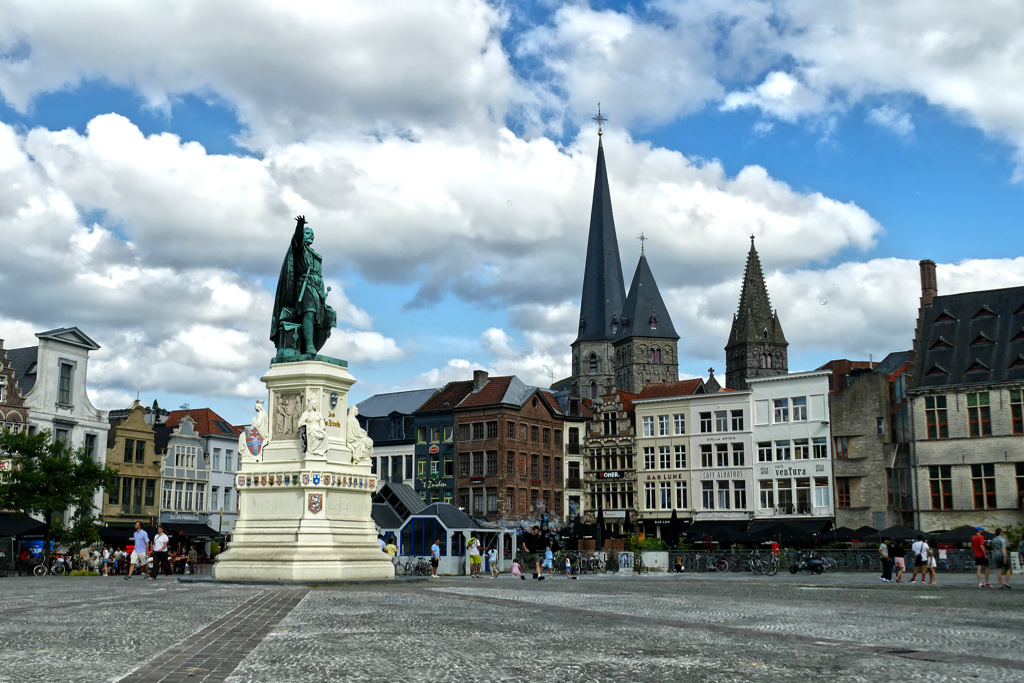
Since that year, the monument to Jacob van Artevelde has stood in the center of the Vrijdagmarkt. Van Artevelde was an influential Ghent merchant and politician of the 14th century. During the Hundred Years’ War, he championed the maintenance of trade with England. Securing the vital supply of English wool for Ghent helped to safeguard the city’s cloth industry. Because of this historical role, the statue points with an outstretched arm towards England.
Historic Structures
Because it reflects various phases of Ghent’s urban history, the buildings surrounding the square are not only beautiful but also interesting. Contrary to what the largely uniform appearance might initially suggest, the buildings actually date from different centuries. The square’s historical building fabric was primarily shaped in the 17th and 18th centuries. At that time, older wooden houses were increasingly replaced by stone facades.
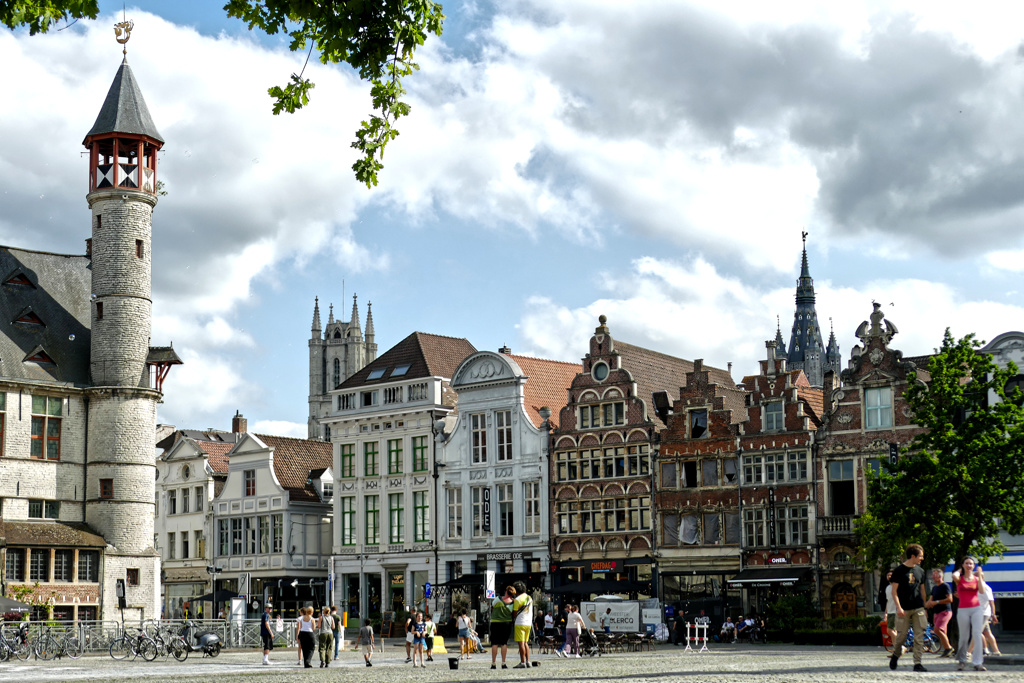
The most striking older building is the Toreken on the corner of Kammerstraat. Toreken, by the way, means little tower. This little tower dates back to the 15th century and is considered the oldest surviving house on the Vrijdagmarkt. Its small corner tower, stepped gable, and late medieval structure convey an impression of what the square might have looked like in earlier centuries. The Toreken also features a historic market clock, which once signaled the start of the market. An iron ring on the facade served as a pillory, but rejected bales of cloth were also hung from it.
Thus, upon closer inspection, the Vrijdagmarkt tells several chapters of Ghent’s history. It was a medieval market and center of power, the scene of political conflicts and executions, later a center of the labor movement, and finally a vibrant city square.
Sint-Jacobskerk
Sint-Jacobskerk, hence, St. James’ Church right next to Vrijdagmarkt is one of Ghent’s oldest churches. It is closely linked to the development of the square and the medieval trading quarter. The current building dates back to the 12th century and has been expanded and altered several times over the centuries. The church’s location directly on Vrijdagmarkt was no accident. St. James’ was the church of the merchants, craftsmen, and travelers who frequented this important market and trading district. Its dedication to the Apostle James also points to the medieval pilgrimage tradition. James was the patron saint of pilgrims to Santiago de Compostela. The Way of St. James passed by the church. As a result, the square also became a place for pilgrims.
St. James’ Church played a particularly important role during the Ghent Revolt against Emperor Charles V. In 1539, the rebelling citizens gathered here. After the suppression of the uprising, Charles V severely punished the city by stripping Ghent of a large part of its municipal privileges.
Sint-Baafsplein and the Three Medieval Towers
Sint-Jacobskerk is one of the oldest churches in Gent, albeit by far not the only significant house of worship. In the immediate vicinity of Sint-Baafsplein, the vibrant heart of Ghent’s old town, stand the three legendary medieval towers.
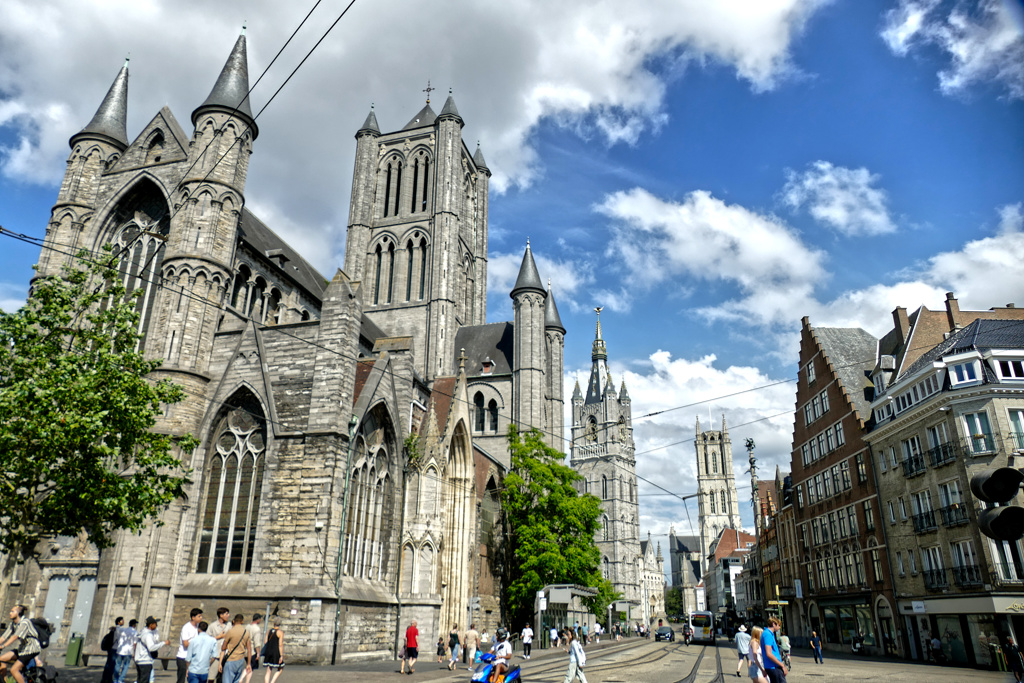
The area acquired its current rectangular shape at the end of the 19th century when two old streets were demolished to open up the view of the cathedral’s imposing west facade. What makes this central meeting point so special is its architectural symbolism, which impressively unites the trinity formed by the three famous medieval towers of Ghent. They stand strong for the historical power structure of the church, bourgeoisie, and trade in medieval Flanders.
St. Bavo’s Cathedral
The easternmost of these spires is the 89-meter-high tower of St. Bavo’s Cathedral. It was built in the Brabantine Gothic style and represents the religious authority of the diocese. This imposing tower originally had a wooden top, which was destroyed by fire in the 16th century and never rebuilt, giving it its current, distinctive flat roof. Saint Bavo, the patron saint of Ghent, gave the Cathedral its name.
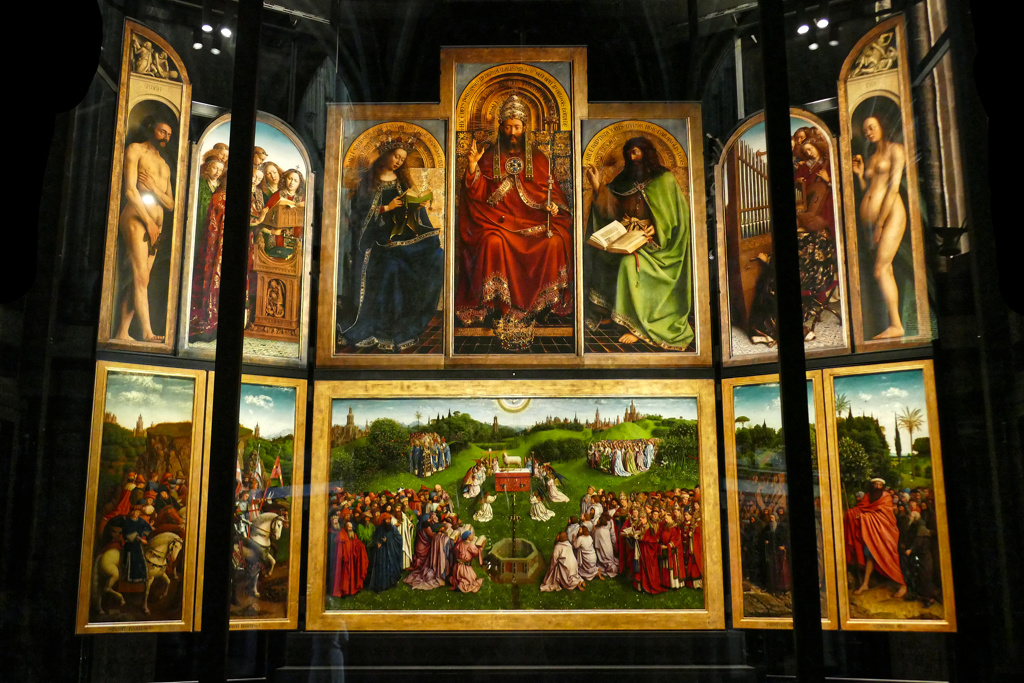
The undisputed centerpiece inside the house of worship is the world-famous Ghent Altarpiece, also known as the Adoration of the Mystic Lamb. The brothers Jan and Hubert van Eyck created this monumental winged masterpiece in the 15th century.
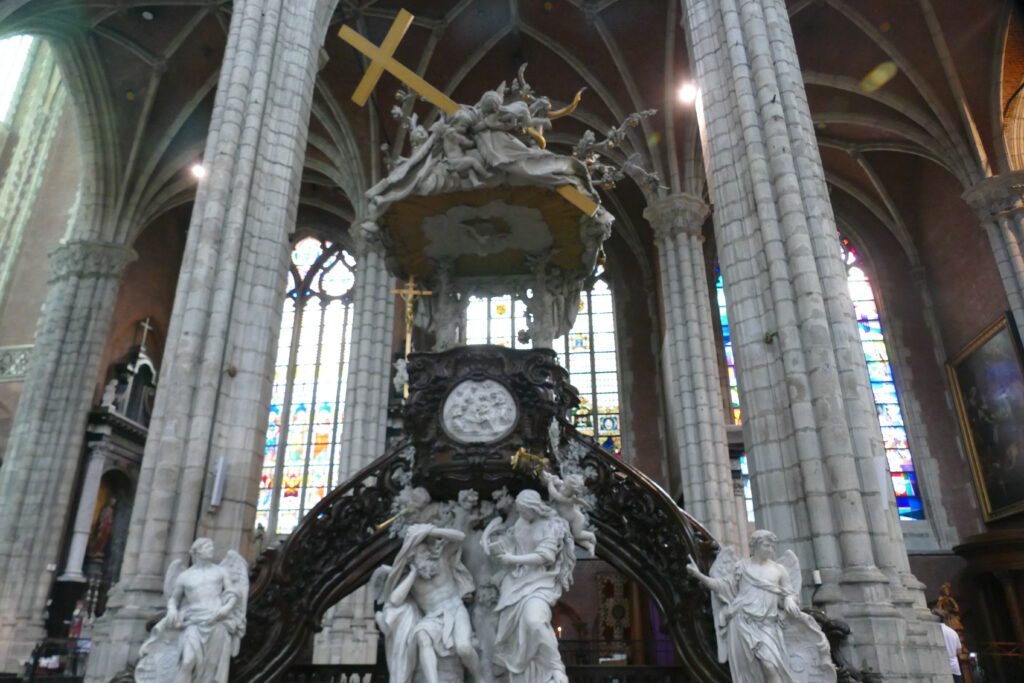
Besides this chef-d’oeuvre, the cathedral also houses a wealth of other artistic treasures, including the monumental painting The Conversion of St. Bavo by Peter Paul Rubens, a magnificent Rococo pulpit made of marble and oak, and a huge Baroque organ. Beneath the nave lies the extensive Romanesque crypt, the oldest surviving part of the building, which still displays original wall paintings from the 15th and 16th centuries.
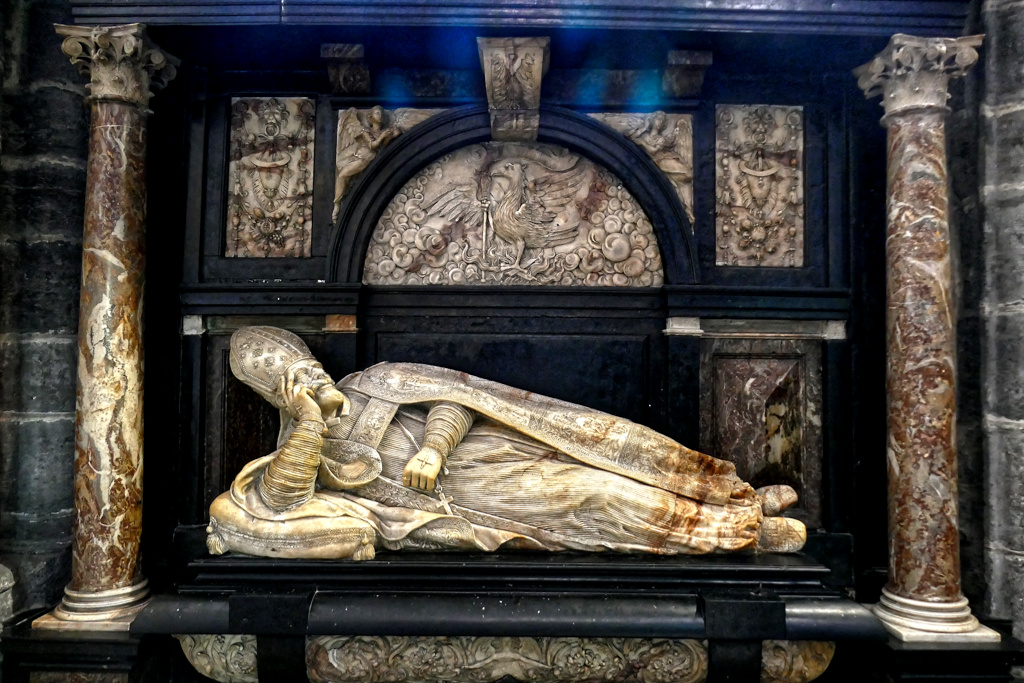
Access to the cathedral’s nave is generally free. You can admire the van Eyck masterpiece up close for 12.50 €uro from Monday to Saturday between 10:00 a.m. and 5:00 p.m, and on Sunday from 1 p.m. to 5 p.m. For a more comprehensive experience, including an augmented reality tour of the historic crypt, the price is 16 €uro. Access to the cathedral’s impressive nave is free. As spots for each time slot are strictly limited, I recommend booking online on their website.
Belfry of Gent
At the center of the imposing row of towers stands the Ghent Belfry. At 91 meters high, it is the tallest of the three towers and a UNESCO World Heritage Site. Unlike its replicas, this is a purely secular monument, erected from 1313 onwards as a proud symbol of the wealth, power, and independence of Ghent’s citizens and cloth merchants.
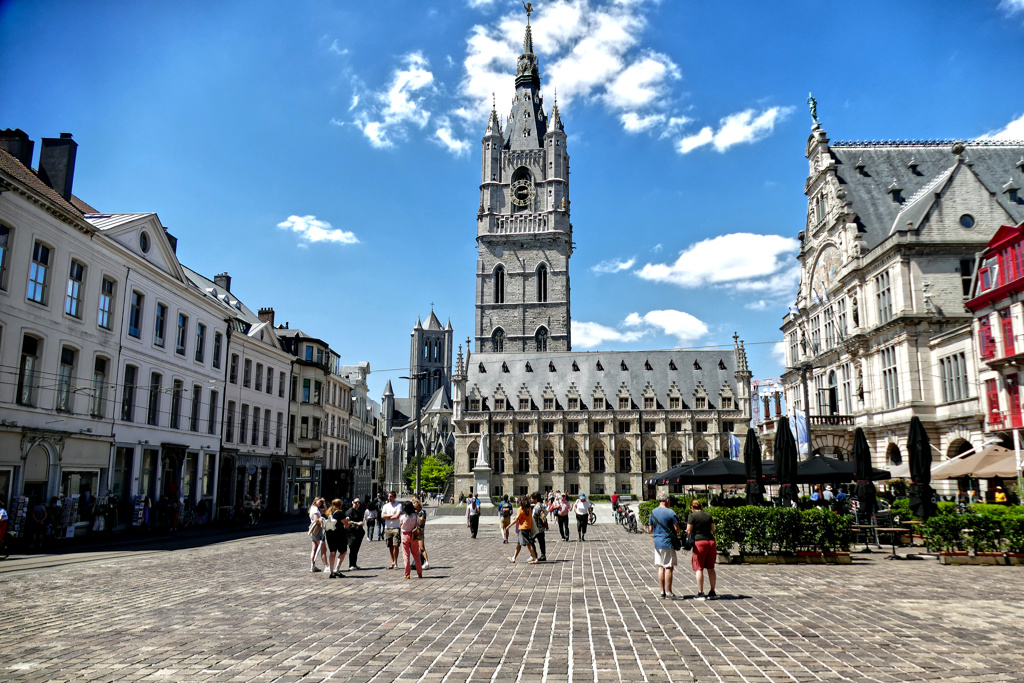
To this day, the golden dragon of Ghent watches over the city from its summit as a fiery guardian and mascot. Over the centuries, the tower has served not only as a watchtower and a secure repository for civic privileges and official documents, but also as a home to an impressive carillon of over 50 bells, which still chimes regularly.
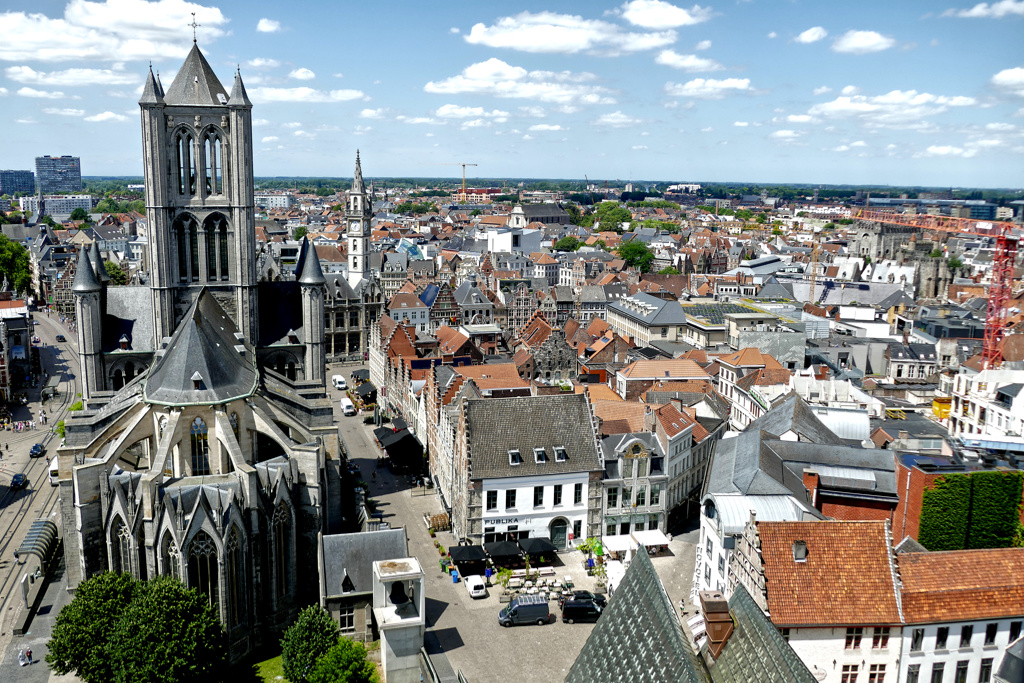
I was quite apprehensive about the climb, but I certainly didn’t want to miss the breathtaking view over the city. Good news: you only have to climb a few steps, as the Belfry has an elevator that whisks you quickly and comfortably to its dizzying heights. The tower can be climbed daily between 10 a.m. and 6 p.m, and this unmissable experience costs 13 €uro. Since capacity in the tower and on the panoramic platform is limited, I recommend booking in advance online via the Belfry’s website.
Saint Nicholas’ Church
The western endpoint of Ghent’s famous row of towers is marked by Sint-Niklaaskerk, hence Saint Nicholas’ Church on Korenmarkt, built in the Scheldt Gothic style. This church, erected in the 13th century, is considered an outstanding example of Scheldt Gothic, a regional architectural style characterized by the use of blue-gray Tournai limestone and elegant, slender corner turrets.
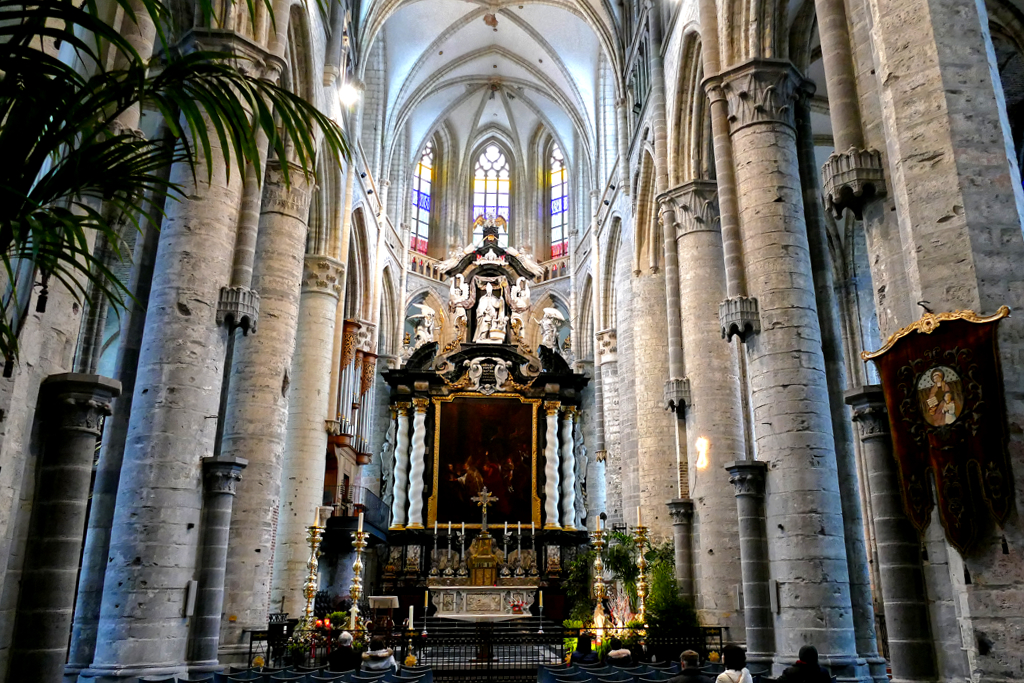
The magnificent building was largely financed by Ghent’s wealthy guilds and merchants, as St. Nicholas is the patron saint of traders and seafarers. The church’s architectural highlight is its imposing crossing tower, which rises directly above the intersection of the nave and transept. Unlike traditional church towers, this tower is open at the bottom, allowing daylight to stream into the center of the church like a natural lantern, creating a unique and mystical atmosphere. Before the construction of the belfry, the church tower also served as the city’s watchtower. Besides its impressive architecture, the church houses significant art treasures. You can visit this historical monument free of charge daily between 10 a.m. and 5 p.m.
Metselaarhuis
Despite a wealth of beautiful buildings, one thing is clear: my absolute favorite in Ghent is the Metselaarshuis. The former stonemasons’ guildhall is located directly opposite St. Nicholas’ Church. It is the most curious secular building in the old town. Constructed in the 16th century in the magnificent Brabantine Gothic style, the building impresses not only with its intricate stonework but also with an extraordinary history of oblivion and rediscovery.
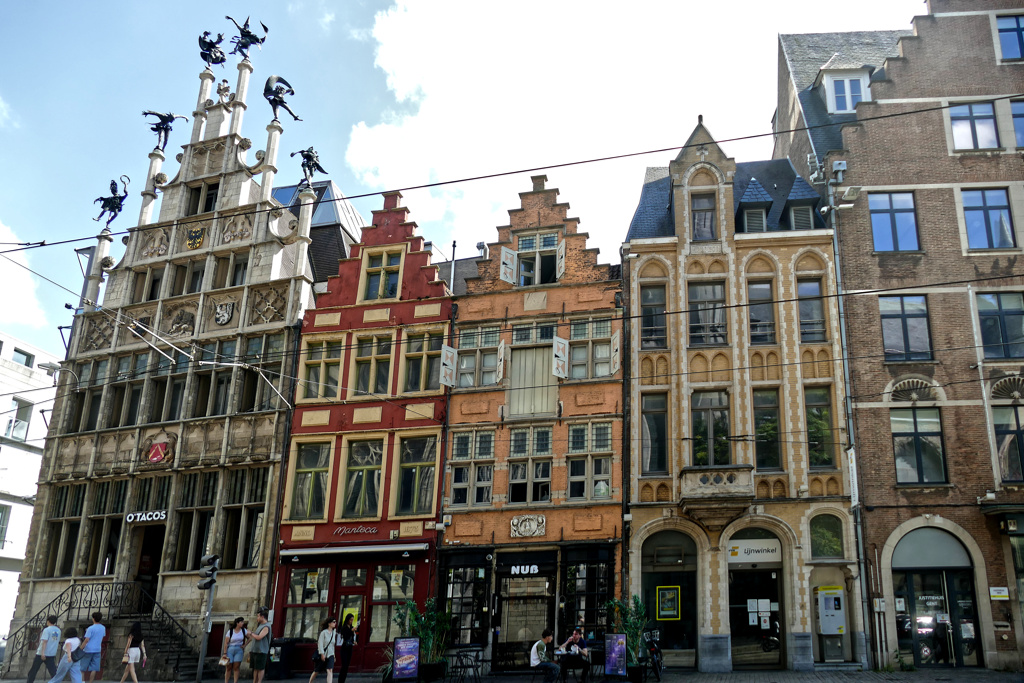
Over the centuries, the historic facade of the house completely disappeared behind unsightly walls. At one point, the people of Ghent even believed the original guildhall had been demolished. For this reason, an exact replica was created for the 1913 World’s Fair based on old plans, and it can still be admired today on the famous waterfront at Graslei No. 8. The big surprise came in 1976 during renovation work, when the original, late-Gothic facade was rediscovered intact behind the plaster and could be uncovered!
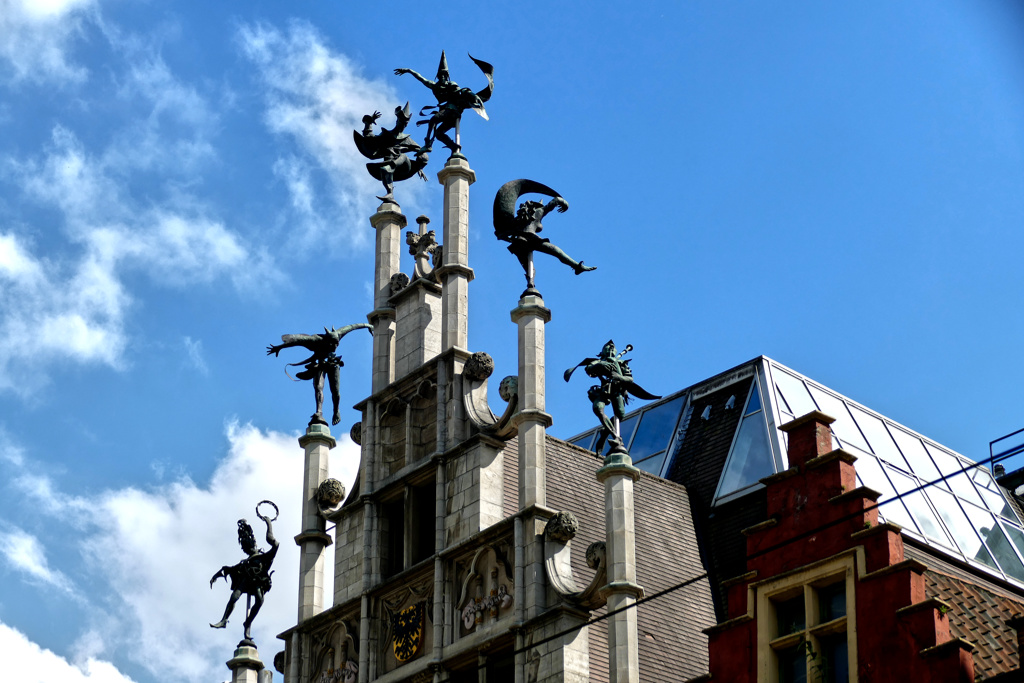
Today, anyone standing before the restored monument is greeted by a striking stepped gable crowned by six modern sculptures created by the artist Walter De Buck. The facade also prominently displays the historical coat of arms of Emperor Charles V, complete with the imperial double-headed eagle and his famous motto Plus Oultre. The building was erected on an old cellar dating back to the 13th century. Today, however, it combines historical architecture with modernity. During a comprehensive renovation, the building received an avant-garde side structure made of glass and steel, which blends respectfully with the historical fabric of the building.
Hotel d’Hane-Steenhuyse
As you know, when I travel, I’m always very interested in life and everyday experiences, both present and past. And that’s why a visit to the Hôtel d’Hane-Steenhuyse on the Veldstraat shopping street is just the thing. This magnificent 18th-century townhouse is a superbly preserved example of aristocratic living from the Ancien Régime. Completed in 1773 under the direction of architect Jan Baptist Simoens, behind its elegant Rococo facade in the Louis XV style lies an opulent world of Flemish nobility. The spacious property gained global political significance in 1815 when King Louis XVIII of France resided here in exile during Napoleon’s legendary Hundred Days, temporarily maintaining his royal court in the palace. Other illustrious figures, such as Tsar Alexander I of Russia and Prince Frederick of Orange-Nassau, also frequented its sumptuous rooms.
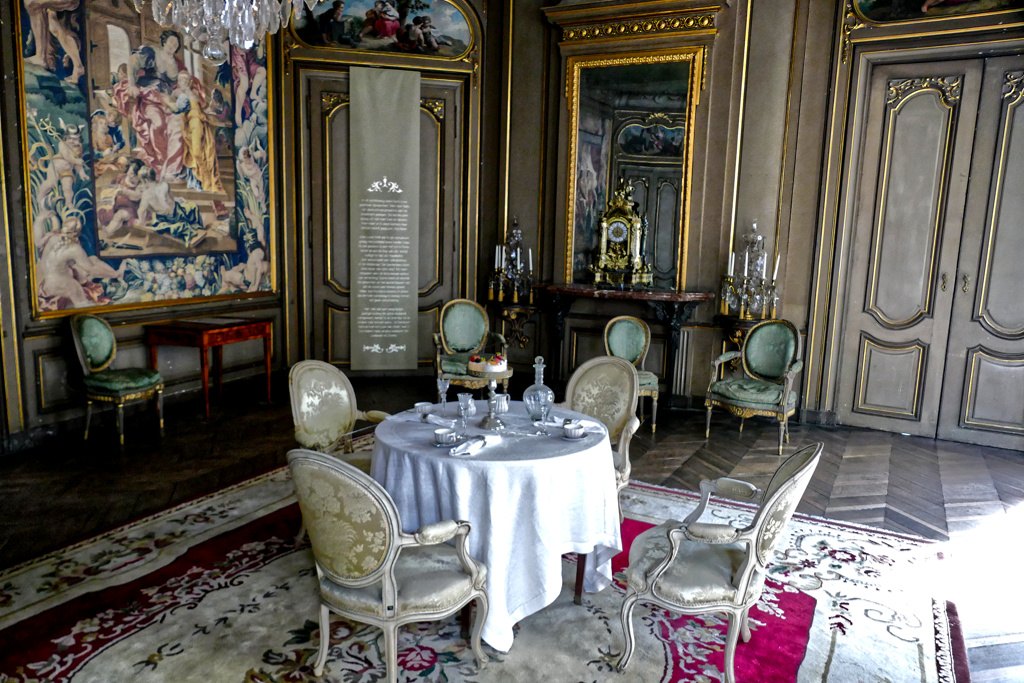
Today, a visit reveals an impressive enfilade of lavishly decorated salons, adorned with exquisite wallpaper, ornate parquet flooring, heavy silk curtains, and precious furnishings. Among the absolute highlights inside are the imposing Italianate ballroom with its majestic chandeliers and the monumental grand staircase leading to the more intimate apartments of the counts and countesses on the upper floor. An oasis of tranquility, far removed from the hustle and bustle of the city, awaits in the walled Baroque garden at the rear of the palace.
To protect the historic building, opening hours are strictly limited to weekends: Friday and Saturday from 2 p.m. to 6 p.m, and Sunday from 10 a.m. to 6 p.m. Admission is free.
Museum Arnold Vander Haeghen
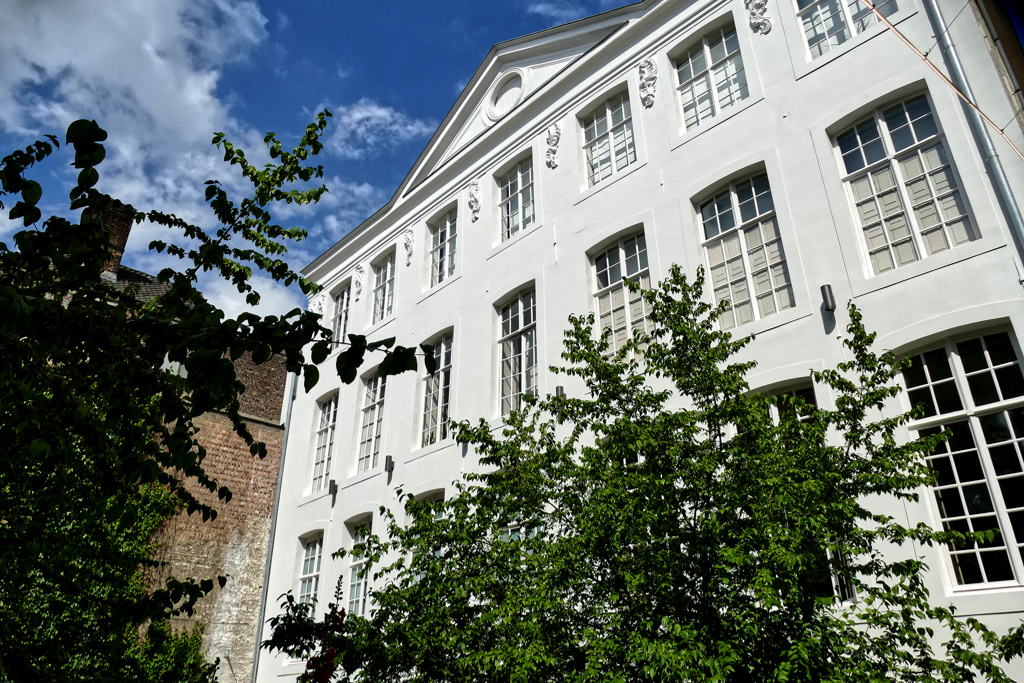
Huis Arnold Vander Haeghen—also known as Hotel Clemmen—is located directly opposite Hotel d’Hane-Steenhuyse. It is the second magnificent 18th-century town mansion belonging to the Ghent aristocracy. In the late 18th century, the successful cotton baron Josse Clemmen acquired the estate; he added Neoclassical elements and even used the rear wing for his textile printing business. In 1836, the splendid mansion passed into the hands of the Vander Haeghen family—from whom it takes its name—who eventually bequeathed the house to the City of Ghent with the stipulation that it remain permanently open to the public as a museum and cultural venue.
One of the house’s absolute highlights is the famous Chinese Salon, featuring walls adorned with original, exquisitely valuable 18th-century Chinese silk wallpaper and murals. Another interior highlight of great literary and historical significance is the faithful reconstruction of the Maeterlinck Study. This room is an exact replica of the study and library of the Ghent-born writer Maurice Maeterlinck—to date, the only Belgian recipient of the Nobel Prize in Literature. His heirs donated the original furnishings from his villa in Nice to the City of Ghent.
Like its sister mansion across the street, the house is open to visitors free of charge on Fridays and Saturdays from 2:00 p.m. to 6:00 p.m., and on Sundays from 10:00 a.m. to 6:00 p.m.
Modern Times at the Citadelpark
When you enter Citadelpark, you leave medieval Ghent behind with its narrow, cobblestone streets and Gothic guildhalls. This expansive park was established in the late 19th century on the former ramparts of the Ghent Citadel. Where military barricades once protected the city, a gently rolling, green oasis now unfolds, acting as a haven of tranquility and, more recently, as a catalyst for the spirit of modernity.
For in the heart of this idyllic parkland beats the artistic heart of modern Ghent in the form of two cultural temples situated opposite each other. The Museum of Fine Arts and the Stedelijk Museum voor Actuele Kunst S.M.A.K., which is housed in a former casino building, make Citadelpark a dynamic cultural hub, demonstrating that while Ghent proudly preserves its rich history, it also actively celebrates its cultural present and future.
Museum voor Schone Kunsten
The Museum of Fine Arts, or MSK for short, is the oldest museum in Belgium and one of the top destinations for art lovers in Flanders. Housed in an impressive neoclassical palace from the early 20th century, it contains more than 400 European masterpieces from the Middle Ages to the modern era. The meticulously curated permanent collection spans from Early Netherlandish and Flemish masters such as Hieronymus Bosch, Peter Paul Rubens, and Anthony van Dyck, through the Flemish Impressionists, to world-renowned 20th-century Belgian artists like James Ensor and the Surrealist René Magritte.
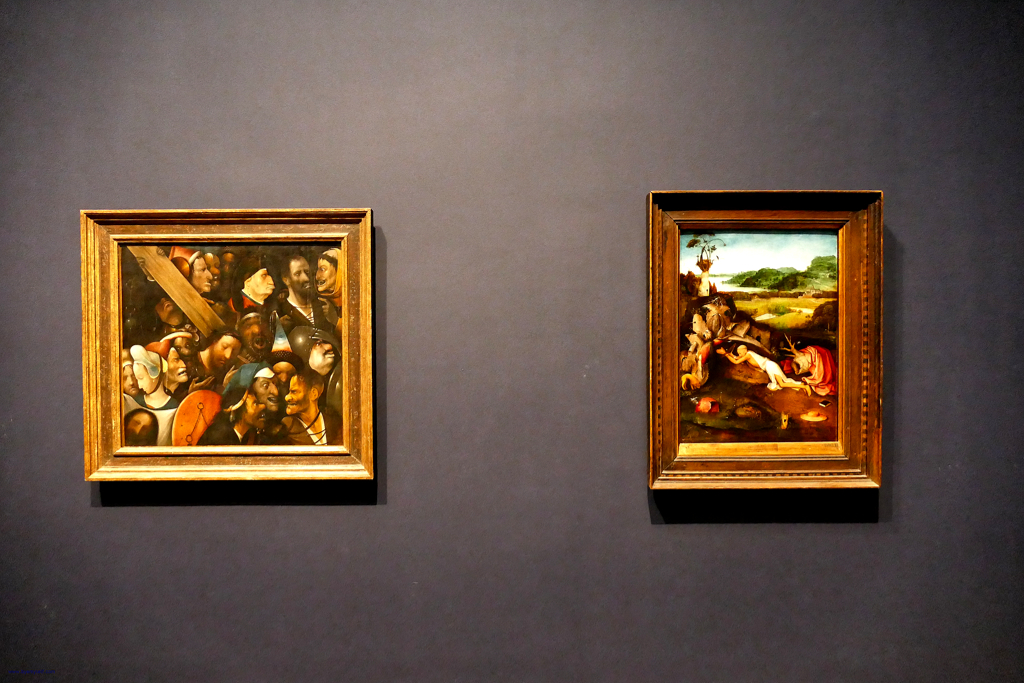
To the left, Christ carrying the cross and next to it Saint Jerome, hence a depiction of the master’s namesake.
An unusual highlight of the museum’s daily life is the glass-walled restoration studio. Here, visitors can watch experts as they painstakingly restore the last remaining original panels of the world-famous Ghent Altarpiece before they are permanently returned to St. Bavo’s Cathedral, probably in spring 2027.
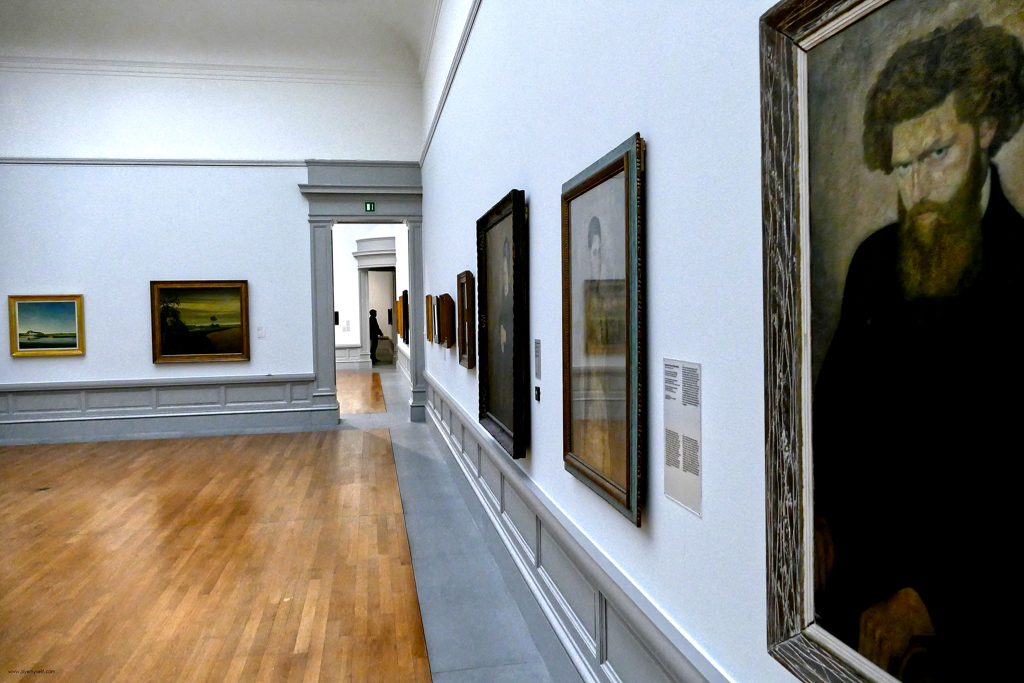
The museum is open Tuesday through Friday from 9:30 a.m. to 5:30 p.m. and on weekends from 10:00 a.m. to 6:00 p.m. A typical tour through the spacious galleries should take approximately two hours.
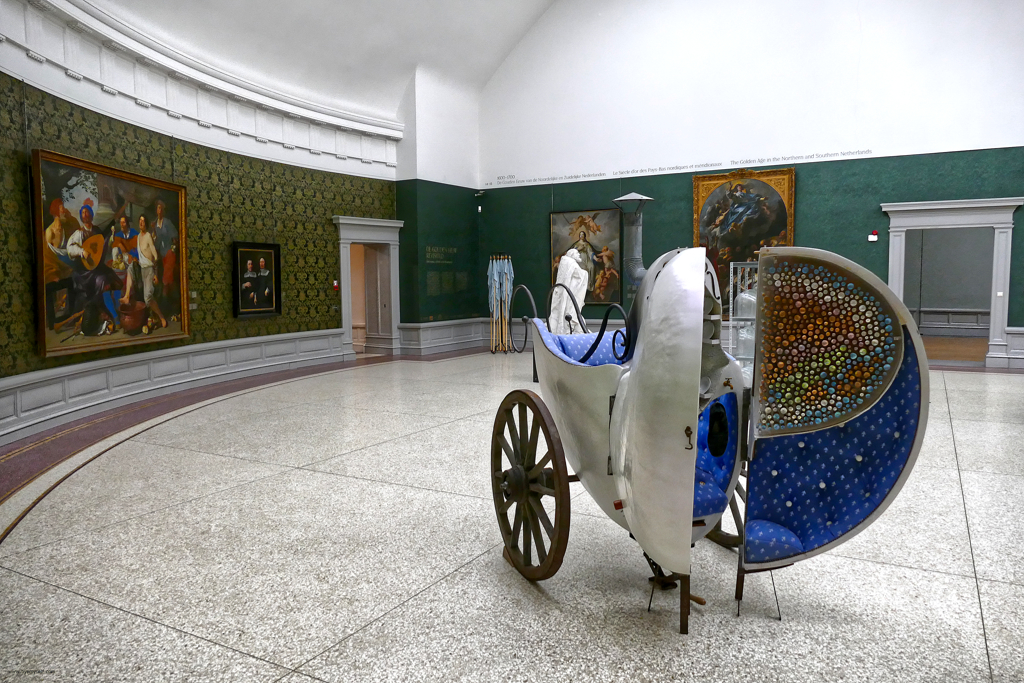
The general admission price is 15 €uro. The ticket price also includes a convenient audio guide in several languages, which offers not only standard explanations but also special tours for children and queer perspectives on art history. Tickets can be booked for a specific time slot via the MSK website.
SMAK – Municipal Museum of Contemporary Art
Directly opposite the Museum of Fine Arts is the Stedelijk Museum voor Actuele Kunst (S.M.A.K.), considered the leading center for contemporary art in Belgium. Founded in 1999, the museum has also made a name for itself internationally with its experimental, unconventional, and often wonderfully provocative exhibitions. Its permanent collection alone comprises more than 5,000 international artworks from the post-war period to the present day. What makes the S.M.A.K. unique is its exhibition concept: the artworks are constantly being re-presented in changing thematic cycles.
The S.M.A.K. is open Tuesday through Friday from 9:30 a.m. to 5:30 p.m., and on weekends from 10:00 a.m. to 6:00 p.m. Admission is 17 €uro. Tickets with a specific time slot can easily be reserved in advance via the S.M.A.K. Ghent website.
Street Art
Street art is also an integral part of Ghent’s cityscape, even if it’s not necessarily found in the medieval center. There, it’s concentrated in Werregarenstraat, better known as Graffiti Street. It was designated as a graffiti area by the city in the 1990s.
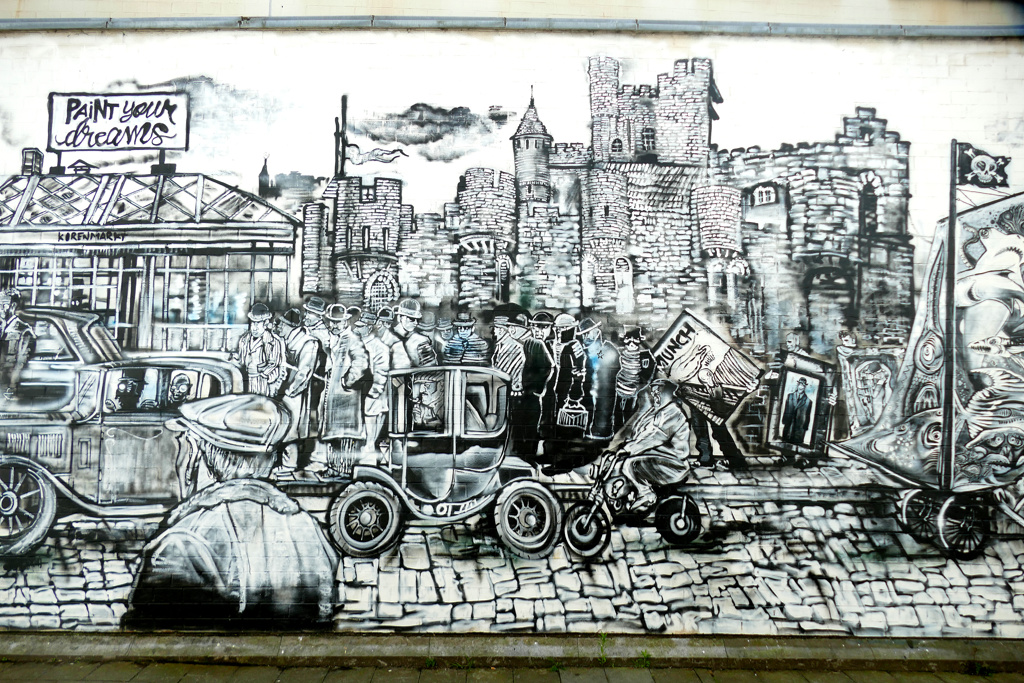
However, the works outside this street and the city center are even more interesting. In various districts outside the city center, works by Belgian and Dutch muralists as well as artists from other countries blend harmoniously into the urban landscape.
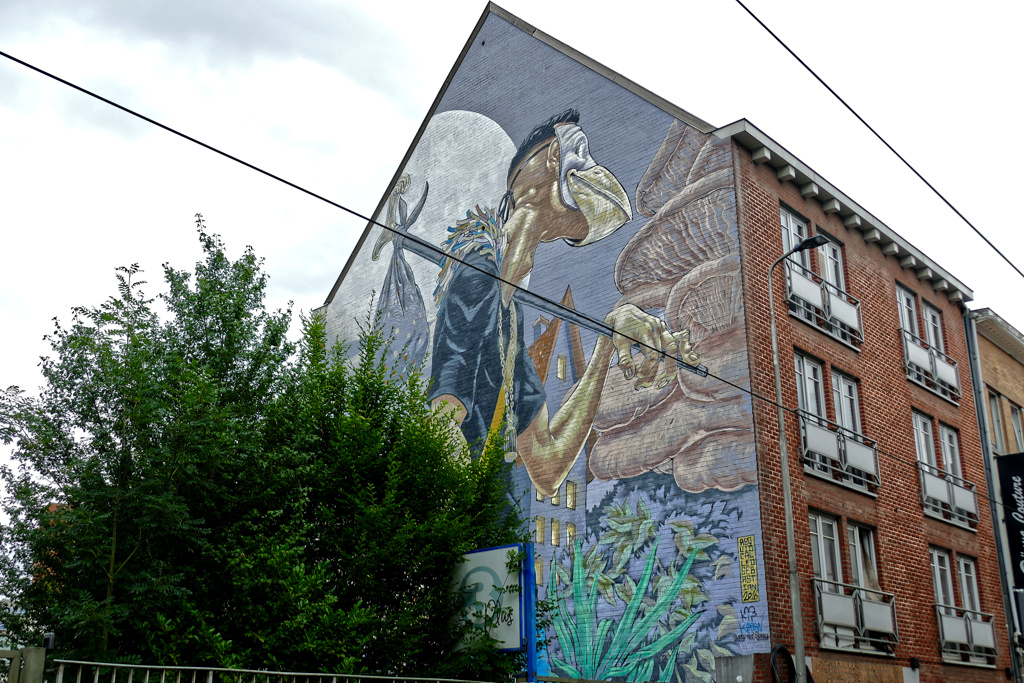
It would be too much for this post to present all the large-scale works on Ghent’s walls. Therefore, in post Best Street Art in GHENT, I’ll introduce you to the best street art spots in Ghent.
Practical Information
How to Get There
Ghent does not have its own airport. The nearest and by far the most important airport is Brussels Airport, about 65 kilometers from Ghent. There are direct train connections from Brussels Airport Zaventem station to Ghent-Sint-Pieters; the journey takes approximately just under an hour.
My Tip
Ghent has two train stations: Ghent-Sint-Pieters and Ghent-Dampoort. The first is the main one, where all trains stop. However, some trains also halt at Dampoort, which, for example, was much closer to my accommodation. So it might be worth checking if your train stops there as well.
Generally, the train is the best way to reach Ghent, especially from Germany, the Netherlands, France, or Great Britain. Travelers arriving on an international high-speed train will change trains to Ghent in cities such as Brussels, Antwerp, or Lille, depending on their point of origin. Ghent is also easily accessible by train from Amsterdam.
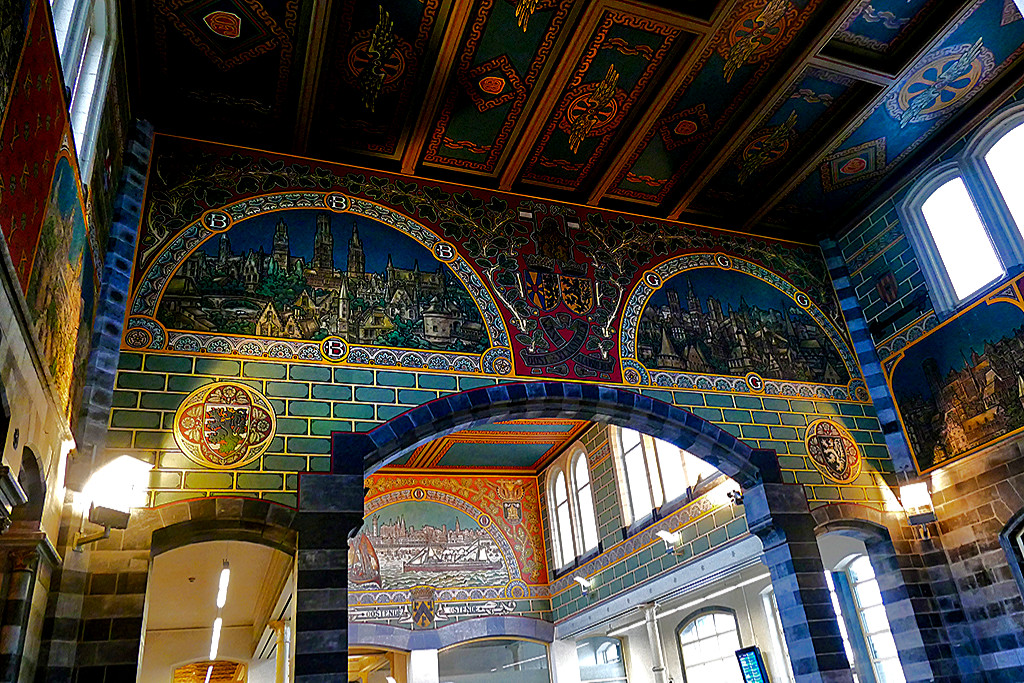
FlixBus connects Ghent with numerous European cities. The buses serve, among other destinations, Ghent-Dampoort. FlixBus is particularly convenient for travelers arriving via Brussels Airport, as there are daily connections from the airport to Ghent-Dampoort.
My Tip
If you plan to visit multiple cities in Belgium or the Benelux region, Ghent is the perfect gateway to Antwerp, Brussels, Bruges, Mechelen, Leuven, Rotterdam, or Amsterdam. Thanks to frequent, reasonably priced train services, these destinations are even suitable for day trips.
How to Get Around
Ghent’s center and even the immediate quarters can easily be visited by walking. Obviously, you can also rent a bike and cycle from landmark to landmark. I have to admit, though, that in cities with trams I’m always terrified of getting caught in the tracks and falling flat on my face. Anyway, lots and lots of other cyclists manage it without incident, so just ignore me.
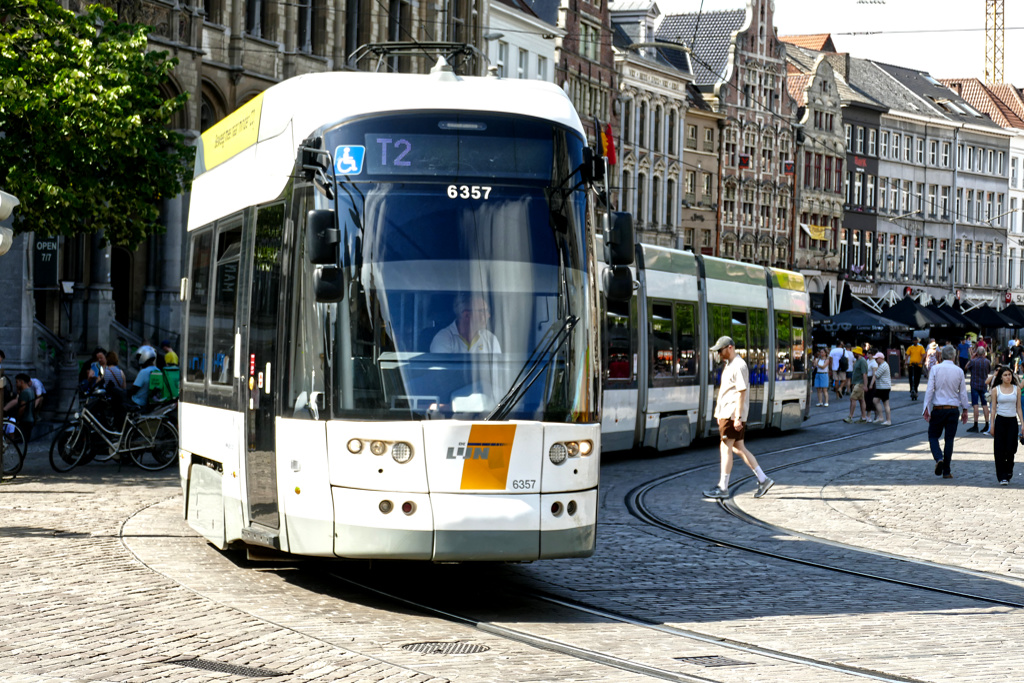
However, Ghent has a very comprehensive network of buses and trams that carry you quickly across the city. Quickly, yes, but not exactly cheaply. A single journey costs 3 €uro and is valid for 60 minutes, including transfers. Note that there is no automatic fare cap. If you plan on taking several trips during your stay, you can save money with a 10-trip ticket for 22 €uro. This ticket can even be shared among various passengers. Alternatively, a day ticket is a good option at 9 €uro, which is valid for 24 hours from the time of first activation on all De Lijn vehicles throughout Flanders. The same applies to the 3-day ticket, which costs 18 €uro.
In general, contactless payment is the most convenient way to buy a ticket. Simply hold your bank card, smartphone, or smartwatch in front of the white reader on board the vehicle. Please keep in mind that you must check in with a physical ticket or a digital scan when boarding – regardless of whether it’s a single ticket, a multi-journey ticket, or a day ticket. Simply hold your ticket up to the reader on the bus or tram. Checking out, as required in cities like Amsterdam or Rotterdam, is not necessary.
Visiting Organized
Although I’m an avid solo-travelling woman, I sometimes like to join organized tours. This way, I get extended info about a place, and it’s fun to visit landmarks in the company of like-minded fellow travellers.
In a historically rich city like Ghent, participating in some guided activities will supply you with a wealth of information and fascinating facts’n’stories. You can choose the perfect activities right here*:
Where to Stay
Unlike many other cities I’ve visited on my recent travels through Europe, accommodation in Ghent isn’t exactly cheap, but it’s not shockingly expensive either. Even so, this time I stayed in an Airbnb outside the city center. For a shorter stay, however, it’s certainly more advisable to find accommodation right in the heart of the city. You can find some recommended options on this map*:
What to Eat
Culinary-wise, Ghent is as diverse as its inhabitants. Alongside classic Flemish cuisine, the city’s food scene is shaped by international influences, fine dining, and a vibrant café culture. Visitors should therefore sample both traditional specialties and modern interpretations. Among the best-known dishes are stoofvlees, a slow-cooked beef stew made with dark Belgian beer, and vol-au-vent, a puff pastry case filled with chicken fricassée. Moules-frites, hence, mussels with fries, are another staple. Belgian fries are considered a culinary institution in their own right and are traditionally served with a wide array of sauces.

The best chip shop in Ghent by far is Frituur Tartaar. They not only fry the most delicious potato sticks, but they also have a wide selection of treats like frikandel, croquettes, meat skewers, and much more. But be warned, don’t overdo it: the portions are enormous.
North of the city center, on the other side of the Leie river, the Turkish and Middle Eastern community has settled. Here you’ll find kebab grills and oriental restaurants side by side, like pearls on a string.
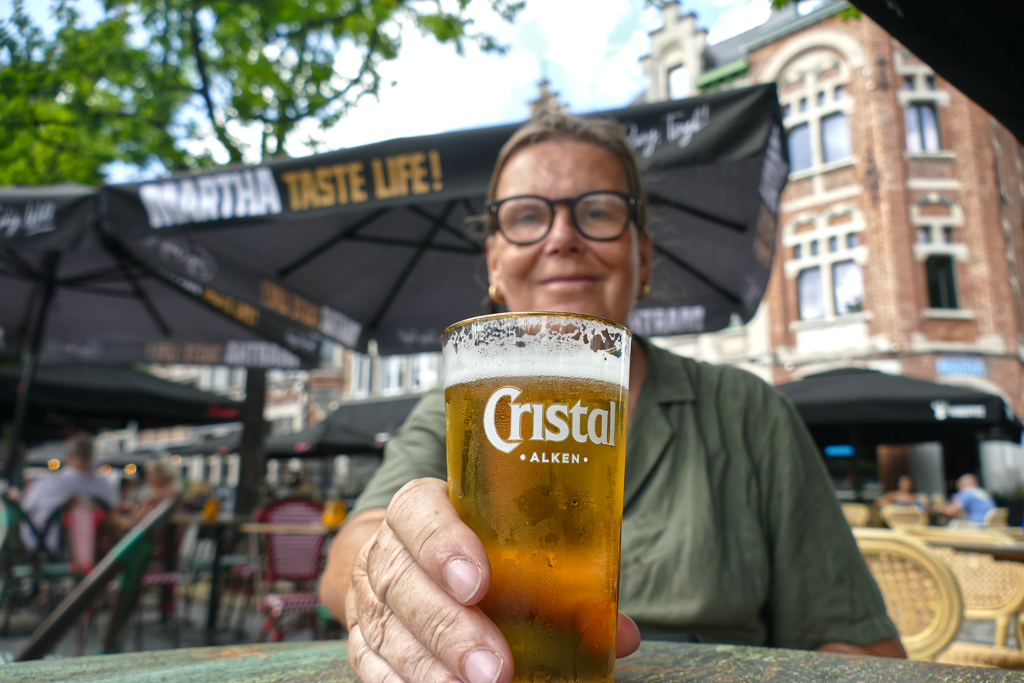
Last but not least, Belgium is renowned worldwide for its beer culture, offering hundreds of different varieties—ranging from fruity lambics and robust Trappist ales to unique regional specialties.
I loved enjoying my evening beer at the Vrijdagmarkt, watching the shoppers and life go by.
Cash, Cards, and Deals
In May 1998, the heads of the member states of the European Union agreed – nota bene in Brussels – on the implementation of the €uro.
Until now, 21 European countries replaced their former local currency with the €uro starting in 2002. Obviously, Belgium is one of them. The exchange rate is 1 US$ = 0.84 EUR as of September 2026. However, you can check today’s conversion rate on this page.
Credit cards are far more accepted than cash. Also, keep in mind that there are not as many ATMs as in other European countries. Therefore, as you finally come across an ATM, there might be a pretty long queue.
Entrance fees in Ghent aren’t ridiculously high like in many other cities. However, the city has so much to offer that the costs can quickly add up. You can save a lot of money with the Ghent CityCard.
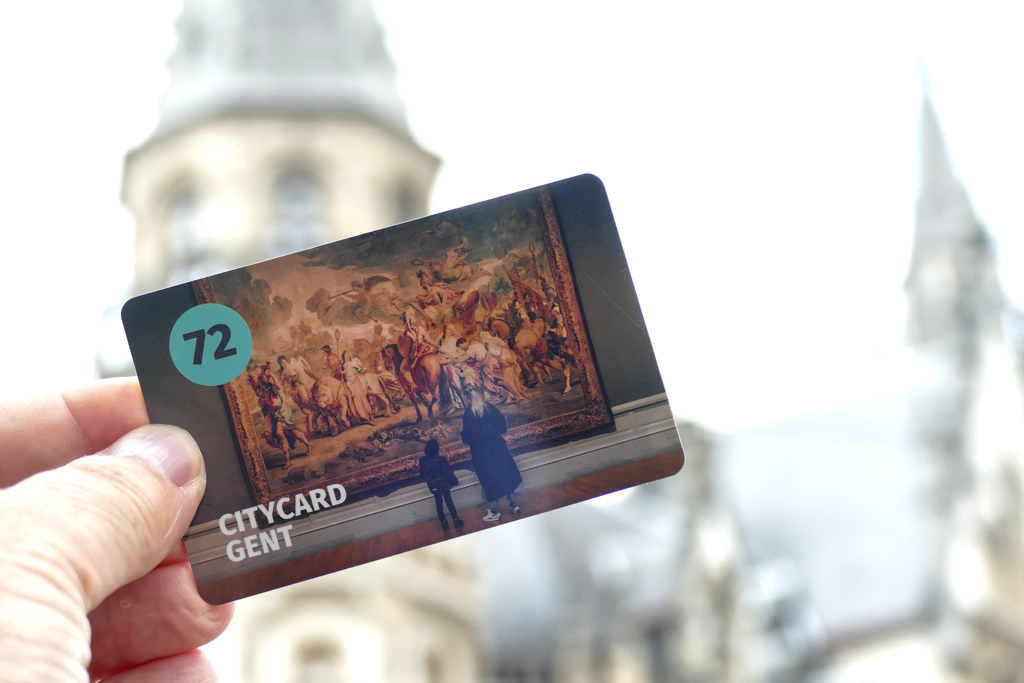
It costs 49 €uro for 48 hours and 55 €uro for 72 hours. With it, you get free entry to all the major museums and top attractions like Gravensteen Castle and the Belfry. It also includes free use of public transport within the city – a significant saving considering the high fares! In addition, you can rent a bike for one day for free, and join a boat trip on the canals. You can buy the card online or get it at the tourist information office.
Before you obtain the Ghent CityCard, keep in mind that museums in Belgium offer age-based discounts. These are not tied to EU citizenship or residency. Adults under 26 often pay half price, and entry is even free for those under 18.
Language
I always find it fascinating that some of the smallest European countries have several official languages. Switzerland leads the way with four, but Luxembourg and Belgium each boast three. Belgium’s three official languages—Dutch, French, and German—are the result of two historical events. First, there was a centuries-old ethnic border. Second, a border shift occurred after the First World War.
The French-speaking population in the south of the country, comprising about 39 percent of the population, arose because Wallonia had been under the influence of France and Roman culture for centuries. When Belgium seceded from the Netherlands in 1830, it was the French-speaking elite who led the revolution and established French as the official language of the state and the upper class. The 60 percent of the population in the north, however, retained their own language. The small German-speaking group in the east, which makes up just under one percent of the population, only became part of Belgium over a century later, in 1919, through the Treaty of Versailles. This treaty granted Belgian citizenship to the German minority virtually overnight.
On top of that, most Belgians also speak English quite well.
Since it’s always nice to be able to say at least a few polite things in the local language, you could learn some Dutch words online with Babbel. The first lesson, which already covers all the greetings and expressions of thanks, is even free. However, you’ll also find French and German courses there.
Map
On this map, you’ll find all the wonderful places I’m introducing in this post.
Clicking on the slider symbol at the top left or the full-screen icon at the top right will display the whole map, including the legend.
Pinnable Pictures
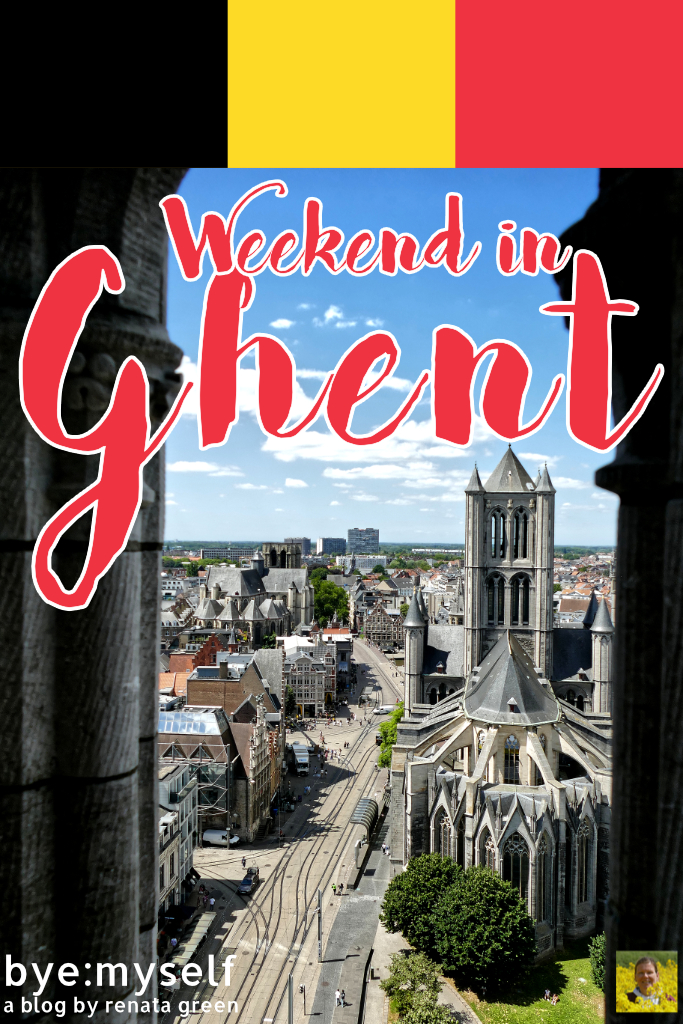
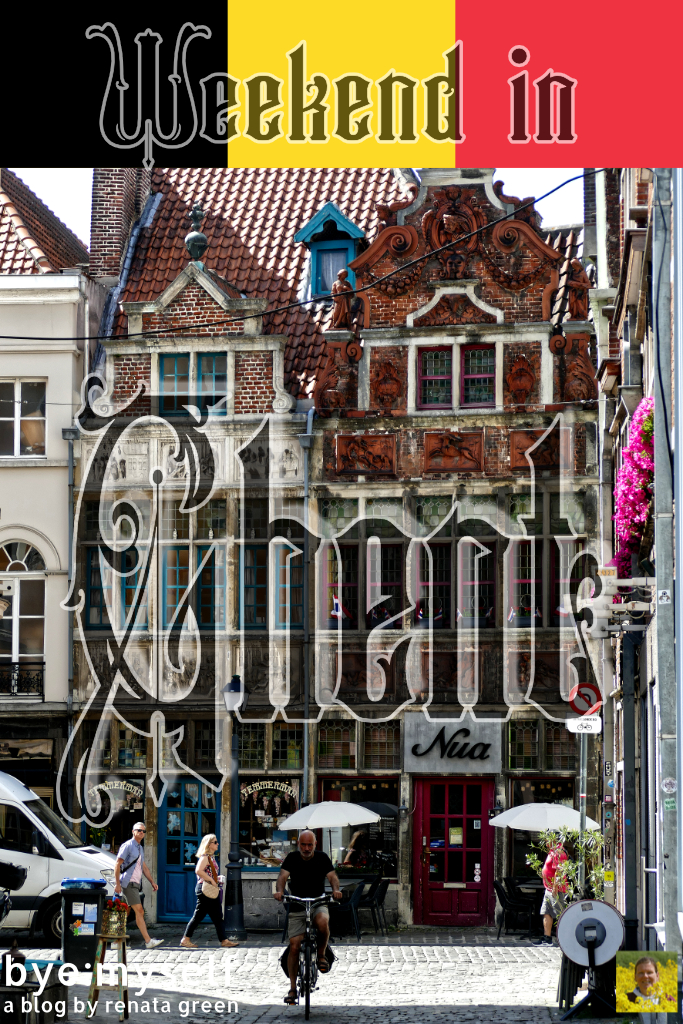
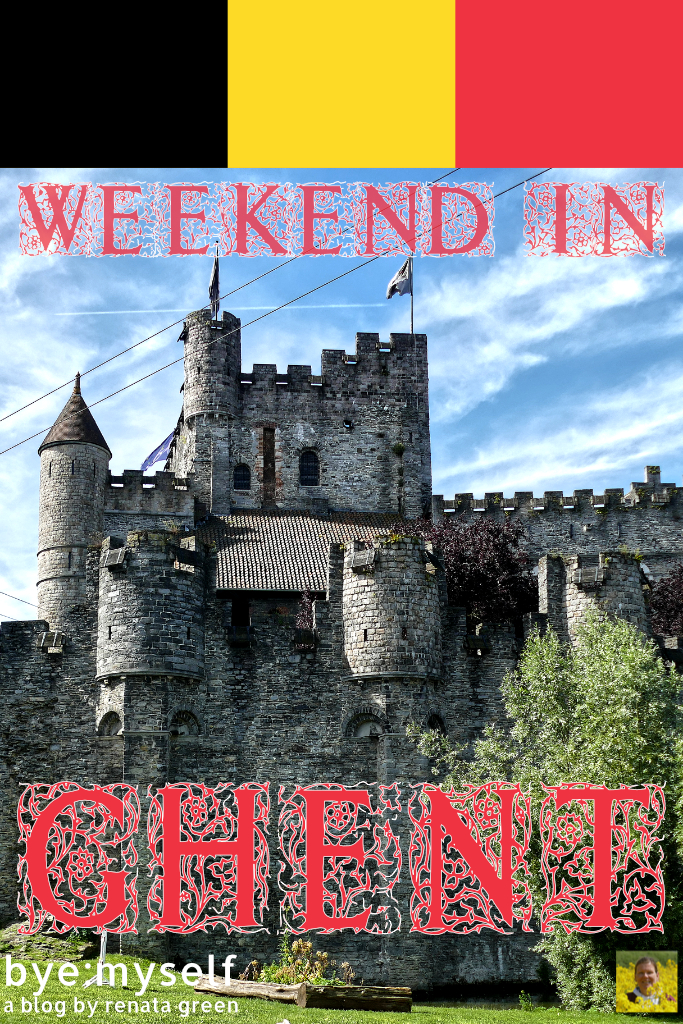
If you choose to pin this post for later, please make sure to use one of these pictures:
Did You Enjoy This Post? Then You Might Also Like These:
Best Things to Do in BRUSSELS, the Capital of Europe
Weekend in GHENT – Medieval Heritage Meets Metropolitan Vibes
24 hours in BRUSSELS
Best Street Art in ANTWERP – Fresh Murals at Zomerfabriek
The Best Murals Along Brussels’ Comic Book Route
Best Street Art in BRUSSELS
What to Do in ANTWERP in Three Days – The Obvious and the Unexpected
Best Street Art in ANTWERP – From Merksem to the City Center

* Disclaimer: I appreciate that Visit Gent supported both of my blogger trips by supplying me with a 72-hour Gent City Card. However, all opinions on these services are mine and weren’t by any means influenced by my cooperation partner.
There are affiliate links in this article. By purchasing items through my affiliate links at no extra cost to you, I will receive a small commission. This helps me to run this site.