The Biennale di Arte, one of the world’s most important art events, takes place every two years. Although Venice is certainly a place worth visiting even when nothing special is on, my post on how to visit the city during the Biennale 2026 will make your trip even more memorable.

Venice and I: Regular Visits to the Mystic Lagoon City
To me, Venice has always been not only one of Europe’s most beautiful cities. It’s also one of the most unique places on planet Earth. Already, the idea of what incredible economic and political power this relatively tiny place built on stilts used to have for centuries is simply mind-blowing. The amazing number of artistic geniuses that were active right here and composed, painted, and sculpted indelible masterpieces with reference to this unique place proves that Venice is somehow magical.
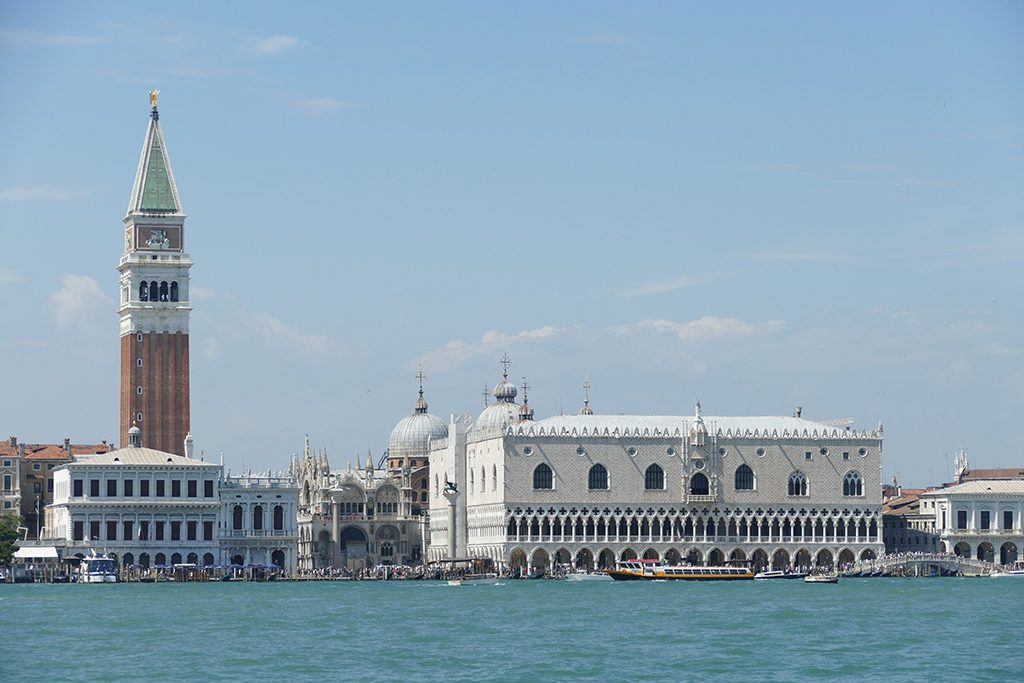
Even large groups of boisterous tourists cannot temper my delight when it comes to Venice. I’m far too mesmerized to be annoyed. And as I keep coming back every other year, I hardly ever frequent the heavy-duty tourist spots, anyway.
The city as such is a valid cause for my frequent visits. Yet, for many years now, the main magnet has been the mega event called Biennale di Arte.
The Biennale and I: The Ideal Event for an Art Addict
As the name suggests, the Biennale di Arte has been taking place every other, odd-numbered year. This changed in 2021 as the 59th edition had to be postponed to 2022 due to the pandemic.
Before I visited the Biennale for the first time many years ago, I was a bit intimidated.
Since Venice was so packed already without anything special going on, how terrible must the crowds be during such an outstanding event? Consequently, I armed myself for the worst.
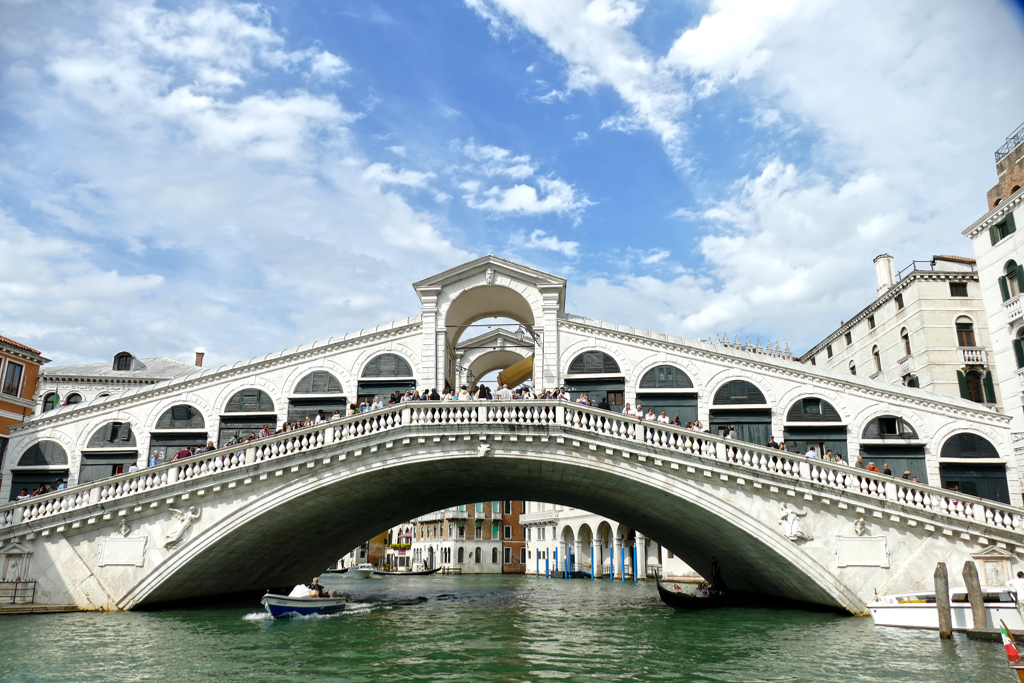
Once I got there, I realized that most tourists still come for the regular sights’n’landmarks. They visit Saint Mark’s Square and the Rialto Bridge, glide in Gondolas, and purchase tacky masks. Many visitors aren’t even aware that a great art show is taking place. Venice seemed to remain pretty much untouched by this event.
It’s in the Mix
Even if you are just coming to see the city, you’d need weeks to visit it all. Venice has about 30 museums, approximately 200 palazzi, and roughly 90 churches. Infact, I’m talking just about the so-called Centro Storico, hence the main fish-shaped part. Now, add around 100 art venues that are temporarily installed during the biennial, and you get the picture.
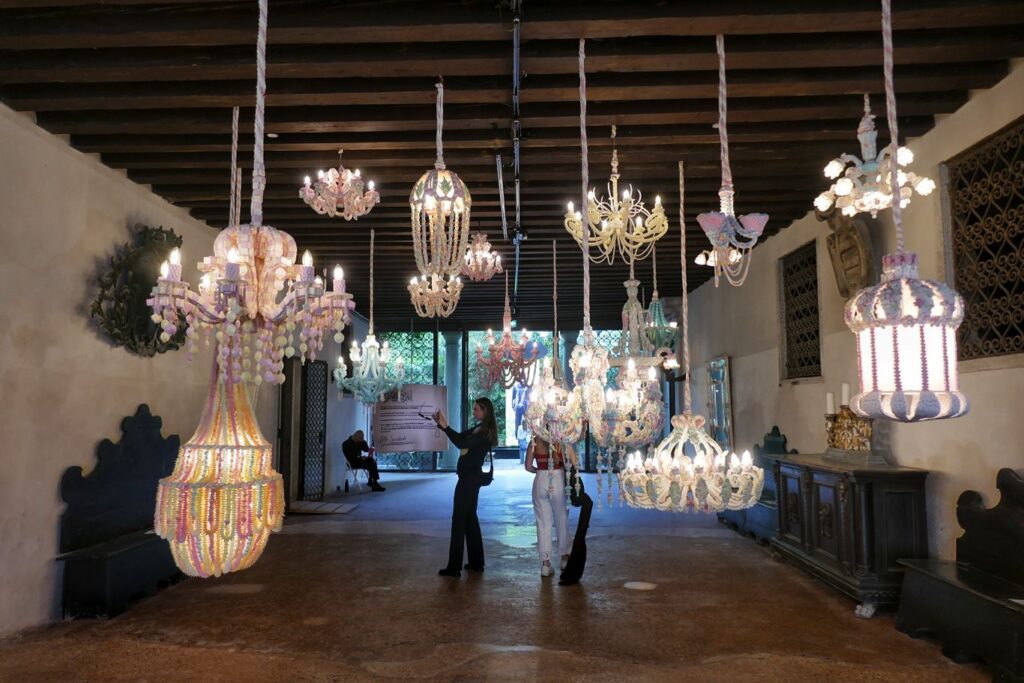
You have to select what to see since you certainly cannot have it all. Therefore, I’m skipping the classic landmarks and heading for the new and the temporary.
However, even for first-time visitors who are focusing more on the traditional must-sees, visiting Venice during the Biennale comes with a great perk. Since many parts of the art event are housed in the old palaces, you get access to palazzi that are normally closed to the public.
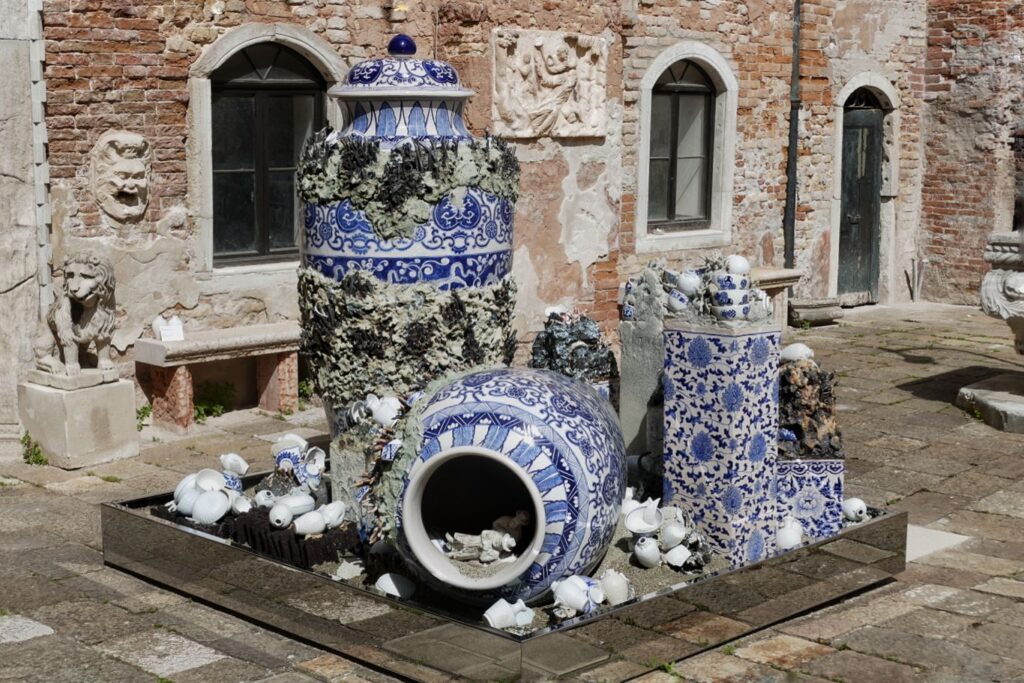
For me, however, it’s the mix of it all that catches me in a whirlwind of awe. The iconic sights of the canals and bridges and alleys that never get old are completed by inspiring art from around the world. Wild’n’daring contemporary pieces are exhibited in front of antique tapestries and under ancient gilded ceilings.
If I could create a world for myself, it would be an everlasting Biennale di Arte in Venice.
Biennale Arte di Venezia
So what exactly is the Biennale di Arte? Well, the Venice Biennale dates back to 1893. Then, the city council decided to introduce an exhibition on Italian art, called Esposizione Biennale Artistica Nazionale. The first edition took place in 1895, and since then, every two years.
Over the years, it opened up to other countries. Therefore, today, it is an important international art show, officially called L’Esposizione Internazionale d’Arte, La Biennale di Venezia.
Normally, this art show takes place every other year, as the title insinuates. Therefore, every odd year, I roam the venues, palaces, and galleries in search of the most inspiring and exciting artworks. Since, ironically, 2021 was quite odd on so many levels, the biennial skipped this odd year. Hence, due to the Covid-19 pandemic, the Biennale has taken place in even years since 2022.
Mind you, apart from 2021, the biennial had to be revoked only during WWI and WWII. This makes the cancellation quite a historical event.
The Giardini and the Arsenale
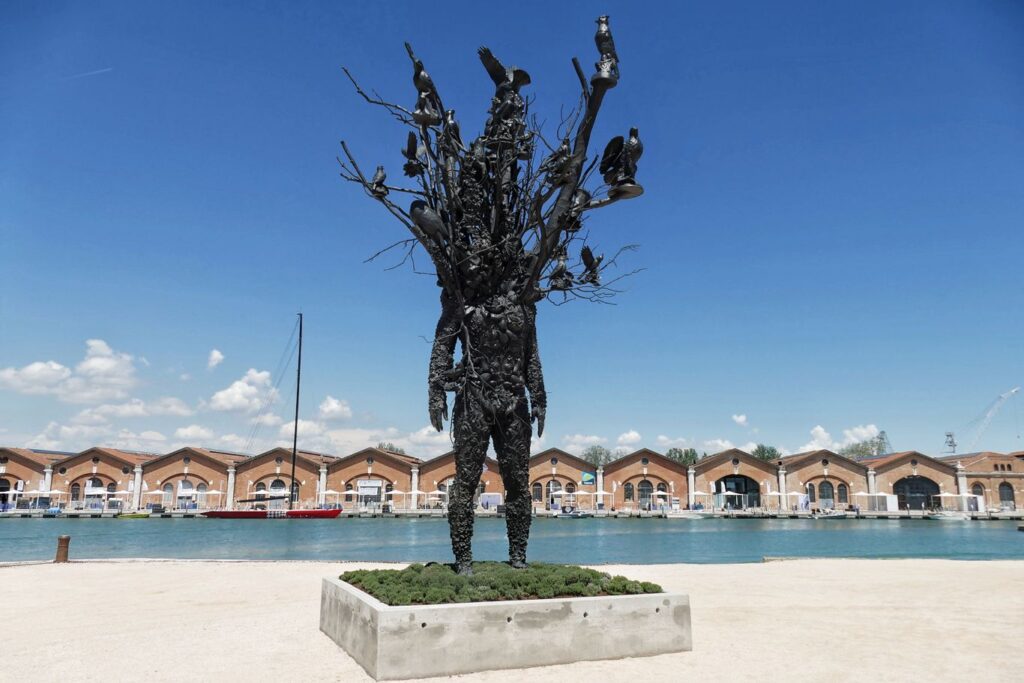
The Biennale takes place primarily at two large venues. One of them is the Giardini, hence, the gardens, located in the Castello neighborhood.
In this venue, 27 countries have the opportunity to present artists of their choice at their respective national pavilions. The first, by the way, was the Belgian one, constructed in 1907.
In 1980, the art show was extended to another major venue, namely the Arsenale. This arsenal is a massive terrain of former shipyards and armories, located just minutes from the Giardini.

The remaining countries that do not have a steady pavilion in one of these central venues can still exhibit in rented places scattered throughout the city. This way, as I pointed out above, you have access to Palazzi and other stately buildings that normally are not open to the public.
Beyond the country’s contributions, there are themed exhibitions in the central pavilions of both main venues. Those are designed by a curator.
What’s on in 2026
Since the Biennale di Arte is such a significant international event, its installations, photographs, and videos invariably address current social and political issues. In 2015, when the Nigerian curator Okwui Enwezor, who passed away in 2019, curated the Biennale, the topic of migration took center stage for the very first time.
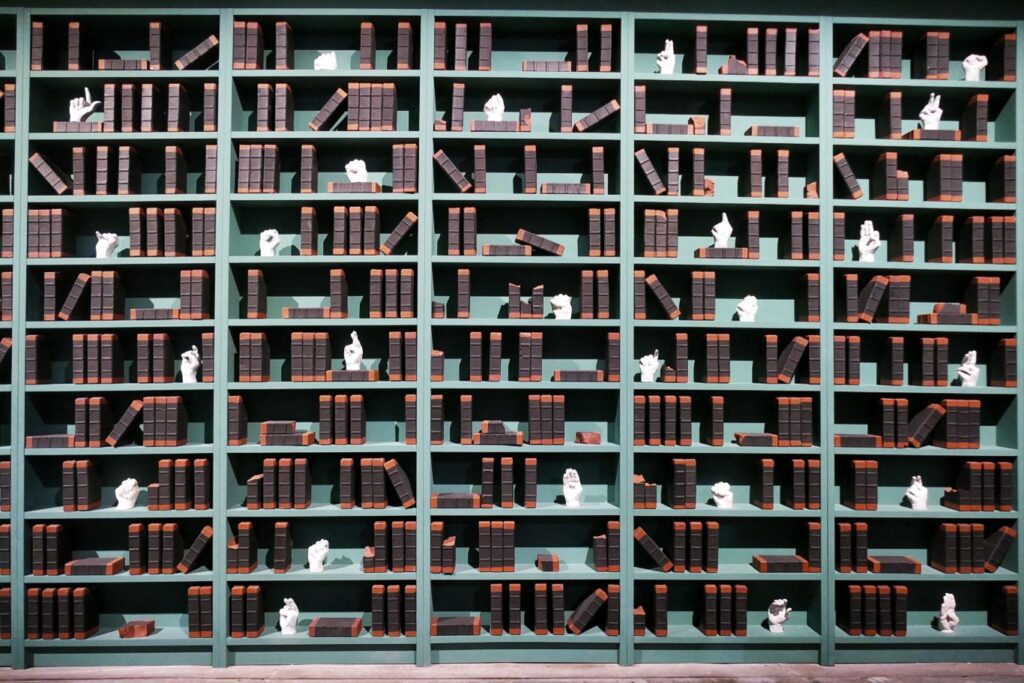
Since then, other matters have come into focus. However, the subjects of rootlessness and otherness in their multifaceted manifestations have remained an integral component.
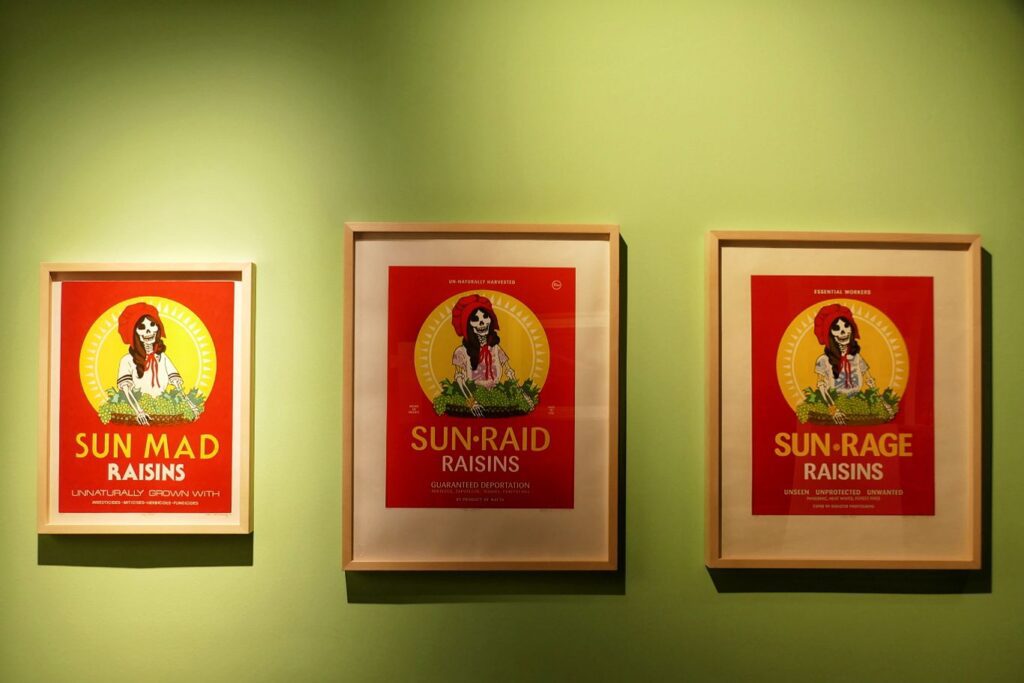
As previously mentioned, alongside the national pavilions, there is a central, curated exhibition distributed across the two main exhibition venues. While the participating nations are not assigned to a specific topic, the central curated section operates under a distinct motto.
Unexpected Tragedy
In October 2024, Koyo Kouoh accepted the invitation to curate the 61st Biennale. She was the Director of the Zeitz MOCAA in Cape Town and one of the most influential figures in contemporary art.
Kouoh dedicated herself intensively to the planning and conceptualization of this project. By early May 2025, she had established the concept and selected the artists. On May 20, 2025, Koyo Kouoh was scheduled to present the result at a press conference. Tragically, she passed away unexpectedly just ten days prior.
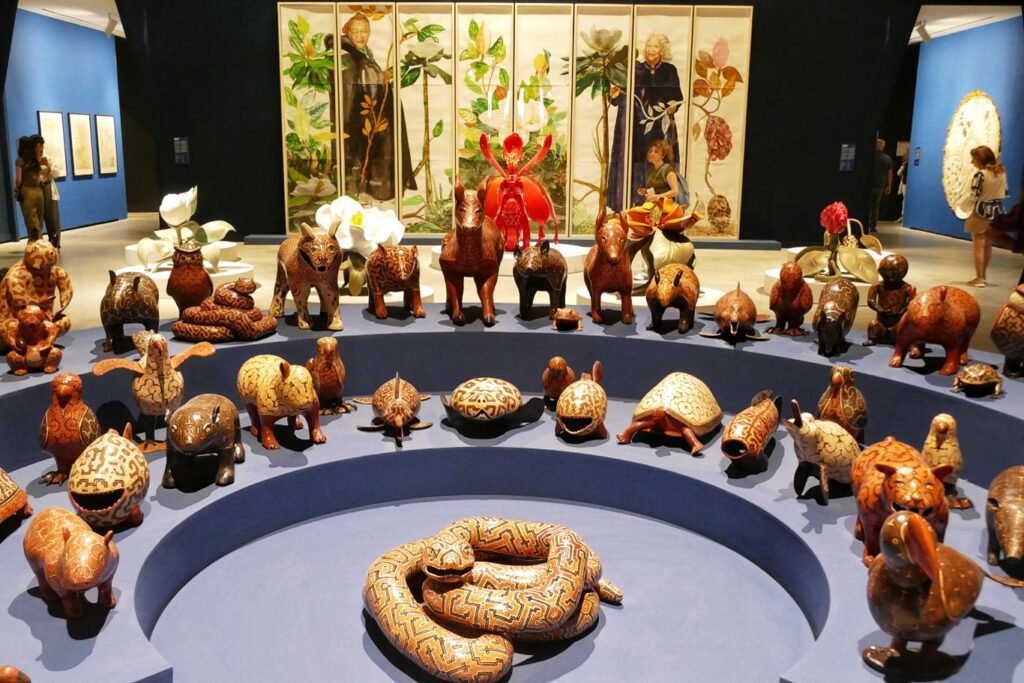
Following her death, the Venice Biennale, in close consultation with Koyo Kouoh’s family, decided to proceed with the exhibition in accordance with her preparations. On May 27, 2025, Koyo Kouoh’s team held the press conference.
The official title is In a Minor Key. It is supposed to take the more the contemplative, the ambivalent, and, at times, the melancholic into focus than the heroic or the triumphant,
Under an Unlucky Star
Somehow, this year is jinxed. Not only did Koyo Kouoh tragically pass away right in the middle of preparations, but shortly before the opening of the 61st edition, a massive conflict erupted. The international jury resigned en masse, the opening ceremony was cancelled, and, for the first time since 1986, no Lions will be awarded. The reason was the participation of Russia and Israel.
After a hiatus, Russia was returning to their pavilion in the Giardini with a performance project curated by Anastassija Kornejewa, the daughter of an intelligence general. Together with the daughter of Foreign Minister Sergey Lavrov, she runs a gallery in Moscow. That this choice would likely prove more than controversial surely didn’t come as a surprise!
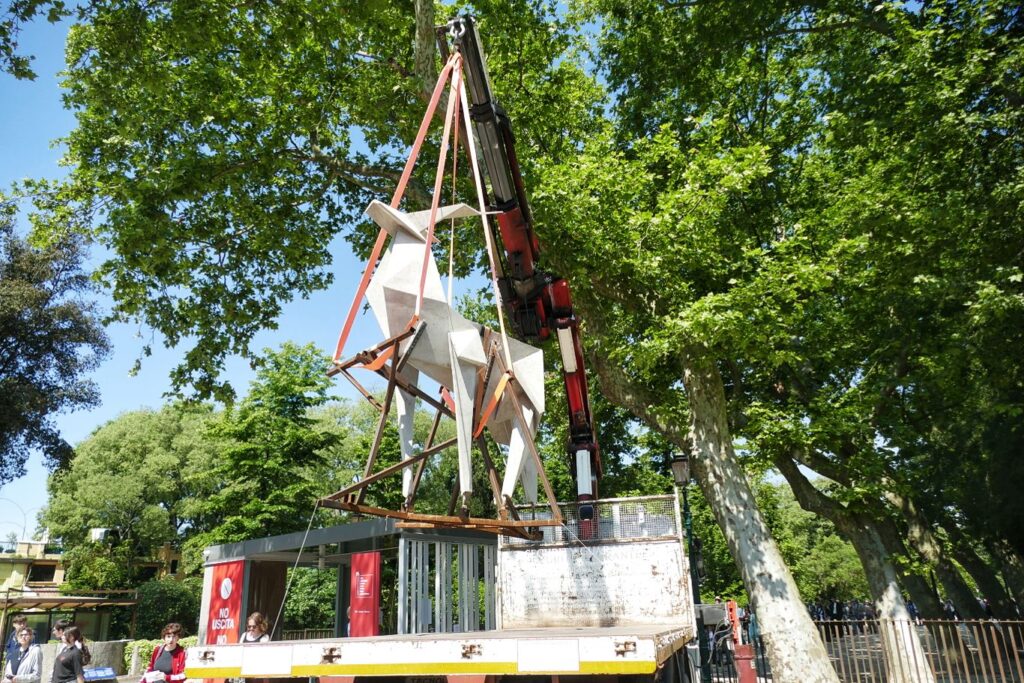
This stance met with fierce international criticism. Following protests, the EU announced it would cut funding amounting to two million €uros. The Italian government, too, distanced itself from the decision and stayed away from the opening.
Following these protests and political pressure, the pavilion now remains closed to the public. There is only minimal activity: monitors outside display recorded performances, but there is no public access to the building. Apparently, the pavilion will remain closed until the end of the Biennale.
Obviously, Israel’s participation has sparked controversy, too. In open letters, 200 artists and initiatives demanded the country’s exclusion. The Biennale, however, stood firm on its decision.
Additionally, another conflict escalated regarding the South African pavilion. After artist Gabrielle Goliath faced political pressure over her exhibition concept and refused to make changes, the official pavilion remains empty. Her work, however, is still exhibited as part of the collateral program.
Somehow, this year is jinxed.
The Collateral Program
In connection with the South African Pavilion, I mentioned the so-called Collateral Program above. The Collaterali are not an official component of the Biennale di Arte. Rather, they constitute a highly exquisite ‘bycatch’ that takes place at the same time.
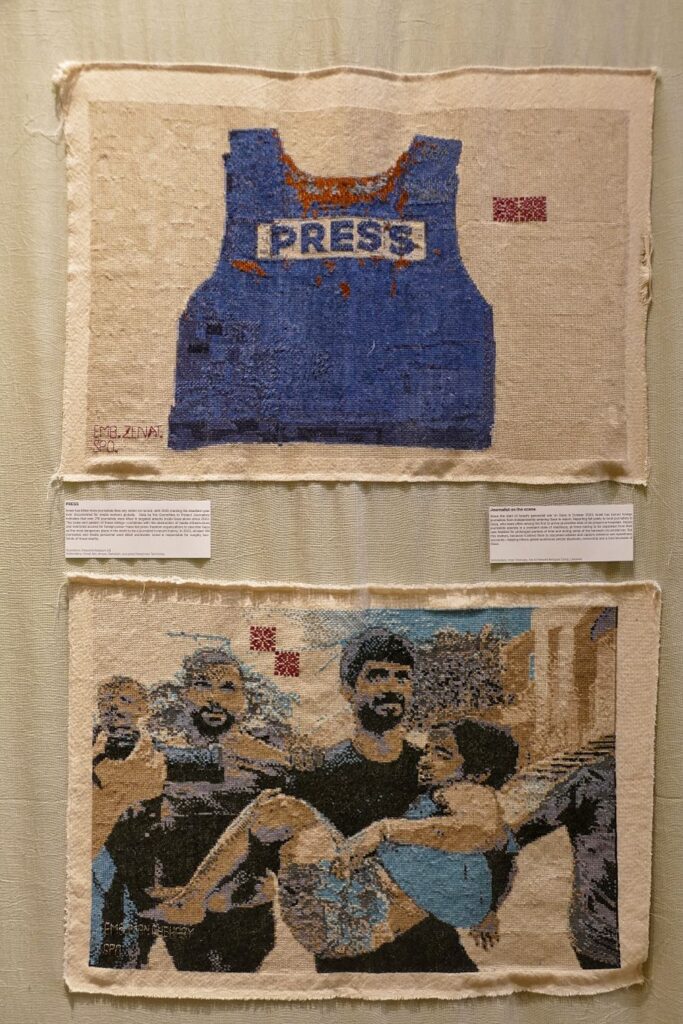
I assume that exhibitors choose the Biennale period for their shows because they know that a significant number of art lovers will be in the city during that period.
In this context, I would like to draw attention to the Palestine exhibition at Palazzo Mora. Through poignant scenes, it addresses themes such as memory, loss, and cultural identity in Gaza, and above all, the traces of destruction and displacement. The use of the traditional Tatreez embroidery technique is particularly moving, creating large-format textile images with thousands of delicate cross-stitches. The combination of traditional needlework and documentary creates a tranquil yet deeply evocative impression that connects personal stories with collective memory.
My Personal Favorites in 2026
I’ve been coming to Venice to see the Biennale for years now. And although it doesn’t really get old, this year I found it harder to list outstanding contributions. In Minor Key is certainly an interesting motto. Unfortunately, it was often filled with irrelevant or, at best, mediocre works. The curated part, in particular, was rather lifeless. I like art that is wild and daring. It should crack me up or move me to tears. I don’t need inspiration to shrug my shoulders. The works as such oftentimes aren’t exactly stirring. Hence, a bloated interpretations filled with pretentious buzzwords has to do the job. At times, it’s quite annoying. Nevertheless, I was able to list 25 contributions that I liked for various reasons.
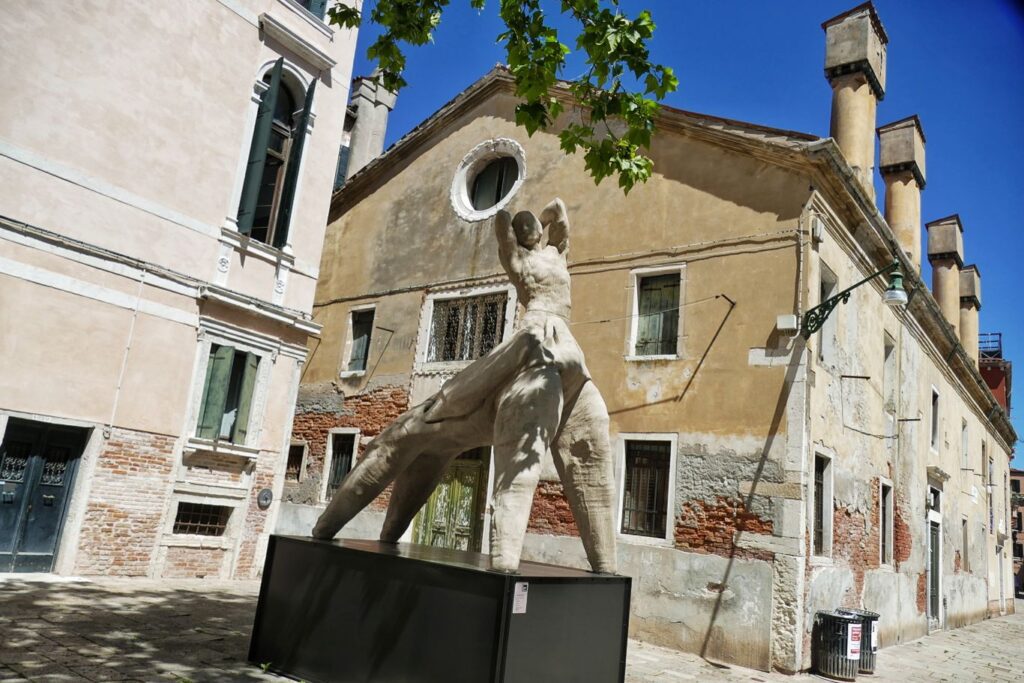
The list below is sorted by country. I’ve added brief info on the work and stated where you’ll find it. Nevertheless, on the map at this post’s end, you will find the main venues, the country pavilions, and the Collaterali. Also, you’ll get all the relevant info to make your visit to the Biennale 2026 smooth and more memorable.
Argentina
Matías Duville: Monitor Yin Yang
With Monitor Yin Yang, Matías Duville presents a large-scale work made from salt and charcoal, combined with video, sound, and installation elements. Rather than a singular art object, the piece creates an immersive, walkable space that visitors traverse and slightly transform through their movement. This way, the salt and charcoal serve as references to nature, transience, and human intervention.
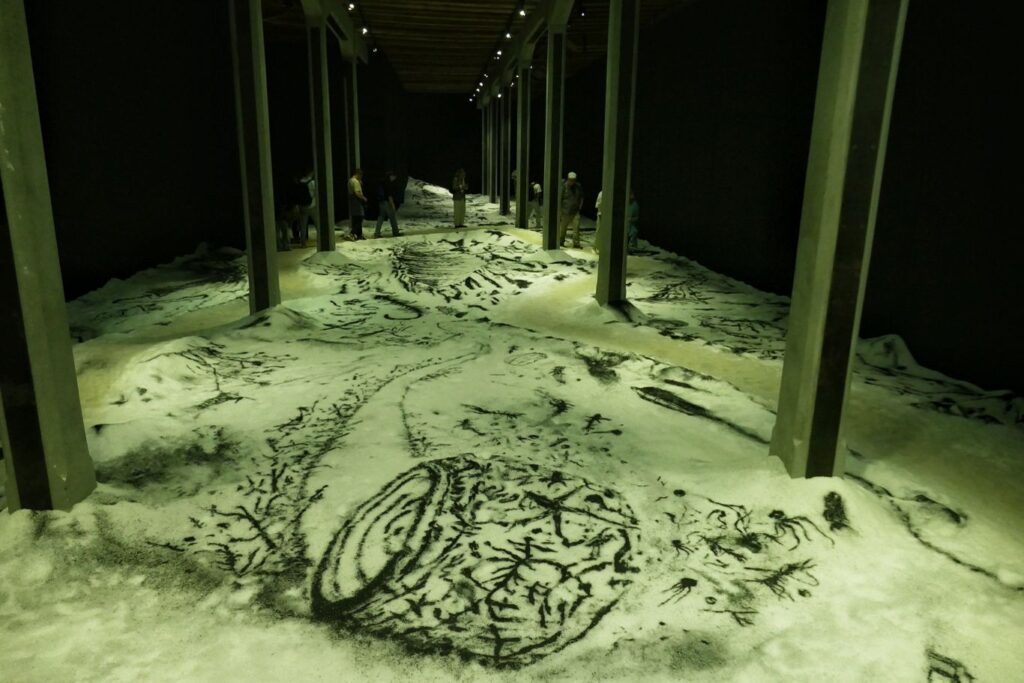
Duville conceives of the installation less as a static image than as a temporary, open-ended landscape—a moment between destruction and renewal that unfolds fully only through movement, sound, and the participation of its visitors.
Venue: Argentinian Pavilion at the Arsenale
Austria
Florentina Holzinger: Seaworld Venice
Water—as a vital resource, a consumer good, and a symbol of change—lies at the heart of Florentina Holzinger’s work. Through a blend of dance, theater, and performance, she explores the human body in a world where nature and technology are increasingly merging.
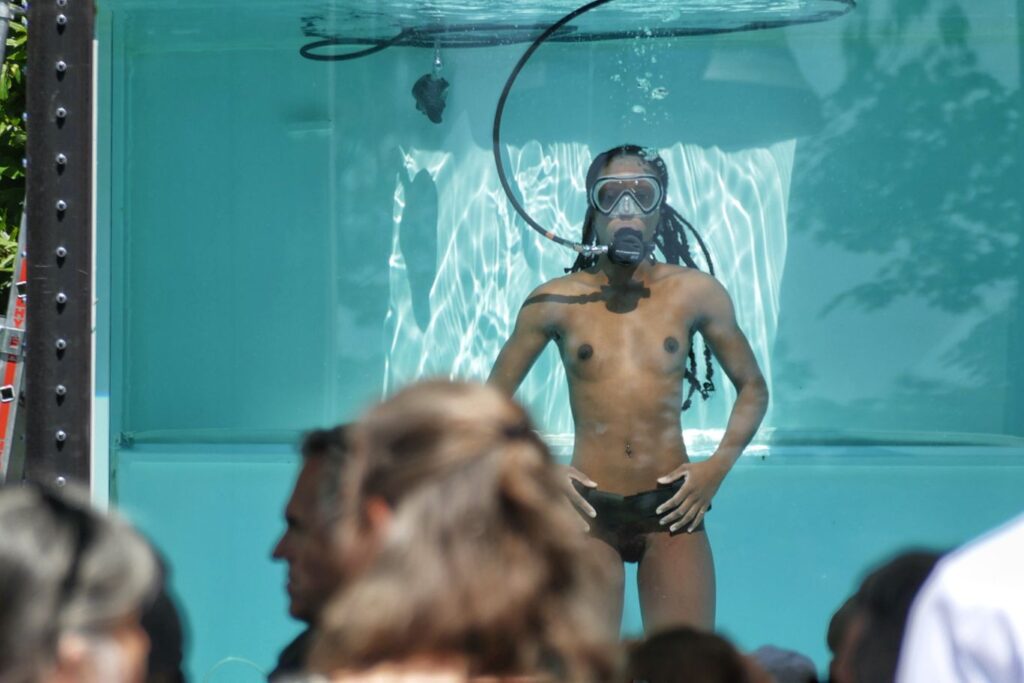
The artist has created a sprawling installation that simultaneously evokes a theme park, a sewage treatment plant, and a sacred site. Seaworld Venice grapples with dichotomies such as purity and pollution, guilt and purification, bringing into view that which is socially repressed or concealed.
As you are planning your visit, keep in mind that even on not so busy days, the wait for entering the pavilion is about one hour!
Venue: Austrian Pavilion at the Giardini
Azerbaijan
Faig Ahmed: The Attention
In The Attention, Faig Ahmed grapples with the overwhelming nature of the information deluge, seeking forms of orientation and meaning amidst the chaos of the present day.
Drawing upon the mystical poetry of the medieval author Nasimi, Ahmed engages with cultural heritage to reflect on the nature of perception and concentration. In doing so, he interweaves historical texts with contemporary concepts drawn from science and philosophy.
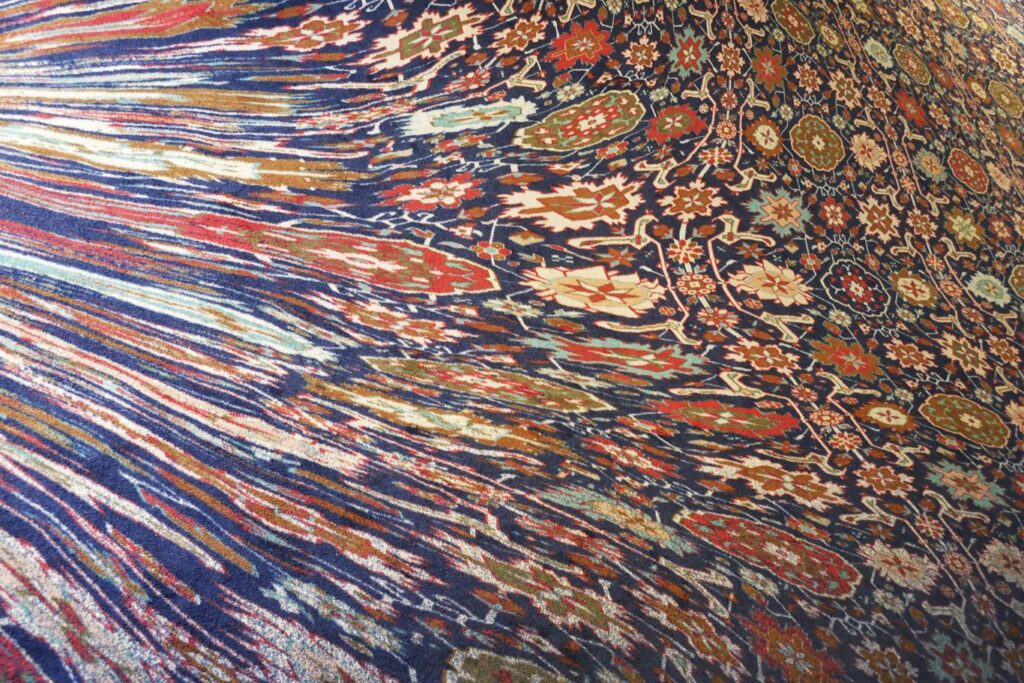
Central to the work is its connection to the Hurufi tradition, in which individual letters possess a symbolic significance. Ahmed transposes this mode of thought onto contemporary systems of signs, data, and perception. Azerbaijani carpet patterns serve as both the visual framework and the conceptual starting point for his installations.
I love how the artists from Azerbaijan always surprise with literally unusual perspectives and find a perfect balance between contemporary views and traditional elements.
Venue: Campo della Tana, Castello 2124/A, Castello 2125
Bahamas
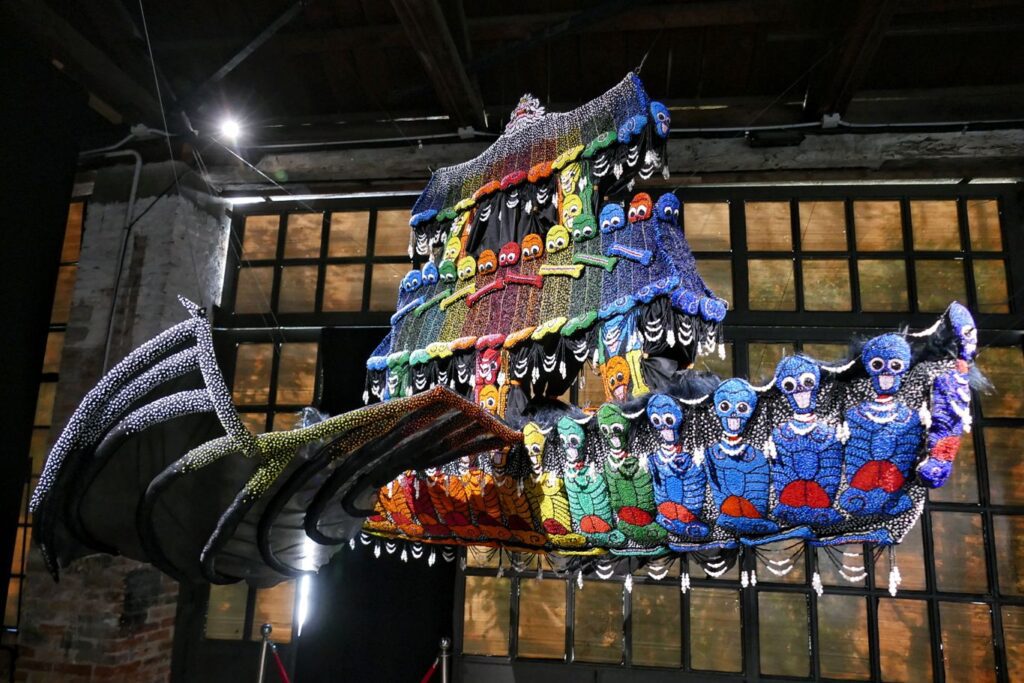
John Beadle and Lavar Munroe: In Another Man’s Yard
In the presentation In Another Man’s Yard, Lavar Munroe enters into a dialogue with the late artist John Beadle.
The project takes as its starting point the Junkanoo carnival, a recurring street festival that plays a central cultural role in the Bahamas. Drawing on discarded costume elements and found materials, large-scale sculptural installations have been created in Venice.
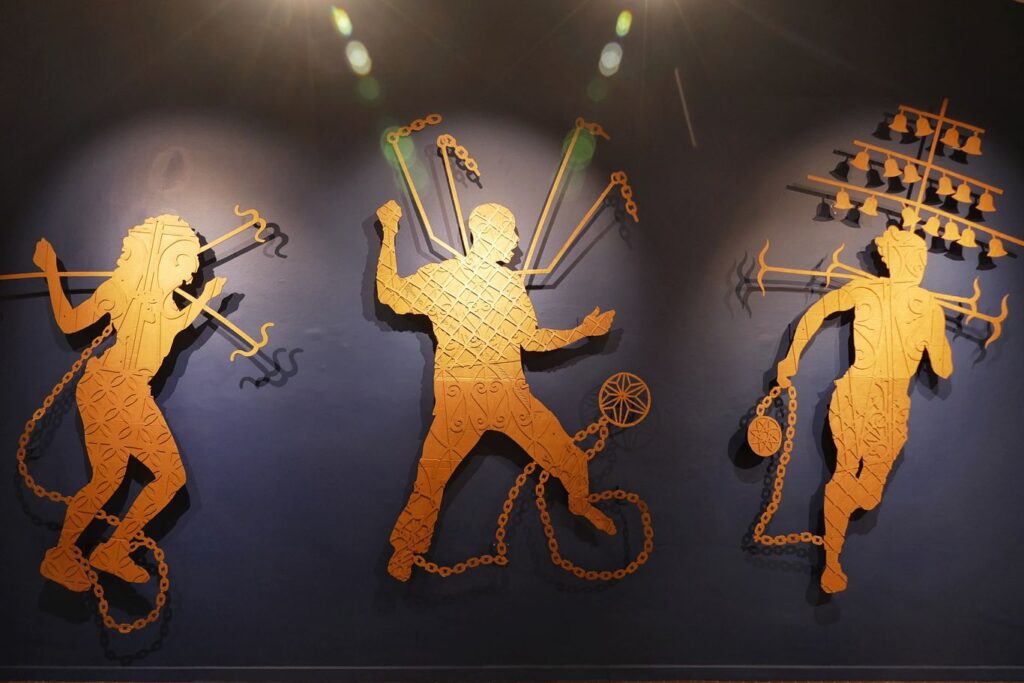
At the core of the project lie questions concerning memory, transmission, and artistic lineage. Works by Beadle are interwoven with new pieces by Munroe, their themes extended and elaborated through materials, sketches, and photographic references.
The Pavilion conceives of Junkanoo not merely as a festive event, but as a cultural archive. The result is an installation that engages with questions of representation, identity, and cultural perception, while challenging conventional imagery of the Caribbean.
Venue: San Trovaso Art Space, Dorsoduro 947
Brazil
Rosana Paulino and Adriana Varejão: Comigo ninguém pode
The title Comigo ninguém pode refers to a plant common in Brazil that often stands before homes as a symbol of protection, yet is simultaneously poisonous. This dual significance serves as the starting point for the exhibition.
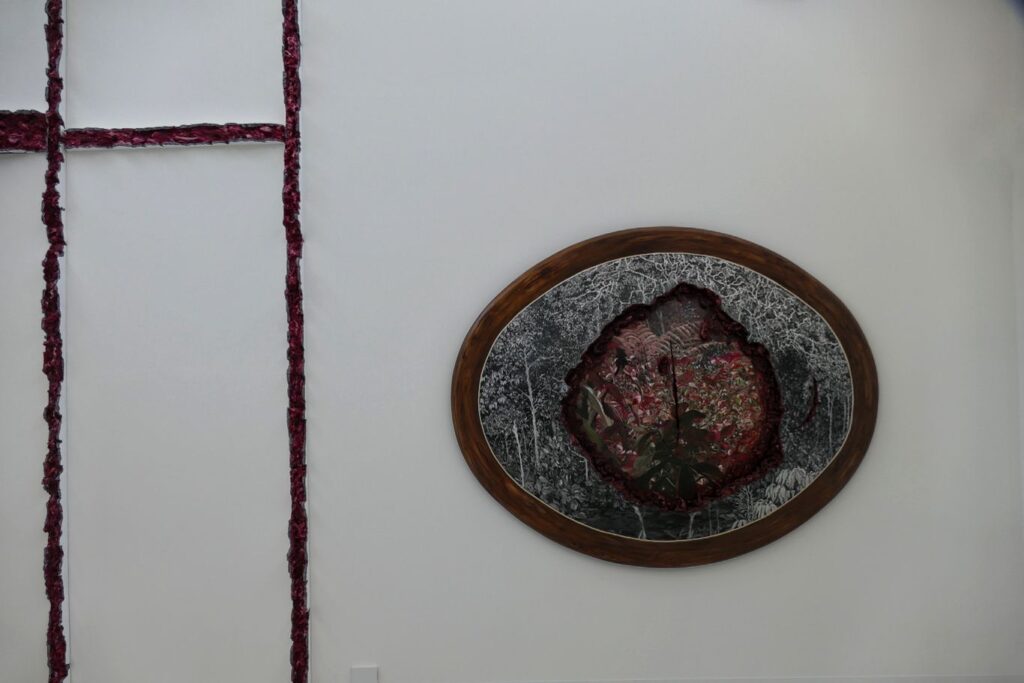
The works of the two artists are displayed jointly throughout the pavilion and engage in a direct dialogue with the building’s architecture.
The exhibition deliberately engages with the tensions and overlaps between the two artists’ positions, rather than presenting them in isolation. This approach creates a shared space in which diverse visual languages, materials, and meanings coexist and mutually overlap.
To see more of Adriana Varejão’s impressive and even slightly disturbing creations, go to my post Trip to BELO HORIZONTE | BRUMADINHO | INHOTIM
Venue: Brazilian Pavilion at the Giardini
Chile
Norton Maza: Inter-Reality
Norton Maza’s multisensory installation Inter-Reality consists of a large architectural structure, which is permeated by various technical and symbolic elements. These include an electricity pylon, golden generators, and a bird of prey serving as a visible marker in the upper section of the installation. Inside the structure, small viewing apertures open onto moving scenes of landscapes.
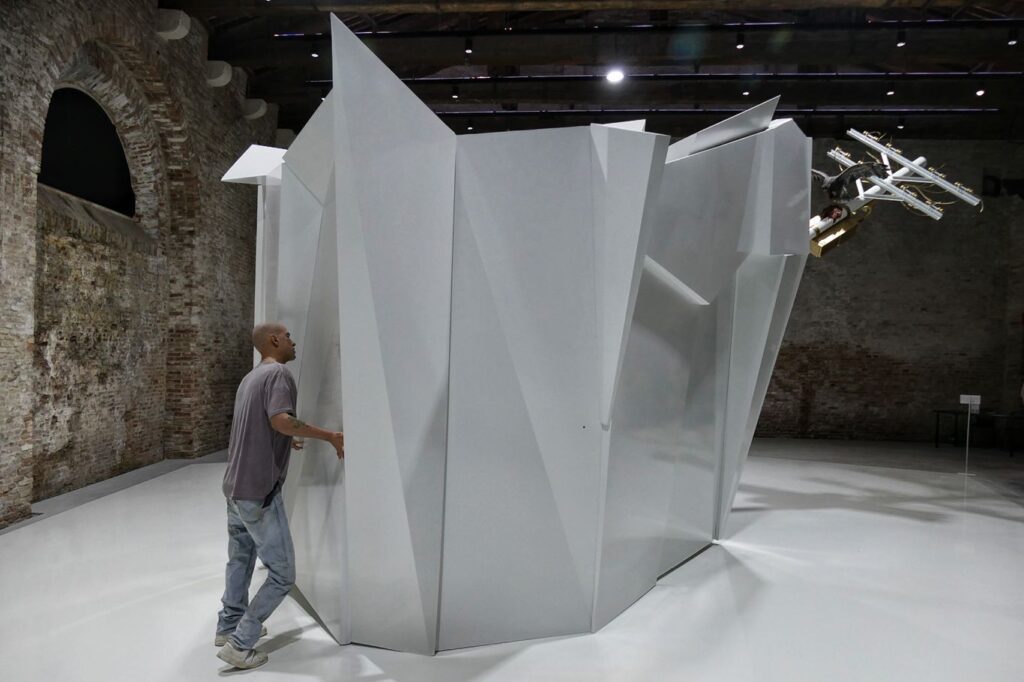
The installation conceives of itself as a spatial system rather than a singular object. It employs shifts in perspective, multiple temporal layers, and a slowed mode of perception to provoke unexpected perspectives.
Venue: Chilean Pavilion at the Arsenale
Cuba
Juan Roberto Diago Durruthy: Hombres Libres / Free men
Roberto Diago presents his sculptural installation Hombres Libres / Free Men as a reflection on memory, displacement, and the ongoing legacies of Afro-diasporic histories within the Caribbean context.

The project is built around assemblages of salvaged and worked materials that carry historical traces. Rather than illustrating a linear narrative of national identity, the installation brings forward fragments of experience shaped by slavery, migration, and contemporary forms of social inequality. The works operate through surface, texture, and material accumulation, where scar and repair become central visual and conceptual elements.
Across the pavilion, material and historical references are tightly interwoven, positioning the installation as a space where Afro-Cuban experience is not represented as fixed heritage, but as an active and continuous process of negotiation between memory, body, and political reality.
Venue: Il Giardino Bianco – Art Space, Via Giuseppe Garibaldi, Castello 1814
Denmark
Maja Malou Lyse: Things to Come
At the heart of the exhibition lies the question of how technology, the body, and digital images are increasingly merging. The starting point is scientific research showing that virtual sexual stimuli can influence biological processes. From this, Maja Malou Lyse develops a speculative future narrative about reproduction, desire, and the impact of digital media on the human body.
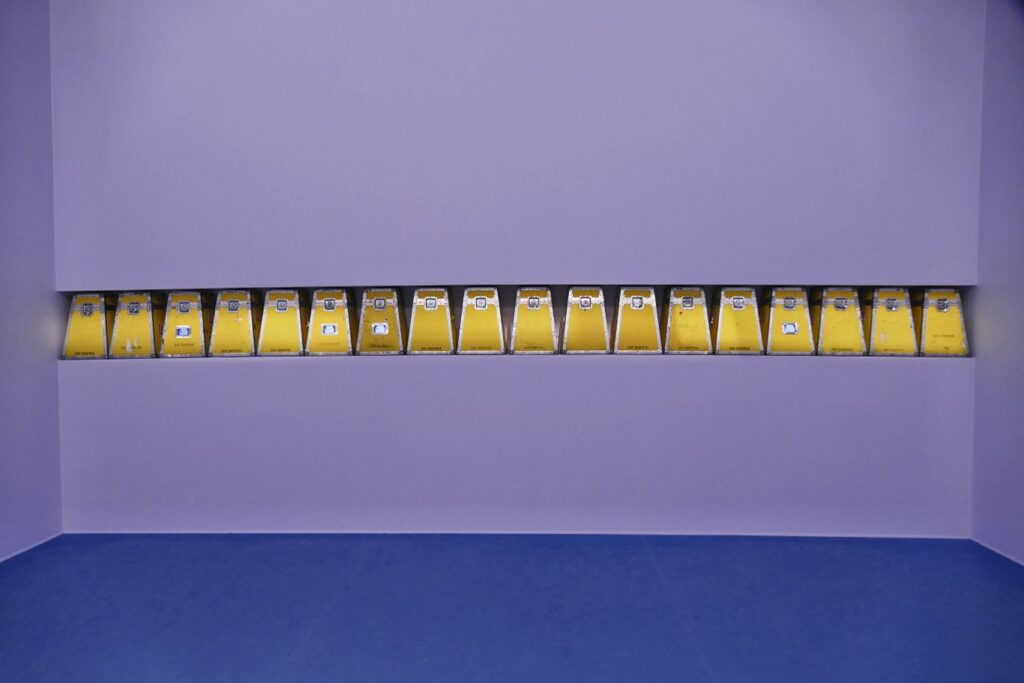
The exhibition combines video, installation, and futuristic architecture to create an immersive environment. Pornographic imagery encounters scientific aesthetics and dystopian science fiction. Themes such as fertility, artificial intimacy, and the role of digital images are not judged, but rather explored as potential future developments.
Venue: Danish Pavilion at the Giardini
Germany
Henrike Naumann, Sung Tieu: Ruin
Under the title RUIN, Sung Tieu and Henrike Naumann transform the German Pavilion into an archive of the history of the GDR. Albeit, they don’t create a closed chapter of the past, but show it as an ongoing process full of ruptures and contradictions.
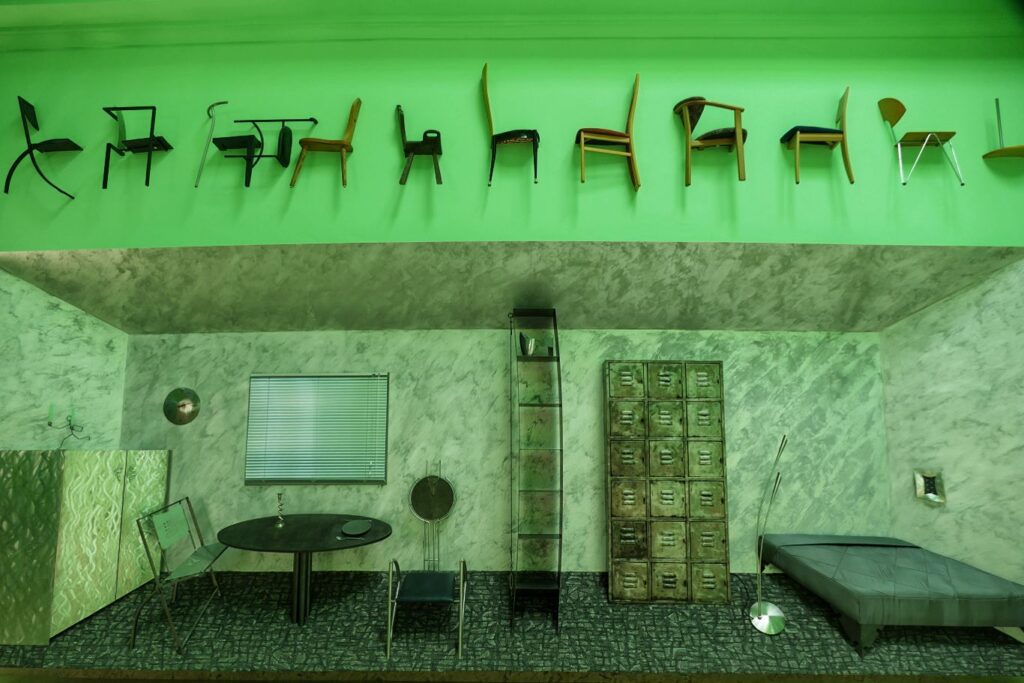
Even from the outside, the Pavilion no longer appears as a monumental structure, but rather as a socialist prefabricated housing block. Sung Tieu covers the façade with millions of mosaic tiles, thereby reconstructing the residential building in East Berlin where she lived following her migration from Vietnam in the 1990s. The building was one of the largest dormitories for Vietnamese contract workers in the GDR.
Inside, Tieu continues to explore her personal memories, addressing themes of migration, labor, and displacement.
The main hall, however, was designed by Henrike Naumann, who sadly passed away shortly before the Biennale at the age of only 41. In her work, she has addressed sociopolitical issues with the aesthetics of furniture and everyday objects.
Venue: German Pavilion at the Giardini
Greece
Andreas Angelidakis: Escape Room
Andreas Angelidakis transforms the Greek Pavilion into an immersive space that reimagines Plato’s allegory of the cave for the present day.
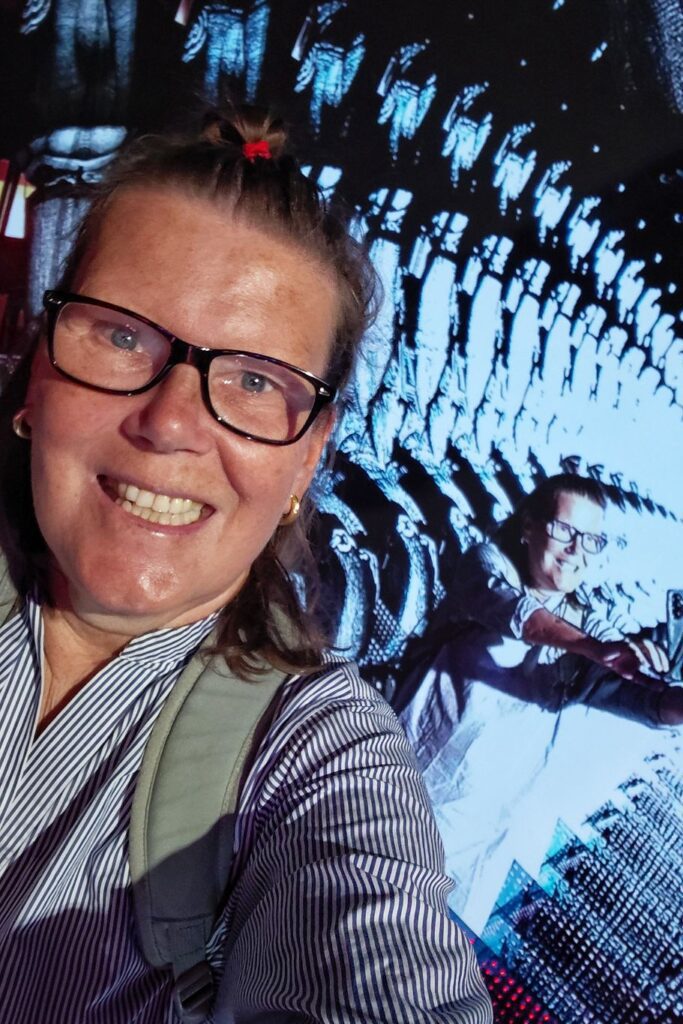
The pavilion is conceived as a walk-in installation in which architecture, history, and fiction overlap. It takes the idea of the cave as a place where perception is shaped by images and appearances, and applies it to a contemporary context marked by digital media.
Rather than presenting a linear historical account, the installation brings together fragments of the Greek Pavilion’s own past, treating them as layered and sometimes conflicting constructions. The space becomes a kind of structured puzzle, where visitors move through different spatial and conceptual rooms.
At the centre of the project is the idea that exhibition spaces themselves can function as systems that produce meaning and belief.
In this sense, Escape Room transforms the pavilion into a space of reflection on individual and collective perception.
Venue: Greek Pavilion at the Giardini
Holy See
Soundwalk Collective: The Ear is the Eye of the Soul
This year, the Holy See’s contribution to the Biennale is spread across two very different locations – and that’s precisely what makes it so interesting.
In the Castello district, works by German filmmaker Alexander Kluge meet the texts and ideas of the medieval mystic Hildegard von Bingen. Despite the nearly 900-year gap, both grapple with fundamental questions about humanity, its responsibility, and its place in the world. The exhibition space invites visitors to engage with this unusual encounter.
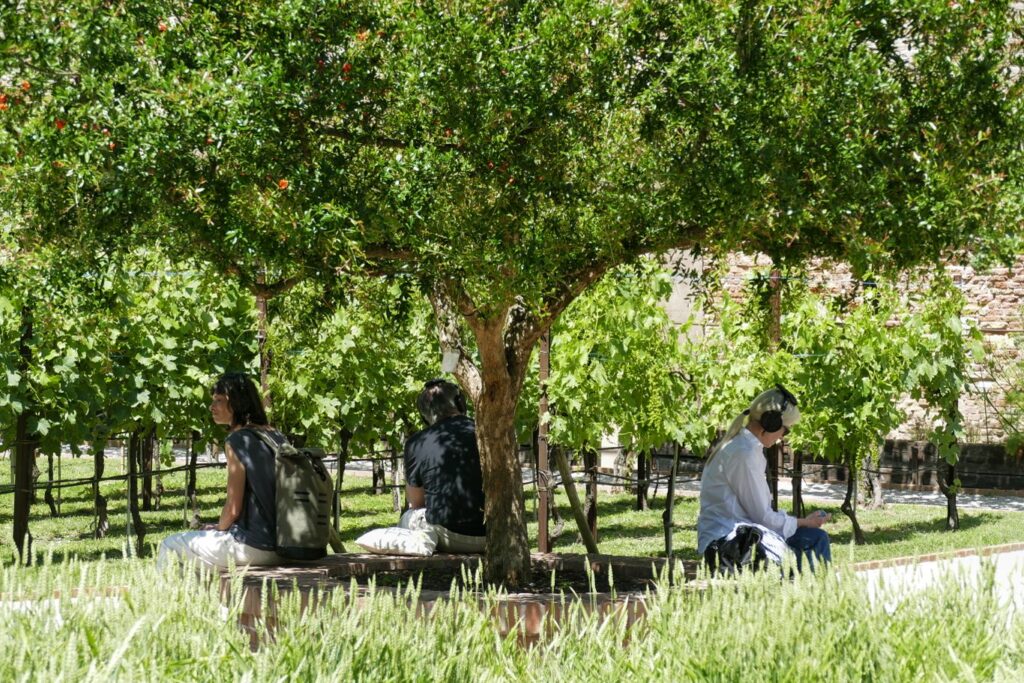
The second part of the exhibition, in the garden of the former seminary next to the Santa Lucia train station, presents a completely different experience. Here, the Holy See brings together prominent voices from international culture such as Patti Smith, Brian Eno, and Jim Jarmusch. Their vocal contributions revolve around themes such as memory, community, spirituality, and how people connect with one another. The garden becomes a space for contemplation but also encounters.
Together, the two exhibitions demonstrate that the Holy See’s contribution is not limited to religious questions in the narrow sense. Rather, it’s about the dialogue between past and present, art and society, and the search for orientation in an increasingly complex world.
The exhibition project is guided by Koyo Kouoh’s curatorial vision, which calls for a pause and a turn to a contemplative and quiet dimension.
Venues: Complei Santa Maria Ausiliatrice, Fondamenta S. Gioacchin, Castello 450, and Giardino Mistico dei Carmelitani Scalzi, Cannare
Italy
Chiara Camoni: With You with Everything
Chiara Camoni’s installation is built as a collective and open structure and the result of her collaborative way of creating. It brings together new and existing works and is organised through processes of reuse, transformation, and recombination of materials. Clay, natural elements, recycled plastics, industrial remnants, and found objects form a shared material landscape in which waste is reinterpreted as something meaningful.
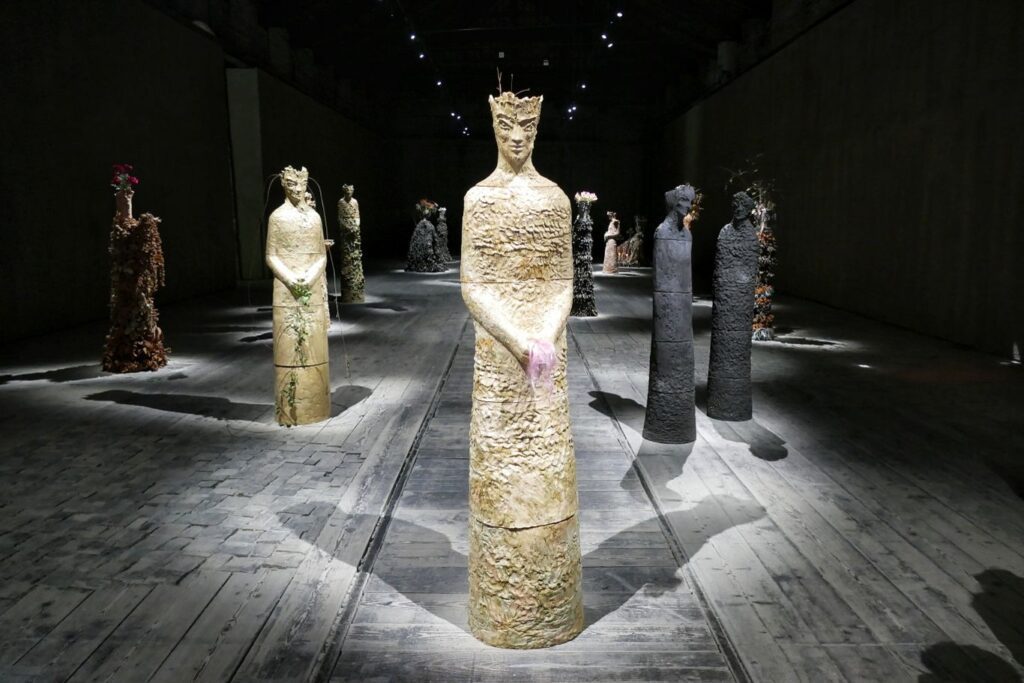
The exhibition unfolds as a sequence of environments. It begins in a dim, enclosed space with a group of anthropomorphic ceramic figures that stand between sculpture and presence, arranged like a gathering. These works are made through hand-building techniques and assemblages, and include natural and discarded materials that link the works to their surroundings.
As you walk through the spacious pavilion, the atmosphere shifts toward a more open and illuminated space. Here, installations combine organic matter, recycled materials, and constructed elements, suggesting an environment in constant transformation.
A further section brings together Camoni’s work with that of other artists and historical references, placing different practices and time periods in dialogue. Across the exhibition, the focus remains on material change, shared making, and the ongoing redefinition of value through transformation.
Venue: Italian Pavilion at the Arsenale
Japan
Ei Arakawa-Nash: Grass Babies, Moon Babies
Ei Arakawa-Nash’s participatory installation continues his long-standing engagement with performance traditions such as Gutai, Fluxus, Happenings, and other related movements.
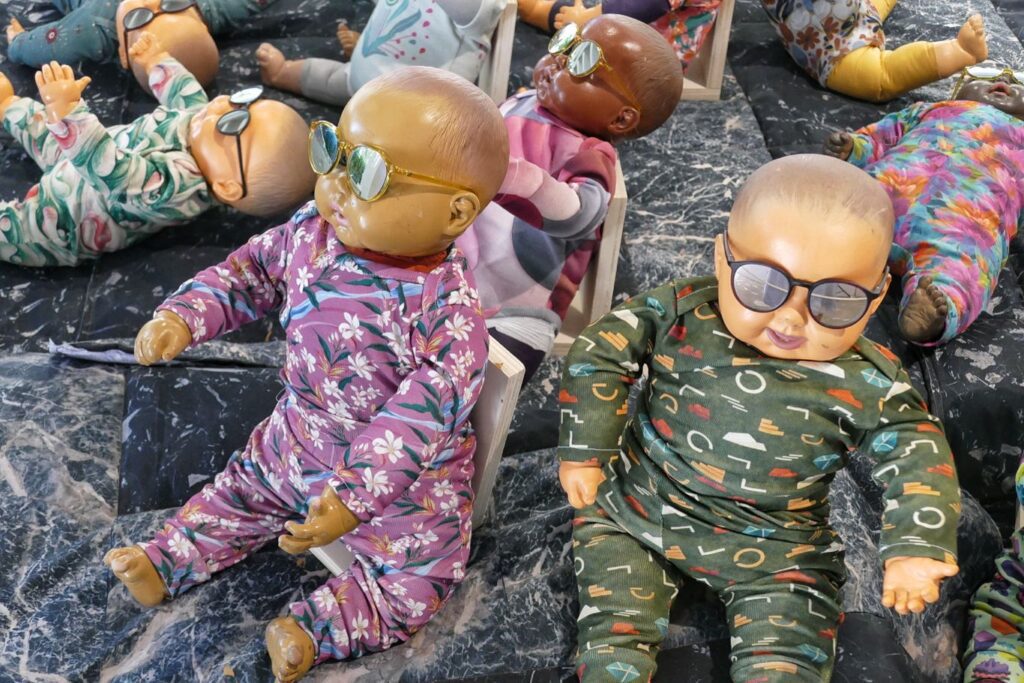
For the Japanese Pavilion, he has created a new installation shaped by questions concerning identity, family, and national representation. The work draws upon his experiences as a queer parent, as well as his interest in how specific roles are installed.
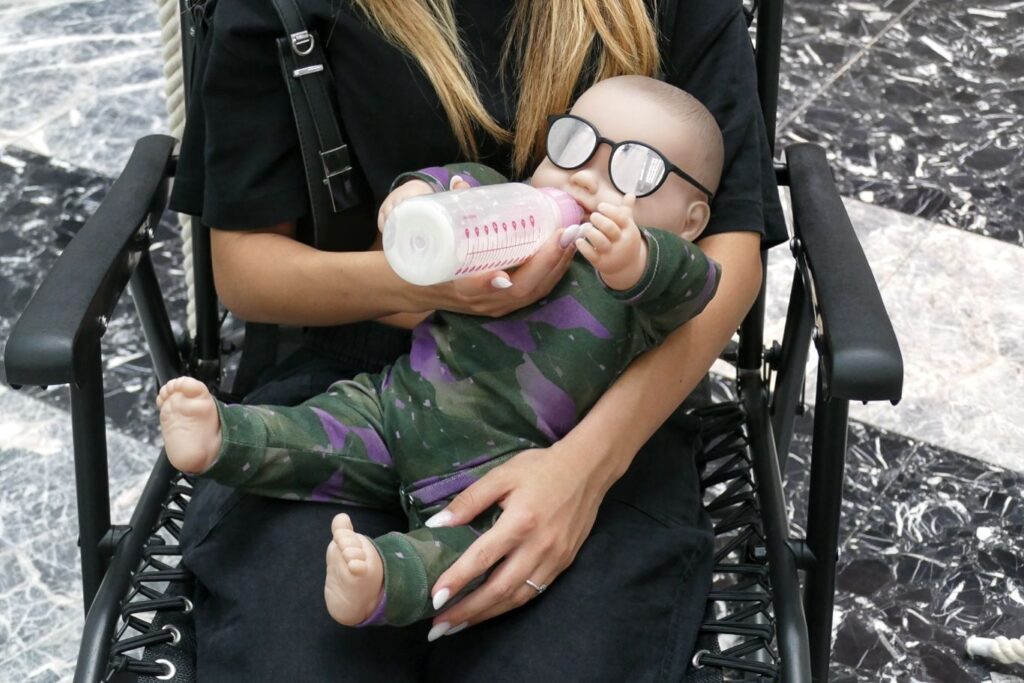
Rather than presenting static artworks, the Pavilion functions as an open space where interaction and performances take place. It places its emphasis on process and participation, as well as on how meaning is generated through collective activity.
Venue: Japanese Pavilion at the Giardini
Kyrgyz Republic
Alexey Morosov: Belek
Alexey Morosov brings the values, traditions and culture of Kyrgyzstan to Venice. The project explores contemporary Kyrgyz identity through ancient history, myth and memory, offering an immersion into the cultural heritage of this remote territory.
At its core is the concept of belek, which translates to gift. It highlights how a small mountain nation in Central Asia manages its most precious resource, namely water.

Two further topics complete the project: kok-börü, the traditional equestrian sport symbolizing the bond between rider and horse, and the recitation of Manas, the epic of the Kyrgyz people. With its vast oral tradition, the rhythmic chanting of Manas evokes a collective memory that brings the exhibition to perfection.
Venue: Ex Chiesa di Santa Caterina, Convitto Foscarini, Cannaregio 4941
Latvia
MAREUNROL’S and Bruno Birmanis: Untamed Assembly: Backstage of Utopia
The Latvian artists are reviving the experimental festivals of fashion, performance, and club culture called Untamed Fashion Assemblies. Those took place in Latvia in the 1990s, hence, after the collapse of the Soviet Union.
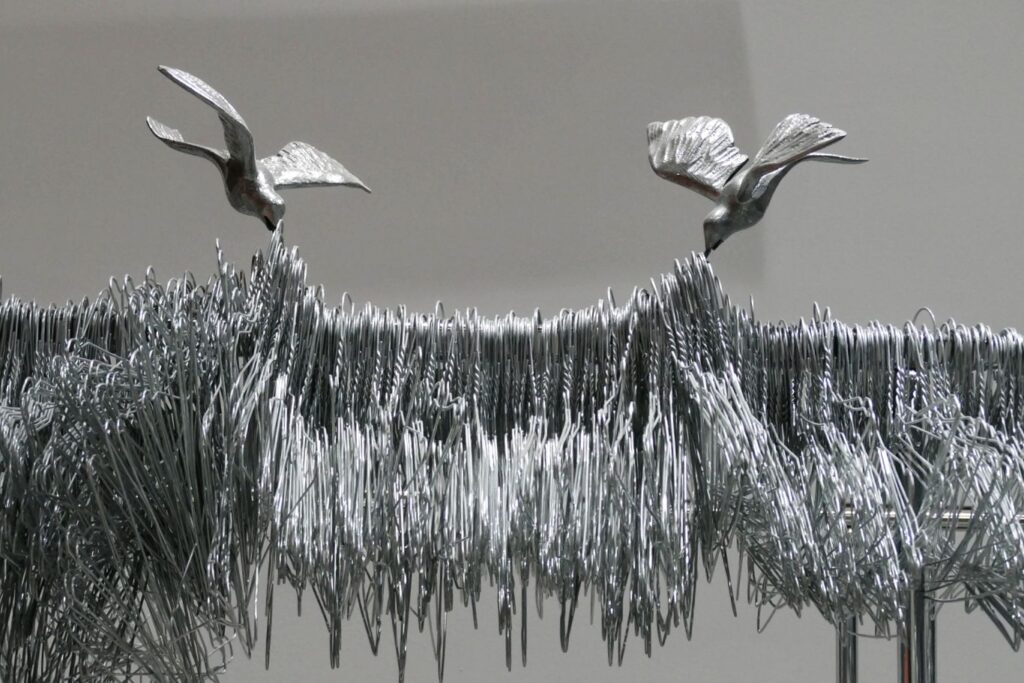
Rather than reconstructing the events directly, the pavilion is conceived as a backstage space of preparation, improvisation, experimentation, and collective work. Clothing racks, textile elements, sound, video, and archival footage form an installation that reflects both the excitement and uncertainty of that period.
The project looks back at the 1990s as a moment of transition and asks how ideas of freedom, artistic experimentation, and alternative social spaces can be reconsidered today.
Venue: Latvian Pavilion at the Arsenale
Luxembourg
Aline Bouvy: La Merde
The Luxembourg Pavilion definitely takes the lead in the unexpected highlights category. Not because it’s the most important or profound work, but because it achieves something rare: it stays with you.
For those who do not know: the title La Merde, translates to shit, and the basic idea initially sounds rather absurd: a pile of excrement gives a lecture. It addresses the audience directly, hands out compliments, makes suggestive remarks, and navigates somewhere between charm offensive, flirtation, and self-promotion.
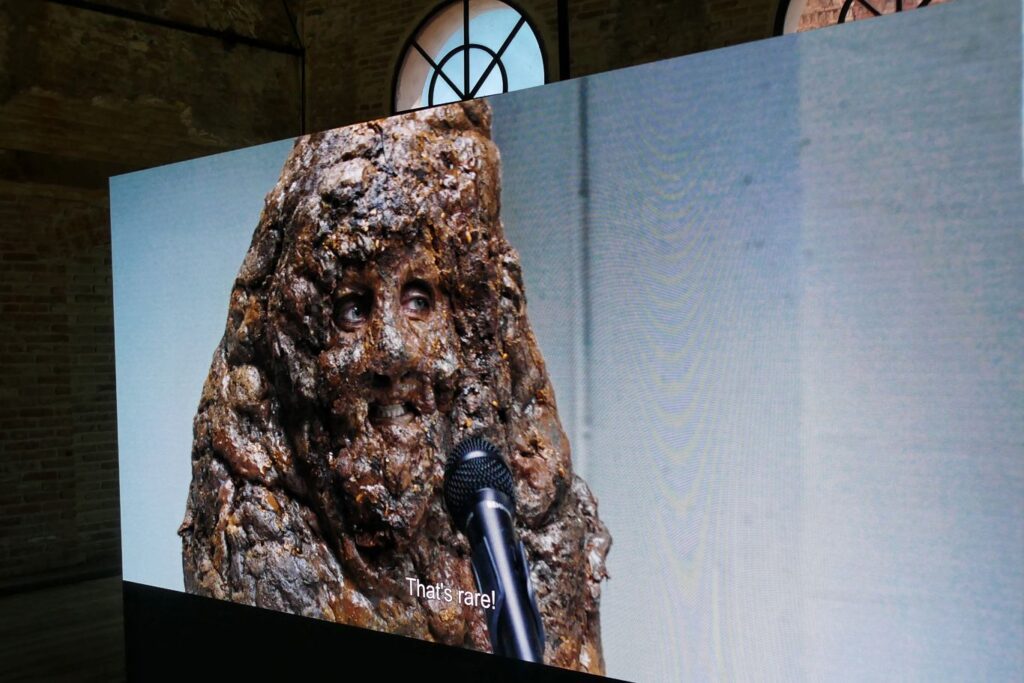
What might quickly come across as a lame joke on paper works surprisingly well. The work is very funny, sometimes even hilarious. At the same time, there are recurring moments where you don’t know whether to laugh or look away in embarrassment. It’s precisely this interplay of humor and vicarious embarrassment that makes the performance so compelling.
The presenter is anything but reserved. The pile flatters, provokes, and occasionally crosses the line of good taste. However, he does so with such self-confidence that it’s almost impossible to resist.
In a biennale that often gets lost in theoretical concepts and contrived meanings, the Luxembourg contribution offers something refreshing: it’s entertaining, direct, and simply fun. And sometimes that’s all it takes.
Because after the fifteenth contribution on “collective memory,” “alternative narratives,” and “spaces of resistance,” a shamelessly flirtatious pile of shit is almost a welcome relief. No pun intended.
Venue: Luxembourg Pavilion at the Arsenale
Malta
Adrian MM Abela, Charlie Cauchi, Raphael Vella: No Need To Sparkle. Experiments in Love and Revolution
Artists Adrian MM Abela, Charlie Cauchi, and Raphael Vella work with film, drawing, sculpture, and various mixed media. For the pavilion, they have created three filmic works that raise questions and encourage reflection.
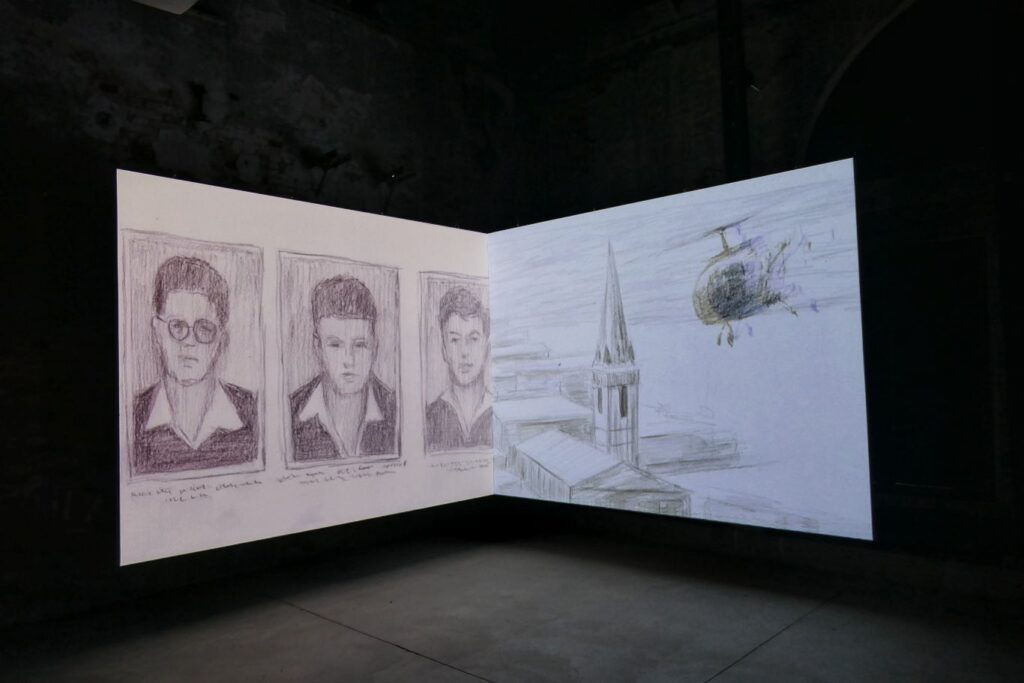
The starting point is the idea of critically examining certainties. In doing so, the artists respond to the simplistic messages of political debates and the increasing polarization of society. Doubt is not understood as an excuse for inaction, but rather as a prerequisite for independent thought and action.
Together with curator Margerita Pulè, the artists explore the present, the past, and possible futures. They draw on diverse sources, including archival material, films, popular culture, and historical and religious texts. The pavilion’s title, No Need to Sparkle, references Virginia Woolf’s 1929 essay A Room of One’s Own.
The works address themes such as mythology, identity, political and spiritual resistance, and the impact of images and narratives. Historical materials are placed in new contexts, and existing ideas are questioned. The pavilion invites visitors to challenge simplistic truths and to deal productively with uncertainty.
Venue: Maltese Pavilion at the Arsenale
Mongolia
Various Artists: Entanglements – Connectivities Across Borders
The Mongolia Pavilion presents works by four important contemporary artists who explore the historical and cultural connections between Europe and Asia in which the Mongols have played a part for centuries.
Based on recent research in global art history, the pavilion presents Mongolia not only as a geographical location but also as part of a far-reaching network of exchanges and encounters.
Venice is a particularly fitting venue for this exhibition: In the 13th century, close ties existed between the city and the Mongol Empire, facilitated by figures such as Marco Polo. The pavilion takes up these historical connections and relates them to current political and social tensions.
The four artists address themes such as life and death, myths from Eurasia, religious tolerance, nomadic worldviews, and the relationship between humanity, nature, and spiritual concepts. Many of these themes have a long tradition in Mongolian culture.
With these works, the Mongolia Pavilion brings a perspective to the Biennale that emphasizes historical interconnections and cultural exchange as an important basis for understanding the present.
Venue: Squero Castello, Salizada Streta 368
North Macedonia
Velimir Zernovski: Pietà in the Emergency Blankets
The installation revisits Michelangelo’s Pietà by covering it with gold emergency blankets. This simple intervention changes how the sculpture is seen and connects it to contemporary experiences of crisis, displacement and loss.
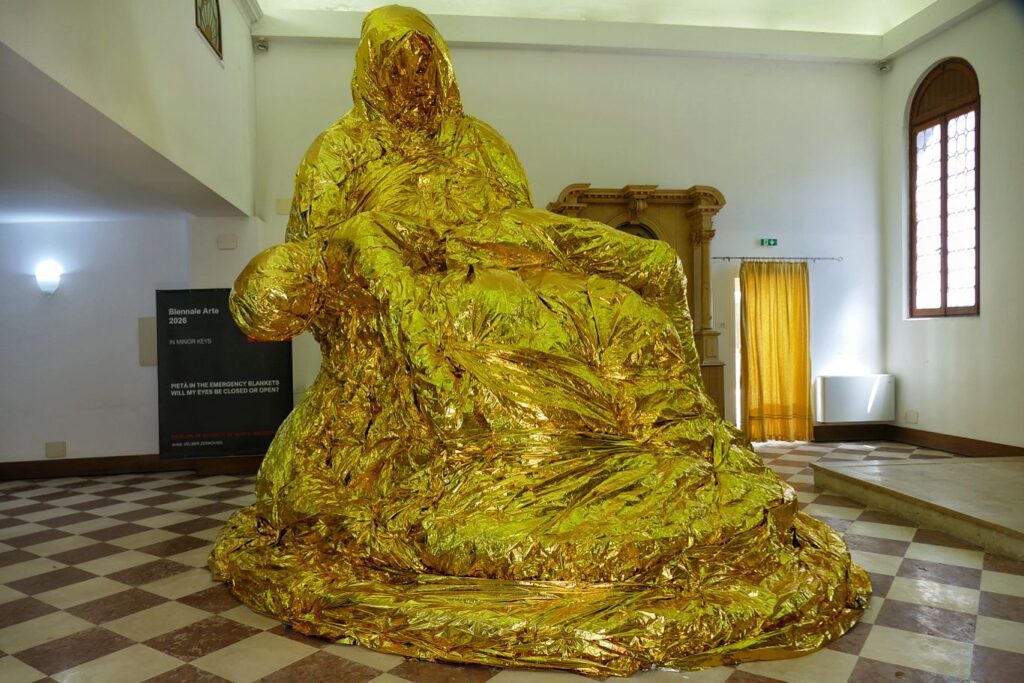
Originally developed for space missions, emergency blankets have become familiar images in the context of war, migration and humanitarian emergencies. Wrapped in their reflective folds, the figures of the Pietà are partly hidden and partly revealed, creating a sense of uncertainty and change.
The work invites viewers to think about the people behind these crises: those who have lost homes, loved ones or a sense of security. Rather than presenting grief as a final state, the sculpture suggests that experiences of loss can also lead to empathy, solidarity and new forms of connection.
The gold blankets bring a historical icon into the present. The monumentality of the original gives way to something more temporary and fragile, reflecting a world in which stability and belonging can no longer be taken for granted.
Venue: Ex Cappella Buon Pastore, Castello 77
Nordic Countries
Benjamin Orlow, Klara Kristalova, Tori Wrånes: How Many Angels Can Dance on the Head of a Pin?
With How Many Angels Can Dance on the Head of a Pin?, Klara Kristalova, Benjamin Orlow, and Tori Wrånes transform the Nordic Pavilion into an immersive world of sculpture, sound, and narrative. Inspired by Nordic myths, fairy tales, and the Kalevala, the three artists explore how humans, animals, and landscapes change and are interconnected.
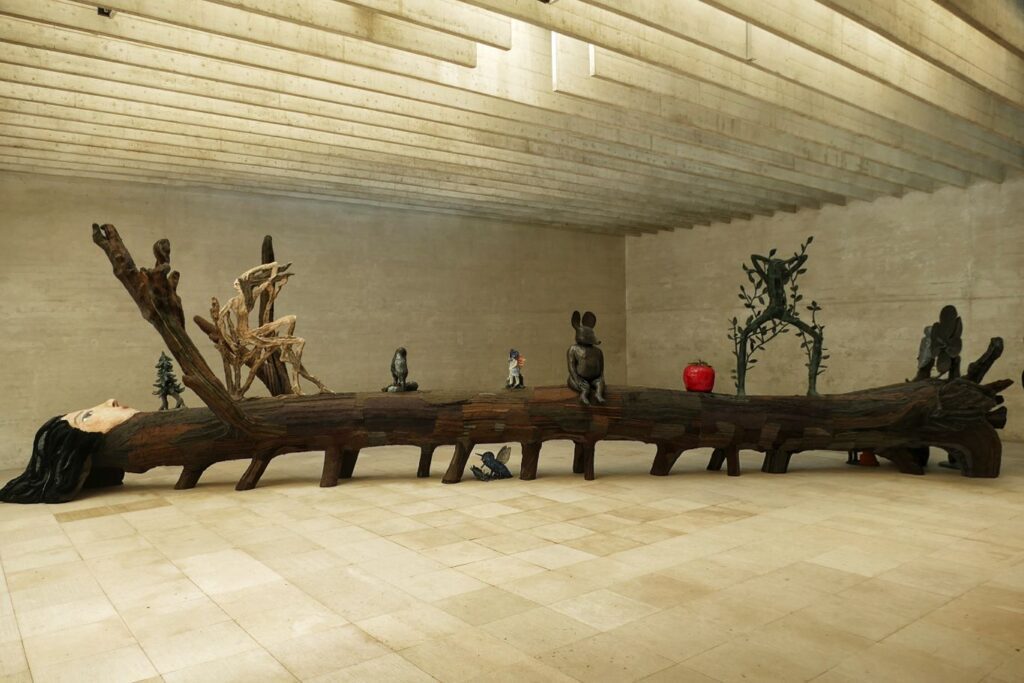
At the center of the installation is a monumental tree-like form by Klara Kristalova, reminiscent of a human body. Around it appear hybrid beings made of ceramic, bronze, and wood, existing somewhere between human, animal, and plant. Her works speak of vulnerability, transformation, and the close relationship between humanity and nature.
Benjamin Orlow presents a large-scale sculpture made of unfired clay, which visibly ages during the Biennale. The material dries out, cracks, and changes shape. The work makes the processes of creation, decay, and renewal directly tangible.
Tori Wrånes complements the exhibition with sound, sculpture, and performance. Their works permeate the pavilion, activating the architecture itself as part of the performance. Recurring sounds and performative elements create an atmosphere where reality, myth, and fantasy intertwine.
Together, the three artists create a poetic vision of a world in flux. Instead of fixed identities and clear boundaries, transitions, connections, and cycles take center stage. The pavilion thus becomes a place where questions of nature, community, and change are explored in a compelling yet accessible way.
Venue: Pavilion of the Nordic Countries (Finland, Norway, Sweden) at the Giardini
Serbia
Predrag Djaković: Through Golgotha to Resurrection
Dejan Vasić presents a large-scale installation composed of more than forty archival panels, over 17,000 objects, photographs, newspaper clippings, and documents from over forty countries.
Together, these materials form a dense visual archive that brings together personal and collective traces of the 20th century—marked by wars, revolutions, migration, displacement, and ideological conflict. Rather than following a linear narrative, the installation assembles fragments that overlap and intersect across different histories.
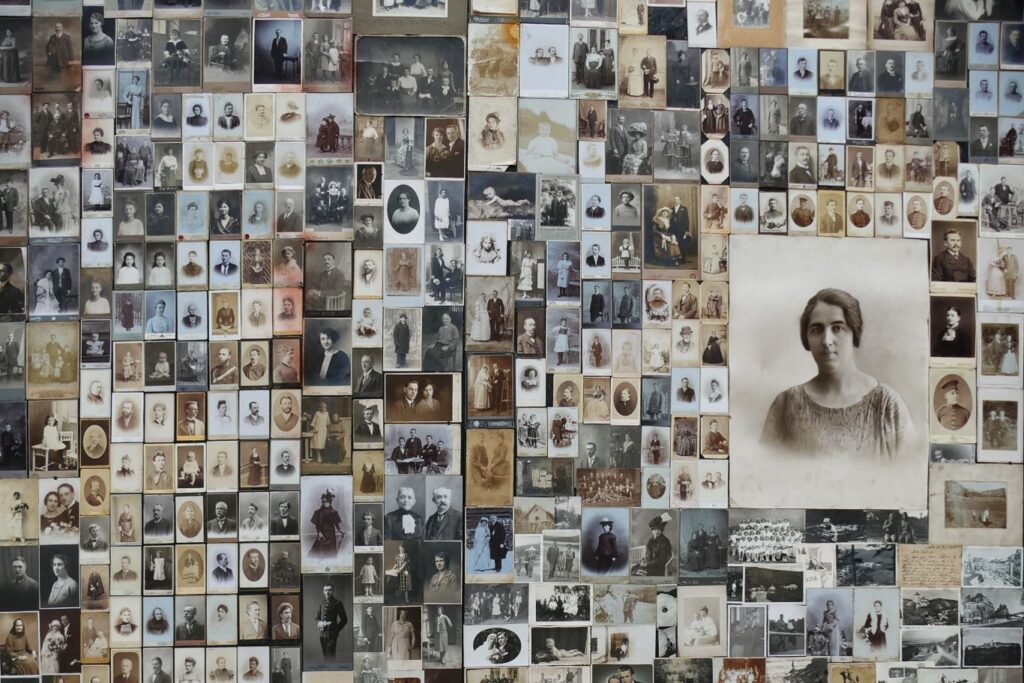
A central wall, 25 meters long, functions as a continuous field of memory. Images and documents are placed side by side without hierarchy, allowing individual and collective experiences of loss, movement, and survival to coexist within the same space.
A recurring motif is the suitcase, used as a symbol of departure and forced migration—objects reduced to what can be carried when leaving home.
Sound is present through an original jazz composition by Predrag Đaković, which adds an emotional layer to the installation. The music connects themes of memory and loss with the idea of continuation and resilience.
Rather than offering a fixed historical reading, the work opens a space for reflection on how memory is formed, transmitted, and reshaped after periods of rupture and violence.
Venue: Serbian Pavilion at the Giardini (Pavilion of Former Yugoslavia)
Spain
Oriol Vilanova: Los Restos
Vilanova transforms the interior of the pavilion into a kind of imaginary museum, grounded in collecting and memory. The starting point is a long-standing practice: the collecting of postcards from flea markets and second-hand shops.
These fragments from the world of tourism are displayed in a dense wall installation, devoid of hierarchy or linear narrative. Rather than monumentalism, the focus lies on the repetitive act of collecting and preserving, as well as on the fragility of the materials and the shifting nature of communication forms.
The project extends beyond the pavilion through two additional elements:
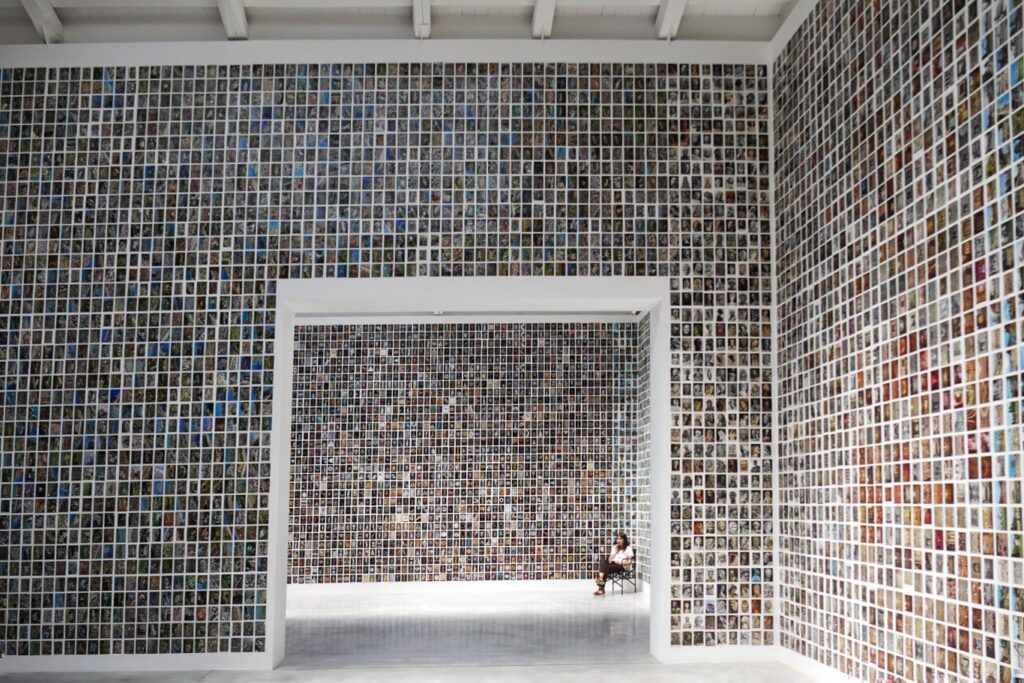
A publication gathers supplementary material and contributions from various authors, thereby expanding the context of the work.
A performative intervention takes place—without prior announcement—within the grounds of the Giardini della Biennale and the Arsenale di Venezia. This gives rise to chance encounters in which the body itself becomes part of the exhibition.
Taken together, the result is an expanded system of collection, text, and action that engages with themes of memory, order, and chance.
Venue: Spanish Pavilion at the Giardini
Switzerland
Various Artists: The Unfinished Business of Living Together
Switzerland’s exhibition focuses on the idea of coexistence as something unresolved and continually negotiated.
The exhibition revisits historical Swiss television debates from the late 1970s and 1980s, in which questions of social belonging and visibility were publicly discussed for the first time on mainstream media. These broadcasts are used as a starting point to reflect on how public speech is shaped, who is heard, and who is excluded.
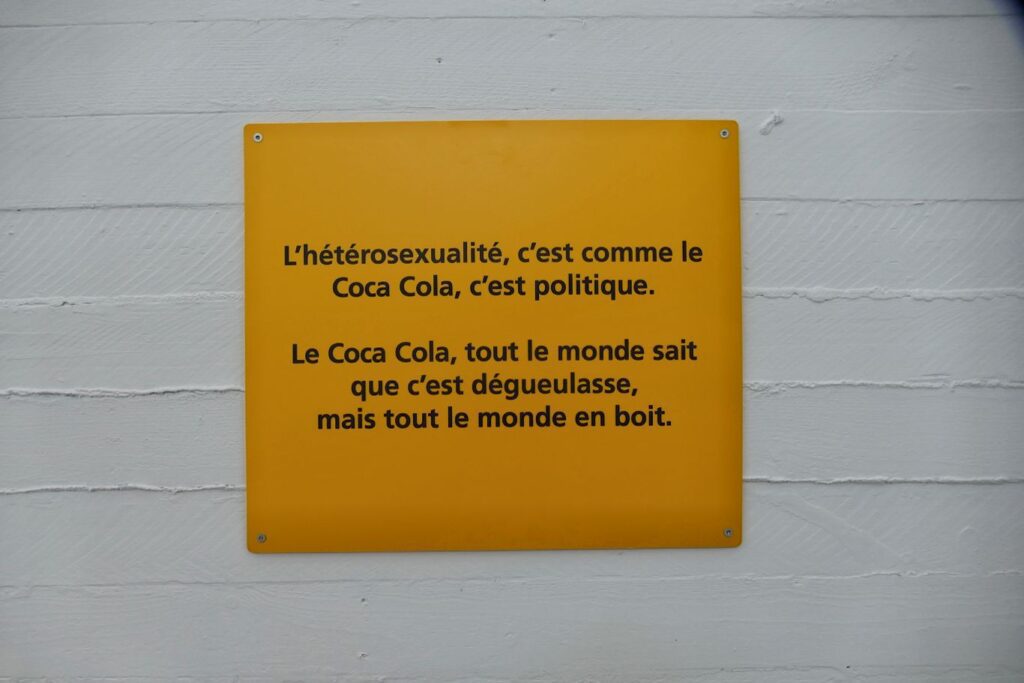
Rather than presenting a linear narrative, the project works with archival material, new audiovisual production, and spatial installation. It reactivates historical media formats to explore how social norms are formed and challenged over time.
The pavilion also extends into the surrounding space, linking questions of intimacy, public presence, and memory. It treats the archive not as fixed history, but as material that can be re-edited and reinterpreted in the present.
Overall, the exhibition is built as a collaborative project that brings together different perspectives and practices, asking how shared spaces and shared narratives are constantly produced and renegotiated.
Venue: Swiss Pavilion at the Giardini
Venice
Ilya and Emilia Kabakov: Diario Veneziano
Among the many contributions to the Biennale, Diario Veneziano by Ilya and Emilia Kabakov is one of the quietest and most impressive works. It is a piece that doesn’t attempt to explain Venice, but rather to listen to it.
For the project, hundreds of Venetians were invited to contribute a personal object and a handwritten page about their relationship to the city. From these memories, stories, and found objects emerges a multifaceted portrait of Venice. The city appears here neither as a tourist icon nor as a symbol of its own vulnerability, but as a living space shaped by the experiences of its inhabitants.
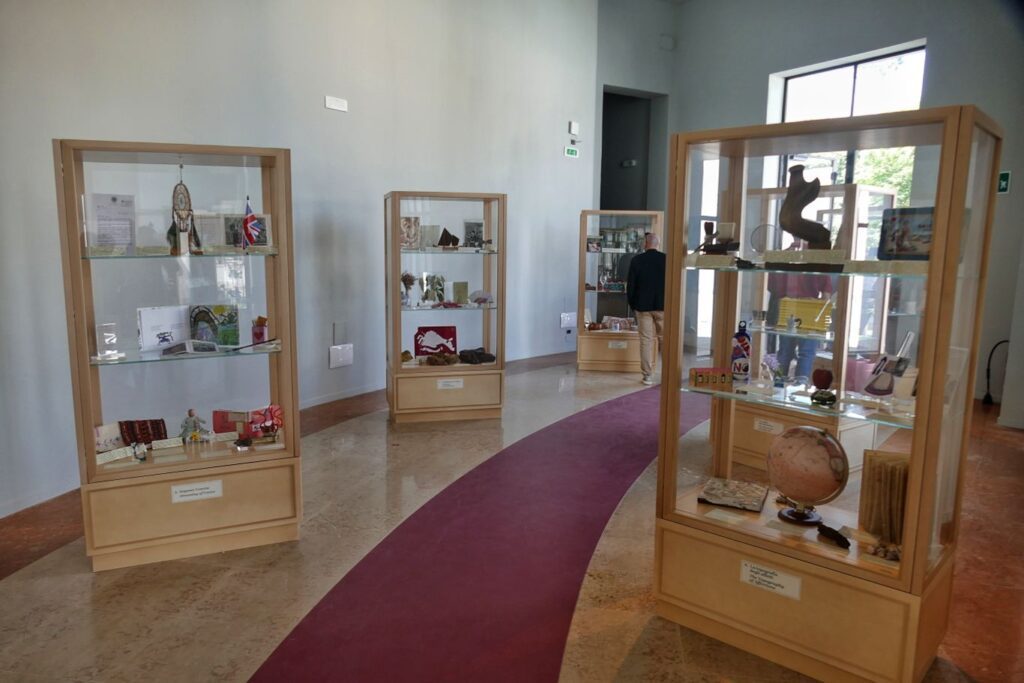
Those familiar with the Kabakovs’ work will immediately recognize the central idea behind their art. For decades, they have explored the hopes, memories, and dreams of ordinary people. Their installations focus attention on the personal and the inconspicuous, making visible what is often lost in grand historical narratives. Diario Veneziano follows this approach as well. The focus is not on artists or institutions, but on the people of the city themselves.
Moving Legacy
What is particularly moving is that the project is based on a shared idea by Ilya and Emilia Kabakov and was continued by Emilia Kabakov after Ilya’s death. This makes the work itself a form of remembrance. While the inhabitants of Venice preserve their stories, the work simultaneously preserves the artistic vision of an extraordinary artistic couple.
In a Biennale full of grand themes and spectacular installations, Diario Veneziano almost seems like a counterpoint. The work reminds us that a city is not solely defined by its architecture or its history, but above all by the people who live in it. Their memories, objects, and narratives become the true bearers of collective memory.
This is precisely where the work’s particular strength lies. It connects to the humanistic core that has characterized the Kabakovs’ work for decades. Their installations speak of utopias, the passage of time, and the traces that people leave behind. Diario Veneziano takes this idea to an impressive conclusion – with an entire city as the main character.
I’d like to point out that the Kabakovs are some of my very favorite artists ever. I introduced another one of their ingenious art projects in my post Weekend in ESSEN: From Coal Mine to Treasure Box. If you haven’t done so already, you should definitely check it out!
Venue: Venetian Pavilion at the Giardini
Zimbabwe
Various Artists: Second Nature | Manyonga
The exhibition presents works that engage with the consequences of technology and rapid societal change.
The starting point is the concept of neuroplasticity: the brain constantly adapts to new experiences—much in the same way that societies and identities are transformed by digital technologies and crises.
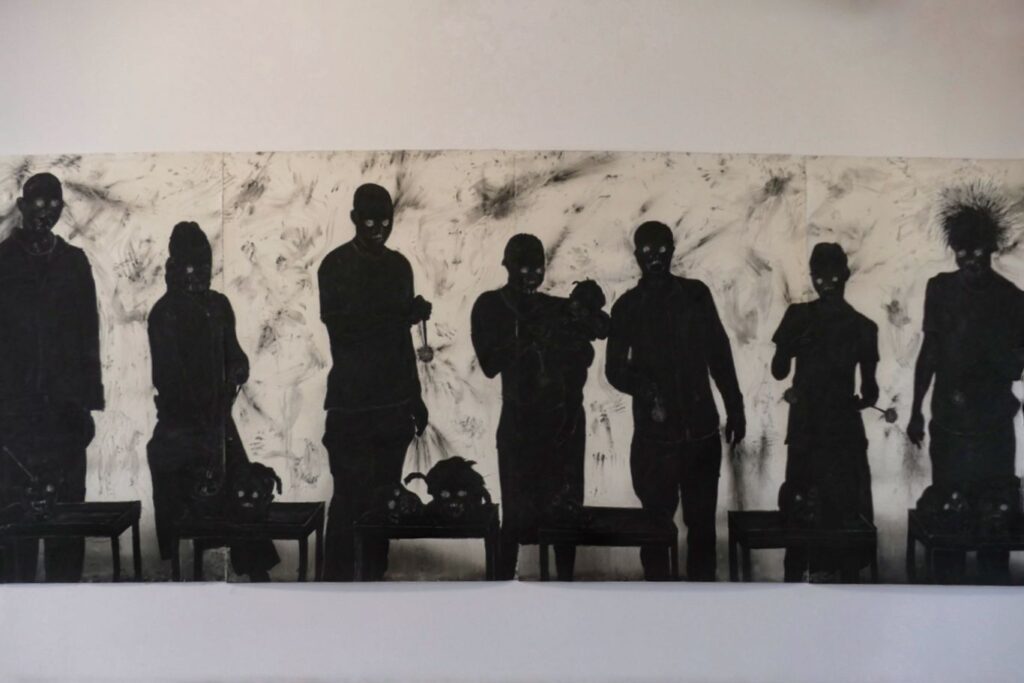
The artists respond to these upheavals using a wide variety of approaches, all of which revolve around themes of adaptation, transformation, and new beginnings. Their works emerge within the dynamic interplay between humanity, technology, and the environment.
The exhibition presents these artistic positions as a cohesive space exploring the nature of perception under contemporary conditions—conditions shaped by digitalization, global crises, and shifting realities of life.
Venue: Santa Maria della Pietà, Castello 3701
Berengo Studio Glasstress
Venice is world-famous for Murano glass. However, for some years now, someone else has been overtaking the tradition. Adriano Berengo was born in Venice in 1947. He studied in his hometown at the Ca’ Foscari University in Venice as well as at the State University of New York, where he obtained his Ph.D. After a short career as a teacher of English Literature and Language, he started working as the artistic director at the glassworks Vetreria Salviato & C. in 1982. In 1989, Berengo founded the Berengo Studio to promote glass as an artistic medium.
In 2009, the project Glasstress was introduced. It shows the most interesting glassworks as a collateral during the Biennale di Arte. At that time, the venue of choice was the historical Palazzo Franchetti across from the Accademia, right in the heart of the Centro Storico.
In 2014, Fondazione Berengo was founded. It focuses on Adriano Berengo’s thirty-year project, namely to unite and present the traditional glass art of Murano together with contemporary art projects in a fresh, innovative way.
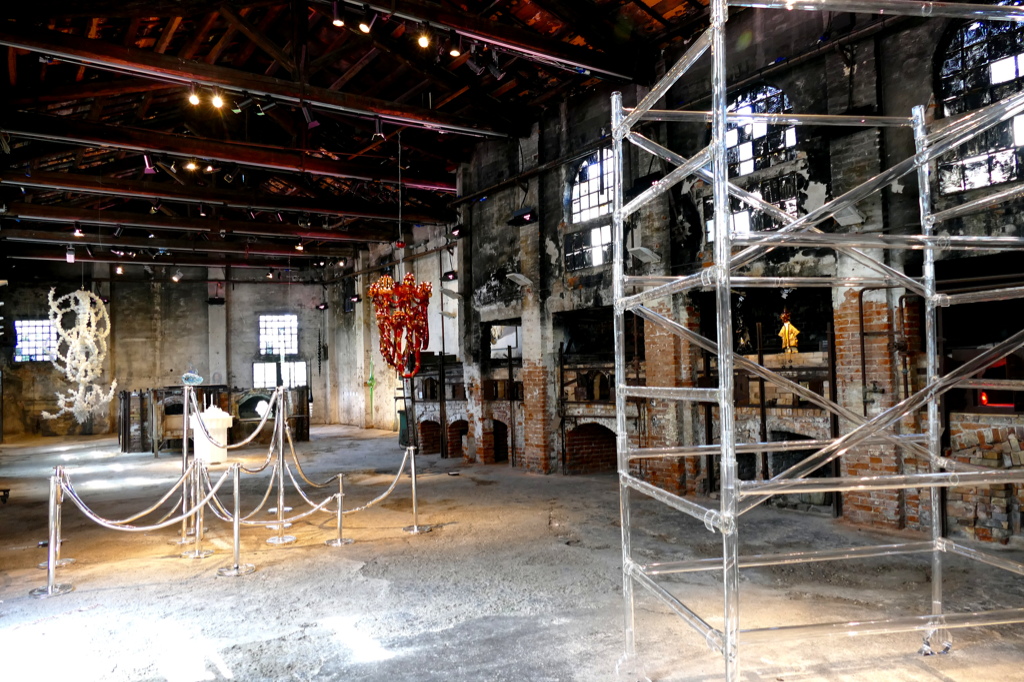
When I visited Glasstress in 2013 for the first time, the exhibition just blew me away and left me speechless.
To me, glass, whether used in handicrafts or art, had always been not only a fragile and tender material. I expected the products to be lovely and sweet, pleasant and pleasing.
But what I saw there was totally different from what you’d expect from glass. The works were raw and rough, political, critical, and daring.
It was possible to create this from glass?! Wow!
Moving On
In 2019, to celebrate Glasstress’ 10th anniversary as well as 30 years of Berengo Studio, the exhibition moved from the Palazzo Franchetti to the island of Murano.
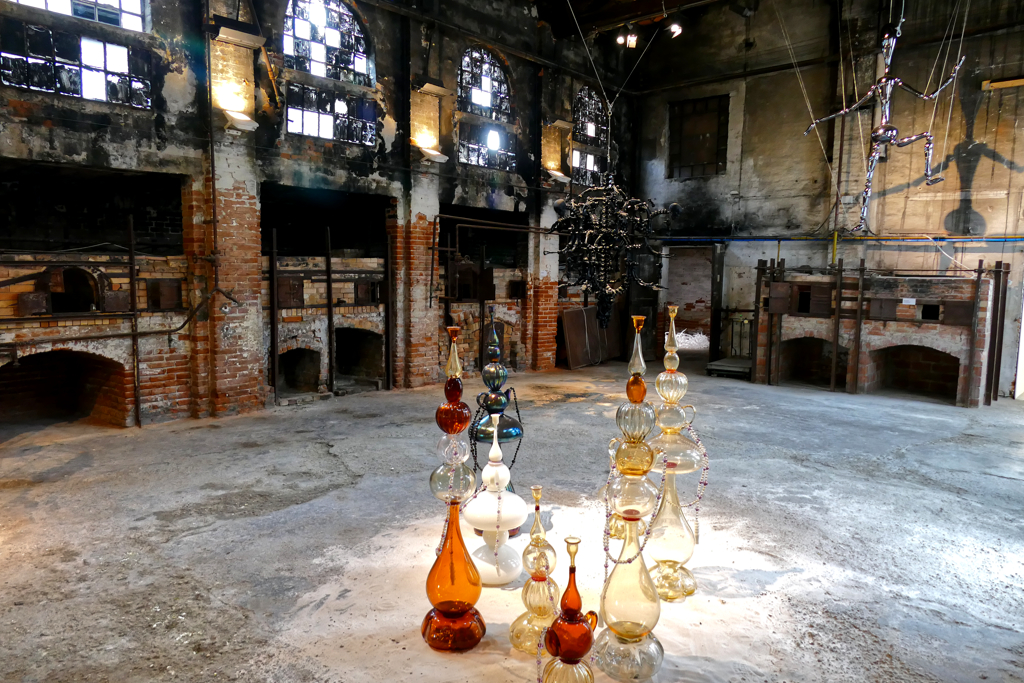
It was simply a masterstroke to choose an abandoned glass furnace for presenting this kind of outstanding work and installation. You truly have the impression to witness how these incredible pieces are emerging before your eyes.
Glasstress became one of my very favorite shows at the biennials and since then, I haven’t missed a single one. But unfortunately, Glasstress 2026 will be introduced only in June when I’m long gone – at least from Venice. However, there have been some smaller shows taking place since May.
This year, Glasstress opens its doors only on July 12, hence, long after my visit. The fact that Berengo Studio is already cooperating with other exhibitions was a small consolation to me.
The Only True Protest is Beauty
In a biennale marked by crises, conflicts, and political tensions in many places, The Only True Protest Is Beauty deliberately sets a different tone. Curated by Dries Van Noten and Geert Bruloot, the exhibition brings together more than two hundred works of art, design, fashion, jewelry, ceramics, and glass at the Palazzo Pisani Moretta. Its starting point is the idea that beauty need not be an escape from reality, but can be a form of resistance.
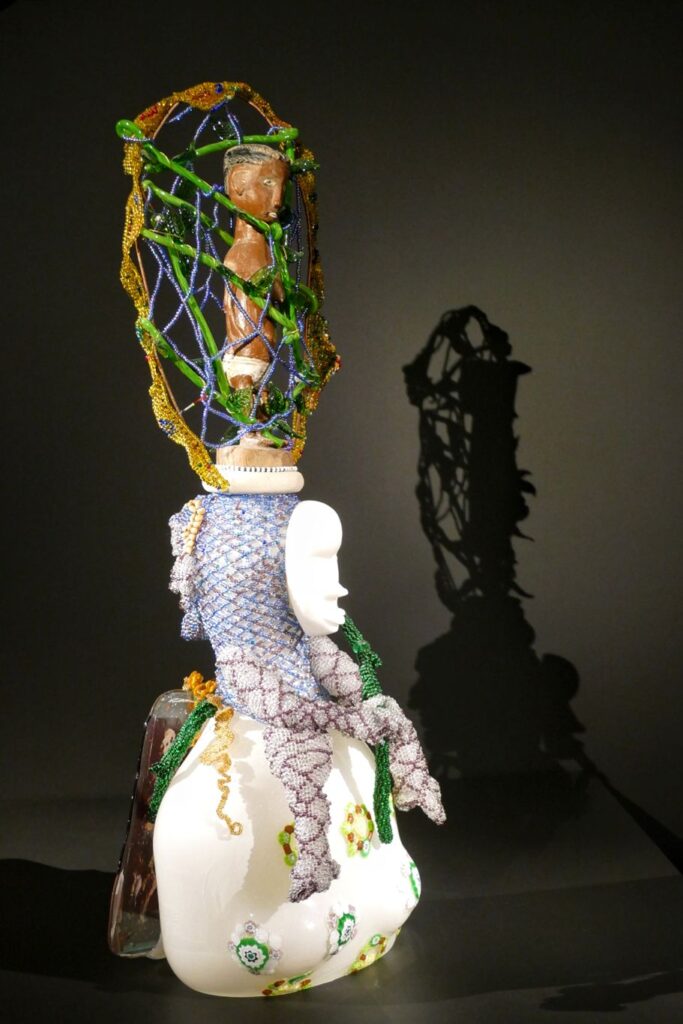
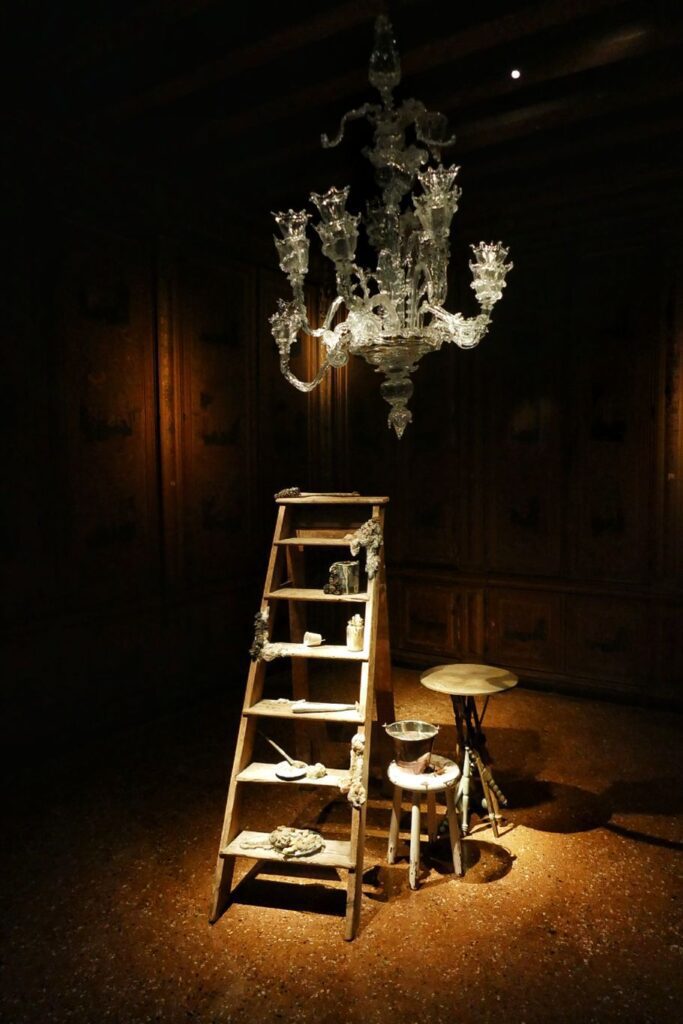
The exhibition does not follow an art historical chronology or a theoretical program. Instead, it creates surprising encounters between established positions and emerging voices, between masterful craftsmanship and experimental approaches. Beauty is understood here not as a decorative quality, but as an experience that captures attention and alters familiar perceptions.
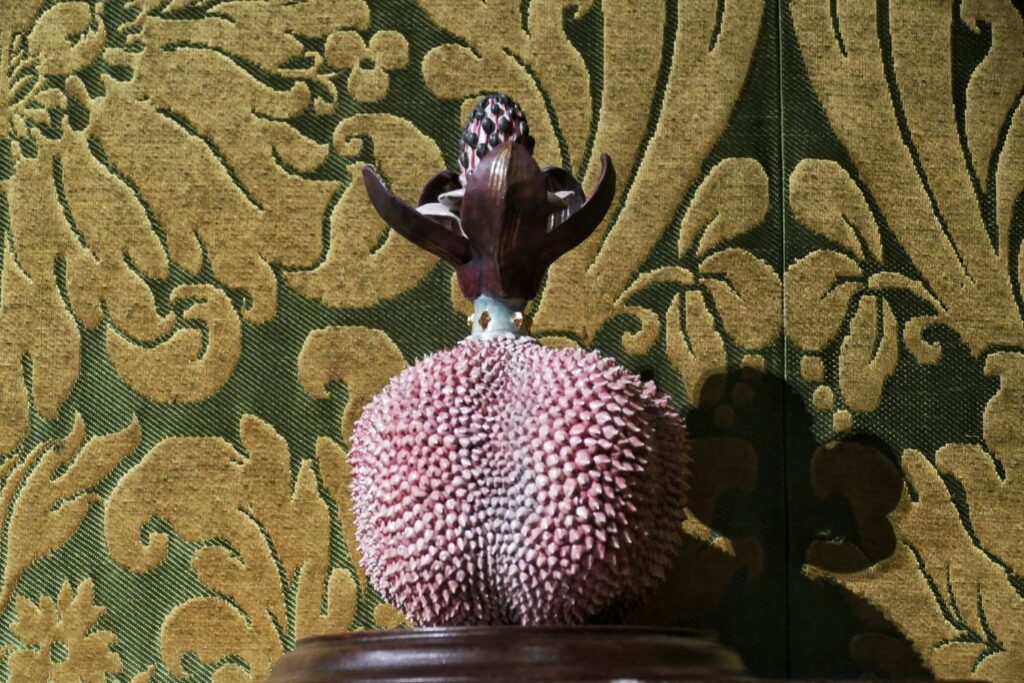
In this context, Berengo plays a crucial role. For decades, Adriano Berengo has been working to liberate glass from the niche of craftsmanship and establish it as a fully-fledged medium of contemporary art. Numerous artists were only able to realize their ideas through collaboration with the glass masters of Murano. The presence of glass within the exhibition therefore not only references Venetian traditions but also Berengo’s long-standing commitment to exploring new artistic possibilities for this material.
Thus, The Only True Protest Is Beauty becomes a celebration of imagination and craftsmanship. Especially in a time of constant crisis diagnoses, the exhibition reminds us that beauty need not be superficial. It can capture attention, foster empathy, and open up new perspectives.
Venue: Palazzo Pisani Moretta, San Polo 2766
Ocean of Drops
With Ocean of Drops, the Fondazione Berengo presents a solo exhibition by Tony Cragg, one of the most important sculptors of our time. The starting point is a new glass sculpture created in Murano, which gives the exhibition its title. Around it, Cragg has assembled other recent works that continue his long-standing exploration of form, material, and perception.
Anyone familiar with Cragg’s work knows that his sculptures never simply depict objects. Rather, they seem to constantly transform before the viewer’s eyes. Organic and technical forms merge, and solid matter appears surprisingly alive. The central glass sculpture of Ocean of Drops also unfolds this particular tension. It evokes natural growth processes, currents, condensations, and movements that defy any definitive description.
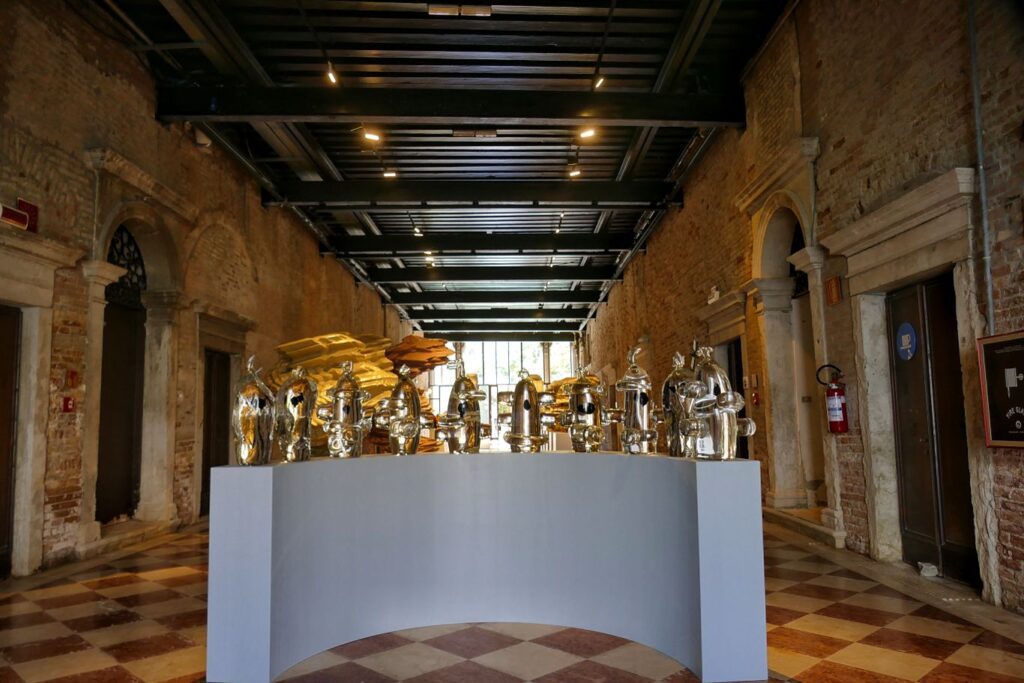
Berengo’s involvement is far more than mere organizational support. The collaboration with the glass masters of Murano allows Cragg to extend his exploration of material and form to a medium that uniquely combines transparency, light, and movement. Here, glass is not merely a decorative effect, but the very vehicle for the idea.
The exhibition impressively demonstrates why Berengo has been one of the most important promoters of contemporary glass art for years. Artists like Tony Cragg don’t use the material to create traditional glass objects, but rather to explore new boundaries of sculpture. Ocean of Drops is a particularly compelling example of this.
Venue: Ca’ Tron, Santa Croce 1957
Dreamers
Among the most delightful discoveries at Palazzo Franchetti is the exhibition “Dreamers” by Czech glass artist Martin Janecký. Born in Liberec in 1980, Janecký is now considered one of the leading figures in contemporary glass art. His sculptures are created using an exceptionally technical method: Janecký shapes them from within, working directly into the still-hot glass bubble and giving it form.
The works often appear as apparitions between dream and memory. People emerge from the glass as if they were just materializing. Their bodies are present yet fleeting, imbued with melancholy and quiet poetry. It is precisely this balance between technical virtuosity and emotional restraint that gives his work its unique appeal.
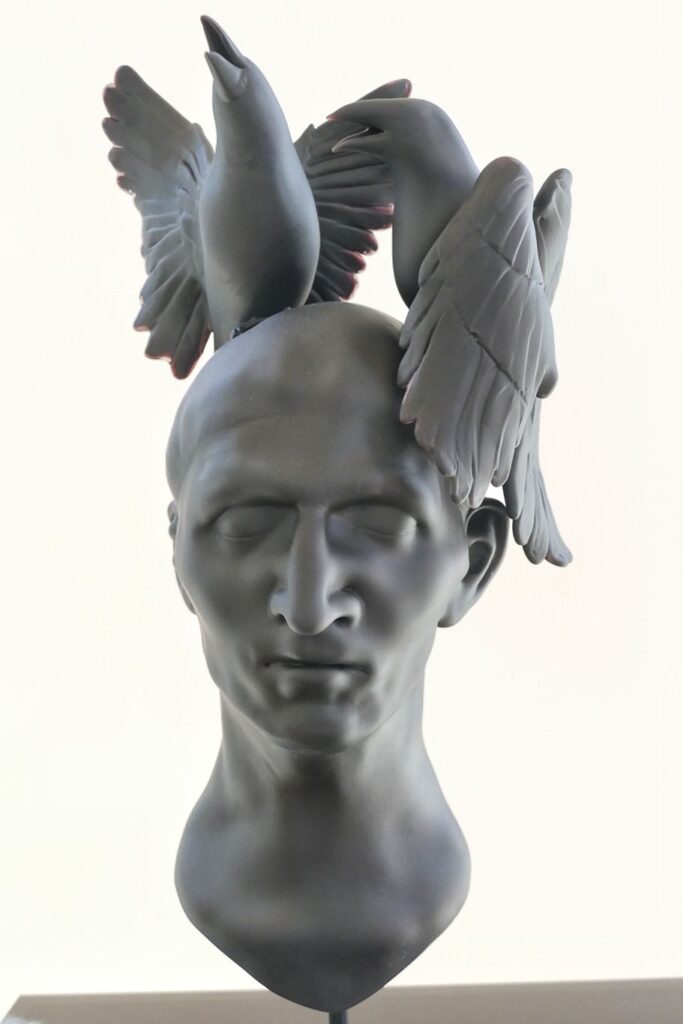
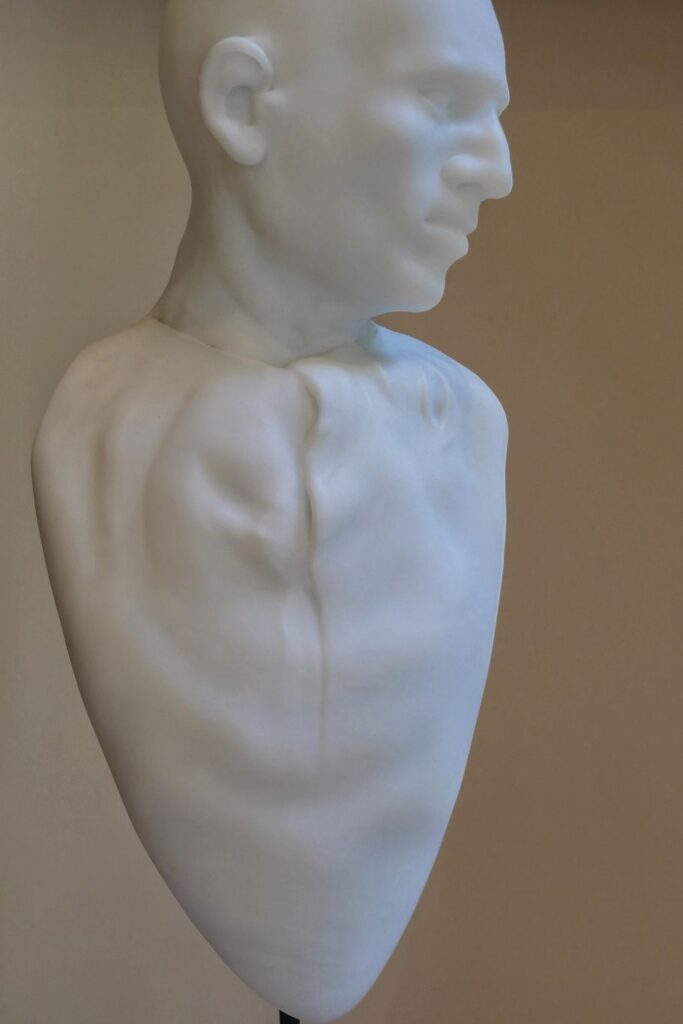
The exhibition is presented by the Fondazione Berengo and exemplifies its commitment to making glass visible as a contemporary artistic medium. Berengo not only provides artists with Murano’s technical infrastructure but also offers them the opportunity to explore the material beyond traditional conventions.
In Dreamers, this idea is revealed in its most beautiful form. The glass is not used to demonstrate artisanal perfection, but becomes a vehicle for memory, vulnerability, and humanity. The figures seem to be made of light and air, reminding us that despite its hardness, glass always retains something fragile. Therein lies the quiet beauty of this exhibition.
Venue: Palazzo Cavalli-Franchetti, Fondamenta Nani 2847
Luna
With Luna, Filipino artist Ronald Ventura presents one of the most impressive collateral events of the 2026 Venice Biennale. In the former Cantieri Cucchini docks, a multifaceted installation unfolds, encompassing painting, sculpture, drawing, video, and Murano glass, connecting two worlds shaped by water: the Venetian Lagoon and the Philippine city of Malabon. Both places owe their existence to water and are simultaneously marked by its threats.
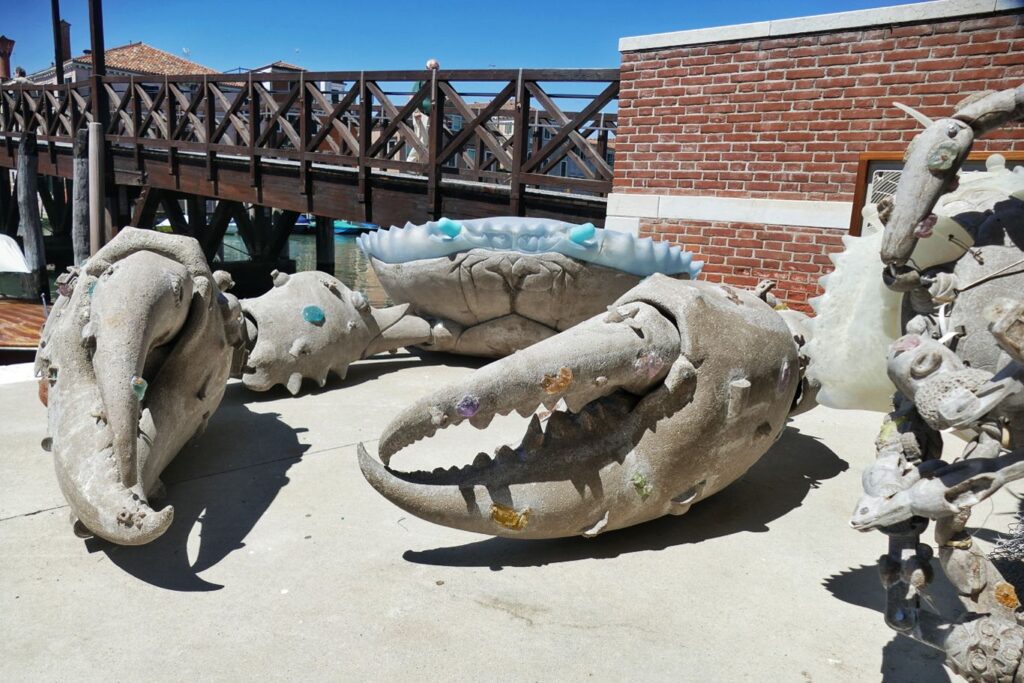
At the heart of the exhibition is the moon. As the origin of the tides, it connects these two geographically distant locations and becomes a symbol of the forces that unite people across borders. Ventura does not approach this motif in a documentary manner, however. His visual world is characterized by surprising juxtapositions: Renaissance figures encounter comic book elements, photorealistic depictions meet dreamlike scenes, mythology meets the present. From these contrasts emerges a visual language that is both familiar and enigmatic.
Particularly fascinating are the sculptures in which human figures and boats merge. They seem to hover between departure and shipwreck, hope and uncertainty. In this way, they become symbols of a world where water is both life-sustaining and a danger.
Here, the significance of the collaboration with the Murano glassworks and the Fondazione Berengo becomes apparent. The glass pieces are not merely additions to the exhibition, but central components of its poetic visual language. Transparency, light, and reflections lend the works a special lightness, making them appear as apparitions between dream and reality.
Venue: Docks Cantieri Cucchini, Castello 1/A
Chihuly in Venice in 2026
Come to think of it, it wasn’t Adriano Berengo who really got me hooked on glass art. It was non other than Dale Chihuly.
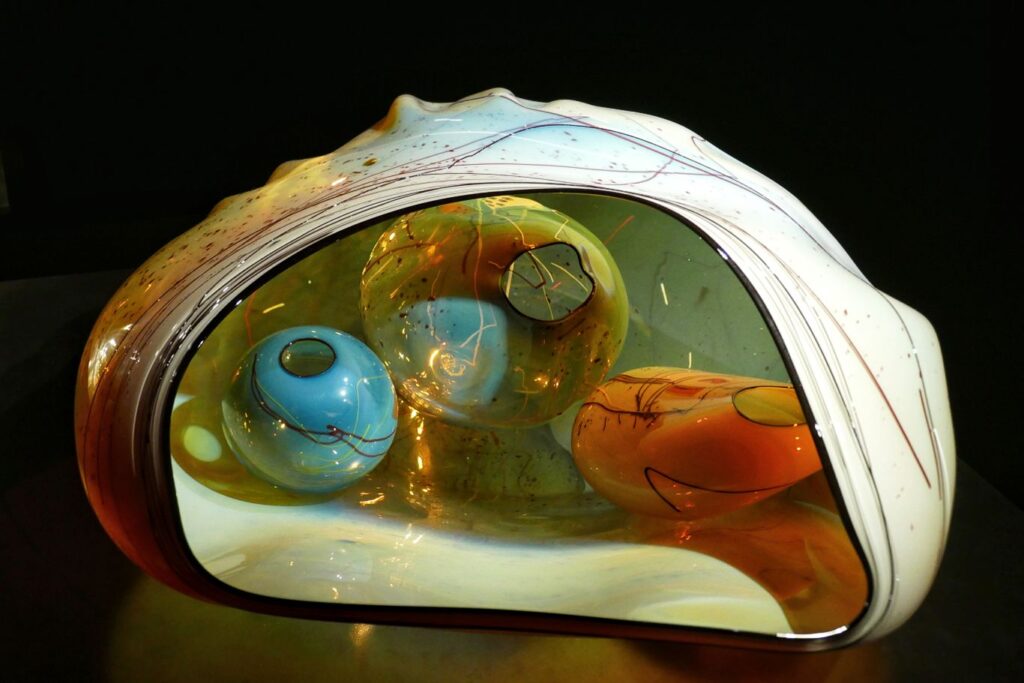
A few years ago, on a trip to Florida, I made a special detour to Saint Petersburg to visit the Dalí Museum. However, I returned with an equally impressive discovery: a visit to the Chihuly Gallery.
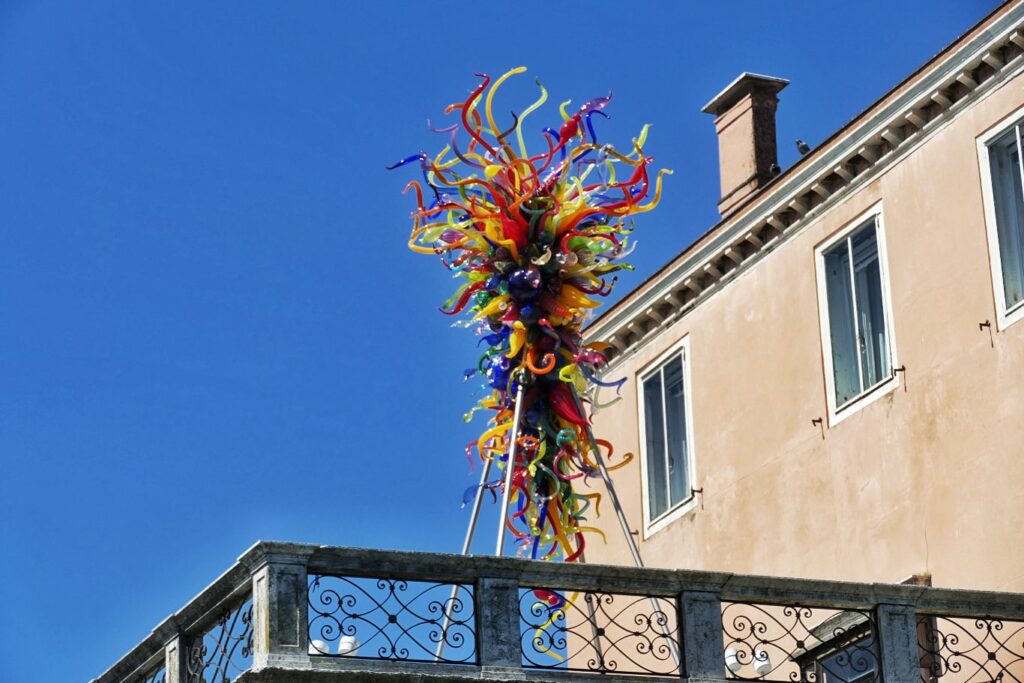
Since then, I’ve been a huge fan. Therefore, I was thrilled to learn that this year the grand master is presenting his larger-than-life glass art at several prominent locations in Venice, not in Murano, as one might expect, but in the Centro Storico. I’ve marked the locations on the map at the end of this post.
Plan Your Visit
This year’s 61st biennial has begun at the beginning of May. It will then last until the end of November.
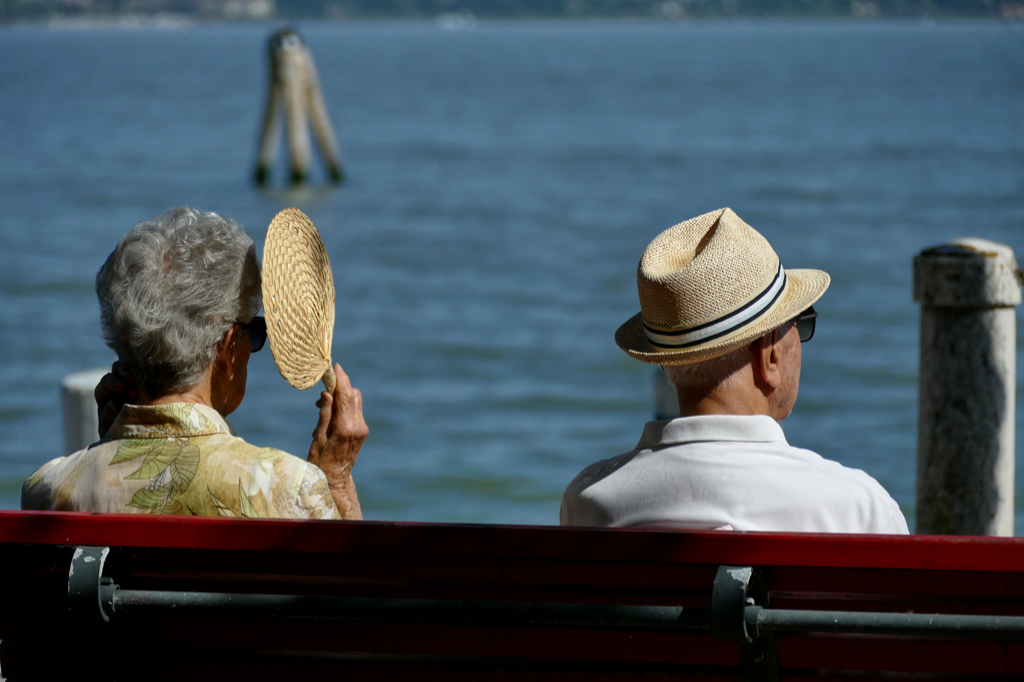
I recommend to visit during the shoulder season. Then, prices for accommodation and many services are still lower than during the high season in summer. Also, during the summer months, it gets really hot, and walking around is more of a drag than fun.
Either way, make sure to check out my post on how to visit Venice on a budget. There, I supply you with tons of tips on how to visit Venice smoothly and without burning a hole in your wallet.
Tickets
As I wrote above, the Biennale is basically divided into three parts. Firstly, there are the two official venues Arsenale and Giardini. Then, there are the country pavilions scattered all over the city. Finally, you have the so-called Collaterali, major art exhibitions taking place at exclusive venues.
To visit the Arsenale and the Giardini, you need to buy a ticket, obviously. However, there are different kinds of tickets – with or without guided tours and other extras.
This year, a general ticket costs 30 €uros and grants one-time access to both main venues on the same day or on different days that don’t even have to be consecutive. Visitors over 65 pay 20 €uros and students and visitors under the age of 26 pay only 16 €uros.
Then, some passes grant multiple visit.: A three-day ticket sets you back 40 €uros and grants access on three consecutive days. You can also obtain a ticket for 7 consecutive days for 50 €uros. For unlimited visits, the full price is 75 €uros. Students and visitors under the age of 26 pay only 45 €uros. However, the last two options are really only for you hardcore culture vultures. Let me tell you, there is a lot going on you want to see also outside the Giardini and the Arsenale. According to my experience, it’s enough for your eyes and your brain to visit each venue only once.
I absolutely recommend buying tickets online to avoid standing in line.
Opening Hours
The Giardini and the Arsenale are open from 11 a.m. to 7 p.m. until September. During this period, the Arsenale will be open until 8 p.m. on Fridays and Saturdays. From October, they will be open from 10 a.m. to 6 p.m.
While the two main venues remain closed on Mondays, many of the country pavilions in the center close on Tuesdays.
Theoretically.
In practice, it happens that you find a note on the door of a pavilion saying it will remain closed for whatever reason. Or you are asked to come back later since there is a problem with the electricity. Or for no apparent reason, a pavilion doesn’t open.
Ever, no matter how often you pass by.
This can be very frustrating, especially if you’ve searched for that address for hours or even had to take a Vaporetto to another islet.
Yet, somehow, it’s part of the charm of the whole thing, so don’t get upset and just pick another venue. There is enough other stuff to see, believe me.
Entrance Fees Outside the Main Venues
In general, there is no entrance fee to the country pavilions. Since they are spread across the entire city and beyond, the challenge is rather to find them in the narrow, hidden alleys of Venice.
However, the city pavilions are a very charming part of the Biennale since you have access to buildings that normally are not open to the public. Also, the combination of the old, deteriorating walls and ceilings, and the sometimes hyper-modern art is very alluring.
Simultaneously with the main event, Biennale di Arte, major art exhibitions are taking place. They either focus on one famous, important artist or a group of artists in a themed exhibition.
Since these so-called Collaterali often take place at exclusive art venues such as the Fondazione Prada, the François Pinault Foundation, or the Ca’ Foscari, you need an extra ticket to visit them.
How to Get Around
As you might know, the Centro Storico and most of the smaller islands in the Venetian lagoon are car-free. Therefore, you simply cannot avoid a lot of walking. As a matter of fact, neither can you avoid taking some kind of boat if you want to visit exhibitions on other islets such as the Giudecca or the Isola di San Giorgio Maggiore, to name just two. Also, depending on where you’re based, the walk to and from the main venues can be an exhausting hike, especially after a long day spent walking around galleries.
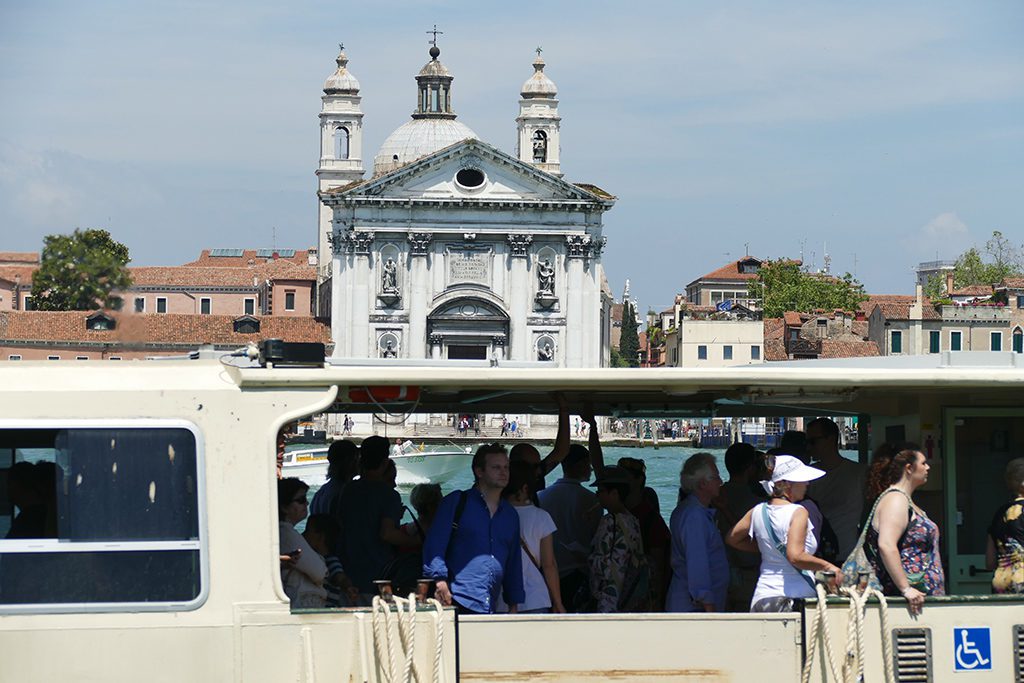
Venice has the tacky gondolas, and there are very expensive water taxis. However, there is also a very comprehensive network of Vaporetti, which are basically water buses.
Tickets and Passes
While at 9.50 €uros, individual tickets are ridiculously expensive, there are travel passes that are actually not that bad. The more days you buy, the cheaper your rides are. Here is a chart on how much you pay for a day pass in 2026:
| 24 hours | 48 hours | 72 hours | 168 hours (7 days) |
| 25 €uros | 35 €uros | 45 €uros | 65 €uros |
Note that a 24-hour ticket can actually be used on two days since the clock starts ticking the moment you validate your ticket and lasts actually 24 hours. With the other tickets, it’s the same, obviously.
The passes are also valid in other parts of the Venetian area, for instance on the buses on the Lido di Venezia and buses, trains, and the tram in Mestre. All in all, they are a really great deal.
Young people under 29 years of age get an even better deal with the Rolling Venice Card. This title costs 6 €uros and is valid for one whole year. Not only do you get great discounts at many museums and other places of interest. You also pay only 27 €uros for a 72-hour pass instead of the regular 45 €uros. Unfortunately, you can actually buy only 72-hour passes. But if you stay, for instance, for a week, you can get two so that you pay only 54 €uros in total.
My Tip:
Also, here’s a little technical tip: If you have a valid ticket and the turnstile still refuses to let you through when you tap, you’ve definitely tapped at the wrong entrance. At busy stations such as Piazzale Roma or Ferrovia, there are actually two entrances: One for tourists and one for residents. When the Vaporetto arrives, the passengers in the resident queue have priority boarding. I think this is a very practical and fair solution since the residents are already so disturbed by the masses of tourists that they should at least have priority when taking the Vaporetto.
So if your perfectly good ticket declines, try the other entrance.
Venice Entrance Fee
Yes, it is true: In its battle against relentless overtourism, Venice introduced an entry fee in 2024.
In 2026, Venice will continue to require day-trippers to pay an access fee of 5 €uro, provided they arrive on selected days with particularly high visitor numbers between April and July. The fee applies from 8:30 a.m. to 4 p.m. for visitors aged 14 and older. Bookings made less than four days in advance cost 10 €uro. Overnight guests, residents, and commuters are exempt from the fee, but they, too, must register online at cda.veneziaunica.it.
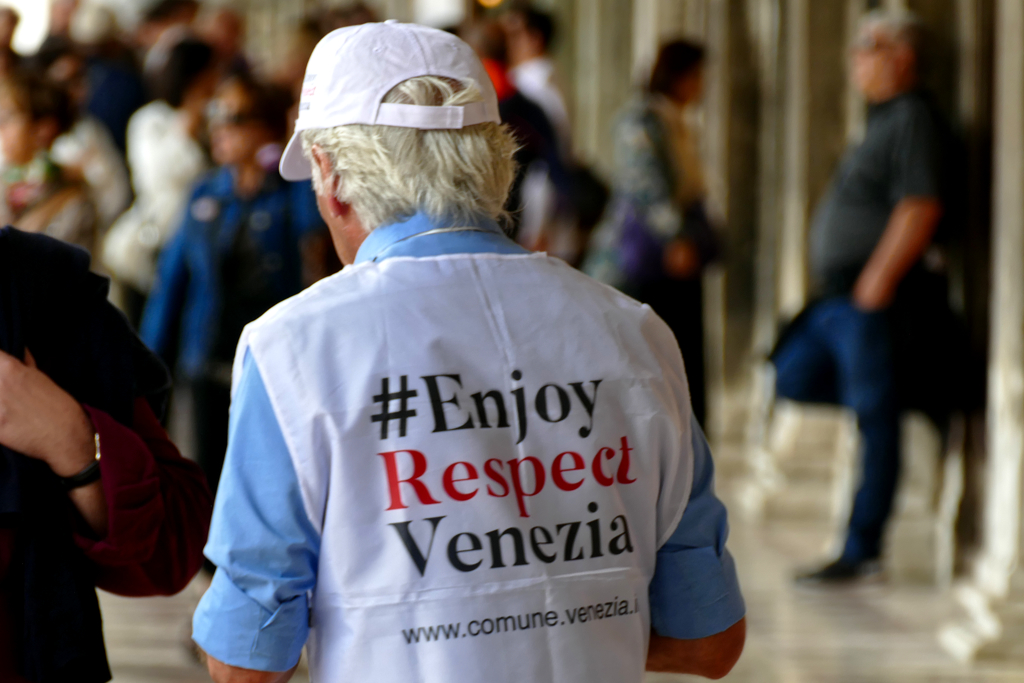
The fee applies to the historic center, but not to the surrounding islands, such as Murano or Burano.
Failure to pay or to produce proof of payment via a QR code will result in fines ranging from 25 €uro to 150 €uro.
Some Extra Tips
After having been to several biennials, I’m happy to share some tips that will make your visit less stressful:
- Walk as little as possible.
Don’t get me wrong, I’m an avid walker. On city breaks, I walk miles and miles. However, you’ll walk those miles even if you try to walk as little as possible. Because cannot expect the Vaporetto to stop right in front of your accommodation. You’ll probably have to cross a couple of bridges to get to your nearest stop.
To get from the end of the Arsenale back to the entrance, it’s about a mile. Will say, even if you go straight from the entrance to the final pavilion and back, you’ll walk two miles. This route does not include the meandering within the galleries nor detours to bathrooms.
You won’t be exactly lazy even if you avoid walking wherever you can. - Wear comfortable, sturdy shoes
After having explained above how much you’ll automatically have to walk, it should go without further explanation why you have to wear comfortable shoes. It won’t hurt – literally – if you even opt for hiking boots.
Visiting Venice is an exercise. Visiting the Biennale is boot camp. - Bring some picnic and water
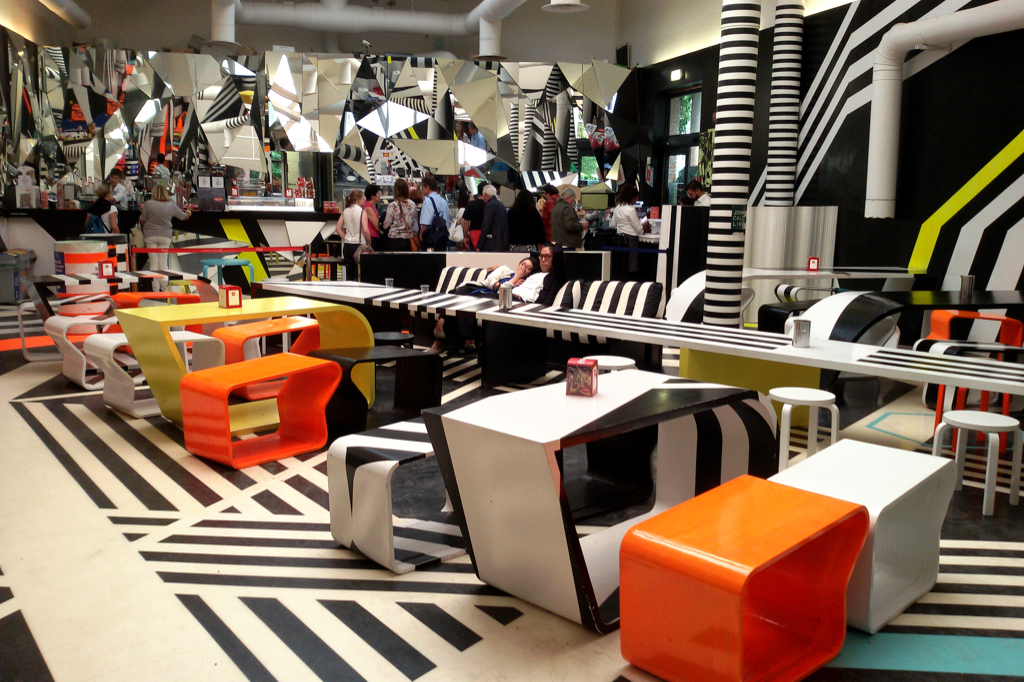
This is actually optional since there are stands and cafeterias at the main venues. However, It won’t surprise you that they are slightly overpriced. As a matter of fact, the prices aren’t even the reason that I don’t like to buy there. The main reason is the long lines. You wait in line at the entrance, you wait at the bathroom – do yourself a favor and avoid waiting in line for a sip of water.
Map
On this map, you get an overview of where all these wonderful works can be found. Clicking on the slider symbol at the top left or the full-screen icon at the top right will display the whole map, including the legend. To better identify the respective work, I’ve uploaded pictures that you can see as soon as you open the legend.
Pinnable Pictures
If you choose to pin this post, please use one of these pictures:


Did You Enjoy This Post? Then You Might Also Like These About More Art And Art Events:
Guide to SÃO PAULO – Brazil’s Art Hub
Street Art in SEVILLE: Arte Para Todos in the San Pablo District
How to Visit the NordArt in 2022
Best Street Art in TENERIFE

United Colors of Biennale – Visiting the Biennale di Arte in 2017
The Amazing Murals of the Hotel Ruins of Alyko
PARIS Museum Pass: Skip the Lines And See It All For Less
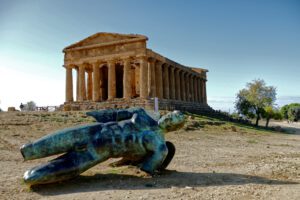
The Valley of the Temples of Agrigento And La Villa Romana del Casale di Piazza Armerina: A Day Trip Not to Miss
* This is an affiliate link. If you book through this page, not only do you get the best deal. I also get a small commission that helps me run this blog. Thank you so much for supporting me!
thank you!!! I can’t wait!!! Was there pre-COVID for my first time. Life changing, beautiful, thought provoking and I ended up buying a piece by an artist that i couldn’t get out of my mind for years.
How exciting! I hope you enjoy it as much as you did on your first visit!